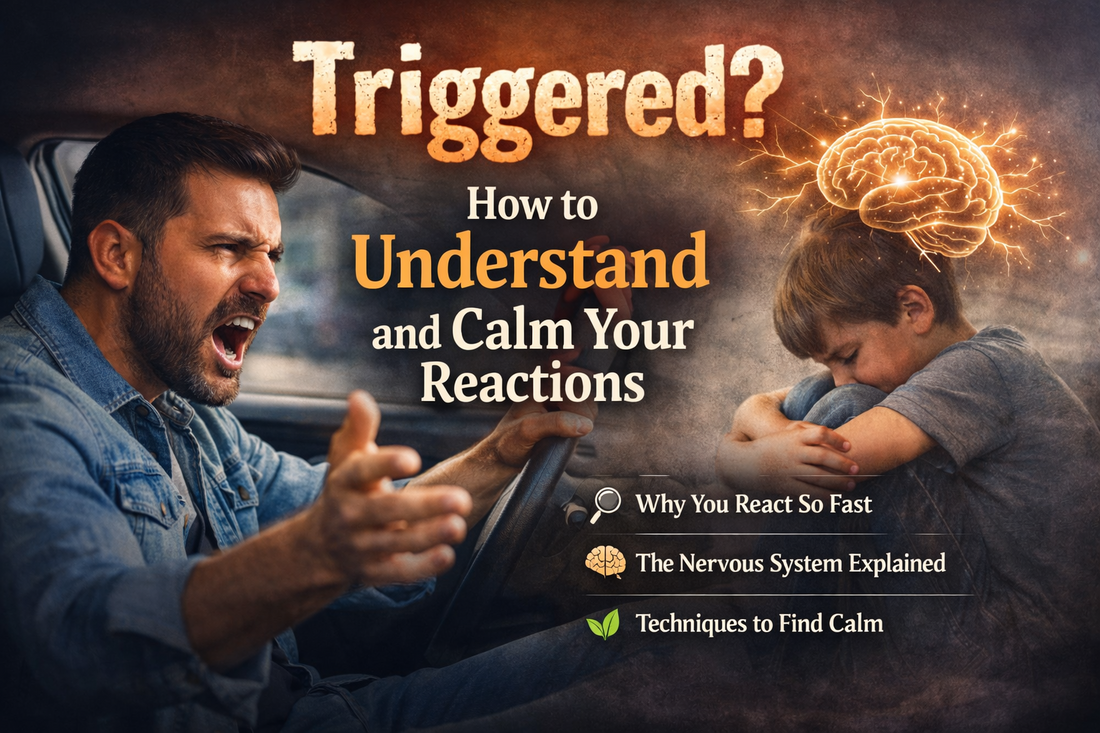
 "You don’t discover yourself when you’re peaceful. You discover yourself when something disturbs your peace." That moment when someone cuts you off… When your parent says that thing again… When a small inconvenience creates a big reaction… That is not random. That is revelation. Most people treat triggers as problems to suppress. But triggers are not interruptions. They are instructions. They show you exactly where your inner work lives. The nervous system: why this happens so fast Your nervous system is built for survival. Not for calm. Not for wisdom. Not for patience. When it senses a threat, it reacts before your thinking mind catches up. A tone. A look. A honk. A certain phrase. And your body goes: “Danger. Protect. Now.” That response can look like:
This is not weakness. This is conditioning. Your body learned somewhere along the way: “In moments like this, we react fast.” A simple truth most people miss Peace doesn’t expose you. Pressure does. When nothing is happening, you feel evolved. When something hits you, you see what is still raw. That reaction? It was not just the moment. It was memory. Pattern. Protection. Let’s break it down Every trigger has 3 layers: 1. The Story (Surface) “This person is rude.” “This shouldn’t be happening.” 2. The Emotion (Signal) Anger. Frustration. Defensiveness. 3. The Root (Truth) What actually got touched?
That is where the real work is. Real-life example You’re driving. Someone honks, speeds past, gives you a look. Instant reaction: “What the hell is his problem?!” But look deeper:
Now you are not dealing with a driver. You are dealing with a pattern. Another example Someone interrupts you. Surface: “They are disrespectful.” Deeper: “I’m not being heard.” Root: “My voice doesn’t matter.” Here’s the shift Instead of asking: “Why are they like this?” Ask: “Why did this affect me like that?” That question changes everything. A simple framework to use in real time 1. Catch it “Something just got activated.” 2. Name it “What am I feeling?” 3. Trace it “What does this remind me of?” 4. Identify the threat “What feels at risk? Respect? Control? Safety?” 5. Reframe it “Is this about them… or something in me?” How to calm yourself (this is where the real power is) You cannot always stop the first reaction. But you can regulate what happens next. If you catch it early (before or during) 1. Slow your breath (this is the fastest reset)
This tells your body: we are safe. 2. Relax your body on purpose
The body sends signals to the mind, not just the other way around. 3. Widen your awareness Instead of locking onto the trigger, zoom out:
You break the tunnel vision of the reaction. 4. Use a simple grounding thought Not something fancy. Something believable:
If the reaction already happened 1. Don’t fight it Adding judgment (“I shouldn’t react”) makes it worse. Let it pass through. 2. Shorten the recovery time That is the real growth. Minutes → seconds → moments. 3. Reset your body again Breath. Posture. Relaxation. You are teaching your nervous system a new ending. 4. Reflect later, not during Ask:
This is how you rewire. Questions to ask yourself
The uncomfortable truth You may not eliminate the first reaction. Your body is fast. But you can become someone who:
That is mastery. Final thought Your triggers are not your flaws. They are your unfinished lessons. Life will keep pressing the same buttons… Until you stop reacting and start understanding. That is when peace becomes real.
0 Comments
 How the Brain Processes Trauma, Anxiety, and Insight When the Ego Is Offline Most people misunderstand dreams because they ask the wrong question. They ask, “What does this dream mean?” When the real question is, “What emotion is being processed?” Dreams are not symbolic riddles or prophetic messages. They are the brain’s emotional maintenance system, running in the background when the conscious mind finally gets out of the way. The events in dreams are not clues about your life. They are containers for emotions already active in your waking state. The Core Principle (this changes everything) Dreams prioritize emotion, not narrative. The brain does not dream to tell stories. It dreams to regulate, consolidate, and integrate emotional information that has not been fully processed while awake. The imagery is secondary. The emotion is primary. Fear, anxiety, grief, shame, anticipation, relief--these are the real data. The dream simply borrows whatever images are available to express them. Why Dream Events Are Misleading (and usually irrelevant) Take a common example: fear of heights. A dream might place you:
This does not mean:
What it does mean is simpler and more precise: The brain needed an image that reliably produces fear. The subconscious doesn’t care about accuracy. It cares about emotional resonance. If fear exists in your waking life--fear of uncertainty, exposure, loss, failure--the brain reaches into its memory archive and grabs whatever already knows how to feel like fear. The context is interchangeable. The emotion is not. Trauma: When the Brain Stops Using Metaphors A fair challenge to this model is trauma dreams. Trauma dreams often replay events literally. Does that contradict this theory? No. It strengthens it. In trauma, the emotional charge is so intense and unresolved that the brain does not need substitute imagery. The original memory is already maximally tagged with fear and threat. This aligns with trauma research associated with Bessel van der Kolk, showing that traumatic memories are stored sensory-first, not narrative-first. In short:
Same function. Different intensity. Anxiety Dreams: The Cleanest Proof Anxiety dreams are the clearest validation of this model. Common anxiety dream themes:
None of these are predictions. None of them are symbolic puzzles. They are emotion generators. Anxiety in waking life is often:
The dream is not saying what you’re afraid of. It’s showing that fear is active. Recurring Dreams = Unintegrated Emotion Recurring dreams don’t mean the universe is nagging you. They mean:
When the waking emotional relationship changes, recurring dreams:
No decoding required. Integration ends repetition. The Dream–Emotion Integration Framework This is where theory becomes practice. Step 1: Ignore the Story Do not analyze symbols. Do not Google meanings. Do not intellectualize. The story is noise. Step 2: Identify the Dominant Emotion Ask:
Name one primary emotion. Step 3: Locate It in Waking Life Ask: “Where in my waking life do I feel this same emotion--without the drama?” Look for:
Step 4: Feel It Without Fixing It This is critical. Don’t solve. Don’t explain. Don’t suppress. Let the emotion be felt consciously. This is integration. Step 5: Watch the Dream Change As emotional integration happens:
The system says: “Handled.” Meditation and Dreams Do the Same Job The difference is timing. Dreams:
Meditation:
When you meditate regularly, especially in stillness, emotional processing happens while awake. That’s why:
Meditation doesn’t eliminate dreams. It reduces emotional backlog. The Unified Model
either asleep or still. The Takeaway Dreams are not trying to teach you something mystical. They are trying to finish something emotional. If you chase symbols, you stay confused. If you track emotion, clarity follows. Dreams aren’t messages. They’re maintenance logs. And meditation is how you read them while awake. Guided Meditation: Observing the Emotional Landscape Find a comfortable position. You can sit upright or lie down. Let your body settle. There is nothing you need to accomplish during this meditation. No goal to reach, no state to force. Just observation. Take a slow breath in through your nose. And gently release it. Allow your breathing to return to its natural rhythm. The breath knows what to do without your help. Now bring your awareness to the weight of your body. Notice how gravity holds you effortlessly. Feel the points where your body touches the chair, the floor, or the bed. Let the muscles soften. Your only task is to observe. Now allow your mind to be exactly as it is. Thoughts may appear. Images may appear. Memories may pass through. Let them come and go the way clouds move through the sky. There is no need to chase them or push them away. Simply notice. Now gently bring your attention to your emotional state. Ask yourself quietly: What emotion is present right now? There is no right answer. Sometimes the emotion is clear. Sometimes it is subtle, like a faint background tone. Maybe it is calm. Maybe curiosity. Maybe tension. Maybe something you can’t quite name yet. Just notice. If a recent dream comes to mind, allow it to appear briefly. Do not analyze the story. Let the images fade and focus only on the feeling that was present in the dream. Ask yourself: What emotion was strongest in that dream? Fear, uncertainty, pressure, sadness, anticipation, relief—whatever it was, simply acknowledge it. Now ask gently: Where in my waking life do I feel this same emotion? Do not force an answer. Let the mind wander naturally. It may show you a situation, a conversation, a relationship, or a subtle pressure you’ve been carrying. If nothing appears, that’s perfectly fine. Stay with the emotion itself. Now shift your attention to your body. Where do you feel this emotion physically? Perhaps in the chest. The stomach. The throat. The shoulders. Rest your awareness there. Do not try to change the sensation. Do not try to solve anything. Simply allow the feeling to exist in the light of awareness. This is how emotions integrate—when they are allowed to be seen without resistance. Stay here for a few breaths. Now let the focus soften again. Allow your mind to drift freely. Sometimes when the mind is relaxed and open, insights appear naturally—like a puzzle quietly solving itself. If an understanding arises, simply observe it. If nothing arises, that is also perfect. The mind continues its work even when we are unaware of it. Trust the process. Take a slow breath in. And gently exhale. Begin to feel the space around you again. Notice the room, the air, the sounds around you. When you are ready, slowly open your eyes. Carry this awareness with you. Remember: Your mind processes experiences both day and night. Dreams do it while you sleep. Meditation allows it to happen while you are awake. Both are simply the mind maintaining balance. 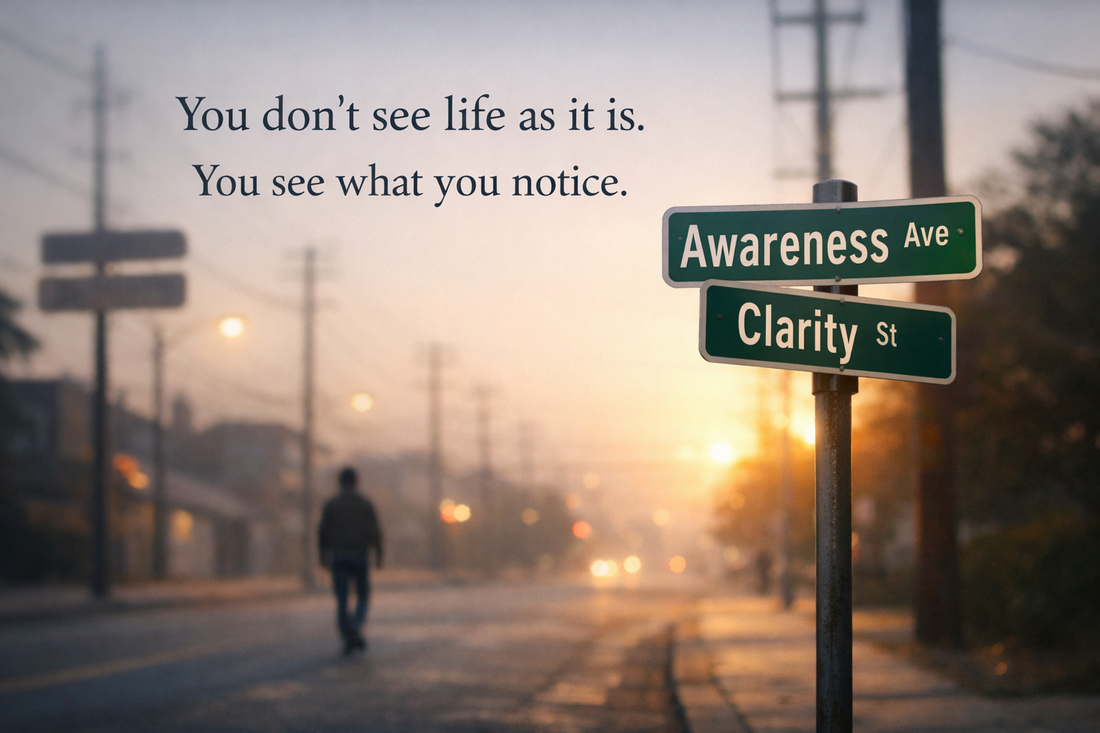 Most people don’t live bad lives. They live unconscious ones. We don’t experience reality as it is--we experience what we pay attention to. Everything else disappears into the background, not because it isn’t there, but because our awareness never stops to notice it. I realized this through a simple experiment. I’ve lived in the same neighborhood for sixteen years, yet I still don’t know the names of some of the cross streets near my home. When I finally slowed down and intentionally paid attention, I remembered the street names immediately. This wasn’t a memory problem. It was an attention problem. That insight opened a larger question: if I can overlook something so basic for years, how many important aspects of my life have I also missed--patterns, emotions, beliefs, opportunities--simply because I wasn’t paying attention? Why Most People Live Unconsciously Living unconsciously isn’t a moral failure. It’s a biological strategy. The brain is designed to conserve energy. Awareness takes effort. Questioning takes effort. So the mind defaults to automation. Our experience of life is shaped by what we attend to. Attention acts as a filter--what passes through becomes our reality. Most people don’t consciously choose that filter. Instead, it’s shaped by:
Over time, this creates a narrow version of reality that feels complete but isn’t. Research in psychology supports this. Daniel Kahneman showed that much of human behavior operates on fast, automatic thinking. We don’t actively choose most of our thoughts--we repeat them. Efficiency keeps us functioning. But it also keeps us asleep. The Hidden Cost of Unconscious Living When we don’t pay attention:
The problem isn’t suffering. The problem is not noticing the cause of suffering. An unconscious life isn’t empty--but it’s limited. Awareness Is Not a Personality Trait--It’s a Skill Here’s the good news: awareness isn’t something you either have or don’t have. It’s a skill. I didn’t need years of meditation or a spiritual retreat to notice the street names. I simply directed my attention deliberately for a moment. That single act revealed something important: unconscious living isn’t permanent. It’s a default setting. Every moment of noticing--your breath, your tension, your thoughts, your reactions--is a small interruption in that default. How Attention Changes Your Life Your life doesn’t change when circumstances change. It changes when attention changes. Most people try to fix their lives by changing external conditions. Fewer people realize that shifting attention alters perception, behavior, and ultimately identity. When you begin to observe instead of react:
This isn’t abstract philosophy. It’s practical awareness. A Simple Practice to Live More Consciously Start small. Pick one ordinary thing today and pay full attention to it--your walk, your breathing, a conversation, the environment around you. No analysis. Just noticing. Then ask yourself: What else in my life have I been moving past without seeing? That question alone begins to wake you up. Final Thought Most people aren’t unconscious because they’re incapable of awareness. They’re unconscious because they were never taught that attention shapes reality. Once you see this, you can’t unsee it. And the real question becomes: What kind of life unfolds when you notice on purpose?  Is success written in destiny, or is it the result of probability and preparation? After years in financial advising, investing, and observing human behavior under pressure, I’ve come to believe that luck is real — but misunderstood. Success isn’t fate. It’s what happens when skill, emotional stability, and time intersect with randomness. There’s a dangerous myth about success. Some say it’s destiny. Others say it’s hustle. Most secretly believe it’s luck. After watching nearly 90% of new financial advisors leave the industry, I can say this confidently: If destiny exists, it favors those who refuse to exit. Early in my career, I wasn’t sure I would survive. The rejection was constant. Results were inconsistent. I saw intelligent, capable people quit. I stayed. Not because I knew I’d win. But because I didn’t want a temporary downturn to make a permanent decision for me. Over time, my skills sharpened. My emotional control strengthened. My pattern recognition improved. The business grew — slowly, then meaningfully. Looking back, I can see moments that changed everything. At the time, they looked ordinary. That’s the part most people misunderstand about luck. Gambling, Variance, and the Illusion of Control Before I deeply understood markets, I used to gamble casually. I noticed something: luck fluctuates. When variance turned negative, I stopped. When things were favorable, I pressed cautiously. I didn’t chase losses. I didn’t assume a hot streak would last forever. When friends and I pooled money at slot machines, it wasn’t about multiplying luck. It was about extending time. More time meant more exposure to positive swings. Back then, I thought I was reading luck. Now I understand: I was managing variance. That’s different. Luck isn’t a force you feel. It’s randomness you survive. Investing: Where Destiny Meets Probability In markets, people often believe they failed because they entered at the wrong time. But I’ve seen clients invest at market peaks and still build significant wealth — simply because they stayed invested. Historically, the S&P 500 has endured wars, recessions, inflation shocks, crashes, and global crises — yet long-term growth persisted. If you zoom in, it looks chaotic. If you zoom out, it looks directional. Was that destiny? Or was it probability compounded over time? The investor who panic sells during a downturn converts temporary volatility into permanent loss. The investor who stays allows probability to unfold. Time is the bridge between randomness and outcome. Destiny Is Just Probability You Stayed Around For Here’s the philosophical edge most people avoid: We call something destiny when we can no longer see the branches that could have gone differently. If I had quit in year three, no one would call my current position fate. It would be a story that ended quietly. Success feels destined in hindsight. But in real time, it’s just repeated exposure to uncertainty. The ones who last long enough experience enough variance for positive asymmetry to occur. That’s not mystical. It’s mathematical. The Real Success Formula After years of observation, here’s the cleanest model I can offer: Success = Exposure × Skill × Emotional Stability + Variance Variance is unavoidable. Skill is learnable. Emotional stability is trainable. Exposure is a choice. You cannot eliminate randomness. But you can increase your capacity to withstand it. Early in my career, opportunity knocked and I didn’t recognize it. Now I do. Not because the universe chose me. But because experience refined my perception. The Balance Between Surrender and Control Here’s where philosophy matters. If you believe everything is destiny, you become passive. If you believe everything is control, you become arrogant. The truth lives between them. You control preparation. You do not control timing. You control discipline. You do not control cycles. You control whether you stay. You do not control when probability turns favorable. That balance is mature power. Luck is real. But luck alone doesn’t create durable success. Readiness does. Emotional endurance does. Time does. Destiny may write the weather. You still have to build the boat.  Some people thrive on ambition and achievement, while others feel strangely unmotivated by goals that once seemed meaningful. If you’re highly self-aware, this isn’t a flaw—it’s a signal. As awareness deepens, ego-driven motivation begins to collapse, and the effort behind achievement suddenly feels heavier than the reward. This article explores why high awareness can kill motivation, the hidden difference between ego-based striving and truth-driven expression, and how alignment—not ambition—becomes the real force that moves you forward. Why Some People Don’t Feel the Weight of Work Some people don’t seem to mind the work it takes to achieve in life. They push, grind, build, chase—and they often accomplish a lot. That’s because most achievement is ego-driven. The ego runs on:
Effort feels invisible when the ego is excited. Why Awareness Changes Everything As awareness increases, the illusion weakens. You begin to see:
So when a new project or desire appears, you don’t just see the starting point—you see the entire arc: effort → achievement → short-lived high → restlessness → another goal. And a quiet question emerges: Why start something that won’t actually fulfill me? This hesitation isn’t laziness. It’s clarity. Why It Felt Easier When You Were Younger When you’re younger, desire is simpler. You want something, you work for it, you get it, you feel better—at least for a while. The emotional return feels worth the effort, so you don’t even register the work involved. Back then:
The spell is broken. Ego-Driven Action vs Truth-Driven Expression This is the distinction most people never learn to make. Ego-Driven Action
Even when successful, it often leaves a subtle emptiness. Something feels off—because the action wasn’t aligned with your deepest belief. It was aligned with maintaining an identity. Truth-Driven Expression
When you act from truth, you operate from your pure belief system, not the ego. For example: If I’m honest with myself and recognize that buying a new piece of clothing is purely to satisfy my ego, that awareness changes the choice. Now I hold a clean belief: This is ego-driven. If I go through with it anyway, it feels like subtle self-betrayal—disalignment. But if I honor that belief and choose differently, I experience integrity. Truth creates alignment. Ego creates performance. Why You Hesitate to Start Once you’ve tasted alignment, ego goals feel heavy. You don’t resist work. You resist work that isn’t true. You’re no longer motivated by:
You’re moved by:
And aligned action, while often quieter, feels clean. Self-Reflection: Are You Unmotivated or Just Done With Illusion? Ask yourself—honestly:
These questions require brutal honesty. Without it, clarity gets mislabeled as laziness. The Provocative Truth High awareness kills ego motivation. That’s the price of seeing clearly. Once you recognize the cycle—effort, achievement, dissatisfaction—you can’t unknow it. And when ego stops driving you, nothing external can push you anymore. Now only alignment moves you. That’s dangerous. Because when you can’t lie to yourself, you’re left with two options:
Most people go back to chasing. Very few choose alignment—because it demands honesty over ambition. And once you see the difference, there’s no going back.  Before you answer these questions, I suggest you read the post about Friendship & Love: Needs vs. Alignment. Answer each question based on your most significant relationship (romantic or friendship). Choose the option that feels most true most of the time, not on your best days. 1. When I feel emotionally off, this person primarily… A. Brings relief and calms me down B. Grounds me, but I can regulate myself without them C. Feels essential for me to feel okay 2. If this relationship ended tomorrow, I would feel… A. Deep grief, but still grounded in myself B. Anxiety, panic, or fear about how I’d cope C. Mostly fine—I’d miss them, but my sense of self remains intact 3. My growth and change within this relationship feels… A. Encouraged and supported B. Neutral—it depends on the situation C. Tension-filled or destabilizing 4. When conflict arises, we usually… A. Return to calm and understanding B. Escalate emotionally, then repair C. Avoid, shut down, or spiral 5. I stay in this relationship mainly because… A. I admire who they are and how they live B. It feels familiar and emotionally safe C. I’m afraid of losing what they provide 6. My nervous system around this person feels… A. Calm, open, and steady B. Activated—excited, anxious, or on edge C. Relaxed only when they’re present 7. If my core emotional needs were fully met elsewhere, I would… A. Still choose this relationship B. Be unsure C. Likely drift away 8. This relationship is rooted primarily in… A. Shared values and worldview B. Shared experiences and history C. Shared pain, struggle, or emotional regulation Scoring
Results Interpretation 🟢 Alignment-Based Relationship Your connection is rooted in shared values, respect, and emotional self-responsibility. Needs exist—but they are not the glue. Growth strengthens the bond rather than threatening it. Reflection: This is a relationship of choice, not survival. Protect it by continuing to regulate yourself and communicate honestly. 🟡 Transitional / Mixed Relationship Your relationship contains both need and alignment. This is common—and often temporary. Reflection: You’re likely in a phase where growth is redefining the bond. With conscious self-regulation and honest dialogue, this relationship can evolve in either direction. 🔴 Needs-Based Relationship This connection functions primarily as a regulation strategy. The relationship stabilizes your nervous system more than it expresses shared identity. Reflection: This relationship isn’t “wrong”—it’s informative. It’s pointing you toward inner work that will eventually change how you bond. Growth may transform—or end—the relationship. Both outcomes are valid. Relationships aren’t a test you pass or fail. They’re mirrors that show you where safety still lives outside of you. This quiz doesn’t just measure relationships. It quietly educates the nervous system while doing it.  Most people think relationships fail because of incompatibility. More often, they fail because two nervous systems stop speaking the same language. Polyvagal Theory: Why the Body Decides Before the Mind According to Stephen Porges, our nervous system is constantly asking one unconscious question: Am I safe here? Before thought, before logic, before intention—the body answers first. Polyvagal Theory explains three primary states:
Needs-Based Relationships: Regulation Through Another Person Needs-based relationships often form when one or both people are dysregulated. Someone else becomes:
The nervous system learns: “I feel safe when I’m with them.” This creates powerful bonding—but it’s conditional. If that person:
The nervous system interprets it as threat, not loss. That’s why needs-based relationships often feel:
It’s not just emotional attachment—it’s biological reliance. Alignment-Based Relationships: Co-Regulation Without Dependency Alignment-based relationships emerge when both people can access ventral vagal safety on their own. Here’s the difference:
These relationships activate:
They don’t spike the nervous system. They stabilize it. Which is why they can feel “less exciting” at first—and far more sustaining over time. Why Growth Disrupts Needs-Based Bonds When one person becomes more regulated:
The old attachment loop loses its charge. The other nervous system feels this as:
But what’s really happening is simple: The body no longer needs the same strategy to feel safe. Alignment-based relationships survive this shift. Needs-based ones often fracture under it. Self-Check: Needs or Alignment? Ask your body first. Then your mind.
Your nervous system never lies. It just speaks softly—until you ignore it long enough that it has to shout. Visual Diagram From Need to Alignment: How Relationships Actually Form 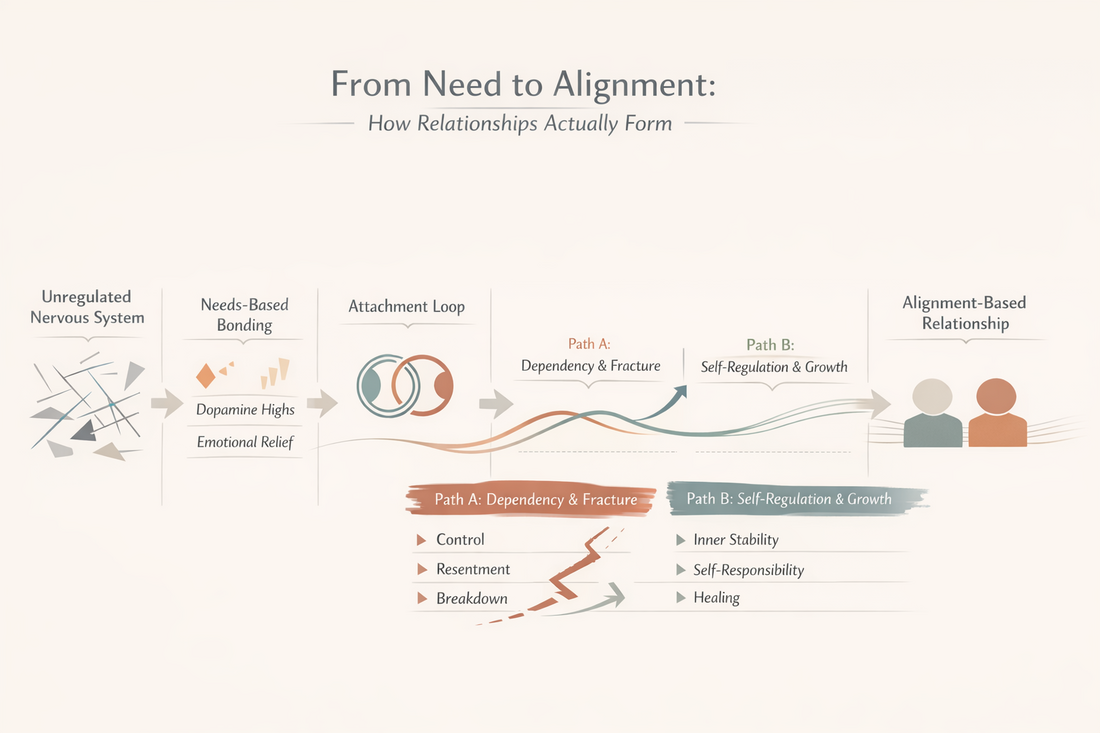 The Deep Reframe Needs-based relationships are survival strategies. Alignment-based relationships are expressions of wholeness. Needs bring people together. Alignment keeps them together. And the real work isn’t fixing relationships. It’s teaching the nervous system that safety can come from within. Once that happens-- connection becomes clean. Love becomes steady. And relationships stop feeling like something you might lose… and start feeling like something you’re free to choose Take this quiz to find out whether your relationship is based on needs or alignment. 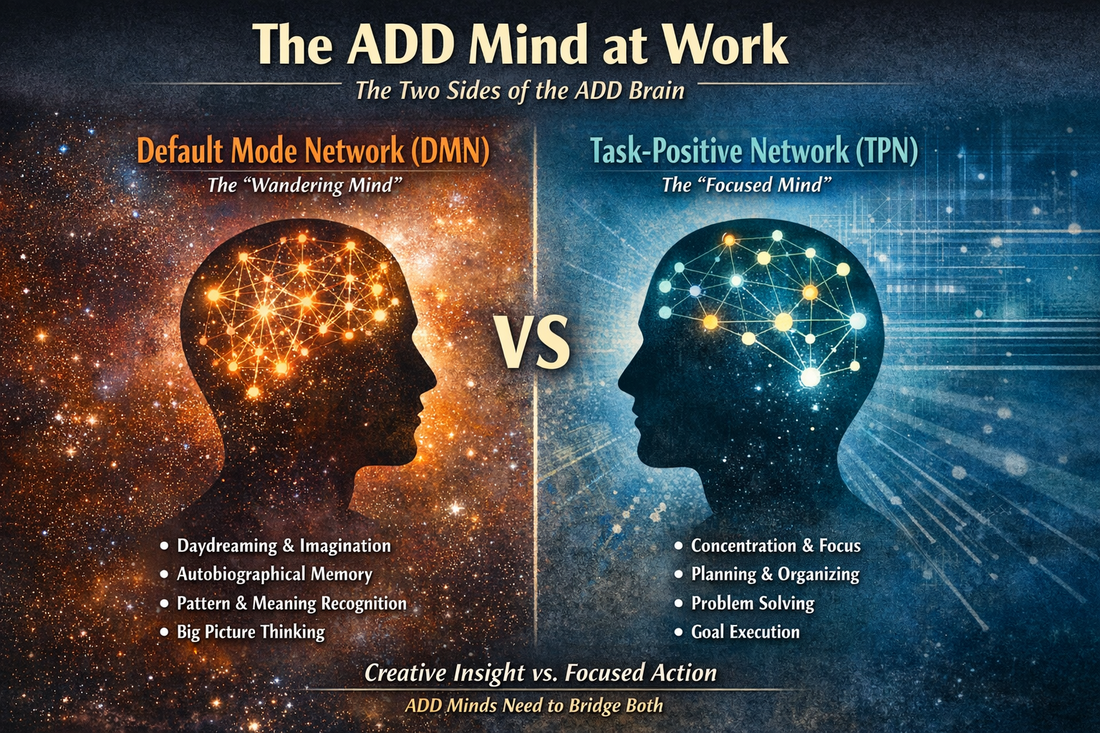 Most people think ADD is about distraction. It isn’t. It’s about where the mind naturally spends its time—and how poorly modern life understands that territory. Many ADD minds are not failing at focus. They are operating from a different neural home base. That home base has a name: the Default Mode Network. The Default Mode Network: Where the ADD Mind Lives The Default Mode Network (DMN) is a large-scale brain network that becomes active when we are not focused on a specific external task. It lights up when we:
In most people, the DMN quiets down when task-focused networks activate. But in many people with ADD, the DMN remains highly active, even when they are supposed to be “paying attention.” This is why ADD minds:
From the inside, it feels like constant mental motion. But here’s the key point most narratives miss: The DMN is not a defect. It is the neural basis of creativity, identity, empathy, and insight. The Wandering Mind Is Not Broken Because the DMN is involved in autobiographical memory and self-referential processing, ADD minds often think in story, metaphor, and meaning, not steps and checklists. This explains why people with ADD are frequently drawn to:
You learn when each is useful. The Real Breakdown: When DMN Has No Translator ADD minds don’t lack ideas. They have too many, too quickly, with too much depth. The problem begins after insight appears. The DMN is excellent at generating meaning, but it is not designed to package that meaning into deliverables. That job belongs to task-positive networks—the ones responsible for planning, sequencing, and execution. When someone with ADD tries to jump directly from DMN insight to execution, the nervous system often overloads. The result looks like this:
It is a missing translation layer. The Generator–Integrator–Bridger Model ADD minds work best when allowed to cycle through three distinct phases. Problems arise when these phases are forced to overlap. 1. The Generator (DMN-dominant) This is the wandering phase. Ideas arise freely. Connections form unexpectedly. Memories, emotions, and insights surface without invitation. Trying to control this phase kills its value. Its purpose is not productivity. Its purpose is raw material. 2. The Integrator (DMN → Task Network Transition) This is the most overlooked phase—and the one that changes everything. Integration is not execution. It is sense-making. This is where the mind asks:
With it, execution becomes obvious. Most ADD frustration comes from skipping integration entirely. 3. The Bridger (Meaning-Supported Action) This is where insight becomes usable. Bridging is the act of translating understanding into form:
It means coherence. One insight. One form. One version. Completion is not the end of truth. It is how truth moves forward. Why ADD Minds Struggle to Finish ADD minds often abandon projects not because they lack discipline, but because dopamine drops before translation is complete. The idea stays internal too long. The DMN keeps refining. The nervous system tires. Interest fades. Finishing begins to feel artificial—or worse, like betrayal of depth. But completion is not betrayal. It is integration made visible. Soft Structure Works Better Than Discipline Rigid systems exhaust ADD nervous systems. What works instead:
If it feels heavy, the mind will rebel. Every time. Reclaiming Identity The most damaging belief ADD minds carry is this: “I can’t finish things.” A more accurate truth is this: “My mind generates faster than it integrates.” That is not a flaw. That is a role. You are not a factory worker of ideas. You are a translator of meaning. When the mind is respected instead of corrected:
A Final Reframe You don’t need to shut down the Default Mode Network. You don’t need to fight wandering. You don’t need to become someone else. You need a bridge between inner insight and outer form. The wandering mind is not lost. It’s simply waiting to be translated. 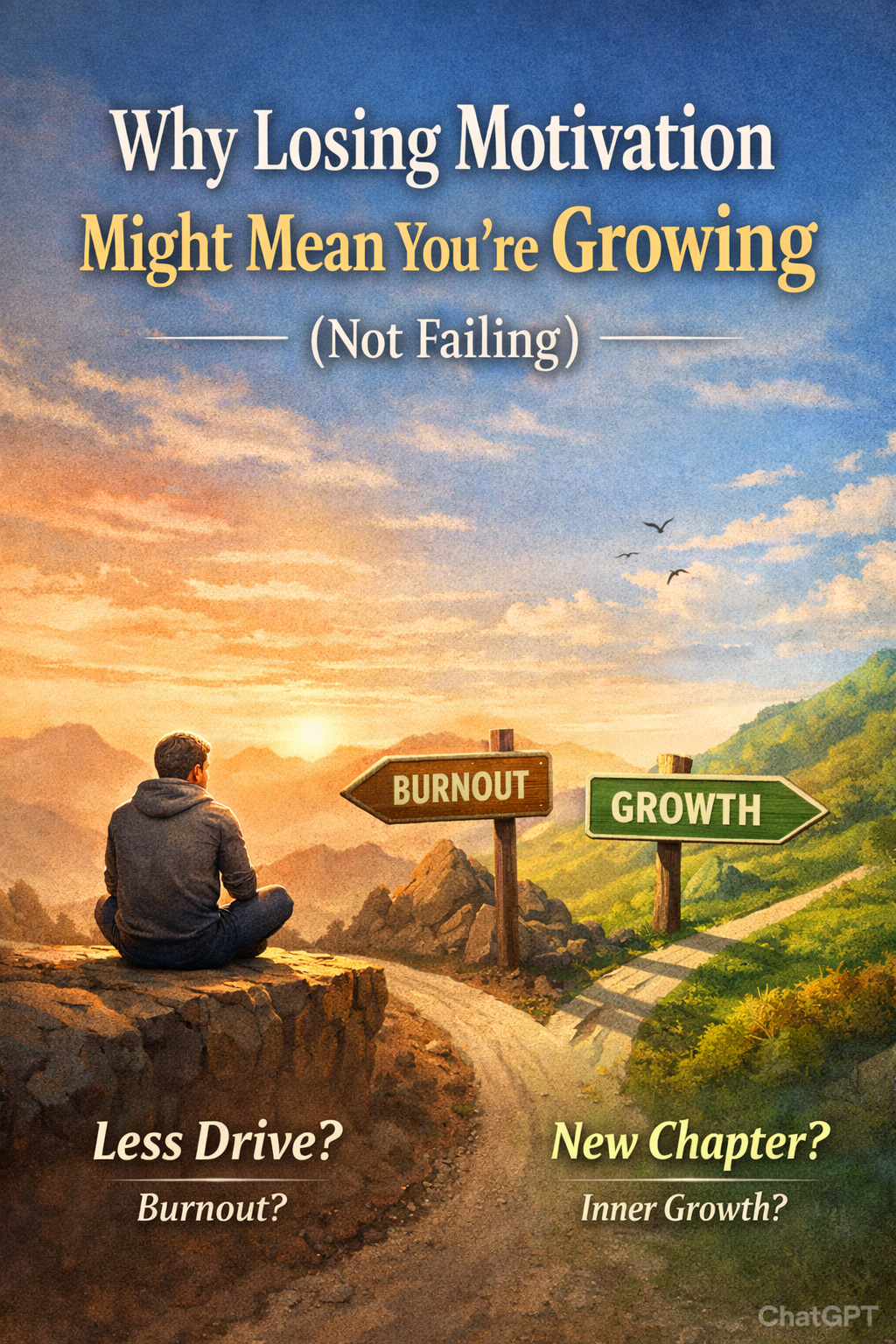 There is a phase of inner growth that rarely gets discussed—because it doesn’t look impressive. Ambition fades. The drive to achieve quiets down. The urge to become someone loosens its grip. And instead of clarity, many people feel unease. Am I evolving… or am I giving up? Is this peace—or fear disguised as contentment? This question doesn’t arise at the beginning of self-development. It appears after years of inner work, when ego has softened but purpose hasn’t yet redefined itself. The Role of Ambition in Human Development Ambition is not the enemy. Early in life, it serves an essential function. We strive in order to:
The problem isn’t ambition—it’s never knowing when to take it down. What Changes When Ego Softens If inner work is genuine, something subtle but radical happens: You no longer need achievement to validate your existence. This often shows up as:
They assume: “If my ambition is fading, something must be wrong.” In reality, something important is reorganizing. Rest vs Retreat: The Critical Distinction From the outside, rest and retreat look identical. Less output. More solitude. Fewer goals. Internally, they are opposites.
A simple test: If life gently asked something of me tomorrow, would I be open to it? A relaxed yes signals rest. A tight no signals retreat. The danger isn’t resting. The danger is mistaking withdrawal for wisdom. What Replaces Ambition After Ego Work When ego-driven ambition dissolves, one of three things replaces it:
A call does not demand constant productivity. It arrives with clarity and lightness. It asks for action—and then releases you again. From the outside, this looks inconsistent. From the inside, it feels precise. Why Many “Successful” People Never Reach This Stage Many high achievers don’t mind working all the time because stopping would force them to sit with themselves. Busyness becomes:
There’s a difference between capacity for work and compulsion to work. Losing the second while keeping the first is growth. The Real Risk at This Stage The risk is not doing less. The risk is using contentment as insulation. When “I’m fine the way I am” becomes a shield against engagement, life slowly thins out. The answer is not forcing ambition back. It’s remaining available. A Simple Operating Principle For this phase of life: Only act on what arrives with clarity and lightness. Not excitement. Not obligation. Not fear. Lightness. If nothing arrives, live fully anyway. Stillness is not a waiting room. It’s part of the work. A Short Mirror (Read slowly) Don’t answer these questions quickly. Notice what happens before the answer forms.
Only signals. Whatever you notice is the information. The Quiet Truth You are not here to maximize output. You are here to minimize distortion. When distortion falls away, contribution becomes inevitable—but no longer constant. And if you step forward again, it won’t be to become someone. It will be because silence finished saying what it could. Why Slowing Down Feels So Uncomfortable - The Science Behind a Mind That Won’t Let Go of Busyness2/12/2026 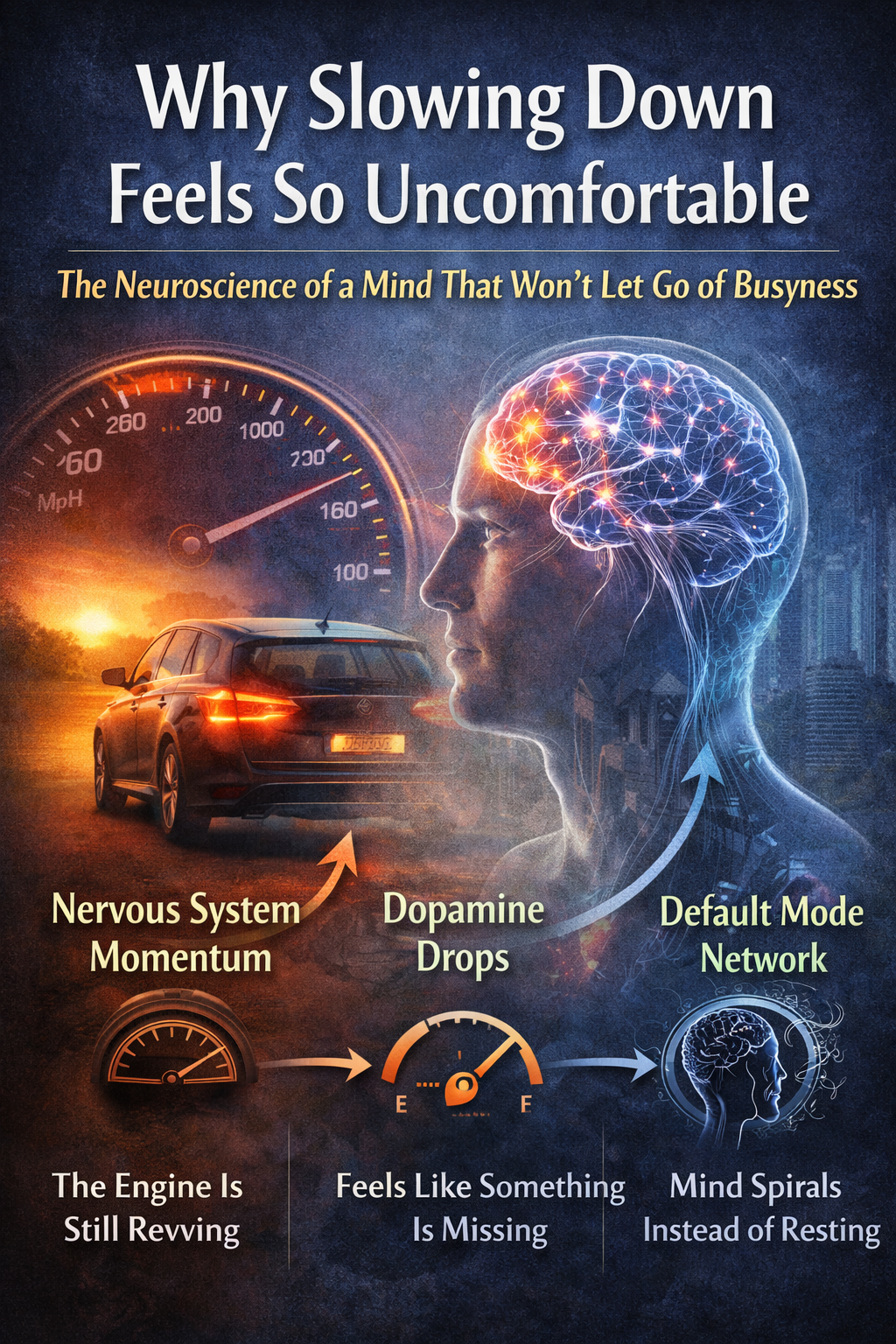 Most people think rest should feel good immediately. But when life finally slows down, something strange happens:
It’s biology. Think of it like driving a car at 100 miles an hour for a long time—and then suddenly slamming the brakes. The wheels stop turning. But the engine is still revving. That “revving” is your nervous system. The nervous system doesn’t switch states instantly When you’re busy for long periods, your body adapts to that pace. Scientifically speaking:
So when external demands suddenly drop:
You didn’t fail at relaxing. Your system just hasn’t downshifted yet. Dopamine is why the mind looks for something to do Dopamine is often misunderstood. It’s not the “pleasure chemical.” It’s the motivation and seeking chemical. During busy periods, dopamine spikes come from:
When that stimulation disappears:
The brain isn’t asking for meaning yet. It’s asking for stimulation. What happens when you stop “doing” When tasks slow down, a brain network called the Default Mode Network (DMN) becomes more active. The DMN is responsible for:
This network is essential—but untrained, it becomes noisy:
So when you stop doing, the mind doesn’t go quiet. It starts talking. That doesn’t mean stillness is bad. It means the mind is entering unfamiliar territory. Why this feels threatening to the system The nervous system learns through repetition. If busyness was associated with:
Then slowing down feels uncertain—even unsafe. The body doesn’t distinguish between: “I don’t know what to do” and “I might be in danger” Both feel like loss of control. So the urge to get busy again isn’t ambition. It’s conditioning. Social media exploits this exact gap This is where modern life complicates things. Social media:
It perfectly fills the uncomfortable space between:
Instead of allowing the nervous system to settle, we hover in between. Not fully busy. Not fully relaxed. Just constantly stimulated enough to avoid stillness. Why slowing down must be intentional at first You can’t think your way into regulation. The nervous system recalibrates through:
This is why rest initially feels uncomfortable—and later becomes nourishing. Stillness is a skill, not a personality trait. The bigger picture Busyness isn’t the enemy. Unconscious busyness is. When you understand what’s happening in the brain and body:
And once that happens? Stillness stops feeling empty. It becomes spacious. Creative. Clarifying. One important real-life example This same mechanism explains why many people struggle after retirement—and why they rush back into the same kind of work they just left. I wrote a separate post on that specifically, because it deserves its own attention. If this resonates, read the companion piece: “Why People Panic After Retirement (And Rush Back to the Same Life)” This post explains how the mind and nervous system work. The other shows what happens when we don’t understand this during major life transitions. Together, they tell the full story. |
AuthorFeelasoulphy Categories
All
Archives
March 2026
|
 RSS Feed