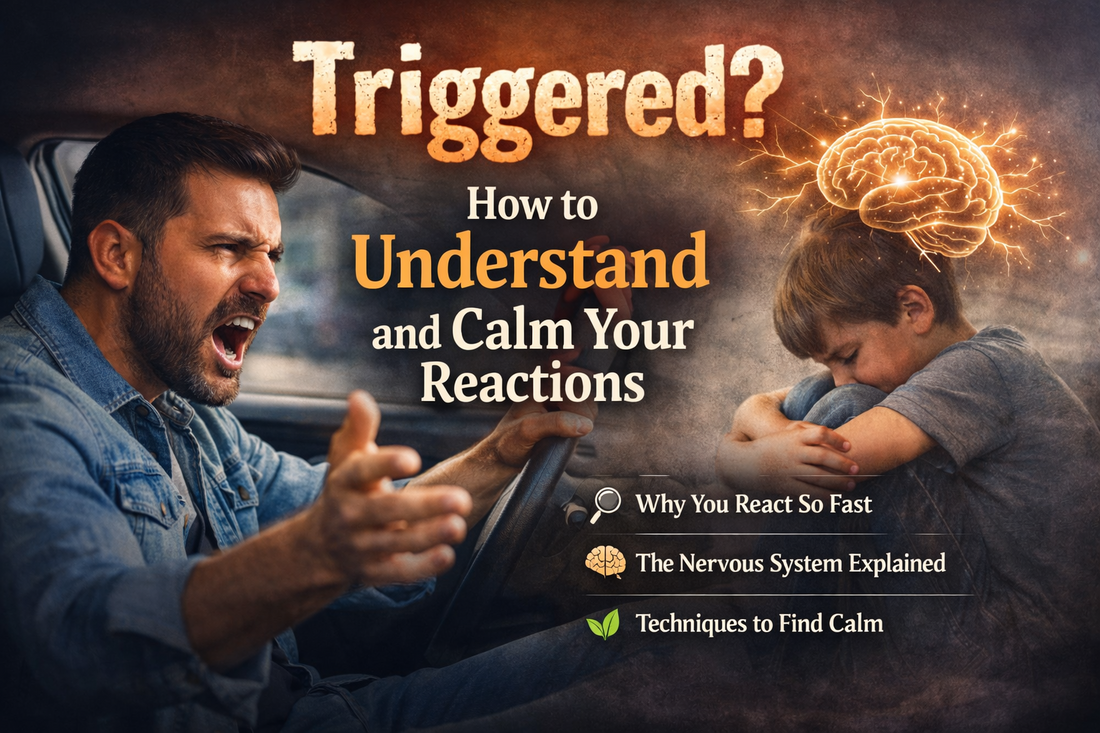
 "You don’t discover yourself when you’re peaceful. You discover yourself when something disturbs your peace." That moment when someone cuts you off… When your parent says that thing again… When a small inconvenience creates a big reaction… That is not random. That is revelation. Most people treat triggers as problems to suppress. But triggers are not interruptions. They are instructions. They show you exactly where your inner work lives. The nervous system: why this happens so fast Your nervous system is built for survival. Not for calm. Not for wisdom. Not for patience. When it senses a threat, it reacts before your thinking mind catches up. A tone. A look. A honk. A certain phrase. And your body goes: “Danger. Protect. Now.” That response can look like:
This is not weakness. This is conditioning. Your body learned somewhere along the way: “In moments like this, we react fast.” A simple truth most people miss Peace doesn’t expose you. Pressure does. When nothing is happening, you feel evolved. When something hits you, you see what is still raw. That reaction? It was not just the moment. It was memory. Pattern. Protection. Let’s break it down Every trigger has 3 layers: 1. The Story (Surface) “This person is rude.” “This shouldn’t be happening.” 2. The Emotion (Signal) Anger. Frustration. Defensiveness. 3. The Root (Truth) What actually got touched?
That is where the real work is. Real-life example You’re driving. Someone honks, speeds past, gives you a look. Instant reaction: “What the hell is his problem?!” But look deeper:
Now you are not dealing with a driver. You are dealing with a pattern. Another example Someone interrupts you. Surface: “They are disrespectful.” Deeper: “I’m not being heard.” Root: “My voice doesn’t matter.” Here’s the shift Instead of asking: “Why are they like this?” Ask: “Why did this affect me like that?” That question changes everything. A simple framework to use in real time 1. Catch it “Something just got activated.” 2. Name it “What am I feeling?” 3. Trace it “What does this remind me of?” 4. Identify the threat “What feels at risk? Respect? Control? Safety?” 5. Reframe it “Is this about them… or something in me?” How to calm yourself (this is where the real power is) You cannot always stop the first reaction. But you can regulate what happens next. If you catch it early (before or during) 1. Slow your breath (this is the fastest reset)
This tells your body: we are safe. 2. Relax your body on purpose
The body sends signals to the mind, not just the other way around. 3. Widen your awareness Instead of locking onto the trigger, zoom out:
You break the tunnel vision of the reaction. 4. Use a simple grounding thought Not something fancy. Something believable:
If the reaction already happened 1. Don’t fight it Adding judgment (“I shouldn’t react”) makes it worse. Let it pass through. 2. Shorten the recovery time That is the real growth. Minutes → seconds → moments. 3. Reset your body again Breath. Posture. Relaxation. You are teaching your nervous system a new ending. 4. Reflect later, not during Ask:
This is how you rewire. Questions to ask yourself
The uncomfortable truth You may not eliminate the first reaction. Your body is fast. But you can become someone who:
That is mastery. Final thought Your triggers are not your flaws. They are your unfinished lessons. Life will keep pressing the same buttons… Until you stop reacting and start understanding. That is when peace becomes real.
0 Comments
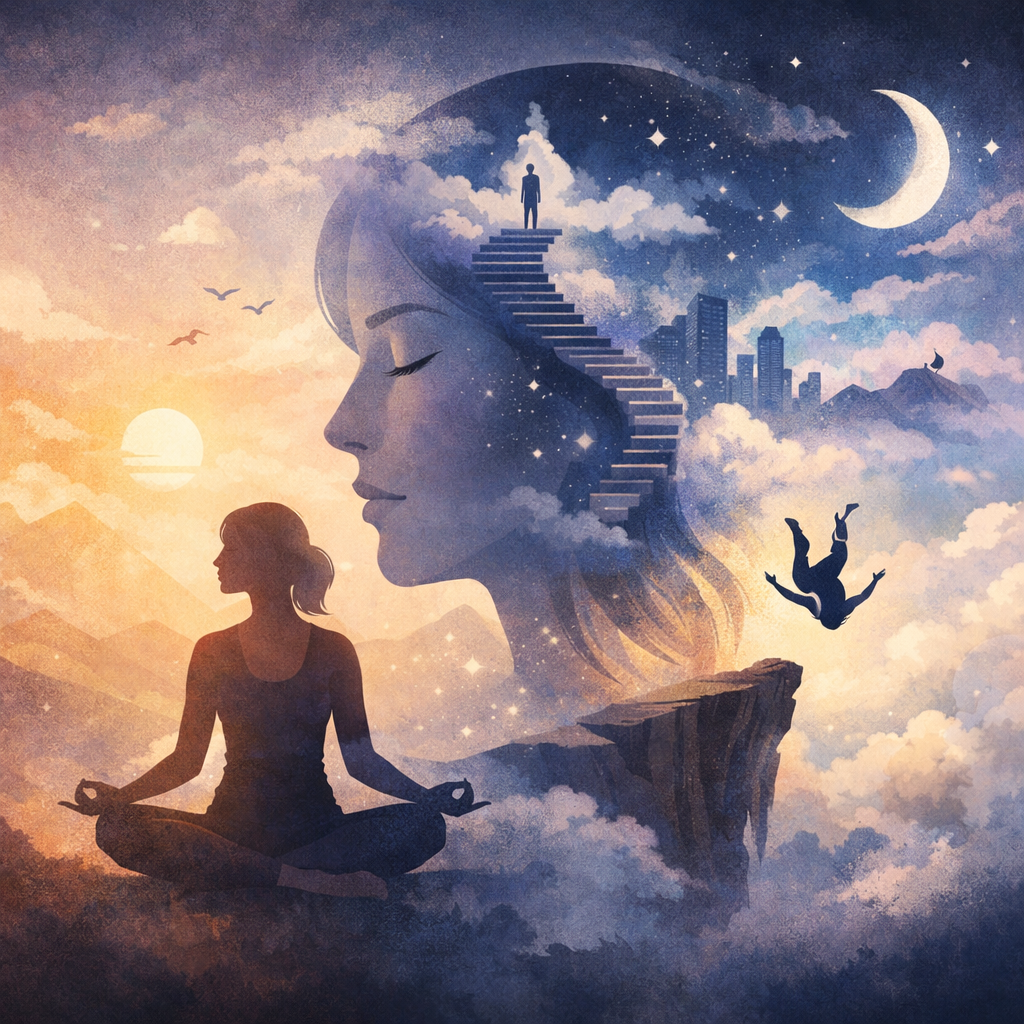 How the Brain Processes Trauma, Anxiety, and Insight When the Ego Is Offline Most people misunderstand dreams because they ask the wrong question. They ask, “What does this dream mean?” When the real question is, “What emotion is being processed?” Dreams are not symbolic riddles or prophetic messages. They are the brain’s emotional maintenance system, running in the background when the conscious mind finally gets out of the way. The events in dreams are not clues about your life. They are containers for emotions already active in your waking state. The Core Principle (this changes everything) Dreams prioritize emotion, not narrative. The brain does not dream to tell stories. It dreams to regulate, consolidate, and integrate emotional information that has not been fully processed while awake. The imagery is secondary. The emotion is primary. Fear, anxiety, grief, shame, anticipation, relief--these are the real data. The dream simply borrows whatever images are available to express them. Why Dream Events Are Misleading (and usually irrelevant) Take a common example: fear of heights. A dream might place you:
This does not mean:
What it does mean is simpler and more precise: The brain needed an image that reliably produces fear. The subconscious doesn’t care about accuracy. It cares about emotional resonance. If fear exists in your waking life--fear of uncertainty, exposure, loss, failure--the brain reaches into its memory archive and grabs whatever already knows how to feel like fear. The context is interchangeable. The emotion is not. Trauma: When the Brain Stops Using Metaphors A fair challenge to this model is trauma dreams. Trauma dreams often replay events literally. Does that contradict this theory? No. It strengthens it. In trauma, the emotional charge is so intense and unresolved that the brain does not need substitute imagery. The original memory is already maximally tagged with fear and threat. This aligns with trauma research associated with Bessel van der Kolk, showing that traumatic memories are stored sensory-first, not narrative-first. In short:
Same function. Different intensity. Anxiety Dreams: The Cleanest Proof Anxiety dreams are the clearest validation of this model. Common anxiety dream themes:
None of these are predictions. None of them are symbolic puzzles. They are emotion generators. Anxiety in waking life is often:
The dream is not saying what you’re afraid of. It’s showing that fear is active. Recurring Dreams = Unintegrated Emotion Recurring dreams don’t mean the universe is nagging you. They mean:
When the waking emotional relationship changes, recurring dreams:
No decoding required. Integration ends repetition. The Dream–Emotion Integration Framework This is where theory becomes practice. Step 1: Ignore the Story Do not analyze symbols. Do not Google meanings. Do not intellectualize. The story is noise. Step 2: Identify the Dominant Emotion Ask:
Name one primary emotion. Step 3: Locate It in Waking Life Ask: “Where in my waking life do I feel this same emotion--without the drama?” Look for:
Step 4: Feel It Without Fixing It This is critical. Don’t solve. Don’t explain. Don’t suppress. Let the emotion be felt consciously. This is integration. Step 5: Watch the Dream Change As emotional integration happens:
The system says: “Handled.” Meditation and Dreams Do the Same Job The difference is timing. Dreams:
Meditation:
When you meditate regularly, especially in stillness, emotional processing happens while awake. That’s why:
Meditation doesn’t eliminate dreams. It reduces emotional backlog. The Unified Model
either asleep or still. The Takeaway Dreams are not trying to teach you something mystical. They are trying to finish something emotional. If you chase symbols, you stay confused. If you track emotion, clarity follows. Dreams aren’t messages. They’re maintenance logs. And meditation is how you read them while awake. Guided Meditation: Observing the Emotional Landscape Find a comfortable position. You can sit upright or lie down. Let your body settle. There is nothing you need to accomplish during this meditation. No goal to reach, no state to force. Just observation. Take a slow breath in through your nose. And gently release it. Allow your breathing to return to its natural rhythm. The breath knows what to do without your help. Now bring your awareness to the weight of your body. Notice how gravity holds you effortlessly. Feel the points where your body touches the chair, the floor, or the bed. Let the muscles soften. Your only task is to observe. Now allow your mind to be exactly as it is. Thoughts may appear. Images may appear. Memories may pass through. Let them come and go the way clouds move through the sky. There is no need to chase them or push them away. Simply notice. Now gently bring your attention to your emotional state. Ask yourself quietly: What emotion is present right now? There is no right answer. Sometimes the emotion is clear. Sometimes it is subtle, like a faint background tone. Maybe it is calm. Maybe curiosity. Maybe tension. Maybe something you can’t quite name yet. Just notice. If a recent dream comes to mind, allow it to appear briefly. Do not analyze the story. Let the images fade and focus only on the feeling that was present in the dream. Ask yourself: What emotion was strongest in that dream? Fear, uncertainty, pressure, sadness, anticipation, relief—whatever it was, simply acknowledge it. Now ask gently: Where in my waking life do I feel this same emotion? Do not force an answer. Let the mind wander naturally. It may show you a situation, a conversation, a relationship, or a subtle pressure you’ve been carrying. If nothing appears, that’s perfectly fine. Stay with the emotion itself. Now shift your attention to your body. Where do you feel this emotion physically? Perhaps in the chest. The stomach. The throat. The shoulders. Rest your awareness there. Do not try to change the sensation. Do not try to solve anything. Simply allow the feeling to exist in the light of awareness. This is how emotions integrate—when they are allowed to be seen without resistance. Stay here for a few breaths. Now let the focus soften again. Allow your mind to drift freely. Sometimes when the mind is relaxed and open, insights appear naturally—like a puzzle quietly solving itself. If an understanding arises, simply observe it. If nothing arises, that is also perfect. The mind continues its work even when we are unaware of it. Trust the process. Take a slow breath in. And gently exhale. Begin to feel the space around you again. Notice the room, the air, the sounds around you. When you are ready, slowly open your eyes. Carry this awareness with you. Remember: Your mind processes experiences both day and night. Dreams do it while you sleep. Meditation allows it to happen while you are awake. Both are simply the mind maintaining balance. |
AuthorFeelasoulphy Categories
All
Archives
March 2026
|
 RSS Feed