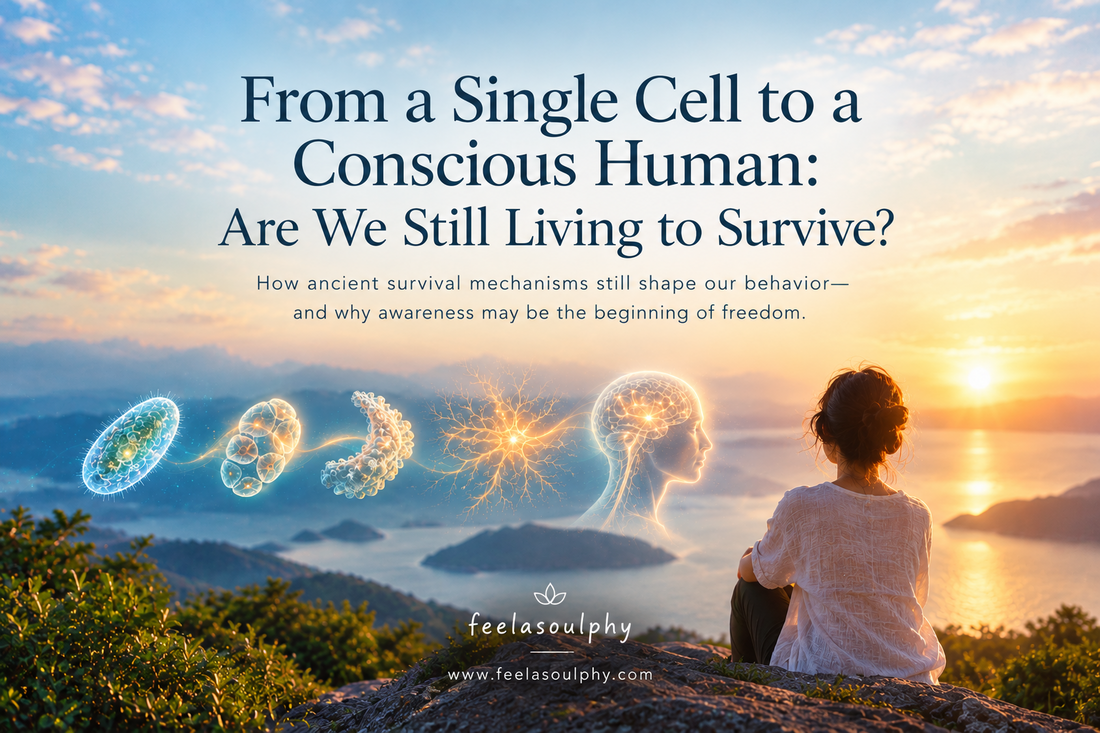
 How ancient survival mechanisms still shape our behavior—and why awareness may be the beginning of freedom. Imagine the first living organism on Earth. No language. No philosophy. No concept of tomorrow. No understanding of death. No question about the meaning of existence. Perhaps it was nothing more than a tiny single-celled organism surrounded by an environment it could barely “understand.” And yet, it had one fundamental problem: it had to keep itself alive.
It had to obtain what sustained it and avoid what damaged it. It didn't need to think about survival; its biology simply responded to its environment. Something beneficial? Move toward it. Something harmful? Move away. Something threatening? Protect itself. There was no meditation between stimulus and response and no philosophical debate. There was simply: Stimulus → Response And that simple relationship became part of the foundation of an extraordinary evolutionary journey. How Did Life Become Better at Surviving? There is an important part of evolution that is easy to misunderstand. When we say an organism “developed” a trait that made it better at surviving, we don't mean the organism consciously decided that it needed a new skill. Evolution doesn't work that way. One of the key ingredients is variation. Individuals within a population are not genetically identical. When organisms reproduce, differences can arise through mutations, recombination, and other biological processes. Most differences may have little consequence. Some may be harmful. Some may happen to be beneficial under particular environmental conditions. Imagine a population of primitive cells living in an environment where nutrients are concentrated in one direction. Suppose one cell happens to have an inherited difference that makes it slightly better at detecting or moving toward those nutrients. That cell has a small advantage. It may obtain more energy, survive longer, and reproduce more successfully. Its descendants inherit that characteristic, while further variation continues to occur. Generation after generation, characteristics that improve survival or reproduction can become more common. The organism didn't consciously learn the trait. The environment filtered the variation. In simplified form: Variation → Selection → Inheritance → Adaptation This process repeated across enormous stretches of time, and life became extraordinarily sophisticated at one thing: survival. From Survival to the Human Brain Over time, organisms evolved increasingly sophisticated ways of sensing and responding to their environments. Then came nervous systems, increasingly complex brains, memory, learning, prediction, emotion, social behavior, and thought. Eventually came humans. But here's the strange thing: the original problem never completely disappeared. We still need food. We still avoid danger. We still seek shelter. We still protect ourselves. We still compete for resources. We still seek connection and belonging. What changed was the sophistication of the machinery—and the environment in which it operates. A single cell might respond to a chemical signal. A human being can respond to an insult. An animal may defend its territory. A human may defend an opinion. An animal may compete for food. A human may compete for wealth, status, recognition, beauty, influence, or social position. The stimulus has changed. The fundamental survival logic has not. And that may explain something fascinating about human behavior: we can be living in an environment that is dramatically safer than the one our ancestors faced while still carrying a nervous system shaped by a very different world. We May Be More Primitive Than We Think Consider something people commonly admire: a person who can deliver a brilliant comeback immediately after being insulted. We might call that person quick-witted, sharp, confident, or strong. And perhaps they are. But why can a fast comeback feel so satisfying? Underneath the sophistication may be an ancient social calculation: “I can defend myself.” In a primitive social environment, responding effectively to aggression could have mattered enormously. Being unable to defend yourself could make you vulnerable. Over time, the expression of defense became more sophisticated. The physical confrontation can become a verbal confrontation. The weapon becomes the argument. The territory becomes reputation. Physical dominance becomes social status. And the instinct remains: “Don't allow yourself to be dominated.” Today, two people can sit safely behind their phones, hundreds or thousands of miles apart, exchanging clever insults. There may be no physical danger whatsoever, yet something inside us can still respond as though something important is at stake. And we may even reward the behavior by saying, “Damn, that comeback was good.” Maybe it was. But it is worth asking: What exactly are we admiring? Are we admiring intelligence and humor, or are we unconsciously admiring someone's ability to defend their psychological territory? Sometimes it may be both. Ancient Survival in Modern Attraction Consider another example. People can be attracted to partners who appear capable of protecting themselves and others. Physical strength can communicate, at a very basic level, “This person can defend us.” But in the modern world, protection doesn't necessarily mean physical strength. It can mean emotional stability, financial competence, confidence, intelligence, social skill, leadership, or the ability to remain calm under pressure and solve problems. The underlying question may still be remarkably ancient: “Can this person handle danger and uncertainty?” In a primitive environment, physical strength could provide an obvious survival advantage. In modern society, the qualities associated with security may be distributed across many different characteristics. This doesn't mean every human preference can be reduced to survival. Human attraction is far too complex for that. But it is worth recognizing how much of what we admire may still carry echoes of our evolutionary past. The expression has changed. The fundamental need for safety and security has not. The Problem Isn't Survival We shouldn't demonize our survival mechanisms. They are extraordinary. They helped keep our ancestors alive, and they still protect us every day. If a car suddenly comes toward you, you don't want to stop and contemplate the metaphysics of transportation. You want to move. Survival mechanisms are useful. The problem isn't that we have survival mechanisms. The problem is that we can become so identified with them that we mistake their reactions for our choices. Someone criticizes you, and your body tightens. You become defensive and feel the urge to strike back. Someone succeeds, and you compare yourself. Someone rejects you, and you withdraw. Your future becomes uncertain, and you worry. Someone challenges your beliefs, and you feel threatened. The ancient question, “Is this safe or dangerous?”, has gradually become, “Does this threaten me?” And “me” can mean much more than our physical body. It can mean our ego, our reputation, our beliefs, our possessions, our relationships, our future, our sense of control, or even our idea of who we think we are. We can spend decades responding to life without ever stopping to ask: “Why am I responding this way?” The Space Between Reaction and Choice This is where being human becomes particularly interesting. A single cell encounters a stimulus and responds according to its biological machinery. Humans have developed something extraordinary: we can observe our own reactions. You can become angry and notice, “I am angry.” You can feel fear and notice, “I am afraid.” You can experience jealousy and notice, “I am feeling jealous.” You can feel the urge to defend yourself and notice, “Something in me wants to defend my identity.” That tiny act of observation creates space. And within that space, something remarkable becomes possible: Choice. Consider two people receiving the same criticism. The first person experiences: Criticism → anger → defense → attack The second experiences: Criticism → anger → awareness → reflection → choice The second person still feels anger. They haven't transcended biology, and they haven't become emotionless. They have simply become aware of what is happening inside them. They may still choose to respond firmly, but the response is no longer necessarily dictated by the first impulse. This is where conscious living begins—not when we stop having emotions, not when we stop experiencing fear, and not when we eliminate our survival instincts, but when we become sufficiently aware of them that we don't automatically obey them. There is a difference between saying, “I am angry,” and recognizing, “Anger is arising in me.” There is a difference between, “I'm afraid,” and, “Fear is present right now.” There is also a difference between, “They disrespected me,” and, “I am experiencing a strong interpretation that I have been disrespected.” The second versions create psychological space, and psychological space creates the possibility of choice. This doesn't mean we should suppress emotions or endlessly analyze every reaction. Sometimes the appropriate response is immediate. Sometimes anger is useful. Sometimes fear is correct. Sometimes you need to defend yourself. Consciousness does not mean becoming passive. It means becoming aware enough to distinguish: “I am choosing this response.” from: “My conditioning chose it for me.” What Do Highly Conscious People Do Differently? Throughout history, contemplative traditions have described people who appear remarkably difficult to provoke. We can also find examples among highly trained meditators, martial artists, therapists, philosophers, and others who have spent years observing their own minds. Does this mean they no longer experience emotion? Not necessarily. There is an important distinction between feeling an emotion and being controlled by an emotion. A person may experience anger without becoming anger. They may experience fear without becoming paralyzed. They may experience pain without immediately turning it into resentment. They may recognize aggression without automatically returning aggression. One possible reason is that deeper awareness can change how an event is interpreted. Imagine someone insults you. Your unconscious mind may interpret it as, “This person is attacking me.” Your identity becomes threatened, and your survival machinery activates. But someone with greater awareness may recognize: “This person is acting from their own conditioning, insecurity, fear, or pain.” The insult is still heard. The behavior may still be unacceptable. But the psychological meaning can change. And when the perceived threat changes, the emotional response can change with it. This doesn't mean such a person becomes passive. Equanimity is not weakness. A conscious person can still establish boundaries. They can walk away. They can say no. They can defend themselves. And if physical danger is real, they can act decisively. The difference is that their action doesn't necessarily come from blind emotional reactivity. They may respond from clarity rather than compulsion. That is a very different kind of strength. Perhaps This Is Part of Human Evolution Biological evolution operates across generations. But humans possess another form of evolution: conscious development. We can observe our patterns, question our assumptions, examine our conditioning, learn new responses, become less reactive, and expand our capacity to tolerate uncertainty. We can recognize when our survival machinery is responding to a psychological threat rather than a physical one. We can choose values over impulses. And perhaps most importantly, we can become aware of the machinery itself. The single cell simply responds to its environment. The animal can learn from its environment. The human can reflect upon its experience. And the conscious human can potentially say: “I see what is happening inside me. I don't have to become it.” Perhaps this is part of what human evolution can mean: from reaction to awareness, from awareness to choice, and from choice to intentional living. You Are Not Your Survival Mechanisms You will still experience fear. You will still experience anger. You will still want approval. You will still feel scarcity. You will still become defensive. You will still sometimes react unconsciously. That's okay. The goal isn't perfection. The goal is to catch yourself a little earlier. Perhaps yesterday you reacted for an hour before becoming aware of what was happening. Tomorrow you notice it after thirty minutes. Eventually, you notice it after five minutes, then perhaps after thirty seconds. And one day, you notice the reaction beginning. That moment of noticing is progress. You are no longer completely lost inside the reaction; you are observing it. And when you can observe something, you have begun creating a relationship with it rather than being completely controlled by it. Catch the Cell For the next seven days, try a simple experiment. You don't need to meditate for an hour or use any special equipment. You simply need to notice. Whenever you experience a strong emotional reaction, pause and take one slow breath. Then ask yourself four questions. What happened? Describe the event without interpretation. For example, “They didn't respond to my message.” Not, “They are ignoring me because they don't care.” Separate the event from the story. What am I feeling? Name the emotion: anger, fear, jealousy, shame, sadness, anxiety, excitement—whatever is actually present. What is my survival system trying to protect? Ask, “What feels threatened right now?” Is it your physical safety, your money, your relationship, your status, your identity, your need to be right, your sense of control, or your need to be accepted? This question can reveal a tremendous amount about ourselves. Finally, ask: What response would I choose if I didn't have to react immediately? Don't ask only, “What do I feel like doing?” Ask, “What do I consciously choose to do?” Then wait. You don't always need to act immediately. Sometimes the most conscious response is no response at all. Notice. Pause. Choose. You can reduce the entire practice to three words: Notice. Pause. Choose. Notice the reaction. Pause before acting. Choose your response. Do this repeatedly and you begin to discover something extraordinary: you are not as free as you may have assumed—but you are also not as trapped as you may have believed. Much of your behavior has been shaped by biology, conditioning, memories, experiences, culture, fears, beliefs, and unconscious patterns. But awareness allows you to see those forces. And what you can see, you can begin to work with. Perhaps that is what conscious evolution really means—not becoming something other than human, but becoming more conscious of the human being you already are. The single cell's primary question was: “How do I survive?” Perhaps humanity's next question is: “Now that I am alive, how do I choose to live?” And perhaps the deepest form of freedom isn't having no conditioning. Perhaps freedom is becoming conscious enough of our conditioning that it no longer automatically determines what we do next. To truly experience free will, perhaps we must first learn to live consciously.
0 Comments
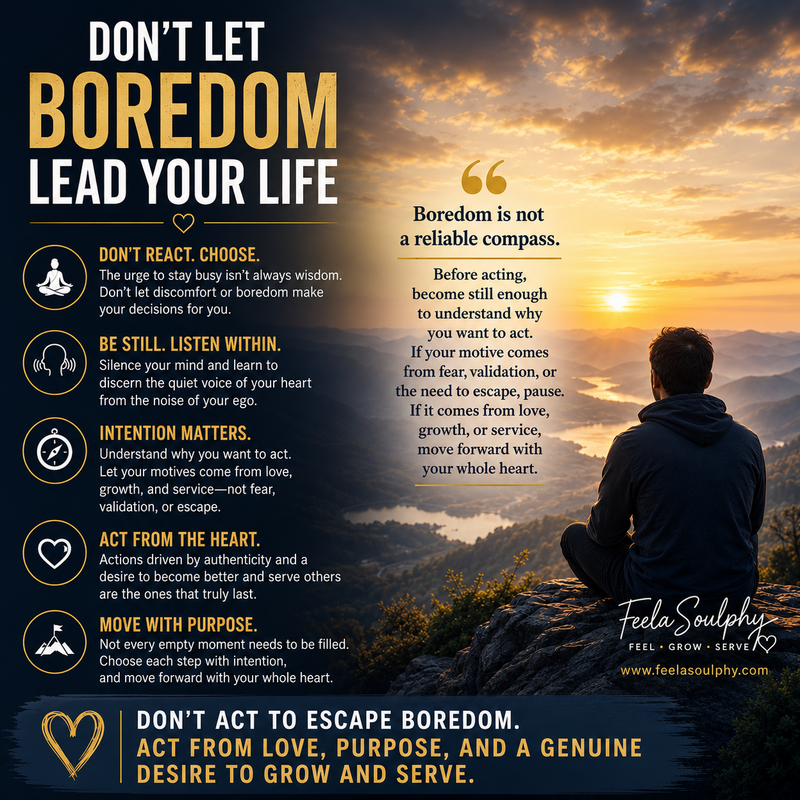 Don’t fill your time simply because you’re bored.
The urge to stay busy isn’t always wisdom. Often, it’s simply discomfort looking for an escape. When you allow that feeling to direct your choices, you’re reacting instead of choosing. Your ego—not your heart—begins to lead the way. Instead, be still. Be patient. Create space for silence. In that silence, learn to distinguish between the quiet voice of your heart and the endless noise of your restless mind. One leads you toward purpose. The other only seeks distraction. Stillness isn’t the opposite of action. It is what allows you to understand why you want to act. The reason behind your actions matters more than the actions themselves. If your motivation comes from loneliness, the need for validation, fear of missing out, or the desire to prove something, your enthusiasm will eventually fade. Ego can fuel ambition, but it rarely brings lasting peace or fulfillment. But when your actions are born from authenticity, love, curiosity, and a sincere desire to become a better person and to serve others, they are sustained by something much deeper. They no longer feel like obligations. They become expressions of who you are. Not every empty moment needs to be filled. A meaningful life isn’t built by filling every moment; it’s built by choosing each moment with intention. Sometimes the wisest thing you can do is pause—not because you’re waiting for life to happen, but because you’re making sure your next step is guided by purpose rather than restlessness. Boredom is not a reliable compass. Before acting, become still enough to understand why you want to act. If your motive comes from fear, validation, or the need to escape, pause. If it comes from love, growth, or service, move forward with your whole heart. Don’t act to escape boredom. Act from love, purpose, and a genuine desire to grow and serve. 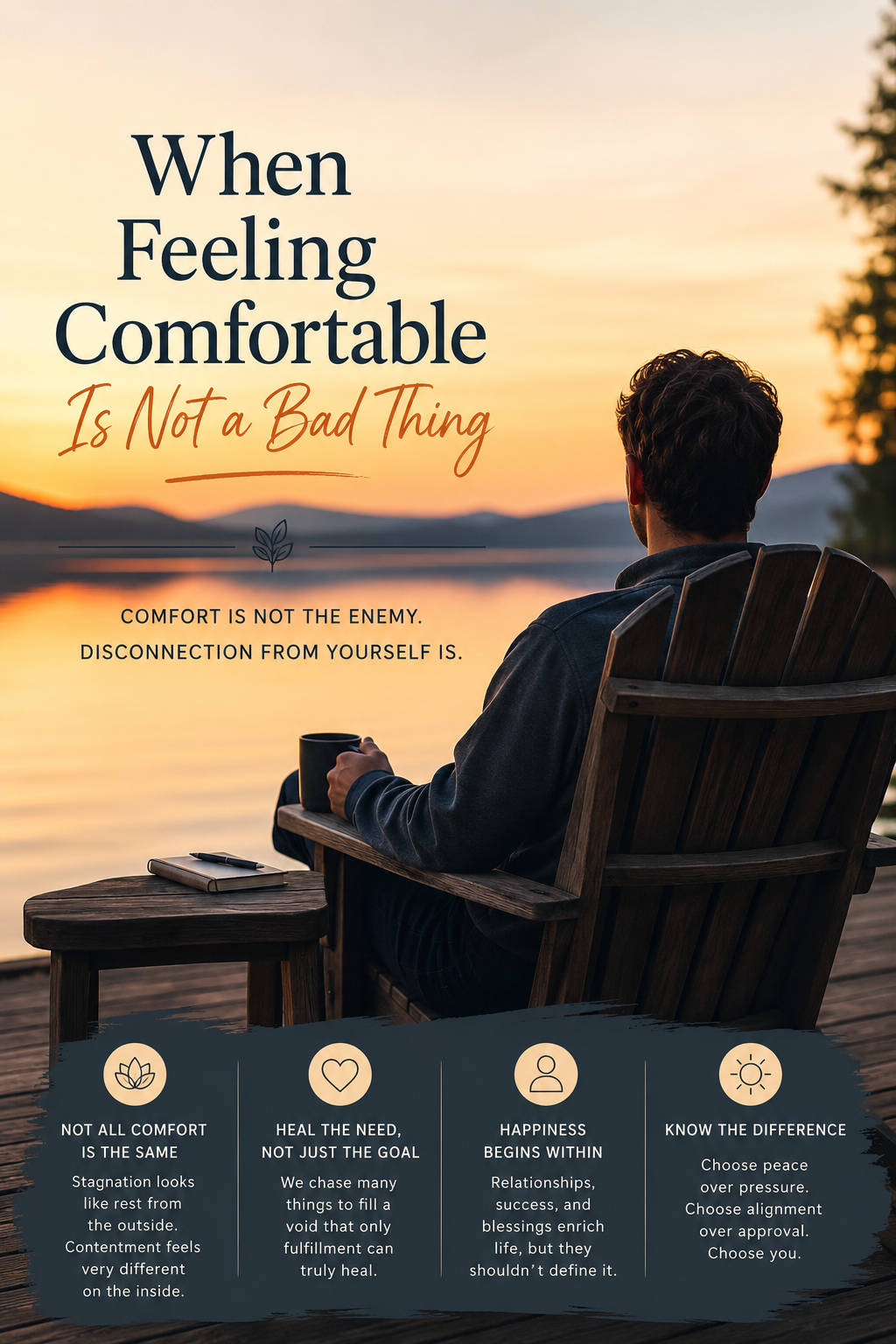 We live in a culture that is obsessed with growth.
Everywhere we look, we are told to work harder, hustle more, achieve bigger goals, and continuously improve ourselves. Social media is filled with messages encouraging us to leave our comfort zones because staying comfortable is often portrayed as the beginning of decline. The underlying message is clear: "If you're not moving forward, you're falling behind." But what if this belief is not always true? What if there are times when feeling comfortable is not a sign of laziness, complacency, or a lack of ambition? What if comfort is sometimes a sign that we have finally found peace? The Fear of Being Comfortable Many people are afraid of becoming too comfortable. They worry that if they stop striving, they will stop growing. If they stop achieving, they will lose their purpose. If they stop chasing goals, their lives will somehow become meaningless. As a result, they constantly search for the next mountain to climb. A promotion. A larger business. More money. More recognition. More accomplishments. There is nothing inherently wrong with pursuing these things. The question is why we pursue them. Are we driven by genuine passion? Or are we trying to fill a void within ourselves? Sometimes ambition is an expression of our purpose. Other times, ambition is simply insecurity wearing a disguise. Comfort Can Mean Two Very Different Things Not all comfort is created equal. There is a form of comfort that comes from avoidance. A person may avoid challenges because they are afraid of failure, rejection, or uncertainty. This type of comfort keeps people stuck. It prevents growth and limits their potential. But there is another form of comfort that comes from contentment. This comfort arises when a person no longer feels compelled to prove their worth through endless achievement. They recognize that their value does not increase with every accomplishment or decrease with every failure. They are comfortable not because they have given up on life, but because they have made peace with themselves. From the outside, these two forms of comfort can look exactly the same. Internally, they are worlds apart. The Business Owner Who Changed His Mind Imagine a man who has always dreamed of starting his own business. For years he tells himself that one day he will prove to everyone that he is capable of succeeding. He imagines the respect, admiration, and validation that will come with building something successful. Then something unexpected happens. He meets the love of his life. Over time, he becomes happier than he has ever been. His need to prove himself begins to fade. The urgency to start the business disappears. What happened? Many people would immediately conclude that he became complacent. But perhaps something deeper occurred. Maybe the business was never his true dream. Maybe it was an attempt to satisfy an emotional need. Maybe he wasn't seeking success. Maybe he was seeking love, acceptance, and belonging. Once those needs were met through a meaningful relationship, the desire to prove himself lost its power. The business was not abandoned. The wound behind it was healed. A Word of Caution There is an important distinction here. If his happiness depends entirely on the relationship, then the foundation remains fragile. If the relationship ends, he may once again feel incomplete. The old desire to prove himself may return stronger than before. He may now feel compelled to prove something not only to himself, but also to his former partner. This reveals that the source of happiness was still external. The relationship merely replaced one dependency with another. True contentment cannot rest entirely upon another person, achievement, possession, or circumstance. Anything that can be taken away cannot be the foundation of lasting happiness. Happiness From Within This does not mean relationships, success, and accomplishments are unimportant. They enrich our lives. They bring joy, meaning, and fulfillment. But they should add to our happiness, not create it. When happiness comes primarily from external circumstances, life becomes a constant struggle to maintain those circumstances. When happiness arises from within, external blessings become gifts rather than necessities. You enjoy them deeply, but you do not depend on them for your sense of self. You appreciate success without needing it. You cherish relationships without clinging to them. You pursue goals without attaching your worth to the outcome. The Real Question Perhaps the problem is not that people become too comfortable. Perhaps the problem is that we rarely stop to examine why we are striving in the first place. Sometimes growth is necessary. Sometimes rest is necessary. Sometimes the most profound transformation occurs not when we achieve something new, but when we realize we no longer need to prove anything at all. The challenge is learning the difference between comfort that comes from fear and comfort that comes from peace. One keeps us asleep. The other is a sign that we have finally come home to ourselves. 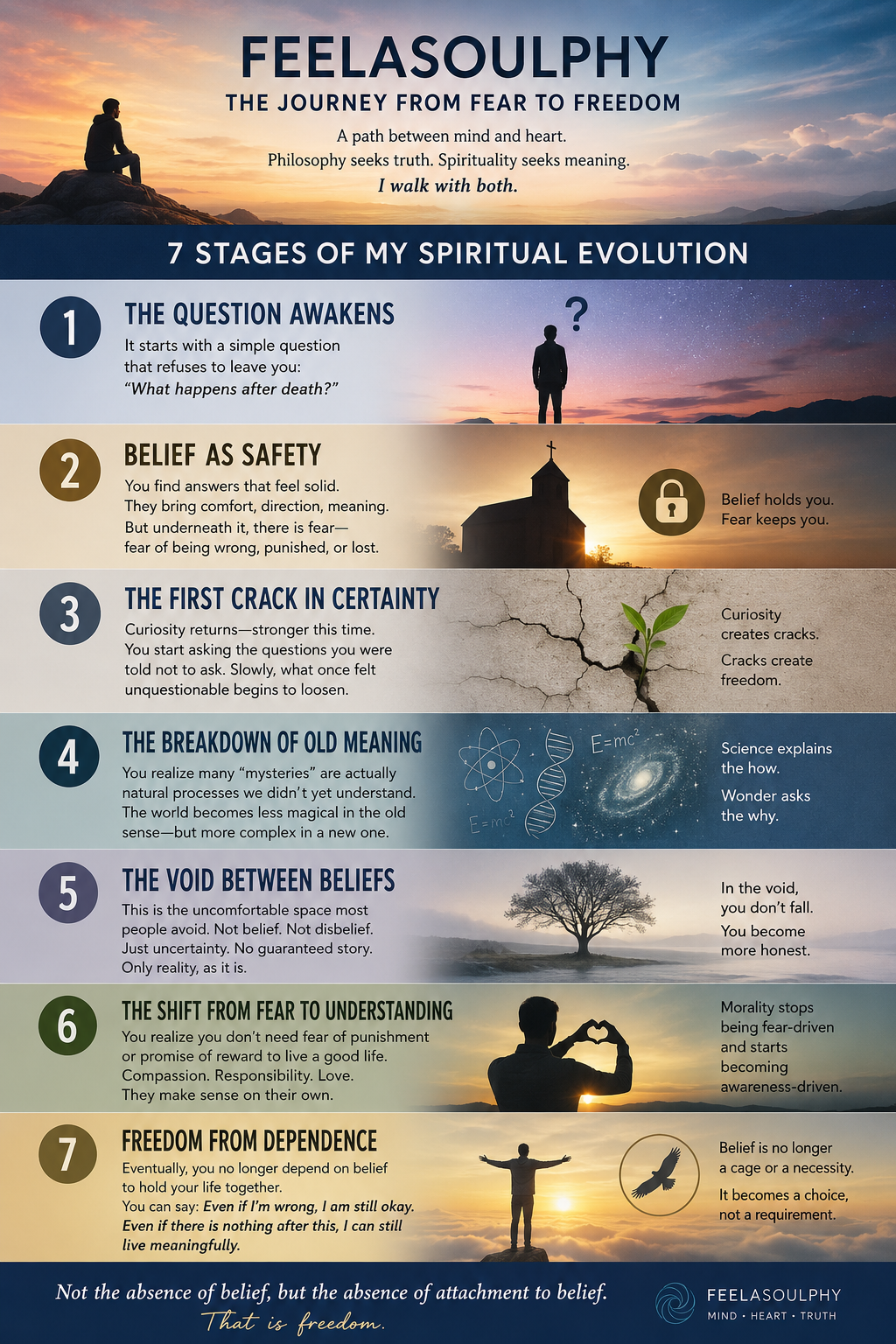 7 Stages of My Spiritual Evolution...To Be Continued... There was a time when I believed life could be neatly categorized. Philosophy belonged to the mind. Spirituality belonged to the heart. One searched for truth through logic, questioning, and reason. The other trusted intuition, meaning, and unseen connection. For a long time, I treated them as separate worlds. Almost like two different languages trying to describe existence. But life doesn’t stay in boxes for long. And neither did I. The Early Search: Fear Disguised as Faith My journey didn’t begin in clarity. It began in curiosity — and uncertainty about what happens after death. That question, once planted, doesn’t leave quietly. It grows into others: What is real? What is God? What is truth? What happens when we die? Eventually, I found myself inside Christianity. And for a while, it gave structure to the unknown. It gave answers where there were none. It gave direction where I felt lost. But underneath it, there was something I didn’t fully recognize at the time: fear. Fear of punishment. Fear of being wrong. Fear of what happens if belief collapses. And fear is a powerful teacher — but not always a truthful one. It can shape belief into something rigid, something protective rather than something alive. At some point, I started to notice that my relationship with belief wasn’t fully free. It was anchored in consequences, not understanding. And once you see that, you can’t unsee it. The Breaking Open: Science, Philosophy, and Unraveling Certainty “Did God create us in His image, or did we create God in ours?” And perhaps beneath both lies an even deeper question: “Did God create us… or did we create God?” - Feelasoulphy The next stage of my journey was not spiritual at all — at least not in the traditional sense. It was analytical. I began studying science, philosophy, and research around consciousness. I explored near-death experiences, reincarnation theories, and scientific perspectives on spirituality. Not to reinforce belief — but to challenge it. Slowly, the world I once saw as “miraculous” became increasingly explainable. The mechanisms of life, the brain, perception, evolution — all of it revealed patterns that didn’t require supernatural explanation. And something shifted in me. I started realizing that many things once attributed to God were actually natural processes we had not yet understood. But instead of closing the mystery, this opened a different one: Even if we understand how something works… we still don’t fully understand why anything exists at all. Science explains mechanisms. But it does not fully explain existence itself. That realization didn’t push me back into certainty. It pushed me deeper into humility. The Transition: Letting Belief Stop Being a Crutch Over time, something unexpected happened. My need for belief as emotional security began to fade. I stopped needing a specific story about what happens after death in order to live meaningfully now. That was a turning point. I reached a place where I could say: Even if there is no God… Even if there is no afterlife… I can still live a good, conscious, and meaningful life. Not because I was forcing myself to be strong — but because I genuinely understood why compassion, love, and responsibility matter. Not from fear. Not from reward. But from clarity. And when belief is no longer required to behave well, something subtle happens inside a person. The mind becomes lighter. The heart becomes less defended. And truth becomes less threatening. The Shift: From Dependency to Freedom At some point, I realized I no longer depended on belief in God or the afterlife to guide my actions. And that changed everything. Because belief stopped being a psychological structure holding me together. It became something I could examine freely. I was no longer afraid of my worldview collapsing. I was no longer attached to it as identity. I could question it, challenge it, even let it dissolve — and I would still be okay. That is when I first felt something I can only describe as freedom. Not freedom from meaning. But freedom from fear-based meaning. Feelasoulphy: A Middle Path This is where the idea of Feelasoulphy emerged for me. A bridge between:
Not as a contradiction — but as integration. Because I’ve come to see that philosophy without feeling becomes empty abstraction. And spirituality without inquiry becomes fragile belief. We are not meant to live in only one half of ourselves. We are meant to become whole. Fear-Based Belief vs Freedom-Based Belief One of the clearest distinctions I’ve learned is this: There is a kind of belief that is built on fear:
And there is a kind of belief — or perhaps a way of being — that is built on freedom:
Fear-based belief needs certainty to feel safe. Freedom-based understanding can hold uncertainty without collapsing. That difference changes everything. The Question I Keep Returning To I don’t claim to know what happens after death. I don’t claim to fully understand consciousness or the origin of reality. But I also no longer need those answers to live well. And maybe that is the real shift. Not from belief to disbelief. But from dependence to independence. And from independence… to a quieter possibility: That perhaps meaning is not something we receive from certainty, but something we embody through awareness. Where I Am Now Today, I feel something simple but profound: I am okay not knowing. Not in resignation — but in openness. I can explore spirituality without needing it to be “true in the ultimate sense.” I can study science without needing it to erase mystery. I can live ethically without needing fear as motivation. And most importantly, I can question everything — without losing myself in the process. That, to me, is freedom. Not the absence of belief. But the absence of attachment to belief. And in that space… life feels strangely more real than ever. 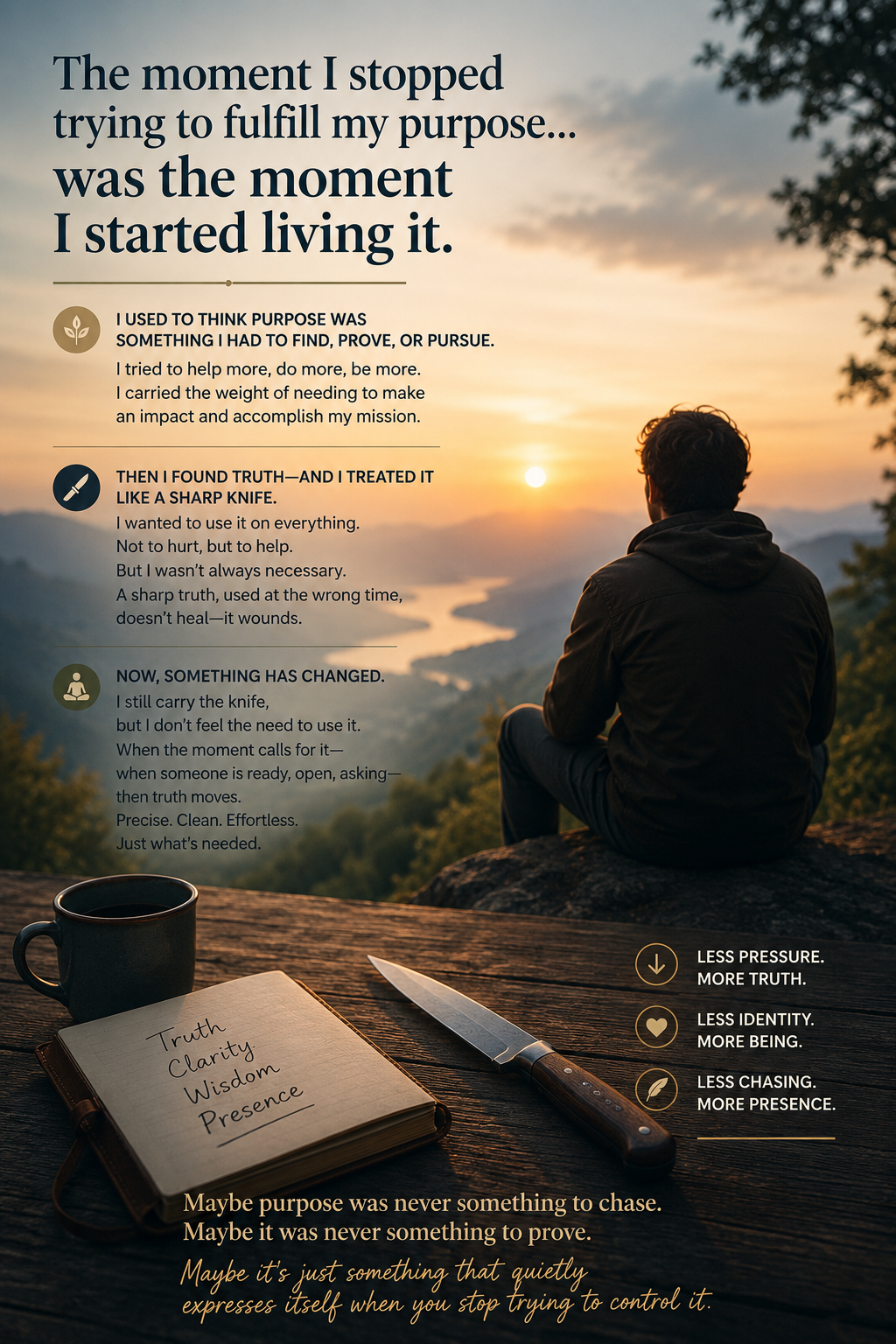 The moment I stopped trying to fulfill my purpose… was the moment I started living it.
For a long time, I carried this quiet pressure: That I was meant to do something meaningful. That I had a mission I needed to accomplish. That my life had to amount to something bigger than myself. It sounds noble… but it’s heavy. Because hidden inside that belief was fear-- Fear of not doing enough. Fear of wasting my life. Fear of not becoming who I thought I was supposed to be. So I tried. I looked for ways to help. I pushed myself to show up. I chased opportunities to make an impact. And when I discovered truth—real clarity, real insight-- it felt like I had found a sharp knife. Something powerful. Something that could cut through illusion. So I used it. In conversations. In people’s beliefs. In the way they saw themselves and the world. Not to hurt—but to help. At least… that’s what I told myself. But the truth is, when something is new and powerful, you feel the need to prove it works. So I cut into everything. And sometimes… I was right. But I wasn’t always necessary. That’s the part no one talks about. A sharp truth, used at the wrong time, doesn’t heal—it wounds. Not because it’s false, but because it’s forced. The more I tried to live my purpose, the more I was acting from pressure—not truth. Then something shifted. I stopped forcing it. Stopped chasing it. Stopped needing to be “the person who helps.” And in that space… something unexpected happened: I didn’t lose my desire to help. I just lost the need to. I still carry the knife. But I don’t feel the need to use it. Now, when someone needs me—I’m there. Fully. But I no longer carry the weight of having to fix, save, or prove anything. I wait. And when the moment truly calls for it-- when someone is ready, open, asking-- Then truth moves. Precise. Clean. Effortless. No force. No pressure. Just what’s needed. Maybe purpose was never something to chase. Maybe it was never something to prove. Maybe it’s just something that quietly expresses itself when you stop trying to control it. Less pressure. More truth. Less identity. More being. And strangely… that feels like freedom. 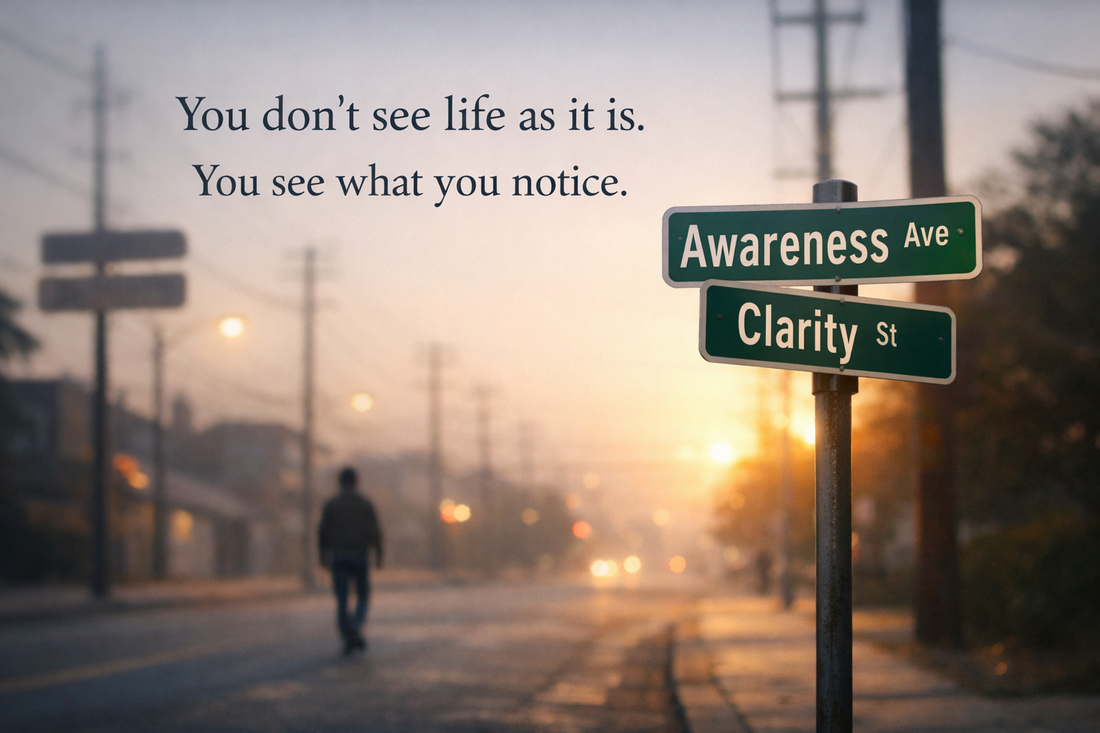 Most people don’t live bad lives. They live unconscious ones. We don’t experience reality as it is--we experience what we pay attention to. Everything else disappears into the background, not because it isn’t there, but because our awareness never stops to notice it. I realized this through a simple experiment. I’ve lived in the same neighborhood for sixteen years, yet I still don’t know the names of some of the cross streets near my home. When I finally slowed down and intentionally paid attention, I remembered the street names immediately. This wasn’t a memory problem. It was an attention problem. That insight opened a larger question: if I can overlook something so basic for years, how many important aspects of my life have I also missed--patterns, emotions, beliefs, opportunities--simply because I wasn’t paying attention? Why Most People Live Unconsciously Living unconsciously isn’t a moral failure. It’s a biological strategy. The brain is designed to conserve energy. Awareness takes effort. Questioning takes effort. So the mind defaults to automation. Our experience of life is shaped by what we attend to. Attention acts as a filter--what passes through becomes our reality. Most people don’t consciously choose that filter. Instead, it’s shaped by:
Over time, this creates a narrow version of reality that feels complete but isn’t. Research in psychology supports this. Daniel Kahneman showed that much of human behavior operates on fast, automatic thinking. We don’t actively choose most of our thoughts--we repeat them. Efficiency keeps us functioning. But it also keeps us asleep. The Hidden Cost of Unconscious Living When we don’t pay attention:
The problem isn’t suffering. The problem is not noticing the cause of suffering. An unconscious life isn’t empty--but it’s limited. Awareness Is Not a Personality Trait--It’s a Skill Here’s the good news: awareness isn’t something you either have or don’t have. It’s a skill. I didn’t need years of meditation or a spiritual retreat to notice the street names. I simply directed my attention deliberately for a moment. That single act revealed something important: unconscious living isn’t permanent. It’s a default setting. Every moment of noticing--your breath, your tension, your thoughts, your reactions--is a small interruption in that default. How Attention Changes Your Life Your life doesn’t change when circumstances change. It changes when attention changes. Most people try to fix their lives by changing external conditions. Fewer people realize that shifting attention alters perception, behavior, and ultimately identity. When you begin to observe instead of react:
This isn’t abstract philosophy. It’s practical awareness. A Simple Practice to Live More Consciously Start small. Pick one ordinary thing today and pay full attention to it--your walk, your breathing, a conversation, the environment around you. No analysis. Just noticing. Then ask yourself: What else in my life have I been moving past without seeing? That question alone begins to wake you up. Final Thought Most people aren’t unconscious because they’re incapable of awareness. They’re unconscious because they were never taught that attention shapes reality. Once you see this, you can’t unsee it. And the real question becomes: What kind of life unfolds when you notice on purpose? 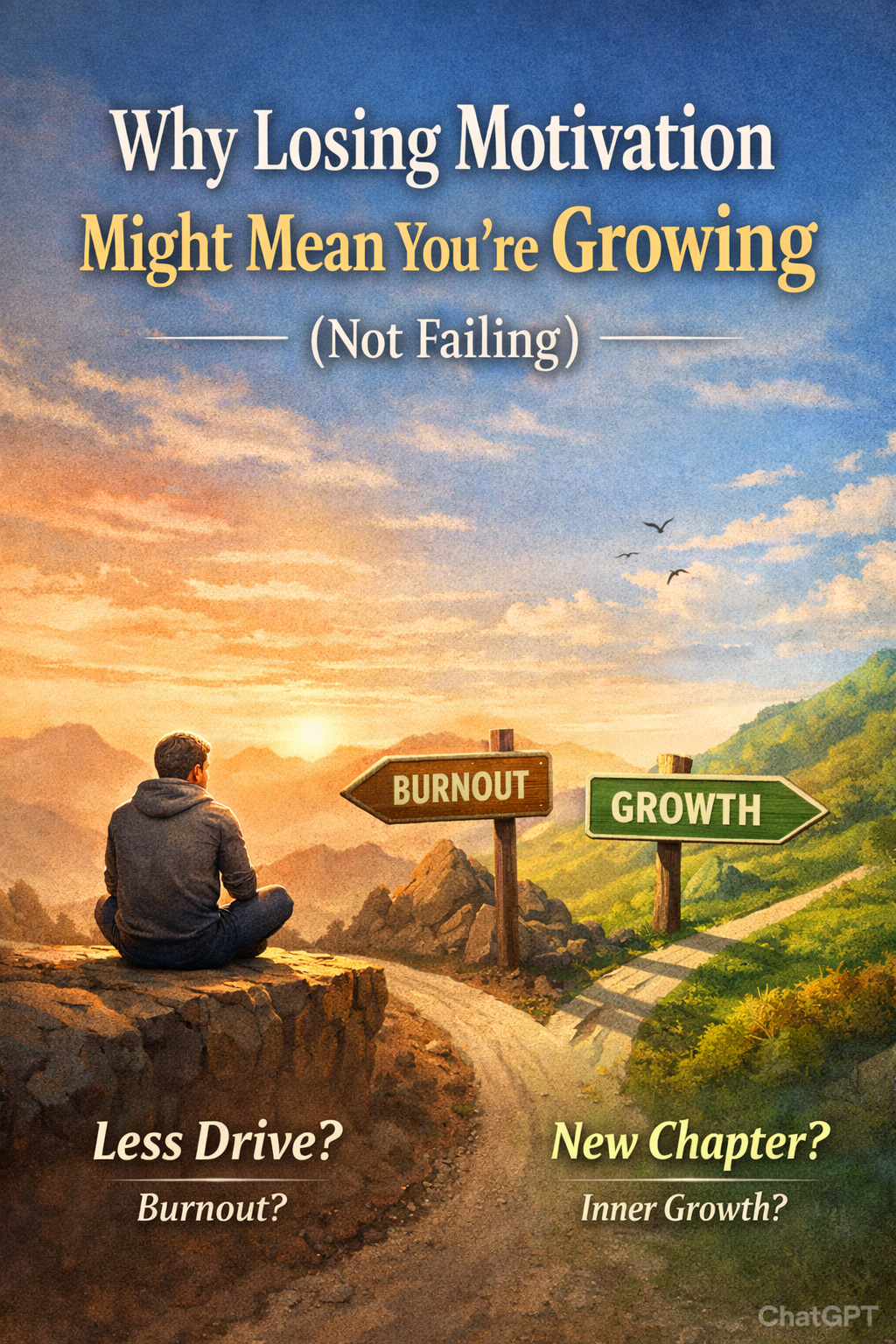 There is a phase of inner growth that rarely gets discussed—because it doesn’t look impressive. Ambition fades. The drive to achieve quiets down. The urge to become someone loosens its grip. And instead of clarity, many people feel unease. Am I evolving… or am I giving up? Is this peace—or fear disguised as contentment? This question doesn’t arise at the beginning of self-development. It appears after years of inner work, when ego has softened but purpose hasn’t yet redefined itself. The Role of Ambition in Human Development Ambition is not the enemy. Early in life, it serves an essential function. We strive in order to:
The problem isn’t ambition—it’s never knowing when to take it down. What Changes When Ego Softens If inner work is genuine, something subtle but radical happens: You no longer need achievement to validate your existence. This often shows up as:
They assume: “If my ambition is fading, something must be wrong.” In reality, something important is reorganizing. Rest vs Retreat: The Critical Distinction From the outside, rest and retreat look identical. Less output. More solitude. Fewer goals. Internally, they are opposites.
A simple test: If life gently asked something of me tomorrow, would I be open to it? A relaxed yes signals rest. A tight no signals retreat. The danger isn’t resting. The danger is mistaking withdrawal for wisdom. What Replaces Ambition After Ego Work When ego-driven ambition dissolves, one of three things replaces it:
A call does not demand constant productivity. It arrives with clarity and lightness. It asks for action—and then releases you again. From the outside, this looks inconsistent. From the inside, it feels precise. Why Many “Successful” People Never Reach This Stage Many high achievers don’t mind working all the time because stopping would force them to sit with themselves. Busyness becomes:
There’s a difference between capacity for work and compulsion to work. Losing the second while keeping the first is growth. The Real Risk at This Stage The risk is not doing less. The risk is using contentment as insulation. When “I’m fine the way I am” becomes a shield against engagement, life slowly thins out. The answer is not forcing ambition back. It’s remaining available. A Simple Operating Principle For this phase of life: Only act on what arrives with clarity and lightness. Not excitement. Not obligation. Not fear. Lightness. If nothing arrives, live fully anyway. Stillness is not a waiting room. It’s part of the work. A Short Mirror (Read slowly) Don’t answer these questions quickly. Notice what happens before the answer forms.
Only signals. Whatever you notice is the information. The Quiet Truth You are not here to maximize output. You are here to minimize distortion. When distortion falls away, contribution becomes inevitable—but no longer constant. And if you step forward again, it won’t be to become someone. It will be because silence finished saying what it could. 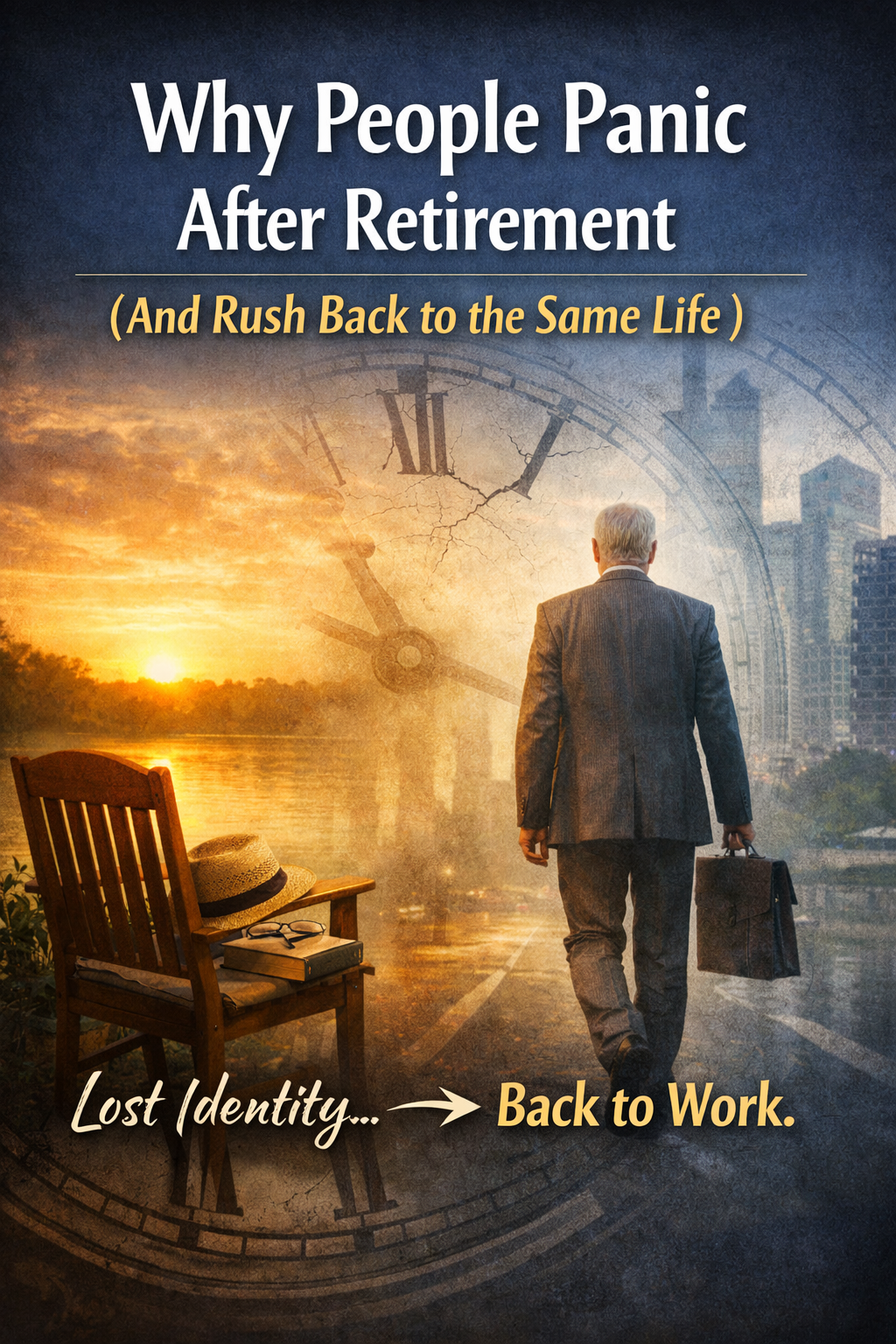 Picture a car that’s been driving at full speed for 30 years. Deadlines. Meetings. Responsibilities. Identity built around “doing.” Then one day… retirement. The wheels stop turning. But the engine is still screaming at 100 miles an hour. So what happens? Rest doesn’t feel restful. Freedom feels unsettling. Days feel empty instead of peaceful. And the mind starts whispering: “Something’s wrong. I need to get busy again.” Nothing is wrong. The nervous system just hasn’t cooled down yet. This is why so many people:
But because busyness feels familiar. Safe. Known. Stillness feels like an identity crisis. Here’s the hard truth: Most people don’t miss the job. They miss the state their nervous system was in. The structure. The stimulation. The sense of being needed. So instead of letting the system downshift, they step right back on the gas. Different job. Same engine speed. This is also why retirement can trigger an identity crisis. For decades, the identity was: “I am what I do.” When the doing stops, the mind asks: “Then who am I?” That question can feel terrifying—unless you understand what’s happening. It’s not a personal failure. It’s a transition phase. The nervous system is shedding an old operating mode. Here’s the warning I wish more people heard: Don’t rush back into busyness just because stillness feels uncomfortable. That discomfort is not a signal to go backward. It’s a signal that your system needs time to recalibrate. This is the moment to:
But what gives meaning without constant motion. Busyness can be a distraction disguised as purpose. If you skip this cooling-down phase, you don’t choose your next chapter consciously. You default to the old one. Same patterns. Same identity. Same exhaustion—just with a new title. True rest isn’t doing nothing forever. It’s allowing space for a new direction to emerge. A life driven by choice, not conditioning. By purpose, not momentum. So if you—or someone you love—is approaching retirement: Don’t just stop the car. Let the engine idle. Let the system learn that it’s safe to slow down. Only then ask: “What do I actually want this next chapter to be about?” That question can’t be answered at 100 miles an hour. If you'd like to get a deeper understanding on this subject you can check out this post that explains how dopamine, the nervous system, and brain momentum keep the mind addicted to busyness. Why Slowing Down Feels So Uncomfortable - The Science Behind a Mind That Won’t Let Go of Busyness How to Be Alone Without Being Lonely - Awareness, Curiosity, and the Education We Keep Ignoring2/10/2026 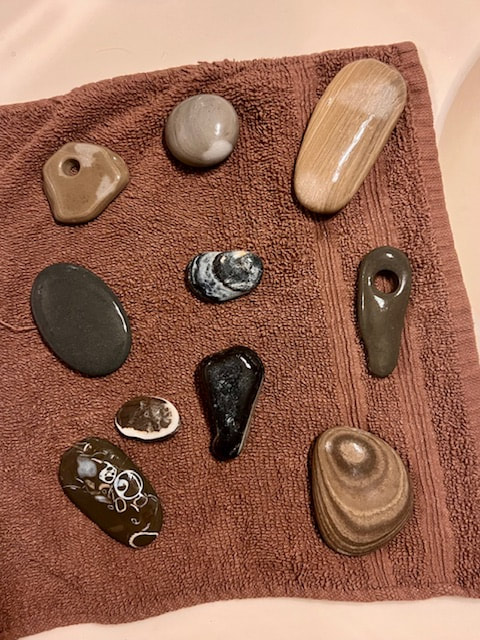 Naturally shaped pebbles off a beach in Santa Cruz, California, USA. They are Sandstones, Mudstones, Limestones (with fossils), Cherts. Ages 1 million to over a billion years old. Any idea which one is the oldest? Most people don’t fear being alone. They fear what happens when distractions disappear. Solitude feels empty only when awareness is low. When awareness rises, learning speeds up — and suddenly, being alone becomes alive. The other day, I spent hours alone at the beach. No plan. No productivity agenda. Just attention. What unfolded taught me more than weeks of routine thinking ever could. I watched seagulls fly high into the air carrying mussels, then drop them onto rocks below to crack the shells. Again and again. No frustration. No overthinking. Just experimentation. Gravity became their tool. The rock became their ally. That matters for one simple reason: Many animal species have survived on this planet far longer than humans. Some for millions of years. Some relatively unchanged. They didn’t do that by accident. They figured something out. If we refuse to learn from them, an honest question follows: Who exactly do we think we’re learning from instead? Later that same day, I noticed a man running along the beach — with two crows flying beside him. I didn’t understand it at first. An hour later, they were still together. Then I saw it: he was feeding them as he ran. He had learned how to attract them, how to stay in rhythm with them. That wasn’t dominance. That was relationship. Crows don’t obey. They choose. That scene alone says more about intelligence than most definitions do. In between, I picked up pebbles. Smooth ones. Scarred ones. Some carrying fossil-like imprints of ancient shells. Later, I learned many of these stones began forming 1 million to over a billion years ago — shaped slowly by pressure, water, and time. Holding one felt like holding patience itself. Most people would call that “just a rock.” That’s not accuracy — that’s inattention. Jane Goodall changed how we understand chimpanzees not by imposing theories, but by doing something radical: she stayed curious longer than most people are willing to. She watched. She listened. She allowed understanding to emerge instead of forcing conclusions. And, perhaps most importantly, she genuinely enjoyed being alone in nature and learning from it. That’s what solitude in nature does when awareness is present. And here’s the part we underestimate: Awareness doesn’t just deepen insight — it accelerates learning. When you’re attentive:
This is why “unplugging” works — not because technology is evil, but because disconnection from noise allows reconnection to reality. Or put simply: Disconnect to reconnect. I had been stressed with work for a while. Busy. Productive. Effective — but disconnected from myself and from nature. Solitude in nature didn’t slowly help. It immediately brought me back to life. Not metaphorically. Viscerally. Loneliness comes from disconnection. Solitude comes from engagement. Nature is always teaching. Animals are always demonstrating intelligence, efficiency, cooperation, and presence. The lessons are everywhere. The only requirement is awareness. You don’t need to escape life. You need to pay attention to it. Practical Homework: How to Practice Awareness in Solitude Don’t romanticize this. Practice it. 1. Schedule unstructured alone time No podcasts. No scrolling. No objectives. Go somewhere alive: beach, park, trail, quiet street. 2. Train one sense at a time Spend 5–10 minutes focusing only on:
Awareness grows through specificity. 3. Stay past boredom Watch one thing long enough for it to change. Learning accelerates after the mind stops demanding stimulation. 4. Ask grounded questions Not philosophical ones. Practical ones:
5. Pick up or observe one object — then use AI to learn about it A pebble. A leaf. A shell. A bird. Later, research it. Its age. Its function. Its history. This bridges curiosity, technology, and nature — instead of treating them as opposites. 6. Write down everything you did that day Not just insights — actions:
When I did this, I surprised myself. What felt like “doing nothing” was actually a full, rich, adventurous day. Awareness changes the scoreboard. Do this once a week. That’s enough. Curiosity opens the door. Awareness lets you walk through it. Solitude stops being empty — and becomes education. And eventually, you realize something quietly radical: Being alone isn’t the absence of life. It’s the removal of noise that was keeping you from seeing it. 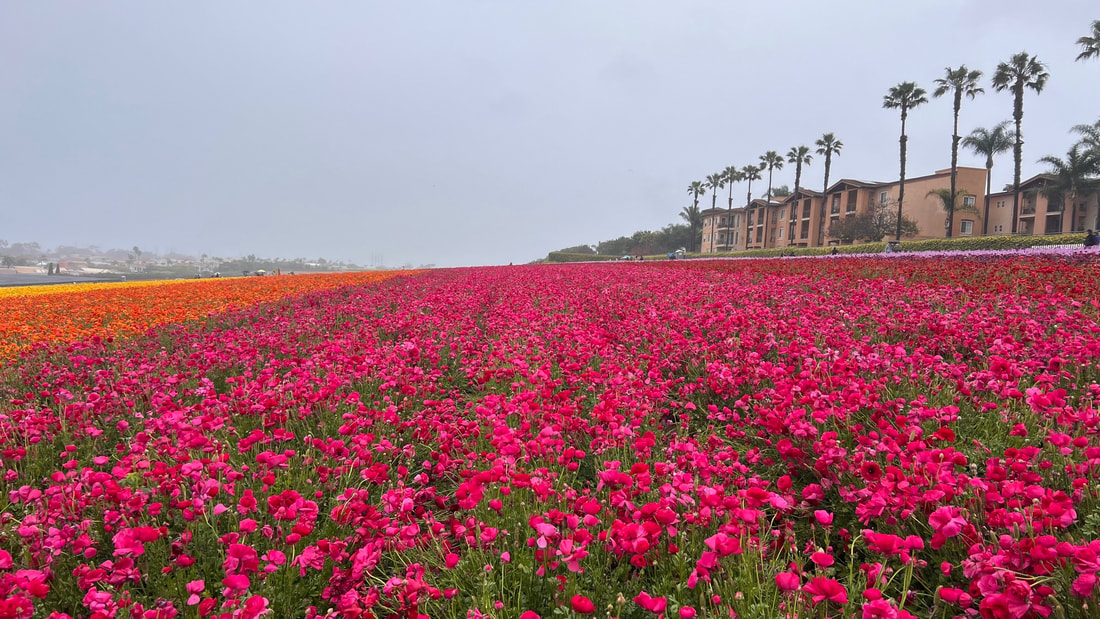 The Flower Fields, Calsbad, California, USA The Spiritual Purpose Behind Our Shifting Passions, Identities, and Paths Have you ever looked back at your life and wondered, “Who was I back then?” Maybe you went through a spiritual phase, a fitness phase, a minimalist phase, a business-building phase, or even a wild-and-free phase. And now, you’re in an entirely different chapter — with different passions, desires, and even a different sense of self. You’re not flaky. You’re evolving. You’re not lost. You’re learning. You’re not inconsistent. You’re in a phase — and that’s not only normal, it’s necessary. Phases Are How the Soul Grows From a spiritual lens, our souls incarnate with a plan — not a rigid blueprint, but a flexible curriculum. The soul doesn’t want sameness, it wants expansion. And how do we expand? Through experience. Each phase you’ve been through — no matter how random or unrelated it seemed at the time — held a piece of your puzzle. Some taught you discipline. Others cracked your heart open. Some helped you build, while others taught you how to let go. From the soul’s perspective, there’s no such thing as “wasted time.” Only lessons. The Psychology of Phases: You’re Wired to Shift Neurologically speaking, we’re not meant to stay in one mode of operation forever. The human brain is shaped by neuroplasticity, which means it constantly adapts, rewires, and reshapes itself based on what you focus on. When you go through a phase, you’re literally forming new neural pathways. You’re reprogramming your mind. This isn’t failure — it’s progress. Yes, society often glorifies “consistency” and “persistence,” but it forgets that adaptability is just as powerful a form of intelligence. The oak tree is sturdy, but the bamboo survives the storm. When to Shift, When to Stay Here’s the part many people get stuck on — how do you know when it’s time to move on, and when you’re just bored or avoiding something uncomfortable? True soul-guided shifts feel expansive, even if they’re scary. Avoidant shifts feel relieving at first but leave you feeling hollow. Some things are meant to be completed. They require your full presence and persistence — not because you’re “supposed to stick with it,” but because there’s a deep soul lesson embedded in the completion, not the escape. The Gift of Many Selves You are not here to be one fixed character your whole life. You’re a multidimensional being having a multidimensional experience. The version of you who loved painting at 20, the one who dove into meditation at 30, and the one now craving simplicity and nature — they’re all you. None of them were wrong or off-path. They were stepping stones. They were phases. They were part of the unfolding. Imagine doing only one thing your entire life — thinking the same, acting the same, dressing the same, believing the same. That’s not consistency. That’s stagnation. The river flows because it moves. A Reminder for the Multi-Passionate Souls So if you’ve ever been made to feel like you “change too much,” here’s your permission slip: You’re not meant to stay the same. You’re meant to stay true. And “true” will look different depending on the season of your soul. The world needs stable builders and daring shapeshifters. We need the ones who master one path for 40 years — and the ones who master the art of reinvention every 5. What matters most is that you’re conscious of your direction. Let your phases be sacred. Let your seasons be teachers. But also learn to listen: Which ones are calling you to finish the lesson? And which ones are whispering: It’s time to begin again? Final Thought: Phases Are Not Detours They’re the journey itself. Just make sure you’re not jumping ship because of discomfort… And you’re not staying out of fear of change. Complete what you came to complete. And when it’s done — don’t be afraid to move on. Because the next phase might just be the one that unlocks everything. |
AuthorFeelasoulphy Categories
All
Archives
March 2026
|
 RSS Feed