 Community Garden, South Laguna Bluff, California, USA What if you could tune into the same brainwave frequency as monks during moments of enlightenment? What if insight wasn’t just mental — but divine? This is where Gamma comes in. Often overlooked in everyday life, Gamma is the brainwave state linked to the highest forms of consciousness, the aha! moments that feel like downloads from beyond, and even spiritual awakening. But Gamma doesn’t show up randomly. It’s a state you can prepare for — and invite. What Are Gamma Waves? Gamma brainwaves range from 30 to 100 Hz, the fastest of all brain frequencies. These waves are associated with:
When you experience a sudden epiphany — the kind that changes your life — you’re likely in a gamma burst. It’s your brain creating an instantaneous global connection, fusing memory, insight, emotion, and intuition into one flash of clarity. Gamma in Mystics, Monks, and Moments of Awakening In groundbreaking research, neuroscientists observed elevated gamma activity in the brains of advanced Tibetan monks during meditation. These monks weren’t just calm — they were in a state of profound, expansive awareness. Love-based meditations, in particular, triggered the most powerful gamma waves. These findings suggest that gamma isn’t just about cognition. It may be the neural signature of transcendence — the bridge between the personal and the divine. How Gamma and Alpha Work Together Think of Alpha as the fertile ground. It’s where you relax, open your awareness, and quiet the noise. Gamma is the lightning strike. It’s the moment the insight arrives, fully formed. Together, they form the perfect flow state:
Your goal isn’t to chase Gamma — but to create the conditions for it to arise. Practices That Induce Gamma States You don’t have to live in a monastery to access gamma. These practices have been shown to boost gamma activity and support spiritual downloads: 1. Insight Meditation Rather than emptying the mind, this style focuses attention on a single subject (a question, concept, or sensation) while observing arising insights without judgment. It combines clarity with curiosity — a recipe for gamma bursts. 2. Breathwork Rhythmic or conscious breathing techniques can alter brainwave patterns, especially when paired with emotional release. Gamma often appears after strong somatic breakthroughs. 3. Deep Focus (Flow States) When fully immersed in a creative, intellectual, or physical activity, your brain can enter “flow” — a state associated with both alpha and gamma synchronization. 4. Acts of Love and Compassion Heart-based states (like gratitude, empathy, and unconditional love) elevate not just your mood, but your frequency. Studies show these emotions correlate with increased gamma activity and neural coherence. How to Invite Gamma Into Your Daily Life The more often you create space, the more likely your brain is to deliver insight. Here’s how to build a gamma-friendly lifestyle: Stillness Windows Designate sacred “alpha zones” during your day — no phone, no noise, just presence. These might include:
See more details about Alpha Brainwave in Part 2. Ask Powerful Questions Gamma breakthroughs often follow curious inquiry. Use questions like:
Let the answers come later — in a flash. Final Insight: Epiphanies Are Spiritual Invitations Gamma is more than a brainwave. It’s a state of divine intelligence. It’s when the veil thins… and something greater than you whispers through the neurons. When you get the message, don’t just admire it — act on it. Because real transformation doesn’t happen when you understand something. It happens when you become it. Read: Part 1: The Neuroscience of Epiphanies: Why Sudden Realizations Can Change Your Life Instantly Part 2: Relax to Receive — Why the Alpha Brainwave Is the Gateway to Spiritual Insight Part 4: The Portal of Dreams - How Theta Brainwaves Reveal Your Soul's Voice Part 5: Breaking Free from Mental Noise - Escapting Beta Overdrive to Find Peace Part 6: The State Shifter - How to Move Between Brainwave States to Master Your Mind & Life
0 Comments
 Bella From the day we’re born, we are entangled with love. It begins before we even know the word—when we’re held, fed, smiled at (or not). That early interaction sets a blueprint for what love feels like. And more importantly, it shapes how we believe we must behave in order to receive it. Most people assume love is just a spiritual ideal—something soft and poetic that we strive for in relationships or spiritual teachings. But what most don’t realize is this: Love is also psychological. Love is biological. Love is survival. When people behave badly—when they lie, control, dominate, brag, lash out—it doesn’t look like love at all. But if you trace it all the way back to the root, it always leads to love. Or more specifically: the need to be loved. The Example of Donald Trump Let’s take a figure who represents dominance, pride, and controversy: Donald Trump. To many, he’s arrogant, aggressive, self-obsessed, divisive. He boasts about being a winner, having the best words, the highest ratings, the strongest policies. He demands loyalty. He hates being criticized. He portrays himself as the savior of America and insists the world recognize his greatness. At first glance, none of this sounds like a man seeking love. It sounds like a man seeking power. But look closer. Power is often a substitute for love. It’s what people reach for when they don’t believe they can simply be loved for who they are. When a person constantly brags, what are they really saying? “Please see me. Please tell me I matter. Please validate that I’m good enough.” When someone can’t tolerate being wrong, they’re often screaming inside: “I don’t feel safe being vulnerable. If I’m flawed, I won’t be loved.” Everything becomes a performance to prove their worth—because deep down, they never felt loved without having to earn it. Broken Strategies for Love We all have our own twisted strategies for getting love, based on what we learned in childhood. Some people:
Trump’s behavior is just a loud, extreme example of what we all do in subtler ways. If you look past the politics, the headlines, and your opinion of him—you’ll see a scared child inside a powerful man, still trying to prove he is worthy of love. This Isn’t About Justifying Harm Understanding that people are wounded doesn’t mean excusing bad behavior. Compassion and accountability must coexist. But when we look at human behavior through the lens of “This person is trying to get love in the only way they know how,” it breaks the cycle of judgment and hatred. And it helps us do the same for ourselves. Love: The Hidden Force Behind It All This is why spiritual teachers keep saying: “Life is all about love.” Not because it’s a feel-good phrase, but because it’s the underlying motivator behind everything we do. Whether we’re succeeding, sabotaging, pushing people away, or drawing them close-- we’re just trying to get back to the feeling of being safe, seen, and accepted. We want what we were born for. We want what the soul remembers. We want love. This is also why so many people love having pets. On a conscious or unconscious level, we are drawn to animals because they offer us an experience of unconditional love—whether we’re receiving it or giving it. Your dog doesn’t care how much money you make or how many mistakes you’ve made. They love you when you’re a mess and when you’re on top of the world. They’re excited to see you come home and sad when you leave. That’s not neediness—it’s devotion. Remember this: you may have many people in your life, but your pet only has you. You are their one and only source of love. So be gentle with them. Take good care of them. They too just want to feel loved—just like you. A Practice for Reflection Next time you catch yourself:
Pause and ask: “What am I really trying to get right now?” “How am I trying to get love?” Then take it a step further and ask: “Who might be hurting because of how I’m trying to get love?” “What is the cost of my unmet needs for the person on the receiving end?” And when you witness someone else behaving badly, try asking: “What twisted strategy for love might they be using?” Just because you’re trying to feel loved doesn’t mean others aren’t feeling unloved in the process. Be mindful: the ways we reach for love—if rooted in fear, control, or insecurity—can push others away or even harm them. And when that happens, we’re not only not getting the love we want, we’re also blocking the love we already have. Healing begins with awareness. Love begins with responsibility. Final Thought The world doesn’t need more punishment. It needs more understanding. It needs more people willing to look beneath the behavior and see the wound. That doesn’t mean tolerating abuse or enabling harm. It means living from the wisdom that says: “Even the most unlovable-seeming person is trying, in their own broken way, to be loved.” That, too, includes you. This post is dedicated to my favoriate dog in the world - Bella, who guided me to this deeper realization about love. Read: The Healing Power of Love 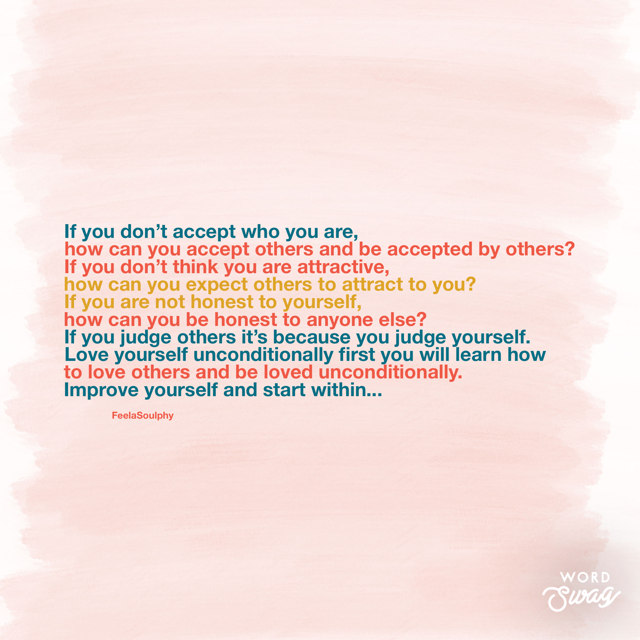 If you don’t accept who you are, how can you accept others and be accepted by others? If you don’t think you are attractive, how can you expect others to attract to you? If you are not honest to yourself, how can you be honest to anyone else? If you judge others it’s because you judge yourself. Love yourself unconditionally first you will learn how to love others and be loved unconditionally. Improve yourself and start within... - FeelaSoulphy |
AuthorFeelasoulphy Categories
All
Archives
March 2026
|
 RSS Feed