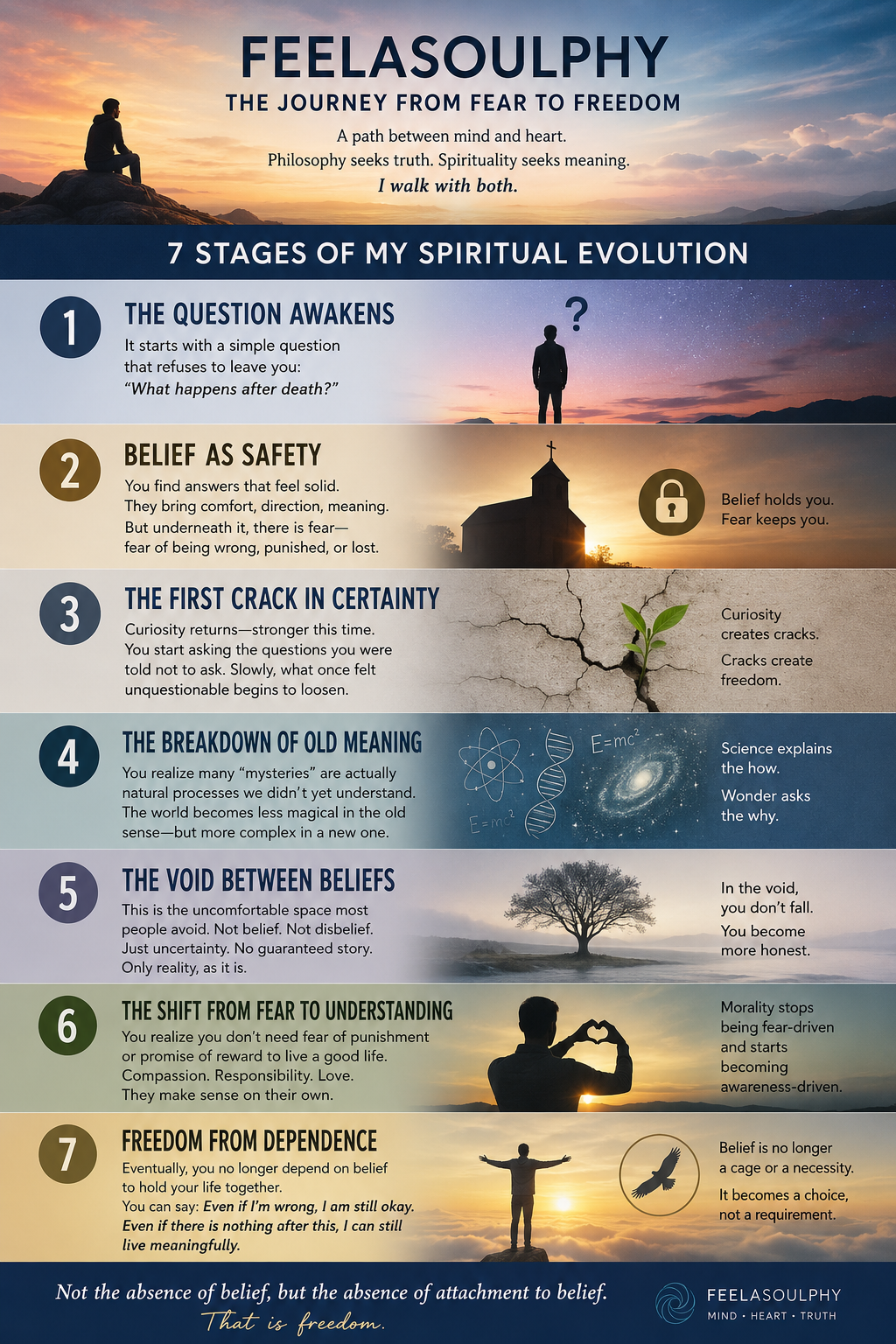
 7 Stages of My Spiritual Evolution...To Be Continued... There was a time when I believed life could be neatly categorized. Philosophy belonged to the mind. Spirituality belonged to the heart. One searched for truth through logic, questioning, and reason. The other trusted intuition, meaning, and unseen connection. For a long time, I treated them as separate worlds. Almost like two different languages trying to describe existence. But life doesn’t stay in boxes for long. And neither did I. The Early Search: Fear Disguised as Faith My journey didn’t begin in clarity. It began in curiosity — and uncertainty about what happens after death. That question, once planted, doesn’t leave quietly. It grows into others: What is real? What is God? What is truth? What happens when we die? Eventually, I found myself inside Christianity. And for a while, it gave structure to the unknown. It gave answers where there were none. It gave direction where I felt lost. But underneath it, there was something I didn’t fully recognize at the time: fear. Fear of punishment. Fear of being wrong. Fear of what happens if belief collapses. And fear is a powerful teacher — but not always a truthful one. It can shape belief into something rigid, something protective rather than something alive. At some point, I started to notice that my relationship with belief wasn’t fully free. It was anchored in consequences, not understanding. And once you see that, you can’t unsee it. The Breaking Open: Science, Philosophy, and Unraveling Certainty “Did God create us in His image, or did we create God in ours?” And perhaps beneath both lies an even deeper question: “Did God create us… or did we create God?” - Feelasoulphy The next stage of my journey was not spiritual at all — at least not in the traditional sense. It was analytical. I began studying science, philosophy, and research around consciousness. I explored near-death experiences, reincarnation theories, and scientific perspectives on spirituality. Not to reinforce belief — but to challenge it. Slowly, the world I once saw as “miraculous” became increasingly explainable. The mechanisms of life, the brain, perception, evolution — all of it revealed patterns that didn’t require supernatural explanation. And something shifted in me. I started realizing that many things once attributed to God were actually natural processes we had not yet understood. But instead of closing the mystery, this opened a different one: Even if we understand how something works… we still don’t fully understand why anything exists at all. Science explains mechanisms. But it does not fully explain existence itself. That realization didn’t push me back into certainty. It pushed me deeper into humility. The Transition: Letting Belief Stop Being a Crutch Over time, something unexpected happened. My need for belief as emotional security began to fade. I stopped needing a specific story about what happens after death in order to live meaningfully now. That was a turning point. I reached a place where I could say: Even if there is no God… Even if there is no afterlife… I can still live a good, conscious, and meaningful life. Not because I was forcing myself to be strong — but because I genuinely understood why compassion, love, and responsibility matter. Not from fear. Not from reward. But from clarity. And when belief is no longer required to behave well, something subtle happens inside a person. The mind becomes lighter. The heart becomes less defended. And truth becomes less threatening. The Shift: From Dependency to Freedom At some point, I realized I no longer depended on belief in God or the afterlife to guide my actions. And that changed everything. Because belief stopped being a psychological structure holding me together. It became something I could examine freely. I was no longer afraid of my worldview collapsing. I was no longer attached to it as identity. I could question it, challenge it, even let it dissolve — and I would still be okay. That is when I first felt something I can only describe as freedom. Not freedom from meaning. But freedom from fear-based meaning. Feelasoulphy: A Middle Path This is where the idea of Feelasoulphy emerged for me. A bridge between:
Not as a contradiction — but as integration. Because I’ve come to see that philosophy without feeling becomes empty abstraction. And spirituality without inquiry becomes fragile belief. We are not meant to live in only one half of ourselves. We are meant to become whole. Fear-Based Belief vs Freedom-Based Belief One of the clearest distinctions I’ve learned is this: There is a kind of belief that is built on fear:
And there is a kind of belief — or perhaps a way of being — that is built on freedom:
Fear-based belief needs certainty to feel safe. Freedom-based understanding can hold uncertainty without collapsing. That difference changes everything. The Question I Keep Returning To I don’t claim to know what happens after death. I don’t claim to fully understand consciousness or the origin of reality. But I also no longer need those answers to live well. And maybe that is the real shift. Not from belief to disbelief. But from dependence to independence. And from independence… to a quieter possibility: That perhaps meaning is not something we receive from certainty, but something we embody through awareness. Where I Am Now Today, I feel something simple but profound: I am okay not knowing. Not in resignation — but in openness. I can explore spirituality without needing it to be “true in the ultimate sense.” I can study science without needing it to erase mystery. I can live ethically without needing fear as motivation. And most importantly, I can question everything — without losing myself in the process. That, to me, is freedom. Not the absence of belief. But the absence of attachment to belief. And in that space… life feels strangely more real than ever.
0 Comments
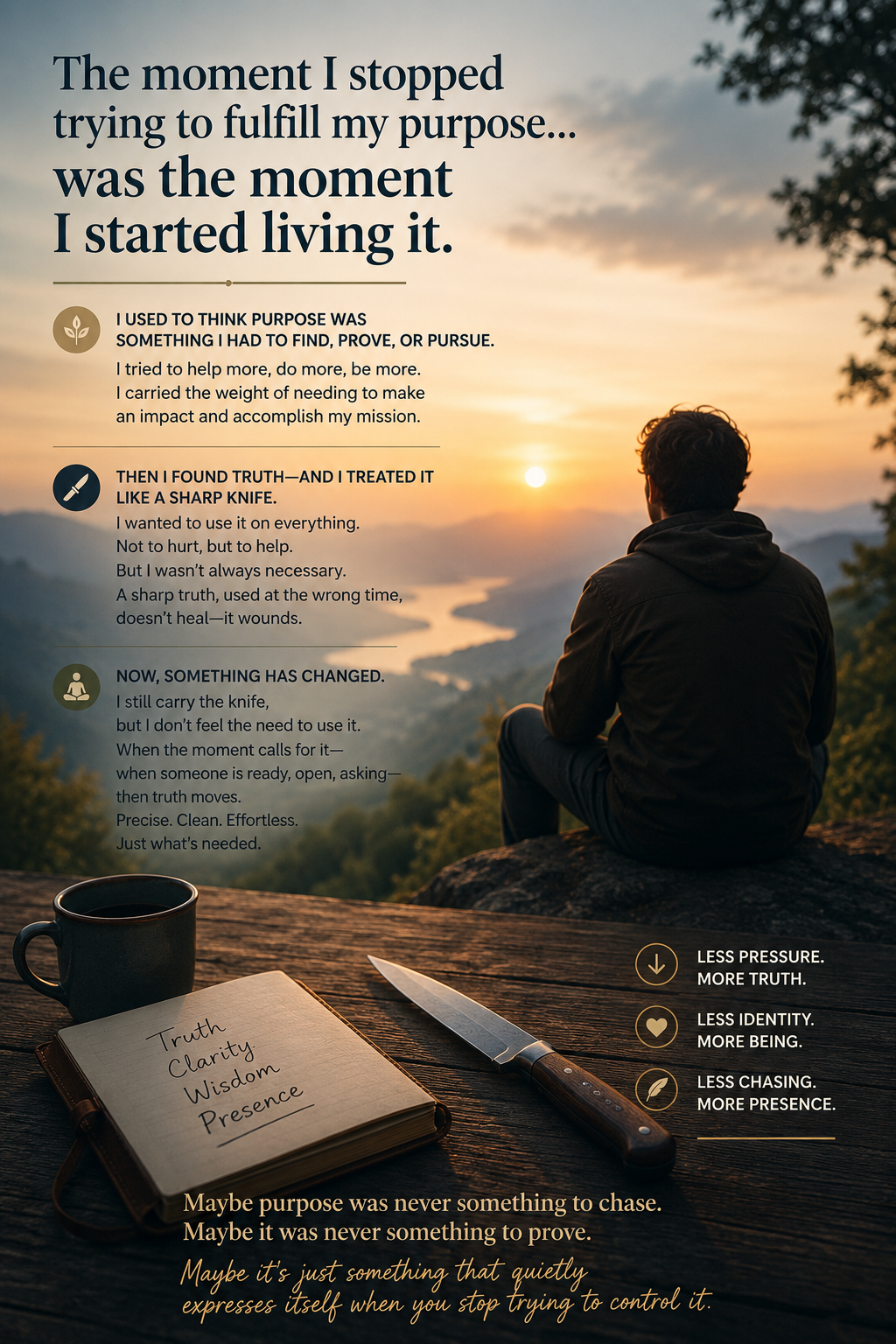 The moment I stopped trying to fulfill my purpose… was the moment I started living it.
For a long time, I carried this quiet pressure: That I was meant to do something meaningful. That I had a mission I needed to accomplish. That my life had to amount to something bigger than myself. It sounds noble… but it’s heavy. Because hidden inside that belief was fear-- Fear of not doing enough. Fear of wasting my life. Fear of not becoming who I thought I was supposed to be. So I tried. I looked for ways to help. I pushed myself to show up. I chased opportunities to make an impact. And when I discovered truth—real clarity, real insight-- it felt like I had found a sharp knife. Something powerful. Something that could cut through illusion. So I used it. In conversations. In people’s beliefs. In the way they saw themselves and the world. Not to hurt—but to help. At least… that’s what I told myself. But the truth is, when something is new and powerful, you feel the need to prove it works. So I cut into everything. And sometimes… I was right. But I wasn’t always necessary. That’s the part no one talks about. A sharp truth, used at the wrong time, doesn’t heal—it wounds. Not because it’s false, but because it’s forced. The more I tried to live my purpose, the more I was acting from pressure—not truth. Then something shifted. I stopped forcing it. Stopped chasing it. Stopped needing to be “the person who helps.” And in that space… something unexpected happened: I didn’t lose my desire to help. I just lost the need to. I still carry the knife. But I don’t feel the need to use it. Now, when someone needs me—I’m there. Fully. But I no longer carry the weight of having to fix, save, or prove anything. I wait. And when the moment truly calls for it-- when someone is ready, open, asking-- Then truth moves. Precise. Clean. Effortless. No force. No pressure. Just what’s needed. Maybe purpose was never something to chase. Maybe it was never something to prove. Maybe it’s just something that quietly expresses itself when you stop trying to control it. Less pressure. More truth. Less identity. More being. And strangely… that feels like freedom.  Some people thrive on ambition and achievement, while others feel strangely unmotivated by goals that once seemed meaningful. If you’re highly self-aware, this isn’t a flaw—it’s a signal. As awareness deepens, ego-driven motivation begins to collapse, and the effort behind achievement suddenly feels heavier than the reward. This article explores why high awareness can kill motivation, the hidden difference between ego-based striving and truth-driven expression, and how alignment—not ambition—becomes the real force that moves you forward. Why Some People Don’t Feel the Weight of Work Some people don’t seem to mind the work it takes to achieve in life. They push, grind, build, chase—and they often accomplish a lot. That’s because most achievement is ego-driven. The ego runs on:
Effort feels invisible when the ego is excited. Why Awareness Changes Everything As awareness increases, the illusion weakens. You begin to see:
So when a new project or desire appears, you don’t just see the starting point—you see the entire arc: effort → achievement → short-lived high → restlessness → another goal. And a quiet question emerges: Why start something that won’t actually fulfill me? This hesitation isn’t laziness. It’s clarity. Why It Felt Easier When You Were Younger When you’re younger, desire is simpler. You want something, you work for it, you get it, you feel better—at least for a while. The emotional return feels worth the effort, so you don’t even register the work involved. Back then:
The spell is broken. Ego-Driven Action vs Truth-Driven Expression This is the distinction most people never learn to make. Ego-Driven Action
Even when successful, it often leaves a subtle emptiness. Something feels off—because the action wasn’t aligned with your deepest belief. It was aligned with maintaining an identity. Truth-Driven Expression
When you act from truth, you operate from your pure belief system, not the ego. For example: If I’m honest with myself and recognize that buying a new piece of clothing is purely to satisfy my ego, that awareness changes the choice. Now I hold a clean belief: This is ego-driven. If I go through with it anyway, it feels like subtle self-betrayal—disalignment. But if I honor that belief and choose differently, I experience integrity. Truth creates alignment. Ego creates performance. Why You Hesitate to Start Once you’ve tasted alignment, ego goals feel heavy. You don’t resist work. You resist work that isn’t true. You’re no longer motivated by:
You’re moved by:
And aligned action, while often quieter, feels clean. Self-Reflection: Are You Unmotivated or Just Done With Illusion? Ask yourself—honestly:
These questions require brutal honesty. Without it, clarity gets mislabeled as laziness. The Provocative Truth High awareness kills ego motivation. That’s the price of seeing clearly. Once you recognize the cycle—effort, achievement, dissatisfaction—you can’t unknow it. And when ego stops driving you, nothing external can push you anymore. Now only alignment moves you. That’s dangerous. Because when you can’t lie to yourself, you’re left with two options:
Most people go back to chasing. Very few choose alignment—because it demands honesty over ambition. And once you see the difference, there’s no going back. 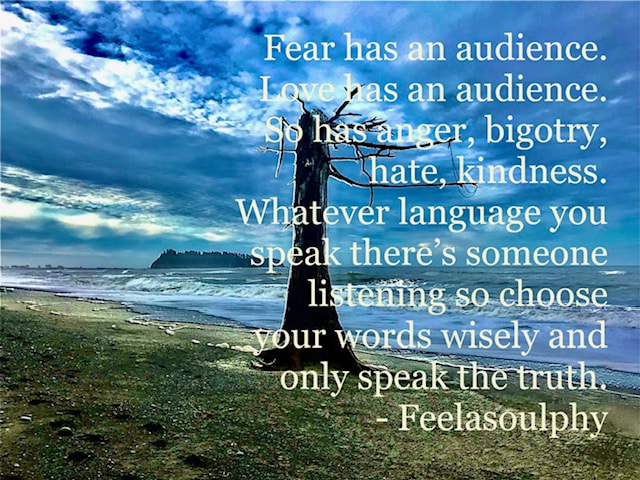 Fear has an audience. Love has an audience; so has anger, bigotry, hate, kindness. Whatever language you speak there’s someone listening so choose your words wisely and only speak the truth. - Feelasoulphy  What makes sense doesn’t mean it is the truth. Not all truth makes sense at the moment. What is true to you today does not mean it will be true to you tomorrow. Telling the truth may be hard but carrying the lies is excruciating. Truth might not seem to be truth and lies tend to pretend to be truth. Lies can never become real truth even they are told a million times. No one knows the ultimate truth besides God who is the creator of truth. - Feelasoulphy  Once your heart is open you will receive the truth and wisdoms of God/Universe. You will no longer be bounded by the limits of the ego. - Feelasoulphy  Until you start telling yourself the truth you will continue to go through the agony of living with the lies. There’s no worse pain than lying to yourself even though the truth can hurt at the moment. - FeelaSoulphy  Don’t believe everything you see or go after the things only please the eyes because the truth is not always seen in the eyes but in the I. - FeelaSoulphy |
AuthorFeelasoulphy Categories
All
Archives
March 2026
|
 RSS Feed