 Most people think relationships fail because of incompatibility. More often, they fail because two nervous systems stop speaking the same language. Polyvagal Theory: Why the Body Decides Before the Mind According to Stephen Porges, our nervous system is constantly asking one unconscious question: Am I safe here? Before thought, before logic, before intention—the body answers first. Polyvagal Theory explains three primary states:
Needs-Based Relationships: Regulation Through Another Person Needs-based relationships often form when one or both people are dysregulated. Someone else becomes:
The nervous system learns: “I feel safe when I’m with them.” This creates powerful bonding—but it’s conditional. If that person:
The nervous system interprets it as threat, not loss. That’s why needs-based relationships often feel:
It’s not just emotional attachment—it’s biological reliance. Alignment-Based Relationships: Co-Regulation Without Dependency Alignment-based relationships emerge when both people can access ventral vagal safety on their own. Here’s the difference:
These relationships activate:
They don’t spike the nervous system. They stabilize it. Which is why they can feel “less exciting” at first—and far more sustaining over time. Why Growth Disrupts Needs-Based Bonds When one person becomes more regulated:
The old attachment loop loses its charge. The other nervous system feels this as:
But what’s really happening is simple: The body no longer needs the same strategy to feel safe. Alignment-based relationships survive this shift. Needs-based ones often fracture under it. Self-Check: Needs or Alignment? Ask your body first. Then your mind.
Your nervous system never lies. It just speaks softly—until you ignore it long enough that it has to shout. Visual Diagram From Need to Alignment: How Relationships Actually Form 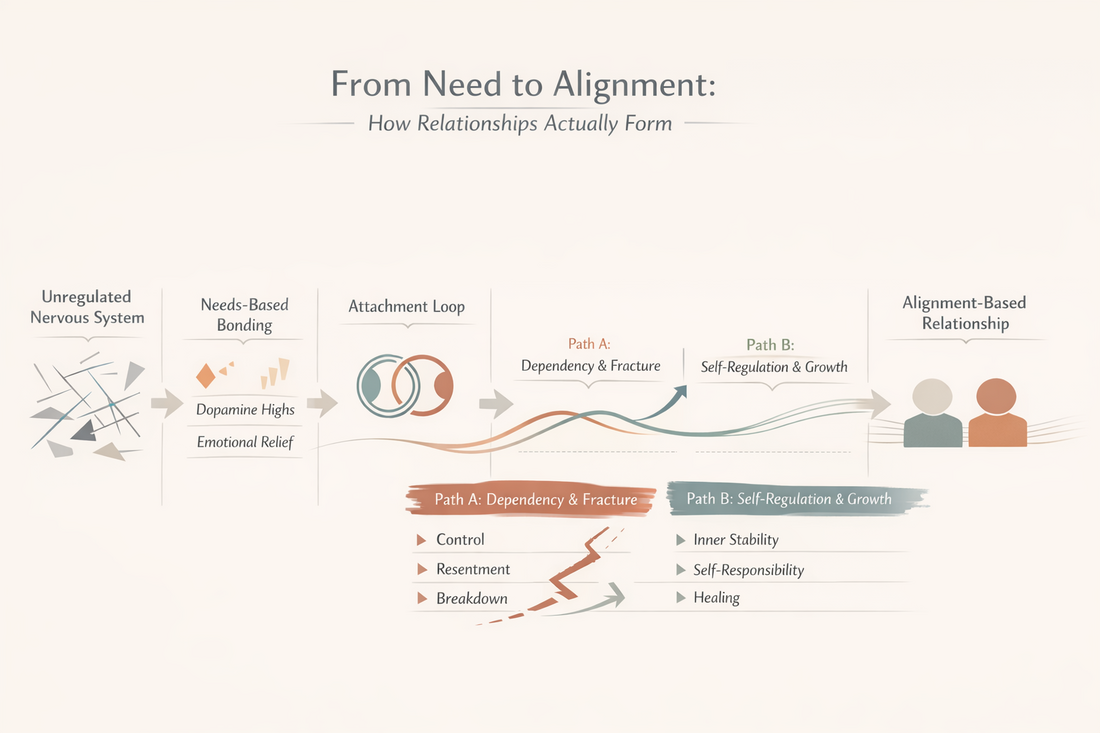 The Deep Reframe Needs-based relationships are survival strategies. Alignment-based relationships are expressions of wholeness. Needs bring people together. Alignment keeps them together. And the real work isn’t fixing relationships. It’s teaching the nervous system that safety can come from within. Once that happens-- connection becomes clean. Love becomes steady. And relationships stop feeling like something you might lose… and start feeling like something you’re free to choose Take this quiz to find out whether your relationship is based on needs or alignment.
0 Comments
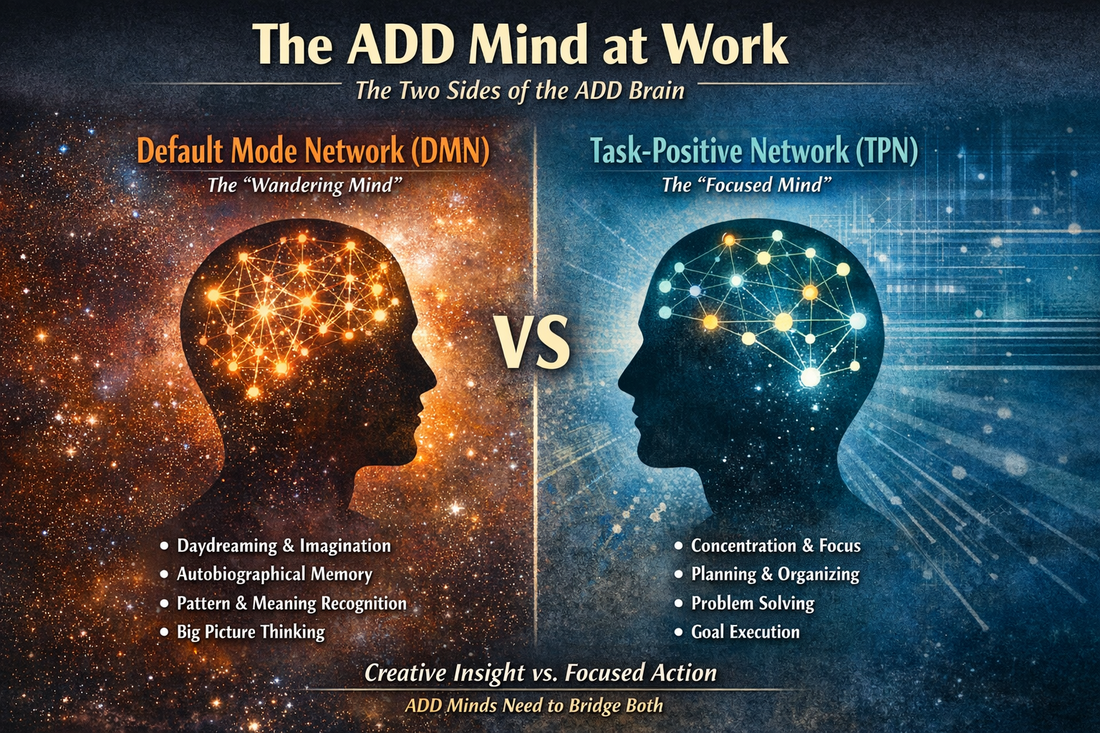 Most people think ADD is about distraction. It isn’t. It’s about where the mind naturally spends its time—and how poorly modern life understands that territory. Many ADD minds are not failing at focus. They are operating from a different neural home base. That home base has a name: the Default Mode Network. The Default Mode Network: Where the ADD Mind Lives The Default Mode Network (DMN) is a large-scale brain network that becomes active when we are not focused on a specific external task. It lights up when we:
In most people, the DMN quiets down when task-focused networks activate. But in many people with ADD, the DMN remains highly active, even when they are supposed to be “paying attention.” This is why ADD minds:
From the inside, it feels like constant mental motion. But here’s the key point most narratives miss: The DMN is not a defect. It is the neural basis of creativity, identity, empathy, and insight. The Wandering Mind Is Not Broken Because the DMN is involved in autobiographical memory and self-referential processing, ADD minds often think in story, metaphor, and meaning, not steps and checklists. This explains why people with ADD are frequently drawn to:
You learn when each is useful. The Real Breakdown: When DMN Has No Translator ADD minds don’t lack ideas. They have too many, too quickly, with too much depth. The problem begins after insight appears. The DMN is excellent at generating meaning, but it is not designed to package that meaning into deliverables. That job belongs to task-positive networks—the ones responsible for planning, sequencing, and execution. When someone with ADD tries to jump directly from DMN insight to execution, the nervous system often overloads. The result looks like this:
It is a missing translation layer. The Generator–Integrator–Bridger Model ADD minds work best when allowed to cycle through three distinct phases. Problems arise when these phases are forced to overlap. 1. The Generator (DMN-dominant) This is the wandering phase. Ideas arise freely. Connections form unexpectedly. Memories, emotions, and insights surface without invitation. Trying to control this phase kills its value. Its purpose is not productivity. Its purpose is raw material. 2. The Integrator (DMN → Task Network Transition) This is the most overlooked phase—and the one that changes everything. Integration is not execution. It is sense-making. This is where the mind asks:
With it, execution becomes obvious. Most ADD frustration comes from skipping integration entirely. 3. The Bridger (Meaning-Supported Action) This is where insight becomes usable. Bridging is the act of translating understanding into form:
It means coherence. One insight. One form. One version. Completion is not the end of truth. It is how truth moves forward. Why ADD Minds Struggle to Finish ADD minds often abandon projects not because they lack discipline, but because dopamine drops before translation is complete. The idea stays internal too long. The DMN keeps refining. The nervous system tires. Interest fades. Finishing begins to feel artificial—or worse, like betrayal of depth. But completion is not betrayal. It is integration made visible. Soft Structure Works Better Than Discipline Rigid systems exhaust ADD nervous systems. What works instead:
If it feels heavy, the mind will rebel. Every time. Reclaiming Identity The most damaging belief ADD minds carry is this: “I can’t finish things.” A more accurate truth is this: “My mind generates faster than it integrates.” That is not a flaw. That is a role. You are not a factory worker of ideas. You are a translator of meaning. When the mind is respected instead of corrected:
A Final Reframe You don’t need to shut down the Default Mode Network. You don’t need to fight wandering. You don’t need to become someone else. You need a bridge between inner insight and outer form. The wandering mind is not lost. It’s simply waiting to be translated. |
AuthorFeelasoulphy Categories
All
Archives
March 2026
|
 RSS Feed