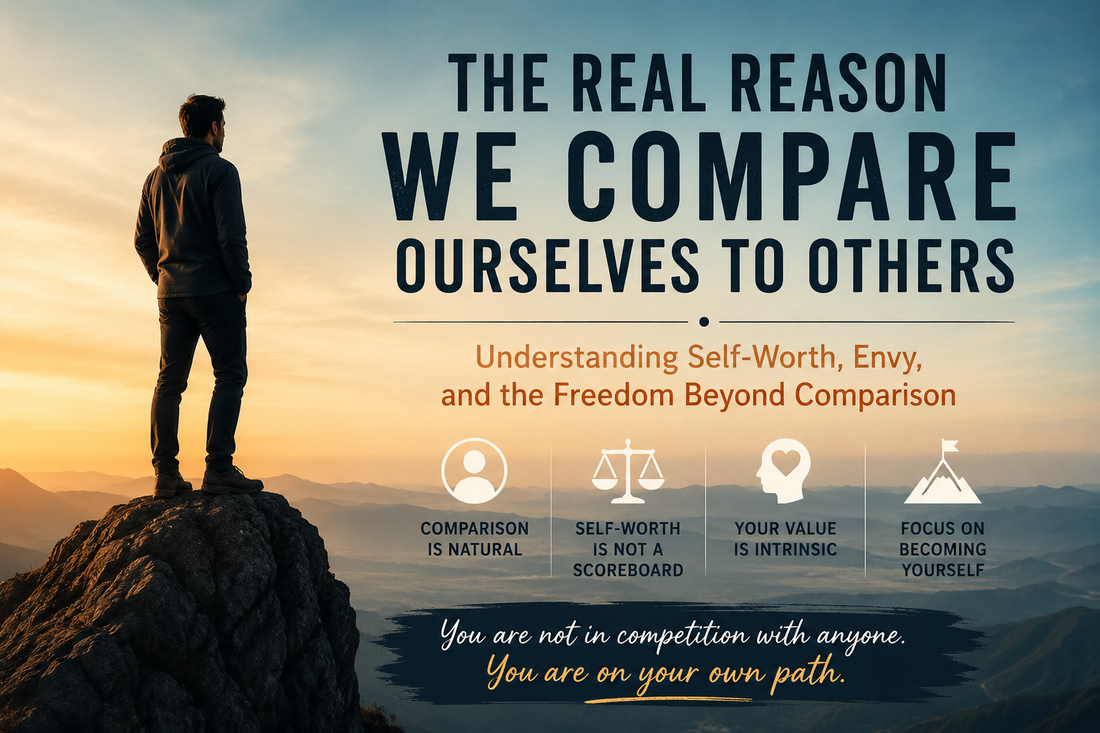
 Most people believe comparison is the problem. We hear phrases like: "Stop comparing yourself to others." "Stay in your own lane." "Comparison is the thief of joy." While these statements contain wisdom, they often fail to address the deeper issue. The truth is that comparison itself is not the problem. The real problem is what comparison threatens. For most of us, comparison threatens our sense of self-worth. Comparison Is Natural The human mind compares things constantly. It compares prices before making a purchase. It compares routes before taking a trip. It compares options before making decisions. Comparison is simply a mental tool. Without comparison, we would struggle to navigate everyday life. The problem begins when we stop comparing things and start comparing our value. Instead of observing differences, we begin measuring ourselves against others. Suddenly, comparison is no longer about information. It becomes about identity. The Hidden Equation Many people unconsciously live by an equation they never chose: Self-Worth = My Value Relative to Others The equation is rarely spoken aloud, but it quietly influences how we feel. If someone is more successful, we feel smaller. If someone is more attractive, we feel less desirable. If someone is wealthier, we feel less accomplished. If someone appears more enlightened, we feel less spiritual. The moment another person rises, our value appears to fall. But is that actually true? Consider two scenarios. In the first scenario, you earn $500,000 a year while everyone around you earns $100,000. In the second scenario, you earn $500,000 a year while everyone around you earns $5 million. Your income has not changed. Your life has not changed. Your achievements have not changed. Only your position within the social hierarchy has changed. Yet many people would feel more successful in the first scenario and less successful in the second. Why? Because the feeling of worth was never coming from the achievement itself. It was coming from comparison. What Is Self-Worth? This is where things become interesting. Most people spend their lives trying to increase their self-worth. But few stop to ask: What is self-worth? Can your worth actually increase? Can it decrease? Can another person's success diminish your value? Can another person's beauty make you less beautiful? Can another person's intelligence make you less intelligent? If your worth can be reduced simply because someone else possesses more of something, then your worth was never truly yours. It was dependent upon external conditions. It was conditional. And anything conditional can be taken away. The Endless Chase The ego loves comparison because comparison creates hierarchy. Hierarchy creates winners and losers. And if there are winners, then perhaps one day we can become one. This creates an endless pursuit. "I'll be worthy when I become successful." "I'll be worthy when I make more money." "I'll be worthy when people recognize me." "I'll be worthy when I find my purpose." "I'll be worthy when I become enlightened." Yet every time one goal is achieved, another appears. The finish line keeps moving. The person may become more accomplished, but they rarely become more whole. This is why some of the most successful people in the world still struggle with envy, insecurity, and self-doubt. They improved their position in the hierarchy but never questioned the hierarchy itself. What Comparison Is Really Protecting When comparison hurts, it is usually protecting an identity. It is protecting a story about who we believe we are. When someone else's success triggers us, we can ask: What am I making this mean about me? Often the answer reveals the deeper fear. Perhaps we fear being insignificant. Perhaps we fear being left behind. Perhaps we fear not being enough. Perhaps we fear that our value depends on being exceptional. Comparison is not creating these fears. It is exposing them. The discomfort we feel is often an invitation to investigate the foundation upon which our identity is built. A Different Way of Living Imagine asking a different question. Instead of: "Am I better than others?" Ask: "Am I becoming more fully myself?" The first question creates competition. The second creates growth. The first depends on what others are doing. The second depends on what you are doing. The first produces envy. The second produces fulfillment. A rose does not compare itself to an oak tree. A mountain does not compare itself to the ocean. Each expresses its nature completely. Neither gains value by becoming the other. Human beings often suffer because we forget this. We spend so much time trying to become someone else that we never fully become ourselves. The End of Envy Many people want to eliminate envy. But envy is often a symptom, not the cause. The cause is the belief that another person's success says something about our worth. Once that belief dissolves, envy begins to lose its foundation. What remains is something entirely different. Admiration instead of jealousy. Inspiration instead of resentment. Appreciation instead of competition. You can witness greatness without feeling diminished by it. You can celebrate another person's success without questioning your own value. You can appreciate beauty without feeling less beautiful. You can honor another person's gifts without denying your own. A Question Worth Contemplating If you were the only person on Earth, would you still have worth? If the answer is yes, then your worth cannot come from comparison. And if your worth does not come from comparison, then comparison loses its power to threaten you. Perhaps freedom is not found in eliminating comparison. Perhaps freedom is found in realizing that your value was never dependent on comparison in the first place.
0 Comments
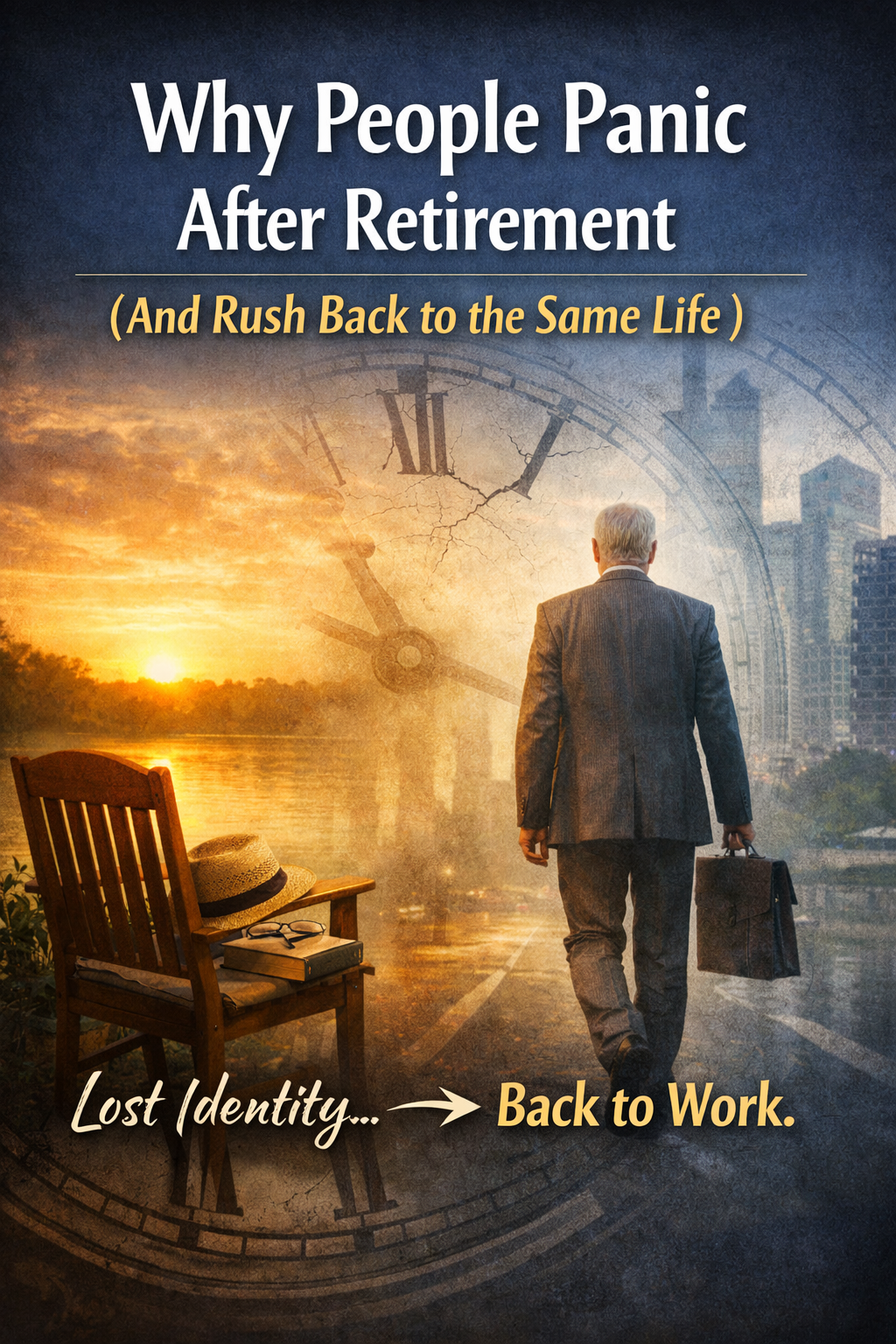 Picture a car that’s been driving at full speed for 30 years. Deadlines. Meetings. Responsibilities. Identity built around “doing.” Then one day… retirement. The wheels stop turning. But the engine is still screaming at 100 miles an hour. So what happens? Rest doesn’t feel restful. Freedom feels unsettling. Days feel empty instead of peaceful. And the mind starts whispering: “Something’s wrong. I need to get busy again.” Nothing is wrong. The nervous system just hasn’t cooled down yet. This is why so many people:
But because busyness feels familiar. Safe. Known. Stillness feels like an identity crisis. Here’s the hard truth: Most people don’t miss the job. They miss the state their nervous system was in. The structure. The stimulation. The sense of being needed. So instead of letting the system downshift, they step right back on the gas. Different job. Same engine speed. This is also why retirement can trigger an identity crisis. For decades, the identity was: “I am what I do.” When the doing stops, the mind asks: “Then who am I?” That question can feel terrifying—unless you understand what’s happening. It’s not a personal failure. It’s a transition phase. The nervous system is shedding an old operating mode. Here’s the warning I wish more people heard: Don’t rush back into busyness just because stillness feels uncomfortable. That discomfort is not a signal to go backward. It’s a signal that your system needs time to recalibrate. This is the moment to:
But what gives meaning without constant motion. Busyness can be a distraction disguised as purpose. If you skip this cooling-down phase, you don’t choose your next chapter consciously. You default to the old one. Same patterns. Same identity. Same exhaustion—just with a new title. True rest isn’t doing nothing forever. It’s allowing space for a new direction to emerge. A life driven by choice, not conditioning. By purpose, not momentum. So if you—or someone you love—is approaching retirement: Don’t just stop the car. Let the engine idle. Let the system learn that it’s safe to slow down. Only then ask: “What do I actually want this next chapter to be about?” That question can’t be answered at 100 miles an hour. If you'd like to get a deeper understanding on this subject you can check out this post that explains how dopamine, the nervous system, and brain momentum keep the mind addicted to busyness. Why Slowing Down Feels So Uncomfortable - The Science Behind a Mind That Won’t Let Go of Busyness  Sunrise at Communications Hill, San Jose, California, USA Society often pushes us to be the best-to reach the top and stay there. But what happens when the title is lost? The truth is, you don’t need to be the best at what you do, as long as you give your best. Being the best is temporary. No one stays at the top forever, and you shouldn’t want to. Progress depends on people surpassing each other. If you attach your identity to being the best, you set yourself up for suffering when the inevitable happens. Look at top athletes-world records never last forever. Someone always comes along and breaks them. If an athlete’s entire identity is built around their record, losing it can feel like losing themselves. The Cost of Being the Best Many high achievers struggle with this reality. Here are two famous examples: 1. Michael Phelps - The most decorated Olympian of all time, yet after the 2012 Olympics, he fell into deep depression. He later admitted he felt lost without swimming, realizing that chasing gold medals had become his entire identity. 2. Tyson Fury - After reaching the pinnacle of boxing by defeating Wladimir Klitschko, he spiraled into depression, alcoholism, and even contemplated suicide. He later shared that his suffering came from having no purpose beyond being “the best”. These examples show that when success is tied to external validation, losing it can be devastating. The Power of Giving Your Best Instead of trying to be the best, focus on trying your best. This shift changes everything:
The irony is that those who always give their best often become their best-but without the fear of losing it. The Journey vs. The Destination Success is often seen as a destination, but in reality, it’s the journey that matters. Being the best is about reaching the top and proving something to the world. Giving your best is about continuous growth and proving something to yourself. The process of discovering your full potential is the real goal. If you only care about being the best, you stop learning once you get there. But if you focus on always giving your best, you never stop evolving. Let Go and Surrender The world encourages us to chase being the best, but it misunderstands the real path to fulfillment. Success isn’t about holding a title-it’s about becoming the best version of yourself through relentless effort. Try your best and let the universe take care of the rest. Success comes and goes, but self-mastery stays with you forever.  Quaking Aspen Trees in Telluride, Colorado, USA Nature's beauty may be deceiving; a closer look at plants and flowers reveals imperfections, like missing leaves and broken branches. Yet, this doesn't diminish their perfection. In reality, they embody perfection by serving their purpose—to sacrifice for others. Similarly, we, and everything in the universe, exist to serve others by simply being ourselves. Our brokenness imparts vital life lessons to us and those around us, forming a perfect and beautiful mosaic. - Feelasoulphy 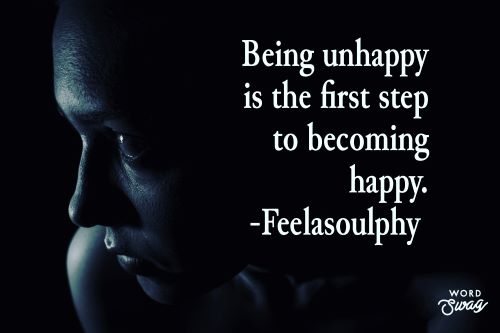 Being unhappy is the first step to becoming happy. Unhappiness is a type of human emotion. Just like all other emotions, it is not always a bad thing if it’s only a temporary or transitional state. What is bad is prolonging the changes that need to be made which results a permanent state. In fact, being unhappy is your first step to happiness. It is the ultimate driver to get out of your current state of being to achieve more desired results. It’s unrealistic to be happy all the time because if you care about yourself you'd want to change for the better. Sometimes change might not feel like a pleasant experience at the moment. If you are constantly trying to improve yourself these emotions of happiness and unhappiness can be a continuous cycle until you reach mastery. You are unhappy because you detect something that is not going right. You might not know exactly what and how to fix it yet but you are consciously and unconsciously trying to make it better. The more self-aware you become the more “flaws” you will notice about yourself. Just because you notice more of your flaws it doesn’t mean you have more issues. It just means you are more aware of them. At some point there will be more happy moments than unhappy moments because there will be less problems to work on. Oftentimes people are unhappy about their unhappiness, but once you understand this emotional cycle you will actually be happier because you begin to accept the unhappiness as part of the process of becoming happy. - Feelasoulphy  Thank you for not giving me what I wanted in those moments because you knew they were not my soul’s desires. Thank you for making me feel disappointed, heart broken, angry, jealous, depressed, embarrassed. Through them you prepare me for what I truly want out of this life! - FeelaSoulphy |
AuthorFeelasoulphy Categories
All
Archives
March 2026
|
 RSS Feed