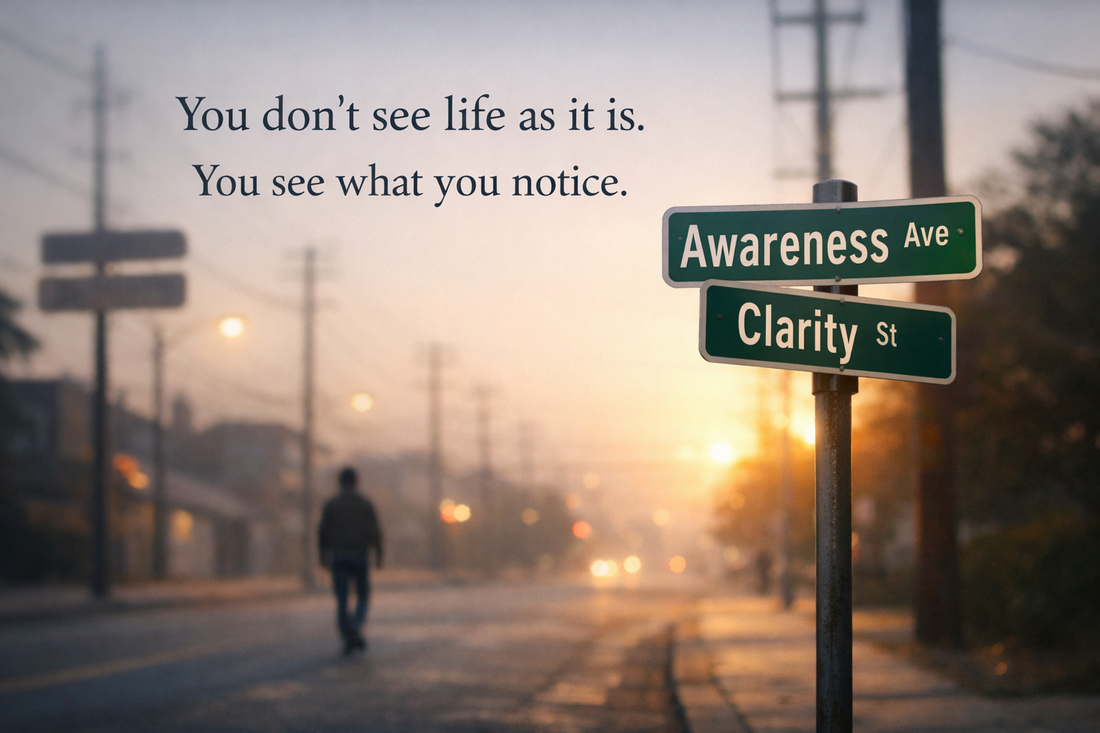
 Most people don’t live bad lives. They live unconscious ones. We don’t experience reality as it is--we experience what we pay attention to. Everything else disappears into the background, not because it isn’t there, but because our awareness never stops to notice it. I realized this through a simple experiment. I’ve lived in the same neighborhood for sixteen years, yet I still don’t know the names of some of the cross streets near my home. When I finally slowed down and intentionally paid attention, I remembered the street names immediately. This wasn’t a memory problem. It was an attention problem. That insight opened a larger question: if I can overlook something so basic for years, how many important aspects of my life have I also missed--patterns, emotions, beliefs, opportunities--simply because I wasn’t paying attention? Why Most People Live Unconsciously Living unconsciously isn’t a moral failure. It’s a biological strategy. The brain is designed to conserve energy. Awareness takes effort. Questioning takes effort. So the mind defaults to automation. Our experience of life is shaped by what we attend to. Attention acts as a filter--what passes through becomes our reality. Most people don’t consciously choose that filter. Instead, it’s shaped by:
Over time, this creates a narrow version of reality that feels complete but isn’t. Research in psychology supports this. Daniel Kahneman showed that much of human behavior operates on fast, automatic thinking. We don’t actively choose most of our thoughts--we repeat them. Efficiency keeps us functioning. But it also keeps us asleep. The Hidden Cost of Unconscious Living When we don’t pay attention:
The problem isn’t suffering. The problem is not noticing the cause of suffering. An unconscious life isn’t empty--but it’s limited. Awareness Is Not a Personality Trait--It’s a Skill Here’s the good news: awareness isn’t something you either have or don’t have. It’s a skill. I didn’t need years of meditation or a spiritual retreat to notice the street names. I simply directed my attention deliberately for a moment. That single act revealed something important: unconscious living isn’t permanent. It’s a default setting. Every moment of noticing--your breath, your tension, your thoughts, your reactions--is a small interruption in that default. How Attention Changes Your Life Your life doesn’t change when circumstances change. It changes when attention changes. Most people try to fix their lives by changing external conditions. Fewer people realize that shifting attention alters perception, behavior, and ultimately identity. When you begin to observe instead of react:
This isn’t abstract philosophy. It’s practical awareness. A Simple Practice to Live More Consciously Start small. Pick one ordinary thing today and pay full attention to it--your walk, your breathing, a conversation, the environment around you. No analysis. Just noticing. Then ask yourself: What else in my life have I been moving past without seeing? That question alone begins to wake you up. Final Thought Most people aren’t unconscious because they’re incapable of awareness. They’re unconscious because they were never taught that attention shapes reality. Once you see this, you can’t unsee it. And the real question becomes: What kind of life unfolds when you notice on purpose?
0 Comments
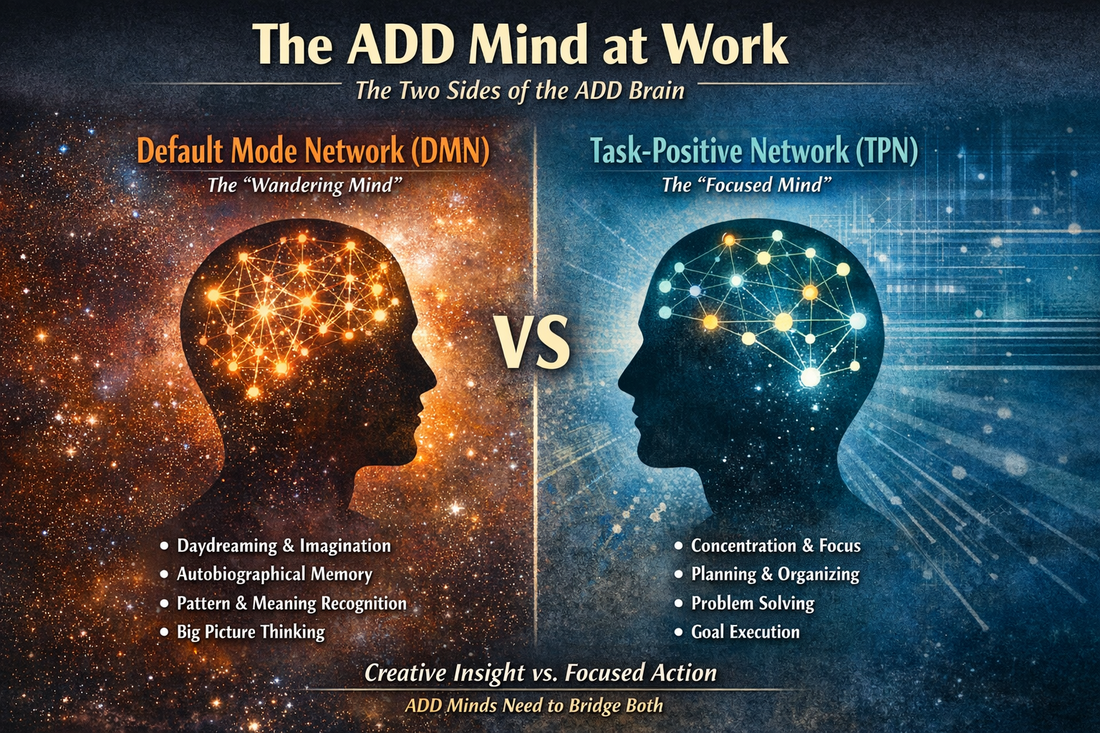 Most people think ADD is about distraction. It isn’t. It’s about where the mind naturally spends its time—and how poorly modern life understands that territory. Many ADD minds are not failing at focus. They are operating from a different neural home base. That home base has a name: the Default Mode Network. The Default Mode Network: Where the ADD Mind Lives The Default Mode Network (DMN) is a large-scale brain network that becomes active when we are not focused on a specific external task. It lights up when we:
In most people, the DMN quiets down when task-focused networks activate. But in many people with ADD, the DMN remains highly active, even when they are supposed to be “paying attention.” This is why ADD minds:
From the inside, it feels like constant mental motion. But here’s the key point most narratives miss: The DMN is not a defect. It is the neural basis of creativity, identity, empathy, and insight. The Wandering Mind Is Not Broken Because the DMN is involved in autobiographical memory and self-referential processing, ADD minds often think in story, metaphor, and meaning, not steps and checklists. This explains why people with ADD are frequently drawn to:
You learn when each is useful. The Real Breakdown: When DMN Has No Translator ADD minds don’t lack ideas. They have too many, too quickly, with too much depth. The problem begins after insight appears. The DMN is excellent at generating meaning, but it is not designed to package that meaning into deliverables. That job belongs to task-positive networks—the ones responsible for planning, sequencing, and execution. When someone with ADD tries to jump directly from DMN insight to execution, the nervous system often overloads. The result looks like this:
It is a missing translation layer. The Generator–Integrator–Bridger Model ADD minds work best when allowed to cycle through three distinct phases. Problems arise when these phases are forced to overlap. 1. The Generator (DMN-dominant) This is the wandering phase. Ideas arise freely. Connections form unexpectedly. Memories, emotions, and insights surface without invitation. Trying to control this phase kills its value. Its purpose is not productivity. Its purpose is raw material. 2. The Integrator (DMN → Task Network Transition) This is the most overlooked phase—and the one that changes everything. Integration is not execution. It is sense-making. This is where the mind asks:
With it, execution becomes obvious. Most ADD frustration comes from skipping integration entirely. 3. The Bridger (Meaning-Supported Action) This is where insight becomes usable. Bridging is the act of translating understanding into form:
It means coherence. One insight. One form. One version. Completion is not the end of truth. It is how truth moves forward. Why ADD Minds Struggle to Finish ADD minds often abandon projects not because they lack discipline, but because dopamine drops before translation is complete. The idea stays internal too long. The DMN keeps refining. The nervous system tires. Interest fades. Finishing begins to feel artificial—or worse, like betrayal of depth. But completion is not betrayal. It is integration made visible. Soft Structure Works Better Than Discipline Rigid systems exhaust ADD nervous systems. What works instead:
If it feels heavy, the mind will rebel. Every time. Reclaiming Identity The most damaging belief ADD minds carry is this: “I can’t finish things.” A more accurate truth is this: “My mind generates faster than it integrates.” That is not a flaw. That is a role. You are not a factory worker of ideas. You are a translator of meaning. When the mind is respected instead of corrected:
A Final Reframe You don’t need to shut down the Default Mode Network. You don’t need to fight wandering. You don’t need to become someone else. You need a bridge between inner insight and outer form. The wandering mind is not lost. It’s simply waiting to be translated. How to Be Alone Without Being Lonely - Awareness, Curiosity, and the Education We Keep Ignoring2/10/2026  Naturally shaped pebbles off a beach in Santa Cruz, California, USA. They are Sandstones, Mudstones, Limestones (with fossils), Cherts. Ages 1 million to over a billion years old. Any idea which one is the oldest? Most people don’t fear being alone. They fear what happens when distractions disappear. Solitude feels empty only when awareness is low. When awareness rises, learning speeds up — and suddenly, being alone becomes alive. The other day, I spent hours alone at the beach. No plan. No productivity agenda. Just attention. What unfolded taught me more than weeks of routine thinking ever could. I watched seagulls fly high into the air carrying mussels, then drop them onto rocks below to crack the shells. Again and again. No frustration. No overthinking. Just experimentation. Gravity became their tool. The rock became their ally. That matters for one simple reason: Many animal species have survived on this planet far longer than humans. Some for millions of years. Some relatively unchanged. They didn’t do that by accident. They figured something out. If we refuse to learn from them, an honest question follows: Who exactly do we think we’re learning from instead? Later that same day, I noticed a man running along the beach — with two crows flying beside him. I didn’t understand it at first. An hour later, they were still together. Then I saw it: he was feeding them as he ran. He had learned how to attract them, how to stay in rhythm with them. That wasn’t dominance. That was relationship. Crows don’t obey. They choose. That scene alone says more about intelligence than most definitions do. In between, I picked up pebbles. Smooth ones. Scarred ones. Some carrying fossil-like imprints of ancient shells. Later, I learned many of these stones began forming 1 million to over a billion years ago — shaped slowly by pressure, water, and time. Holding one felt like holding patience itself. Most people would call that “just a rock.” That’s not accuracy — that’s inattention. Jane Goodall changed how we understand chimpanzees not by imposing theories, but by doing something radical: she stayed curious longer than most people are willing to. She watched. She listened. She allowed understanding to emerge instead of forcing conclusions. And, perhaps most importantly, she genuinely enjoyed being alone in nature and learning from it. That’s what solitude in nature does when awareness is present. And here’s the part we underestimate: Awareness doesn’t just deepen insight — it accelerates learning. When you’re attentive:
This is why “unplugging” works — not because technology is evil, but because disconnection from noise allows reconnection to reality. Or put simply: Disconnect to reconnect. I had been stressed with work for a while. Busy. Productive. Effective — but disconnected from myself and from nature. Solitude in nature didn’t slowly help. It immediately brought me back to life. Not metaphorically. Viscerally. Loneliness comes from disconnection. Solitude comes from engagement. Nature is always teaching. Animals are always demonstrating intelligence, efficiency, cooperation, and presence. The lessons are everywhere. The only requirement is awareness. You don’t need to escape life. You need to pay attention to it. Practical Homework: How to Practice Awareness in Solitude Don’t romanticize this. Practice it. 1. Schedule unstructured alone time No podcasts. No scrolling. No objectives. Go somewhere alive: beach, park, trail, quiet street. 2. Train one sense at a time Spend 5–10 minutes focusing only on:
Awareness grows through specificity. 3. Stay past boredom Watch one thing long enough for it to change. Learning accelerates after the mind stops demanding stimulation. 4. Ask grounded questions Not philosophical ones. Practical ones:
5. Pick up or observe one object — then use AI to learn about it A pebble. A leaf. A shell. A bird. Later, research it. Its age. Its function. Its history. This bridges curiosity, technology, and nature — instead of treating them as opposites. 6. Write down everything you did that day Not just insights — actions:
When I did this, I surprised myself. What felt like “doing nothing” was actually a full, rich, adventurous day. Awareness changes the scoreboard. Do this once a week. That’s enough. Curiosity opens the door. Awareness lets you walk through it. Solitude stops being empty — and becomes education. And eventually, you realize something quietly radical: Being alone isn’t the absence of life. It’s the removal of noise that was keeping you from seeing it.  “What if the world was always this vivid—and we just forgot to pay attention?” Most of us eat distracted. We’re watching TV. Scrolling. Talking over dinner. We don’t even taste our food. But one day, I learned what it was like to really eat. I was on an edible. I remember biting into a kiwi. Suddenly, it was electric. Juicy. Tart. Sweet. The texture of the seeds. The smell of the fruit. Every sense was awake. Even watching a movie, I felt more emotional, more attuned to what was happening on screen. It was like my empathy was dialed up—I could sense what the characters felt. It was such a strange gift. Why did this happen? It turns out this isn’t magic. It’s attention. Edibles (like cannabis) can reduce activity in the default mode network (DMN)—the part of the brain responsible for mind-wandering and constant self-narration. When the DMN quiets down, sensory networks become more active. Emotions and empathy rise to the surface. In other words: When you’re really here, you really feel. Eating is special Eating is one of the few everyday activities that naturally engages all our senses: Sight: color, shape, presentation. Smell: aroma. Taste: layers of flavor. Touch: texture, weight. Sound: crunch, slurp, chew. It’s designed to be immersive. But we numb it by multitasking and rushing. When you actually focus? It’s an experience. It’s not just food—it’s people This kind of presence doesn’t just change eating. It changes how we connect with others. When you really listen to someone—without waiting to talk, without checking your phone—you hear them on a different level. You notice subtle emotions in their voice. You see the story in their eyes. You feel with them, not just next to them. Presence is the foundation of empathy. And empathy is what deepens connection. Science agrees Mindfulness meditation reduces DMN activity, just like certain drugs can—but without side effects. It increases interoceptive awareness (body sensations) and sensory acuity. It also strengthens brain regions linked to empathy and compassion (anterior cingulate, insula). Long-term meditation practice literally rewires the brain for presence. Drugs vs. Meditation Drugs can open the door to this state. They show you how present you could be. But they don’t train you to stay there. Meditation does. Presence practice does. It’s a lifelong shift, not a temporary escape. Try This: A Mindful Eating Practice Pick something simple. A kiwi. An apple. Chocolate. Look at it carefully. Color. Shape. Smell it. Take a slow bite. Chew carefully. Feel the texture. Notice the sound. Taste all the flavors. Keep bringing your mind back when it drifts. This isn’t just about food. It’s a training ground for attention. A Practice for Connection Next time you’re with someone: Put the phone away. Look them in the eyes. Really listen. Notice tone, words, pauses. Feel what they’re feeling. Watch how the conversation changes. Watch how you change. Final Reflection That kiwi taught me that life is always offering something beautiful—if I’m willing to really show up for it. Food can be spiritual. Conversations can be sacred. This moment can be everything. Presence turns ordinary life into holy ground.  Woods Trail, Sierra Azul Preserve, San Jose, California, USA There are many different types of meditation, but the goal is always the same: to achieve a meditative state. Walking meditation is a beautiful practice that not only relaxes your body and mind but can also lead you into deeper states of consciousness, such as Alpha and even Gamma brainwave states, where profound realizations happen. Here’s how to approach it to get the most out of the experience: 1. Choose the Right Trail
2. Minimize Distractions
3. Engage All Six Senses Fully experience your surroundings through:
Take your time. Stop and observe. Take photos if you feel inspired — nature is the ultimate playground for your inner artist.  Beautiful Lupin with patterned water drops on its leaves. 4. Deepen Presence When you relax into the present moment, your experience of nature intensifies — similar to how senses are heightened under the influence of edibles. One reason for this is simple: full concentration on the now magnifies your experience. The vast majority of nature has never been truly experienced by most humans — not because it isn’t beautiful, but because our attention is often elsewhere. 5. Be Mindful
6. Set Intentions, Not Expectations
7. Cultivate a Childlike Curiosity Children are naturally curious — that’s why they learn so quickly and experience so much joy. Scientists and passionate people share this trait too: they remain curious, which keeps their mind and heart alive. Adopt a spirit of curiosity during your walk — it will deepen your experience and open new doors within you. 8. Try New Sensory Exercises
9. Understand Brainwave States Meditation often aims to move your brain into deeper states:
During walking meditation, you’ll likely move in and out of Alpha and Gamma. Let it happen naturally — never force it. Relaxation comes first. Depending on your current mood and state of mind, it might take 20–30 minutes to start feeling relaxed and present. Once in Alpha:
In both states, you’re much more likely to experience epiphanies and “aha” moments — profound realizations that may even be life-changing. 10. Why Epiphanies Happen Normally, our daily lives interrupt our thoughts constantly. We accumulate fragmented, incomplete thoughts that never fully connect. But when the right environment, relaxation, mood, information, and attention come together, your mind naturally makes connections between those fragments — unlocking wisdom already inside you. (I’ll write more about this important process in a future post.) 11. Pace Yourself
Reminders
 A stream running through the forest Suggested Questions and Prompts for Walking Meditation If you feel called to, you can take one or two reflection questions with you on your walk. You can also allow your intuition to guide you naturally without any set focus. Either way, there is no need to force insights or outcomes—set your intention to stay open, curious, and present, and trust that whatever needs to arise will come in its own time. If you want structure, try asking yourself:
Or simply notice and reflect:
Gentle Tips
Remember, the goal is not to force answers but to create the space where answers naturally arise. Final Thoughts Walking meditation is a beautiful practice of reconnecting—with yourself, with nature, and with the present moment. Each walk will be different. Some days you may feel deeply connected and inspired; other days you may simply enjoy a peaceful stroll. Both are valuable. Trust the process. The more you practice, the more natural it becomes to enter deeper states of awareness. Let nature be your guide, your mirror, and your playground. Walk with presence, curiosity, and an open heart—and allow the wisdom within you to arise when the time is right. Also check out this post about The Healing Power of Nature We May Not Know.  patterned water drops on Iris and blades of grass   North Greenland Sea In a world where more than 99.99% remains imperceptible to our eyes, many of us devote nearly 100% of our lives to the tangible, accounting for less than 0.001% of what truly holds significance. The disparity raises a poignant question: How much of life's profound essence eludes our attention? The arithmetic of this contemplation is deceptively simple yet yields a profound perspective on the vast unseen realms we may be overlooking. - Feelasoulphy  Your intention directs your attention which helps you accomplish your mission. But to set the right intention you must know your life mission. - Feelasoulphy  If your happiness depends on other people’s attentions eventually you will be unhappy because the same people you are depending on are too busy seeking attentions from others. - Feelasoulphy 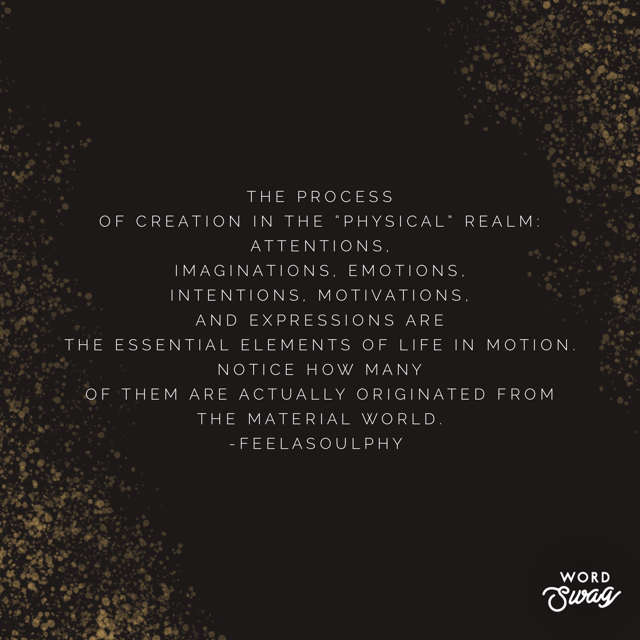 The process of creation in the “physical” realm: Attentions, Imaginations, Emotions, intentions, motivations, and expressions are the essential elements of life in motion. Notice how many of them are actually originated and manifested in the material world. - Feelasoulphy |
AuthorFeelasoulphy Categories
All
Archives
March 2026
|
 RSS Feed