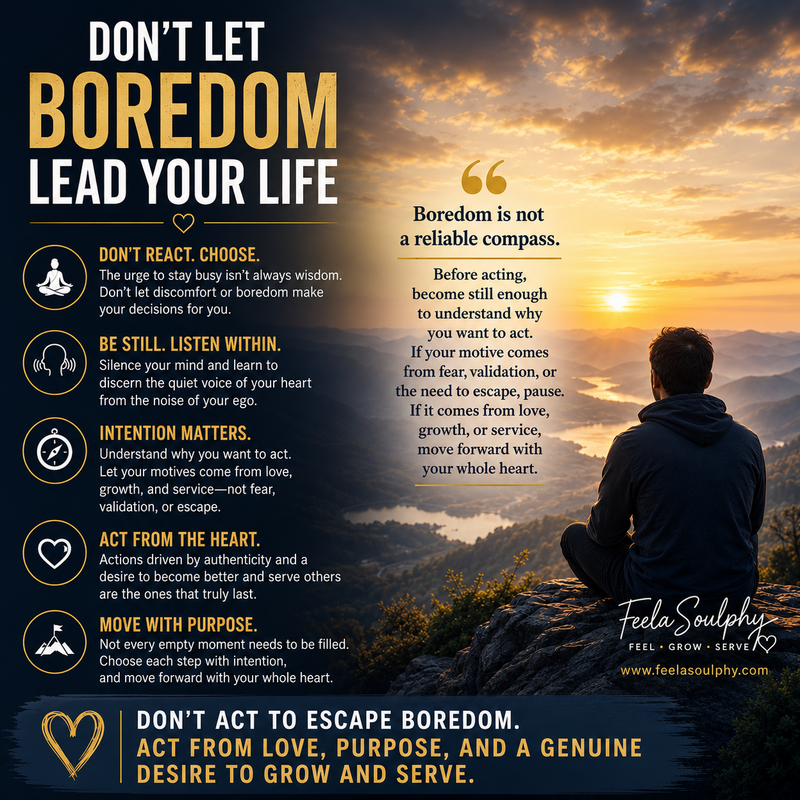
 Don’t fill your time simply because you’re bored.
The urge to stay busy isn’t always wisdom. Often, it’s simply discomfort looking for an escape. When you allow that feeling to direct your choices, you’re reacting instead of choosing. Your ego—not your heart—begins to lead the way. Instead, be still. Be patient. Create space for silence. In that silence, learn to distinguish between the quiet voice of your heart and the endless noise of your restless mind. One leads you toward purpose. The other only seeks distraction. Stillness isn’t the opposite of action. It is what allows you to understand why you want to act. The reason behind your actions matters more than the actions themselves. If your motivation comes from loneliness, the need for validation, fear of missing out, or the desire to prove something, your enthusiasm will eventually fade. Ego can fuel ambition, but it rarely brings lasting peace or fulfillment. But when your actions are born from authenticity, love, curiosity, and a sincere desire to become a better person and to serve others, they are sustained by something much deeper. They no longer feel like obligations. They become expressions of who you are. Not every empty moment needs to be filled. A meaningful life isn’t built by filling every moment; it’s built by choosing each moment with intention. Sometimes the wisest thing you can do is pause—not because you’re waiting for life to happen, but because you’re making sure your next step is guided by purpose rather than restlessness. Boredom is not a reliable compass. Before acting, become still enough to understand why you want to act. If your motive comes from fear, validation, or the need to escape, pause. If it comes from love, growth, or service, move forward with your whole heart. Don’t act to escape boredom. Act from love, purpose, and a genuine desire to grow and serve.
0 Comments
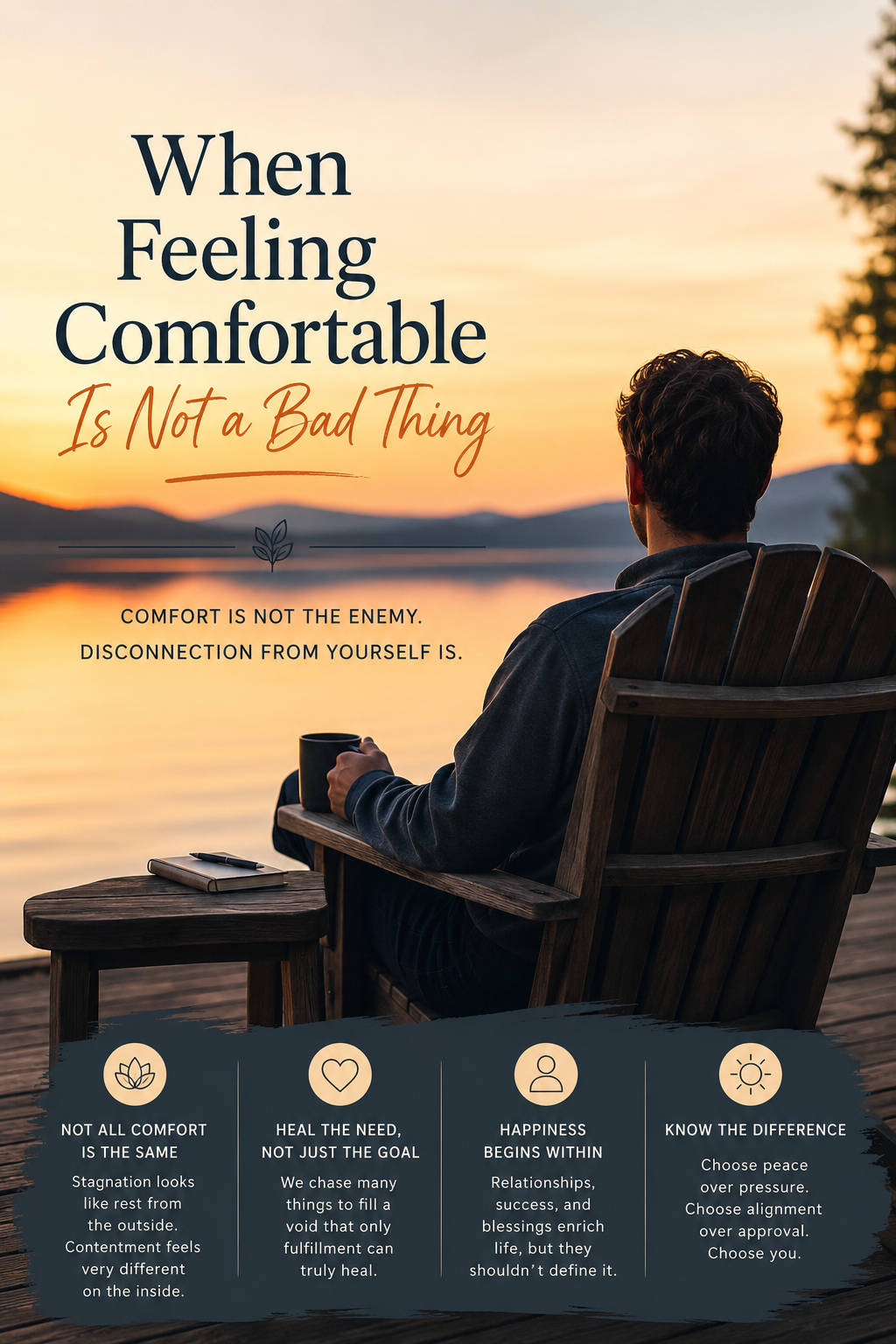 We live in a culture that is obsessed with growth.
Everywhere we look, we are told to work harder, hustle more, achieve bigger goals, and continuously improve ourselves. Social media is filled with messages encouraging us to leave our comfort zones because staying comfortable is often portrayed as the beginning of decline. The underlying message is clear: "If you're not moving forward, you're falling behind." But what if this belief is not always true? What if there are times when feeling comfortable is not a sign of laziness, complacency, or a lack of ambition? What if comfort is sometimes a sign that we have finally found peace? The Fear of Being Comfortable Many people are afraid of becoming too comfortable. They worry that if they stop striving, they will stop growing. If they stop achieving, they will lose their purpose. If they stop chasing goals, their lives will somehow become meaningless. As a result, they constantly search for the next mountain to climb. A promotion. A larger business. More money. More recognition. More accomplishments. There is nothing inherently wrong with pursuing these things. The question is why we pursue them. Are we driven by genuine passion? Or are we trying to fill a void within ourselves? Sometimes ambition is an expression of our purpose. Other times, ambition is simply insecurity wearing a disguise. Comfort Can Mean Two Very Different Things Not all comfort is created equal. There is a form of comfort that comes from avoidance. A person may avoid challenges because they are afraid of failure, rejection, or uncertainty. This type of comfort keeps people stuck. It prevents growth and limits their potential. But there is another form of comfort that comes from contentment. This comfort arises when a person no longer feels compelled to prove their worth through endless achievement. They recognize that their value does not increase with every accomplishment or decrease with every failure. They are comfortable not because they have given up on life, but because they have made peace with themselves. From the outside, these two forms of comfort can look exactly the same. Internally, they are worlds apart. The Business Owner Who Changed His Mind Imagine a man who has always dreamed of starting his own business. For years he tells himself that one day he will prove to everyone that he is capable of succeeding. He imagines the respect, admiration, and validation that will come with building something successful. Then something unexpected happens. He meets the love of his life. Over time, he becomes happier than he has ever been. His need to prove himself begins to fade. The urgency to start the business disappears. What happened? Many people would immediately conclude that he became complacent. But perhaps something deeper occurred. Maybe the business was never his true dream. Maybe it was an attempt to satisfy an emotional need. Maybe he wasn't seeking success. Maybe he was seeking love, acceptance, and belonging. Once those needs were met through a meaningful relationship, the desire to prove himself lost its power. The business was not abandoned. The wound behind it was healed. A Word of Caution There is an important distinction here. If his happiness depends entirely on the relationship, then the foundation remains fragile. If the relationship ends, he may once again feel incomplete. The old desire to prove himself may return stronger than before. He may now feel compelled to prove something not only to himself, but also to his former partner. This reveals that the source of happiness was still external. The relationship merely replaced one dependency with another. True contentment cannot rest entirely upon another person, achievement, possession, or circumstance. Anything that can be taken away cannot be the foundation of lasting happiness. Happiness From Within This does not mean relationships, success, and accomplishments are unimportant. They enrich our lives. They bring joy, meaning, and fulfillment. But they should add to our happiness, not create it. When happiness comes primarily from external circumstances, life becomes a constant struggle to maintain those circumstances. When happiness arises from within, external blessings become gifts rather than necessities. You enjoy them deeply, but you do not depend on them for your sense of self. You appreciate success without needing it. You cherish relationships without clinging to them. You pursue goals without attaching your worth to the outcome. The Real Question Perhaps the problem is not that people become too comfortable. Perhaps the problem is that we rarely stop to examine why we are striving in the first place. Sometimes growth is necessary. Sometimes rest is necessary. Sometimes the most profound transformation occurs not when we achieve something new, but when we realize we no longer need to prove anything at all. The challenge is learning the difference between comfort that comes from fear and comfort that comes from peace. One keeps us asleep. The other is a sign that we have finally come home to ourselves. 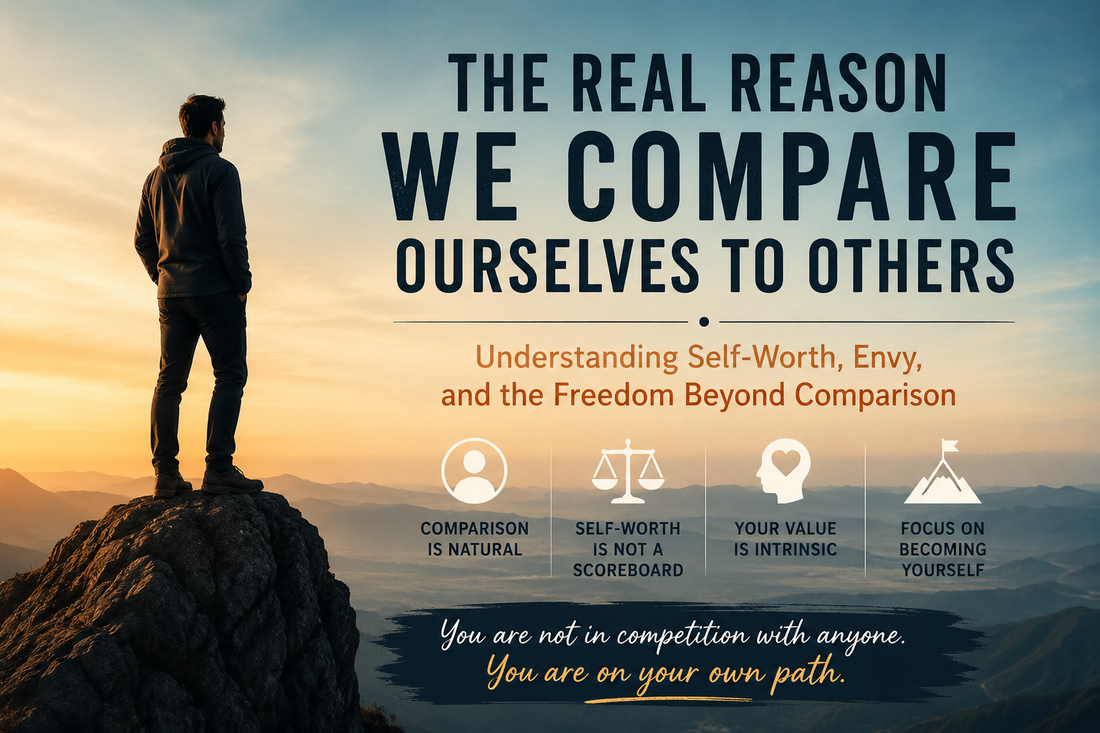 Most people believe comparison is the problem. We hear phrases like: "Stop comparing yourself to others." "Stay in your own lane." "Comparison is the thief of joy." While these statements contain wisdom, they often fail to address the deeper issue. The truth is that comparison itself is not the problem. The real problem is what comparison threatens. For most of us, comparison threatens our sense of self-worth. Comparison Is Natural The human mind compares things constantly. It compares prices before making a purchase. It compares routes before taking a trip. It compares options before making decisions. Comparison is simply a mental tool. Without comparison, we would struggle to navigate everyday life. The problem begins when we stop comparing things and start comparing our value. Instead of observing differences, we begin measuring ourselves against others. Suddenly, comparison is no longer about information. It becomes about identity. The Hidden Equation Many people unconsciously live by an equation they never chose: Self-Worth = My Value Relative to Others The equation is rarely spoken aloud, but it quietly influences how we feel. If someone is more successful, we feel smaller. If someone is more attractive, we feel less desirable. If someone is wealthier, we feel less accomplished. If someone appears more enlightened, we feel less spiritual. The moment another person rises, our value appears to fall. But is that actually true? Consider two scenarios. In the first scenario, you earn $500,000 a year while everyone around you earns $100,000. In the second scenario, you earn $500,000 a year while everyone around you earns $5 million. Your income has not changed. Your life has not changed. Your achievements have not changed. Only your position within the social hierarchy has changed. Yet many people would feel more successful in the first scenario and less successful in the second. Why? Because the feeling of worth was never coming from the achievement itself. It was coming from comparison. What Is Self-Worth? This is where things become interesting. Most people spend their lives trying to increase their self-worth. But few stop to ask: What is self-worth? Can your worth actually increase? Can it decrease? Can another person's success diminish your value? Can another person's beauty make you less beautiful? Can another person's intelligence make you less intelligent? If your worth can be reduced simply because someone else possesses more of something, then your worth was never truly yours. It was dependent upon external conditions. It was conditional. And anything conditional can be taken away. The Endless Chase The ego loves comparison because comparison creates hierarchy. Hierarchy creates winners and losers. And if there are winners, then perhaps one day we can become one. This creates an endless pursuit. "I'll be worthy when I become successful." "I'll be worthy when I make more money." "I'll be worthy when people recognize me." "I'll be worthy when I find my purpose." "I'll be worthy when I become enlightened." Yet every time one goal is achieved, another appears. The finish line keeps moving. The person may become more accomplished, but they rarely become more whole. This is why some of the most successful people in the world still struggle with envy, insecurity, and self-doubt. They improved their position in the hierarchy but never questioned the hierarchy itself. What Comparison Is Really Protecting When comparison hurts, it is usually protecting an identity. It is protecting a story about who we believe we are. When someone else's success triggers us, we can ask: What am I making this mean about me? Often the answer reveals the deeper fear. Perhaps we fear being insignificant. Perhaps we fear being left behind. Perhaps we fear not being enough. Perhaps we fear that our value depends on being exceptional. Comparison is not creating these fears. It is exposing them. The discomfort we feel is often an invitation to investigate the foundation upon which our identity is built. A Different Way of Living Imagine asking a different question. Instead of: "Am I better than others?" Ask: "Am I becoming more fully myself?" The first question creates competition. The second creates growth. The first depends on what others are doing. The second depends on what you are doing. The first produces envy. The second produces fulfillment. A rose does not compare itself to an oak tree. A mountain does not compare itself to the ocean. Each expresses its nature completely. Neither gains value by becoming the other. Human beings often suffer because we forget this. We spend so much time trying to become someone else that we never fully become ourselves. The End of Envy Many people want to eliminate envy. But envy is often a symptom, not the cause. The cause is the belief that another person's success says something about our worth. Once that belief dissolves, envy begins to lose its foundation. What remains is something entirely different. Admiration instead of jealousy. Inspiration instead of resentment. Appreciation instead of competition. You can witness greatness without feeling diminished by it. You can celebrate another person's success without questioning your own value. You can appreciate beauty without feeling less beautiful. You can honor another person's gifts without denying your own. A Question Worth Contemplating If you were the only person on Earth, would you still have worth? If the answer is yes, then your worth cannot come from comparison. And if your worth does not come from comparison, then comparison loses its power to threaten you. Perhaps freedom is not found in eliminating comparison. Perhaps freedom is found in realizing that your value was never dependent on comparison in the first place.  Some people thrive on ambition and achievement, while others feel strangely unmotivated by goals that once seemed meaningful. If you’re highly self-aware, this isn’t a flaw—it’s a signal. As awareness deepens, ego-driven motivation begins to collapse, and the effort behind achievement suddenly feels heavier than the reward. This article explores why high awareness can kill motivation, the hidden difference between ego-based striving and truth-driven expression, and how alignment—not ambition—becomes the real force that moves you forward. Why Some People Don’t Feel the Weight of Work Some people don’t seem to mind the work it takes to achieve in life. They push, grind, build, chase—and they often accomplish a lot. That’s because most achievement is ego-driven. The ego runs on:
Effort feels invisible when the ego is excited. Why Awareness Changes Everything As awareness increases, the illusion weakens. You begin to see:
So when a new project or desire appears, you don’t just see the starting point—you see the entire arc: effort → achievement → short-lived high → restlessness → another goal. And a quiet question emerges: Why start something that won’t actually fulfill me? This hesitation isn’t laziness. It’s clarity. Why It Felt Easier When You Were Younger When you’re younger, desire is simpler. You want something, you work for it, you get it, you feel better—at least for a while. The emotional return feels worth the effort, so you don’t even register the work involved. Back then:
The spell is broken. Ego-Driven Action vs Truth-Driven Expression This is the distinction most people never learn to make. Ego-Driven Action
Even when successful, it often leaves a subtle emptiness. Something feels off—because the action wasn’t aligned with your deepest belief. It was aligned with maintaining an identity. Truth-Driven Expression
When you act from truth, you operate from your pure belief system, not the ego. For example: If I’m honest with myself and recognize that buying a new piece of clothing is purely to satisfy my ego, that awareness changes the choice. Now I hold a clean belief: This is ego-driven. If I go through with it anyway, it feels like subtle self-betrayal—disalignment. But if I honor that belief and choose differently, I experience integrity. Truth creates alignment. Ego creates performance. Why You Hesitate to Start Once you’ve tasted alignment, ego goals feel heavy. You don’t resist work. You resist work that isn’t true. You’re no longer motivated by:
You’re moved by:
And aligned action, while often quieter, feels clean. Self-Reflection: Are You Unmotivated or Just Done With Illusion? Ask yourself—honestly:
These questions require brutal honesty. Without it, clarity gets mislabeled as laziness. The Provocative Truth High awareness kills ego motivation. That’s the price of seeing clearly. Once you recognize the cycle—effort, achievement, dissatisfaction—you can’t unknow it. And when ego stops driving you, nothing external can push you anymore. Now only alignment moves you. That’s dangerous. Because when you can’t lie to yourself, you’re left with two options:
Most people go back to chasing. Very few choose alignment—because it demands honesty over ambition. And once you see the difference, there’s no going back.  Once you discover your true purpose in life, you will be able to fulfill your own dreams and only then you will be better equipped to help others to pursue their dreams. Sometimes when you are not happy with your job it could be because you are helping someone else to fulfill their dreams. What makes other people happy doesn’t mean it will make you happy. In addition, if you are not happy you won’t show up 100% to help others achieve their goals. Each of us has our own unique gifts and purposes for specific reasons in life. Not being able to use your gifts towards your passion can cause disinterest in what you are doing. Discover what your true-life purposes are to fulfill your dreams so you can help others to pursue their dreams. - FeelaSoulphy |
AuthorFeelasoulphy Categories
All
Archives
March 2026
|
 RSS Feed