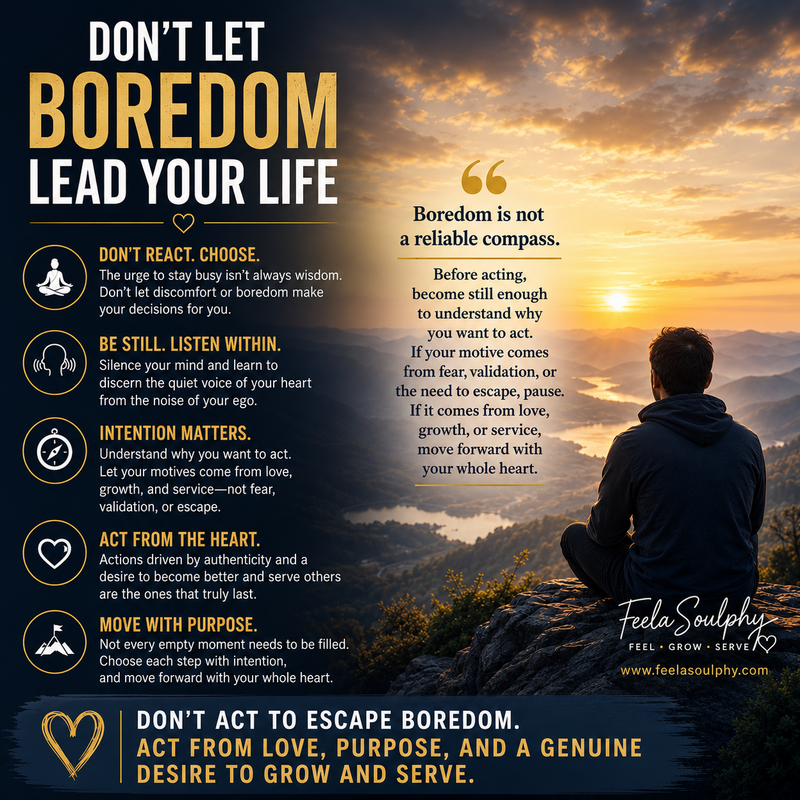
 Don’t fill your time simply because you’re bored.
The urge to stay busy isn’t always wisdom. Often, it’s simply discomfort looking for an escape. When you allow that feeling to direct your choices, you’re reacting instead of choosing. Your ego—not your heart—begins to lead the way. Instead, be still. Be patient. Create space for silence. In that silence, learn to distinguish between the quiet voice of your heart and the endless noise of your restless mind. One leads you toward purpose. The other only seeks distraction. Stillness isn’t the opposite of action. It is what allows you to understand why you want to act. The reason behind your actions matters more than the actions themselves. If your motivation comes from loneliness, the need for validation, fear of missing out, or the desire to prove something, your enthusiasm will eventually fade. Ego can fuel ambition, but it rarely brings lasting peace or fulfillment. But when your actions are born from authenticity, love, curiosity, and a sincere desire to become a better person and to serve others, they are sustained by something much deeper. They no longer feel like obligations. They become expressions of who you are. Not every empty moment needs to be filled. A meaningful life isn’t built by filling every moment; it’s built by choosing each moment with intention. Sometimes the wisest thing you can do is pause—not because you’re waiting for life to happen, but because you’re making sure your next step is guided by purpose rather than restlessness. Boredom is not a reliable compass. Before acting, become still enough to understand why you want to act. If your motive comes from fear, validation, or the need to escape, pause. If it comes from love, growth, or service, move forward with your whole heart. Don’t act to escape boredom. Act from love, purpose, and a genuine desire to grow and serve.
0 Comments
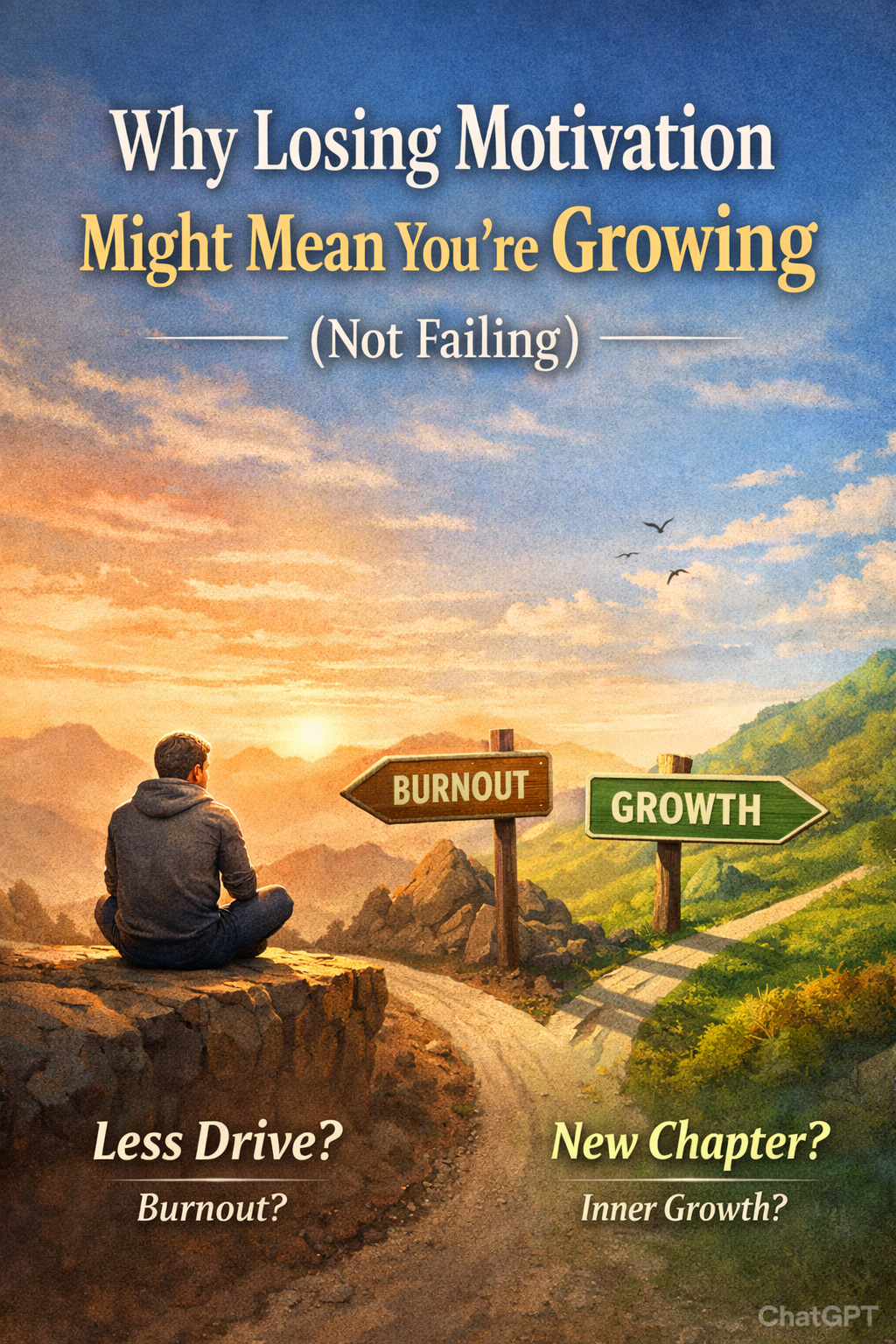 There is a phase of inner growth that rarely gets discussed—because it doesn’t look impressive. Ambition fades. The drive to achieve quiets down. The urge to become someone loosens its grip. And instead of clarity, many people feel unease. Am I evolving… or am I giving up? Is this peace—or fear disguised as contentment? This question doesn’t arise at the beginning of self-development. It appears after years of inner work, when ego has softened but purpose hasn’t yet redefined itself. The Role of Ambition in Human Development Ambition is not the enemy. Early in life, it serves an essential function. We strive in order to:
The problem isn’t ambition—it’s never knowing when to take it down. What Changes When Ego Softens If inner work is genuine, something subtle but radical happens: You no longer need achievement to validate your existence. This often shows up as:
They assume: “If my ambition is fading, something must be wrong.” In reality, something important is reorganizing. Rest vs Retreat: The Critical Distinction From the outside, rest and retreat look identical. Less output. More solitude. Fewer goals. Internally, they are opposites.
A simple test: If life gently asked something of me tomorrow, would I be open to it? A relaxed yes signals rest. A tight no signals retreat. The danger isn’t resting. The danger is mistaking withdrawal for wisdom. What Replaces Ambition After Ego Work When ego-driven ambition dissolves, one of three things replaces it:
A call does not demand constant productivity. It arrives with clarity and lightness. It asks for action—and then releases you again. From the outside, this looks inconsistent. From the inside, it feels precise. Why Many “Successful” People Never Reach This Stage Many high achievers don’t mind working all the time because stopping would force them to sit with themselves. Busyness becomes:
There’s a difference between capacity for work and compulsion to work. Losing the second while keeping the first is growth. The Real Risk at This Stage The risk is not doing less. The risk is using contentment as insulation. When “I’m fine the way I am” becomes a shield against engagement, life slowly thins out. The answer is not forcing ambition back. It’s remaining available. A Simple Operating Principle For this phase of life: Only act on what arrives with clarity and lightness. Not excitement. Not obligation. Not fear. Lightness. If nothing arrives, live fully anyway. Stillness is not a waiting room. It’s part of the work. A Short Mirror (Read slowly) Don’t answer these questions quickly. Notice what happens before the answer forms.
Only signals. Whatever you notice is the information. The Quiet Truth You are not here to maximize output. You are here to minimize distortion. When distortion falls away, contribution becomes inevitable—but no longer constant. And if you step forward again, it won’t be to become someone. It will be because silence finished saying what it could. Why Slowing Down Feels So Uncomfortable - The Science Behind a Mind That Won’t Let Go of Busyness2/12/2026 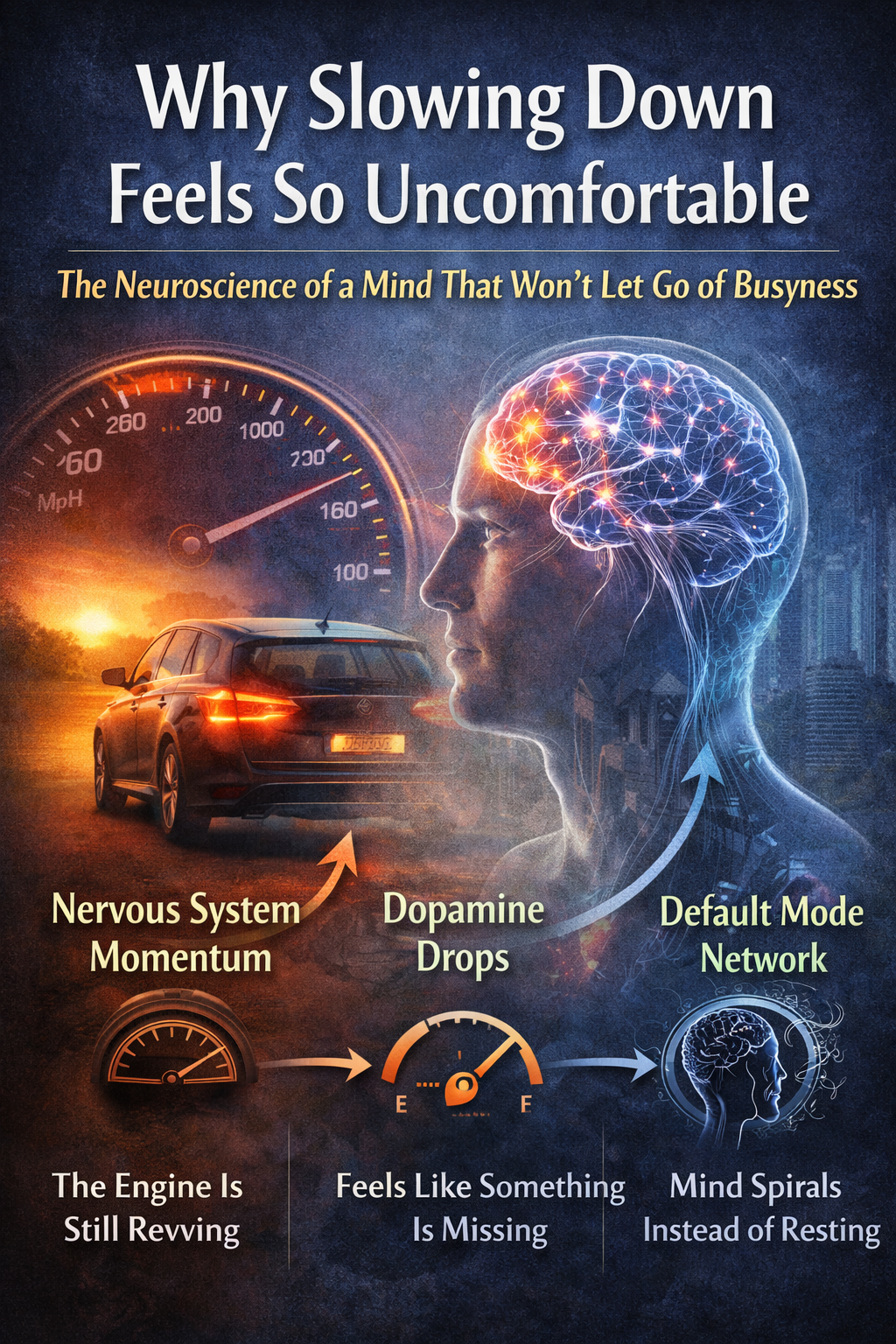 Most people think rest should feel good immediately. But when life finally slows down, something strange happens:
It’s biology. Think of it like driving a car at 100 miles an hour for a long time—and then suddenly slamming the brakes. The wheels stop turning. But the engine is still revving. That “revving” is your nervous system. The nervous system doesn’t switch states instantly When you’re busy for long periods, your body adapts to that pace. Scientifically speaking:
So when external demands suddenly drop:
You didn’t fail at relaxing. Your system just hasn’t downshifted yet. Dopamine is why the mind looks for something to do Dopamine is often misunderstood. It’s not the “pleasure chemical.” It’s the motivation and seeking chemical. During busy periods, dopamine spikes come from:
When that stimulation disappears:
The brain isn’t asking for meaning yet. It’s asking for stimulation. What happens when you stop “doing” When tasks slow down, a brain network called the Default Mode Network (DMN) becomes more active. The DMN is responsible for:
This network is essential—but untrained, it becomes noisy:
So when you stop doing, the mind doesn’t go quiet. It starts talking. That doesn’t mean stillness is bad. It means the mind is entering unfamiliar territory. Why this feels threatening to the system The nervous system learns through repetition. If busyness was associated with:
Then slowing down feels uncertain—even unsafe. The body doesn’t distinguish between: “I don’t know what to do” and “I might be in danger” Both feel like loss of control. So the urge to get busy again isn’t ambition. It’s conditioning. Social media exploits this exact gap This is where modern life complicates things. Social media:
It perfectly fills the uncomfortable space between:
Instead of allowing the nervous system to settle, we hover in between. Not fully busy. Not fully relaxed. Just constantly stimulated enough to avoid stillness. Why slowing down must be intentional at first You can’t think your way into regulation. The nervous system recalibrates through:
This is why rest initially feels uncomfortable—and later becomes nourishing. Stillness is a skill, not a personality trait. The bigger picture Busyness isn’t the enemy. Unconscious busyness is. When you understand what’s happening in the brain and body:
And once that happens? Stillness stops feeling empty. It becomes spacious. Creative. Clarifying. One important real-life example This same mechanism explains why many people struggle after retirement—and why they rush back into the same kind of work they just left. I wrote a separate post on that specifically, because it deserves its own attention. If this resonates, read the companion piece: “Why People Panic After Retirement (And Rush Back to the Same Life)” This post explains how the mind and nervous system work. The other shows what happens when we don’t understand this during major life transitions. Together, they tell the full story.  Picture a car that’s been driving at full speed for 30 years. Deadlines. Meetings. Responsibilities. Identity built around “doing.” Then one day… retirement. The wheels stop turning. But the engine is still screaming at 100 miles an hour. So what happens? Rest doesn’t feel restful. Freedom feels unsettling. Days feel empty instead of peaceful. And the mind starts whispering: “Something’s wrong. I need to get busy again.” Nothing is wrong. The nervous system just hasn’t cooled down yet. This is why so many people:
But because busyness feels familiar. Safe. Known. Stillness feels like an identity crisis. Here’s the hard truth: Most people don’t miss the job. They miss the state their nervous system was in. The structure. The stimulation. The sense of being needed. So instead of letting the system downshift, they step right back on the gas. Different job. Same engine speed. This is also why retirement can trigger an identity crisis. For decades, the identity was: “I am what I do.” When the doing stops, the mind asks: “Then who am I?” That question can feel terrifying—unless you understand what’s happening. It’s not a personal failure. It’s a transition phase. The nervous system is shedding an old operating mode. Here’s the warning I wish more people heard: Don’t rush back into busyness just because stillness feels uncomfortable. That discomfort is not a signal to go backward. It’s a signal that your system needs time to recalibrate. This is the moment to:
But what gives meaning without constant motion. Busyness can be a distraction disguised as purpose. If you skip this cooling-down phase, you don’t choose your next chapter consciously. You default to the old one. Same patterns. Same identity. Same exhaustion—just with a new title. True rest isn’t doing nothing forever. It’s allowing space for a new direction to emerge. A life driven by choice, not conditioning. By purpose, not momentum. So if you—or someone you love—is approaching retirement: Don’t just stop the car. Let the engine idle. Let the system learn that it’s safe to slow down. Only then ask: “What do I actually want this next chapter to be about?” That question can’t be answered at 100 miles an hour. If you'd like to get a deeper understanding on this subject you can check out this post that explains how dopamine, the nervous system, and brain momentum keep the mind addicted to busyness. Why Slowing Down Feels So Uncomfortable - The Science Behind a Mind That Won’t Let Go of Busyness  We spend much of our lives asking questions: Why am I here? What should I do? How do I fix this? When will I feel better? The mind loves these questions. It feeds on inquiry. But here’s the catch: the mind is shaped by the ego. And the ego — no matter how well-meaning — sees life through a narrow lens of identity, survival, and control. So even the best questions are often limited by what the ego thinks is worth knowing. That’s why some of the most profound truths don’t come from questioning at all. They come from stillness. The Nature of Epiphany An epiphany is an answer that arrives unannounced. You didn’t plan it. You didn’t chase it. It just… appeared. Like a flash of lightning on a clear night. It’s not the result of linear logic — it’s a download from somewhere deeper. A soul-level remembering. A glimpse beyond the veil. And most of the time, the mind catches up after the knowing has already landed. Why Silence is Sacred Silence isn’t just the absence of noise. It’s the absence of interference. It’s the pause that lets truth rise from beyond the chatter of the mind. In silence, you're not asking — you're receiving. Not analyzing — but becoming available. Not solving — but allowing. This is why spiritual teachers, mystics, and creatives across centuries all return to the same principle: Get still. Get quiet. Then let what’s real rise. Final Thought: If your mind doesn’t have the question, but your heart suddenly has the answer… That’s not confusion. That’s grace. Epiphanies are soul-whispers. And they don’t care if you were asking. They just come when you're ready. Reading tip: Click on Epiphanies under Categories to read more about the subject.  Community Garden, South Laguna Bluff, California, USA What if you could tune into the same brainwave frequency as monks during moments of enlightenment? What if insight wasn’t just mental — but divine? This is where Gamma comes in. Often overlooked in everyday life, Gamma is the brainwave state linked to the highest forms of consciousness, the aha! moments that feel like downloads from beyond, and even spiritual awakening. But Gamma doesn’t show up randomly. It’s a state you can prepare for — and invite. What Are Gamma Waves? Gamma brainwaves range from 30 to 100 Hz, the fastest of all brain frequencies. These waves are associated with:
When you experience a sudden epiphany — the kind that changes your life — you’re likely in a gamma burst. It’s your brain creating an instantaneous global connection, fusing memory, insight, emotion, and intuition into one flash of clarity. Gamma in Mystics, Monks, and Moments of Awakening In groundbreaking research, neuroscientists observed elevated gamma activity in the brains of advanced Tibetan monks during meditation. These monks weren’t just calm — they were in a state of profound, expansive awareness. Love-based meditations, in particular, triggered the most powerful gamma waves. These findings suggest that gamma isn’t just about cognition. It may be the neural signature of transcendence — the bridge between the personal and the divine. How Gamma and Alpha Work Together Think of Alpha as the fertile ground. It’s where you relax, open your awareness, and quiet the noise. Gamma is the lightning strike. It’s the moment the insight arrives, fully formed. Together, they form the perfect flow state:
Your goal isn’t to chase Gamma — but to create the conditions for it to arise. Practices That Induce Gamma States You don’t have to live in a monastery to access gamma. These practices have been shown to boost gamma activity and support spiritual downloads: 1. Insight Meditation Rather than emptying the mind, this style focuses attention on a single subject (a question, concept, or sensation) while observing arising insights without judgment. It combines clarity with curiosity — a recipe for gamma bursts. 2. Breathwork Rhythmic or conscious breathing techniques can alter brainwave patterns, especially when paired with emotional release. Gamma often appears after strong somatic breakthroughs. 3. Deep Focus (Flow States) When fully immersed in a creative, intellectual, or physical activity, your brain can enter “flow” — a state associated with both alpha and gamma synchronization. 4. Acts of Love and Compassion Heart-based states (like gratitude, empathy, and unconditional love) elevate not just your mood, but your frequency. Studies show these emotions correlate with increased gamma activity and neural coherence. How to Invite Gamma Into Your Daily Life The more often you create space, the more likely your brain is to deliver insight. Here’s how to build a gamma-friendly lifestyle: Stillness Windows Designate sacred “alpha zones” during your day — no phone, no noise, just presence. These might include:
See more details about Alpha Brainwave in Part 2. Ask Powerful Questions Gamma breakthroughs often follow curious inquiry. Use questions like:
Let the answers come later — in a flash. Final Insight: Epiphanies Are Spiritual Invitations Gamma is more than a brainwave. It’s a state of divine intelligence. It’s when the veil thins… and something greater than you whispers through the neurons. When you get the message, don’t just admire it — act on it. Because real transformation doesn’t happen when you understand something. It happens when you become it. Read: Part 1: The Neuroscience of Epiphanies: Why Sudden Realizations Can Change Your Life Instantly Part 2: Relax to Receive — Why the Alpha Brainwave Is the Gateway to Spiritual Insight Part 4: The Portal of Dreams - How Theta Brainwaves Reveal Your Soul's Voice Part 5: Breaking Free from Mental Noise - Escapting Beta Overdrive to Find Peace Part 6: The State Shifter - How to Move Between Brainwave States to Master Your Mind & Life  A bird resting on top of the tree at Montage Laguna Beach, Laguna, California, USA In a noisy world that glorifies mental stimulation and constant doing, relaxation has become a radical act. But it’s in this relaxation—this soft, alert stillness—that your most profound insights begin to emerge. Welcome to the alpha brainwave state: the fertile ground for creativity, intuition, and spiritual downloads. What Are Alpha Brainwaves? Alpha waves are brain frequencies between 8–12 Hz, most active when you’re:
This is the sweet spot between wakefulness and sleep, between effort and surrender. It’s not passive—it’s receptive. And it opens a bridge between your conscious and subconscious mind. Why Alpha Unlocks Spiritual and Creative Flow When you’re in alpha:
This is why many spiritual practices—like meditation, prayer, journaling, or walking in nature—naturally bring you into this state. You’re no longer in “problem-solving mode” (beta). You’re available for something deeper. Alpha is the portal through which insight travels. The space that invites a gamma burst of realization. How to Enter the Alpha State in Daily Life You don’t need a retreat, incense, or silence to access alpha. You just need moments of presence, where the conscious mind lets go. Here are simple, everyday ways to drop into alpha: 1. Hot Shower Meditation Let hot water run down the back of your head and neck. This stimulates the parasympathetic nervous system, relaxing the brain and body while quieting the mind. You’re not just cleaning your body—you’re resetting your brain. Many people get their best ideas in the shower for this very reason. 2. Driving in Silence If you’re familiar with the route, your conscious mind goes on autopilot. This opens up mental bandwidth for the subconscious mind to surface. Ever noticed how deep insights hit you while driving alone on a quiet road—or stuck in traffic? That’s alpha working through stillness and rhythm. 3. Early Morning Stillness (Alpha on Wake-Up) When you first wake up, you’re naturally in alpha/theta. Avoid grabbing your phone. Instead, lie still, observe your thoughts, and ask questions. This is one of the most spiritually potent moments of the day. 4. Nature Walks Without Your Phone Let your senses guide you. No music. No distractions. Just pure presence. Nature entrains the body and mind to calm, rhythmic patterns—instantly inducing alpha. 5. Eating Alone in Silence Put your phone away. Be fully present with the textures, flavors, and sensations of your meal. This deepens awareness and reconnects you with your senses. Some even compare it to the slow, heightened mindfulness of eating edibles—without the altered state. You become the observer, not just the consumer. 6. Free Journaling or Brain Dumping Let your thoughts flow without judgment or editing. When the conscious mind stops filtering, deep truths rise from below. This is often when insight, emotional clarity, and spiritual messages come through. 7. Brushing Teeth or Doing Chores in Silence Doing mundane tasks like brushing teeth, folding laundry, or washing dishes without background noise occupies the conscious mind just enough to let the subconscious seep through. Think of it as keeping your ego busy so your soul can sneak in. 8. Bathroom Breaks Without Your Phone Use bathroom time as a mini meditation. Avoid distractions unless you’re jotting down a note that came through. These “micro-moments of stillness” allow your brain to reset and reconnect. 9. Lo-fi or Alpha Binaural Beats Listening to music in the 8–12 Hz range can entrain your brain to alpha waves. Great during journaling, meditation, or light creative work. What Blocks the Alpha State?
Alpha can’t be forced—it must be invited. It thrives in space, ease, and quiet focus. Final Thought “Alpha is where your soul can finally get a word in.” We often search for answers with the volume turned up too loud. But the voice of truth is quiet—and it speaks when you’re still. Give your mind space to breathe. The insight you’re looking for is already waiting… behind the noise. Read: Part 1: The Neuroscience of Epiphanies: Why Sudden Realizations Can Change Your Life Instantly Part 3: Tapping the Divine Frequency - Gamma, Spiritual Downloads, and the Mystical Mind Part 4: The Portal of Dreams - How Theta Brainwaves Reveal Your Soul's Voice Part 5: Breaking Free from Mental Noise - Escapting Beta Overdrive to Find Peace Part 6: The State Shifter - How to Move Between Brainwave States to Master Your Mind & Life  Sierra Azul Preserve, San Jose, California, USA In our fast-paced world, boredom is often seen as an enemy. A void we rush to fill with any form of distraction, afraid of the silence and stillness it brings. But what if I told you that within this void lies a treasure? A profound opportunity for growth, creativity, and self-discovery? Boredom isn't the issue; our response to it is. When we encounter moments of emptiness, our instinct is to seek immediate stimulation. Yet, it is in these moments, if we dare to embrace them, that our minds can truly wander and explore the depths of our inner selves. This exploration can lead to unexpected insights and breakthroughs, akin to finding gold in a mine thought to be empty. This concept isn't new. It's echoed in ancient wisdom traditions such as Taoism and Zen Buddhism, where the value of stillness and non-action ("wu wei") is a path to enlightenment. Here, the emptiness is not a void but a space brimming with potential. It's an opportunity for the natural, effortless action that arises from being in harmony with the universe. Modern psychology supports this ancient wisdom. Research shows that boredom can foster creativity and problem-solving. When not focused on specific tasks, our minds can make unique connections, leading to epiphanies. This is attributed to the brain's default mode network, which springs to life when we're at rest. It's in these moments of unstructured thought that our most profound insights can surface. Yet, embracing this emptiness requires overcoming our discomfort with inactivity. Our society often equates value with productivity, viewing any moment of stillness as wasted time. This perspective robs us of the profound growth and discovery that lies in what we too quickly dismiss as boredom. I invite you to see these moments of stillness not as voids to be hastily filled, but as sacred spaces for introspection and growth. By welcoming the silence, we open ourselves to the universe's wisdom and our own untapped potential. The next time you find yourself feeling bored, remember: within that 'void' may lie the breakthrough you've been seeking. Embrace the stillness. Explore the emptiness. Discover the treasure within. |
AuthorFeelasoulphy Categories
All
Archives
March 2026
|
 RSS Feed