 Before you answer these questions, I suggest you read the post about Friendship & Love: Needs vs. Alignment. Answer each question based on your most significant relationship (romantic or friendship). Choose the option that feels most true most of the time, not on your best days. 1. When I feel emotionally off, this person primarily… A. Brings relief and calms me down B. Grounds me, but I can regulate myself without them C. Feels essential for me to feel okay 2. If this relationship ended tomorrow, I would feel… A. Deep grief, but still grounded in myself B. Anxiety, panic, or fear about how I’d cope C. Mostly fine—I’d miss them, but my sense of self remains intact 3. My growth and change within this relationship feels… A. Encouraged and supported B. Neutral—it depends on the situation C. Tension-filled or destabilizing 4. When conflict arises, we usually… A. Return to calm and understanding B. Escalate emotionally, then repair C. Avoid, shut down, or spiral 5. I stay in this relationship mainly because… A. I admire who they are and how they live B. It feels familiar and emotionally safe C. I’m afraid of losing what they provide 6. My nervous system around this person feels… A. Calm, open, and steady B. Activated—excited, anxious, or on edge C. Relaxed only when they’re present 7. If my core emotional needs were fully met elsewhere, I would… A. Still choose this relationship B. Be unsure C. Likely drift away 8. This relationship is rooted primarily in… A. Shared values and worldview B. Shared experiences and history C. Shared pain, struggle, or emotional regulation Scoring
Results Interpretation 🟢 Alignment-Based Relationship Your connection is rooted in shared values, respect, and emotional self-responsibility. Needs exist—but they are not the glue. Growth strengthens the bond rather than threatening it. Reflection: This is a relationship of choice, not survival. Protect it by continuing to regulate yourself and communicate honestly. 🟡 Transitional / Mixed Relationship Your relationship contains both need and alignment. This is common—and often temporary. Reflection: You’re likely in a phase where growth is redefining the bond. With conscious self-regulation and honest dialogue, this relationship can evolve in either direction. 🔴 Needs-Based Relationship This connection functions primarily as a regulation strategy. The relationship stabilizes your nervous system more than it expresses shared identity. Reflection: This relationship isn’t “wrong”—it’s informative. It’s pointing you toward inner work that will eventually change how you bond. Growth may transform—or end—the relationship. Both outcomes are valid. Relationships aren’t a test you pass or fail. They’re mirrors that show you where safety still lives outside of you. This quiz doesn’t just measure relationships. It quietly educates the nervous system while doing it.
0 Comments
 Most people think relationships fail because of incompatibility. More often, they fail because two nervous systems stop speaking the same language. Polyvagal Theory: Why the Body Decides Before the Mind According to Stephen Porges, our nervous system is constantly asking one unconscious question: Am I safe here? Before thought, before logic, before intention—the body answers first. Polyvagal Theory explains three primary states:
Needs-Based Relationships: Regulation Through Another Person Needs-based relationships often form when one or both people are dysregulated. Someone else becomes:
The nervous system learns: “I feel safe when I’m with them.” This creates powerful bonding—but it’s conditional. If that person:
The nervous system interprets it as threat, not loss. That’s why needs-based relationships often feel:
It’s not just emotional attachment—it’s biological reliance. Alignment-Based Relationships: Co-Regulation Without Dependency Alignment-based relationships emerge when both people can access ventral vagal safety on their own. Here’s the difference:
These relationships activate:
They don’t spike the nervous system. They stabilize it. Which is why they can feel “less exciting” at first—and far more sustaining over time. Why Growth Disrupts Needs-Based Bonds When one person becomes more regulated:
The old attachment loop loses its charge. The other nervous system feels this as:
But what’s really happening is simple: The body no longer needs the same strategy to feel safe. Alignment-based relationships survive this shift. Needs-based ones often fracture under it. Self-Check: Needs or Alignment? Ask your body first. Then your mind.
Your nervous system never lies. It just speaks softly—until you ignore it long enough that it has to shout. Visual Diagram From Need to Alignment: How Relationships Actually Form 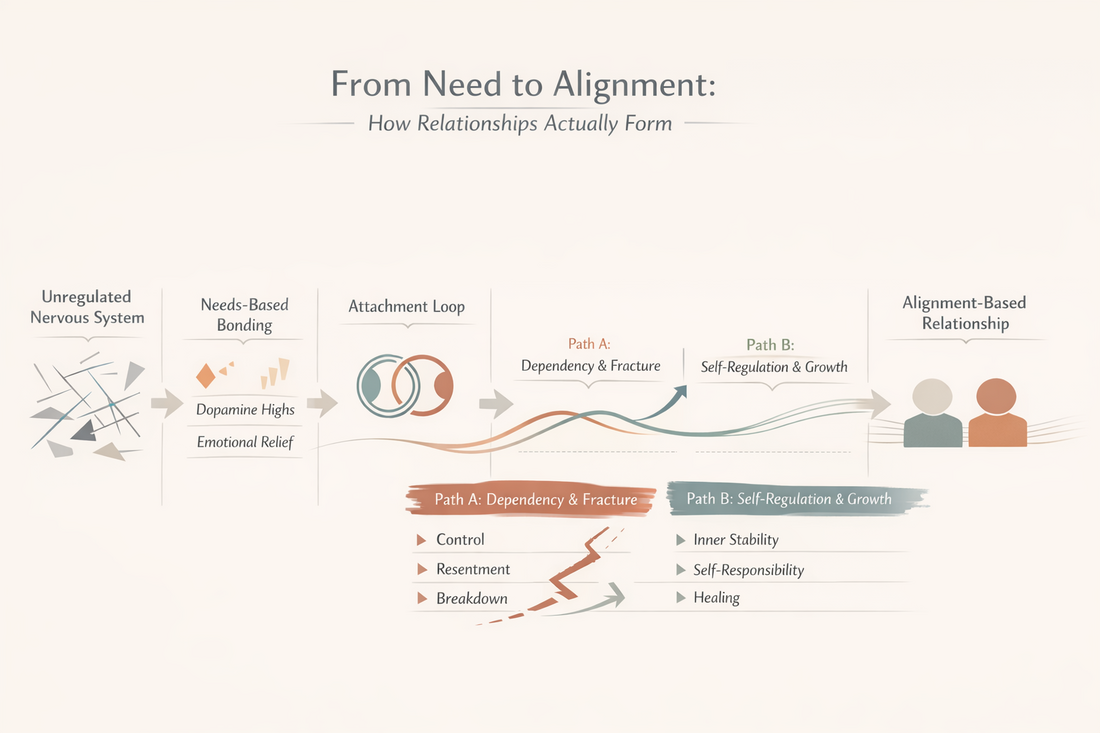 The Deep Reframe Needs-based relationships are survival strategies. Alignment-based relationships are expressions of wholeness. Needs bring people together. Alignment keeps them together. And the real work isn’t fixing relationships. It’s teaching the nervous system that safety can come from within. Once that happens-- connection becomes clean. Love becomes steady. And relationships stop feeling like something you might lose… and start feeling like something you’re free to choose Take this quiz to find out whether your relationship is based on needs or alignment.  Sometimes we are afraid to look at ourselves in the mirror. Especially in the morning. The bed hair, the bags under the eyes, the new wrinkles showed up overnight, etc. Whatever it is it doesn’t make us feel good about ourselves. We know that before stepping out of the door we must make sure we look at our best. However, we can’t see ourselves unless we have a mirror. And we need a clean one to see clearly because a dirty mirror will not show us everything we need to see. In a healthy relationship, such as a friendship or a romantic relationship, the right partner will help us expose our weaknesses that we can’t detect on our own. This is very much like what a mirror does for our physical appearance but instead it reflects our inner self. Unfortunately, often times in order to bring these deep rooted issues to the surface there’s no better way than conflicts and confrontations; which may involve a lot of intense emotions from both sides. These emotions might be difficult to endure at the moment, however they can be great tools to help us achieve breakthroughs with those unresolved issues that are hindering our growth. Sometimes we may need more than one mirror to look at ourselves from different angles all at once. We need to find the mirrors that will display the true us, even though we might not like what we see at first, however I promise you that a clean mirror will show us exactly what we need to see. Otherwise, we would only be living in our own imaginations. Find the best/clearest mirrors you can find and be the best/clearest mirror you can be. And make sure you take good care of those mirrors and keep them clean to show your appreciations at all times because the better/cleaner the mirror the better you see yourself and your soul’s purposes. - FeelaSoulphy |
AuthorFeelasoulphy Categories
All
Archives
March 2026
|
 RSS Feed