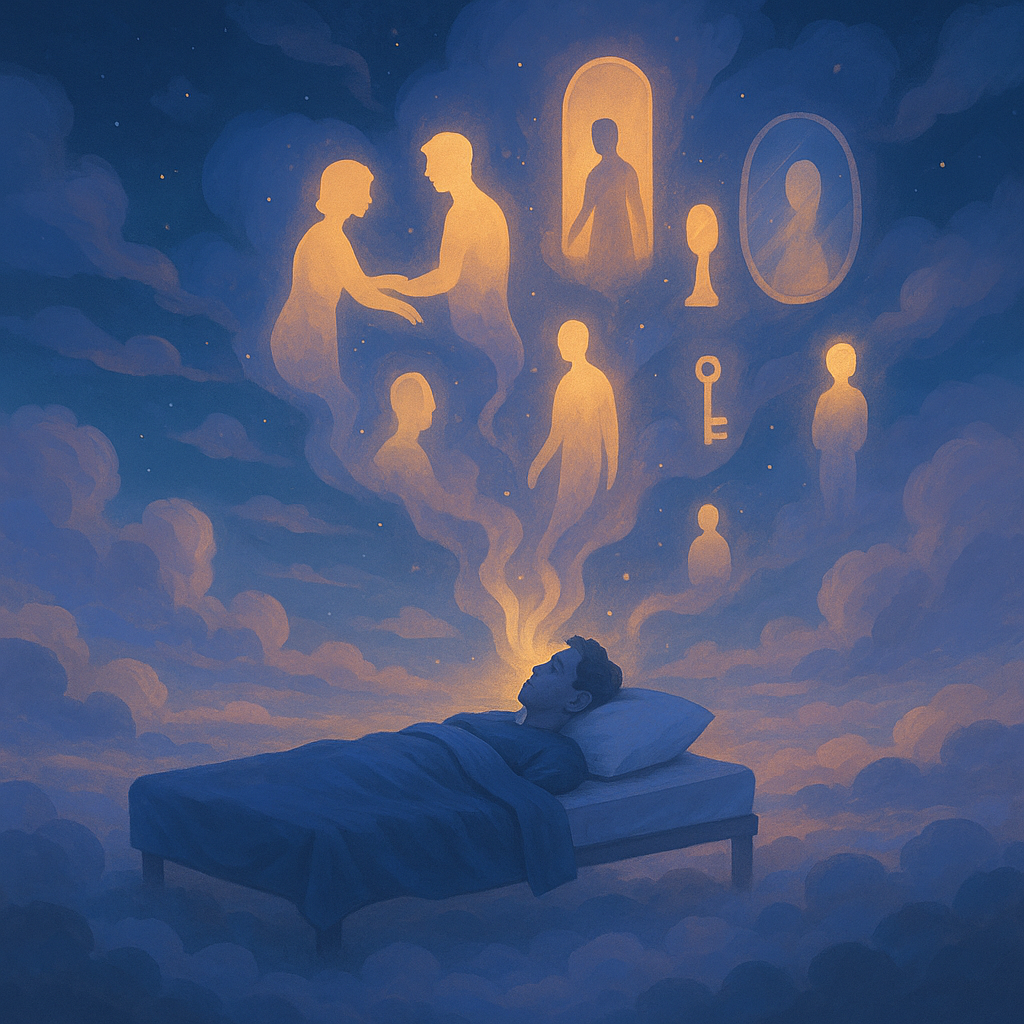
 How the Brain Processes Trauma, Anxiety, and Insight When the Ego Is Offline Most people misunderstand dreams because they ask the wrong question. They ask, “What does this dream mean?” When the real question is, “What emotion is being processed?” Dreams are not symbolic riddles or prophetic messages. They are the brain’s emotional maintenance system, running in the background when the conscious mind finally gets out of the way. The events in dreams are not clues about your life. They are containers for emotions already active in your waking state. The Core Principle (this changes everything) Dreams prioritize emotion, not narrative. The brain does not dream to tell stories. It dreams to regulate, consolidate, and integrate emotional information that has not been fully processed while awake. The imagery is secondary. The emotion is primary. Fear, anxiety, grief, shame, anticipation, relief--these are the real data. The dream simply borrows whatever images are available to express them. Why Dream Events Are Misleading (and usually irrelevant) Take a common example: fear of heights. A dream might place you:
This does not mean:
What it does mean is simpler and more precise: The brain needed an image that reliably produces fear. The subconscious doesn’t care about accuracy. It cares about emotional resonance. If fear exists in your waking life--fear of uncertainty, exposure, loss, failure--the brain reaches into its memory archive and grabs whatever already knows how to feel like fear. The context is interchangeable. The emotion is not. Trauma: When the Brain Stops Using Metaphors A fair challenge to this model is trauma dreams. Trauma dreams often replay events literally. Does that contradict this theory? No. It strengthens it. In trauma, the emotional charge is so intense and unresolved that the brain does not need substitute imagery. The original memory is already maximally tagged with fear and threat. This aligns with trauma research associated with Bessel van der Kolk, showing that traumatic memories are stored sensory-first, not narrative-first. In short:
Same function. Different intensity. Anxiety Dreams: The Cleanest Proof Anxiety dreams are the clearest validation of this model. Common anxiety dream themes:
None of these are predictions. None of them are symbolic puzzles. They are emotion generators. Anxiety in waking life is often:
The dream is not saying what you’re afraid of. It’s showing that fear is active. Recurring Dreams = Unintegrated Emotion Recurring dreams don’t mean the universe is nagging you. They mean:
When the waking emotional relationship changes, recurring dreams:
No decoding required. Integration ends repetition. The Dream–Emotion Integration Framework This is where theory becomes practice. Step 1: Ignore the Story Do not analyze symbols. Do not Google meanings. Do not intellectualize. The story is noise. Step 2: Identify the Dominant Emotion Ask:
Name one primary emotion. Step 3: Locate It in Waking Life Ask: “Where in my waking life do I feel this same emotion--without the drama?” Look for:
Step 4: Feel It Without Fixing It This is critical. Don’t solve. Don’t explain. Don’t suppress. Let the emotion be felt consciously. This is integration. Step 5: Watch the Dream Change As emotional integration happens:
The system says: “Handled.” Meditation and Dreams Do the Same Job The difference is timing. Dreams:
Meditation:
When you meditate regularly, especially in stillness, emotional processing happens while awake. That’s why:
Meditation doesn’t eliminate dreams. It reduces emotional backlog. The Unified Model
either asleep or still. The Takeaway Dreams are not trying to teach you something mystical. They are trying to finish something emotional. If you chase symbols, you stay confused. If you track emotion, clarity follows. Dreams aren’t messages. They’re maintenance logs. And meditation is how you read them while awake. Guided Meditation: Observing the Emotional Landscape Find a comfortable position. You can sit upright or lie down. Let your body settle. There is nothing you need to accomplish during this meditation. No goal to reach, no state to force. Just observation. Take a slow breath in through your nose. And gently release it. Allow your breathing to return to its natural rhythm. The breath knows what to do without your help. Now bring your awareness to the weight of your body. Notice how gravity holds you effortlessly. Feel the points where your body touches the chair, the floor, or the bed. Let the muscles soften. Your only task is to observe. Now allow your mind to be exactly as it is. Thoughts may appear. Images may appear. Memories may pass through. Let them come and go the way clouds move through the sky. There is no need to chase them or push them away. Simply notice. Now gently bring your attention to your emotional state. Ask yourself quietly: What emotion is present right now? There is no right answer. Sometimes the emotion is clear. Sometimes it is subtle, like a faint background tone. Maybe it is calm. Maybe curiosity. Maybe tension. Maybe something you can’t quite name yet. Just notice. If a recent dream comes to mind, allow it to appear briefly. Do not analyze the story. Let the images fade and focus only on the feeling that was present in the dream. Ask yourself: What emotion was strongest in that dream? Fear, uncertainty, pressure, sadness, anticipation, relief—whatever it was, simply acknowledge it. Now ask gently: Where in my waking life do I feel this same emotion? Do not force an answer. Let the mind wander naturally. It may show you a situation, a conversation, a relationship, or a subtle pressure you’ve been carrying. If nothing appears, that’s perfectly fine. Stay with the emotion itself. Now shift your attention to your body. Where do you feel this emotion physically? Perhaps in the chest. The stomach. The throat. The shoulders. Rest your awareness there. Do not try to change the sensation. Do not try to solve anything. Simply allow the feeling to exist in the light of awareness. This is how emotions integrate—when they are allowed to be seen without resistance. Stay here for a few breaths. Now let the focus soften again. Allow your mind to drift freely. Sometimes when the mind is relaxed and open, insights appear naturally—like a puzzle quietly solving itself. If an understanding arises, simply observe it. If nothing arises, that is also perfect. The mind continues its work even when we are unaware of it. Trust the process. Take a slow breath in. And gently exhale. Begin to feel the space around you again. Notice the room, the air, the sounds around you. When you are ready, slowly open your eyes. Carry this awareness with you. Remember: Your mind processes experiences both day and night. Dreams do it while you sleep. Meditation allows it to happen while you are awake. Both are simply the mind maintaining balance.
0 Comments
 Use your dreams to track your healing, rewiring, and evolution. Here’s a little-known truth: If you behave differently in your dreams than you did in the past… that means you’ve already reconditioned your mind. You’ve rewired your brain on a deep, subconscious level. Why? Because dreams are not random. They are generated by your subconscious, the part of your mind that stores your emotional patterns, core beliefs, traumas, and triggers—long after your conscious mind has moved on. So when a situation shows up again in a dream—an ex, a fear, a fight—and this time you respond calmly or wisely or with power, you didn’t just dream it. You became it. Psychological Insight: Behavior Shift in Dreams = Subconscious Rewiring In behavioral psychology, our reactions are often automatic—especially under stress. Dreams simulate stress, emotion, and choice in surreal ways. If your instinctual response in a dream changes, it means your internal conditioning has shifted. You didn’t “decide” to change in the dream. You just acted. That’s how you know the change is real—it bypassed the thinking mind. Neuroscience Supports This Too
Dreams as a Spiritual Classroom Most things that happen in our dreams will never happen in real life. And that’s what makes them so valuable. They give you emotional simulations—safe environments to re-experience old wounds, future scenarios, or alternate versions of the self. Why did I make that choice in the dream? Would I act the same in real life? Why or why not? Since all the characters are projections of your perception of the world, every interaction is a conversation with yourself. Create a Morning Dream Practice (Before You Forget!)
My Personal Discovery I once watched a movie before bed and dreamed of an ex I hadn’t thought of in years. The dream wasn’t about her—it was about an unresolved emotion the movie triggered. I analyzed the dream the next morning, traced the emotion back to the memory, and felt it fully. That’s when it lifted. I let it go, completely. That one dream gave me more healing than months of overthinking. Final Thought: When your dreams start changing, your healing is already happening. You don’t need proof from the outside world—your subconscious has spoken. Use your dreams like a mirror. Learn from them. Talk to them. Let them show you what still hurts, and celebrate when something no longer does. Because when you act differently in a dream… you are no longer the same.  Carcamping by A Radiata Pine Tree in the fog off Highway 1 by Big Sur, California, USA Have you ever woken up with a strange but powerful thought, a feeling that something just clicked, or a vivid image that lingered for hours? That’s not random. That’s Theta. And Theta is the doorway. It’s the portal between your conscious mind and the vast ocean of your subconscious. It’s where healing begins, memories surface, and your soul whispers truths you may not hear in the noise of the day. What Are Theta Brainwaves? Theta brainwaves operate at 4 to 8 Hz, and are most active during:
In this state, you are relaxed but not unconscious. You are suggestible but still present. It’s fertile ground for inner work, intuition, and spiritual connection Why Theta Matters Spiritually and Psychologically Theta is where we meet:
In this liminal state, the conscious mind loosens its grip. Your subconscious takes the stage. This is why theta is often associated with dreamwork, deep healing, and mystical visions. In many indigenous cultures, dreams are considered more real than waking life — a realm where the soul travels and speaks. Pre-Sleep and Early Morning States: The Hidden Gold Two of the most potent windows for accessing Theta are: 1. Just Before Falling Asleep (Hypnagogia) This is when your brain transitions from beta (alert) to alpha (relaxed), then into theta. It’s the “twilight zone” where images flash, memories drift in, and symbolic insights arise. Practice: Instead of scrolling or watching something, lie in silence and observe what thoughts, visuals, or messages come through. You’re slipping into the soul’s frequency. Sleep tip: If you're having a hard time falling asleep, try letting your mind naturally create a series of random images, one after another. Often, this can help you drift off within minutes. This technique mimics the way we dream—moving from one random scene to the next without pause. By doing this, you're essentially allowing your subconscious mind to take over and gently ease you into a dream state. 2. Just After Waking Up You haven’t fully left the theta state yet. This is the moment when you’re most open, intuitive, and unguarded — before the rational mind boots up. Practice: Lie still, reflect on your dreams or first thoughts, and write them down. You’re catching the echoes of the subconscious before they dissolve. Journaling in Theta: Soul-Deep Integration Journaling during these windows isn’t just for remembering dreams — it’s for integration. You’re documenting raw material from the subconscious. Ask:
You don’t need to interpret every symbol. Often, just recording it anchors the insight into waking consciousness. You can also use AI to analyze your dreams. This has helped me gain deeper insights into their meanings and has even led to personal breakthroughs. Why Theta Is the Sweet Spot for Reprogramming Your subconscious mind runs about 95% of your daily behavior. It holds the beliefs you absorbed as a child — and the ones still shaping your life today. Theta is the state where these beliefs are accessible and changeable. That’s why hypnotherapy, guided meditation, and affirmations are most effective during or just before sleep. Use this time to plant new beliefs:
Repeated in the theta state, these aren’t just affirmations — they become rewrites in the code of your mind. Using Theta for Deep Healing The subconscious doesn’t just hold beliefs. It stores emotions, energy, trauma, and intuition. Theta allows you to:
Healing in Theta is non-linear. It’s not logical. It’s emotional. It’s symbolic. It’s spiritual. And it’s real. Final Thought: The Voice in the Silence In the theta state, your soul speaks softly. Not through thoughts, but through images. Emotions. Sensations. Symbols. You don’t need to force understanding. Just listen. Record. Trust. Because this is the realm where your soul becomes your guide, your dreams become your teachers, and your beliefs become changeable. Theta is not the absence of awareness. It’s where your deepest awareness lives. Read: Part 1: The Neuroscience of Epiphanies: Why Sudden Realizations Can Change Your Life Instantly Part 2: Relax to Receive - Why the Alpha Brainwave Is the Gateway to Spiritual Insight Part 3: Tapping the Divine Frequency - Gamma, Spiritual Downloads, and the Mystical Mind Part 5: Breaking Free from Mental Noise - Escapting Beta Overdrive to Find Peace Part 6: The State Shifter - How to Move Between Brainwave States to Master Your Mind & Life  Sunset at James Lick Observatory, Mt. Hamilton, San Jose, California, USA Our minds are a complex system of two primary components: the conscious and the subconscious. While they work together seamlessly, each has distinct roles depending on the state we are in—awake, asleep, or meditating. Understanding this dynamic can help us tap into deeper insights and maximize our mental potential. The Roles of Conscious and Subconscious Minds Conscious Mind: • The seat of focus, logic, and deliberate thought. • Active during tasks requiring attention, problem-solving, and decision-making. Subconscious Mind: • A vast memory bank, storing all experiences, emotions, and information. • Operates automatically, running habits, retrieving memories, and processing emotions in the background. How the Two Minds Interact 1. In Daily Life: • When awake and focused, the conscious mind leads, while the subconscious supports by providing background data (e.g., recalling memories or automatic skills). • Example: Driving a familiar route while consciously thinking about other things relies heavily on the subconscious. 2. In Sleep and Dreams: • During sleep, the subconscious dominates, creating dreams by piecing together fragmented memories. • The conscious mind typically takes a backseat unless you experience lucid dreaming, where awareness emerges within the dream state. 3. In Relaxed States: • When relaxed, such as in the alpha brainwave state, the subconscious becomes more active. This is why daydreaming and wandering thoughts occur effortlessly. • The conscious mind shifts to an observer role, which allows for contemplation and creative connections. Meditation: A Bridge Between the Two Minds Meditation offers a unique opportunity to balance the two minds: • The conscious mind quiets down, stepping into the role of a calm observer. • The subconscious becomes more accessible, revealing forgotten memories or making unexpected connections. In this state, insights often emerge because the subconscious processes information in a non-linear way, free from the constraints of conscious logic. Writing down these realizations after meditation ensures they don’t fade away. Epiphanies and Creative Breakthroughs Ever had a great idea seemingly out of nowhere? That’s the result of your subconscious working in the background. Even when the conscious mind moves on to something else, the subconscious continues processing information. When the two minds synchronize, this background processing can deliver surprising insights or solutions. This explains why moments of clarity often occur during relaxed states, like taking a walk, showering, or meditating. The Subconscious as a Memory Bank The subconscious is like a hard drive—it stores everything, but it isn’t always organized. • Dreams, for instance, can feel chaotic because the subconscious tries to link unrelated memories. • Without conscious intervention, it can seem as if the subconscious has “a mind of its own,” creating unexpected scenarios that even surprise us. By taking time to reflect, meditate, or write down these thoughts, we can give structure to this vast storehouse of information. Practical Takeaways 1. Meditate Regularly: • Use meditation to quiet the conscious mind and gain access to subconscious insights. • Don’t try to analyze during meditation—just observe. 2. Write Things Down: • Whether it’s a dream, a random thought, or a moment of clarity, writing helps organize subconscious material for conscious analysis later. 3. Leverage Relaxed States: • Activities like walking, daydreaming, or light meditation allow the subconscious to take the lead. These moments often spark creativity or problem-solving. 4. Trust the Process: • Understand that the subconscious works in the background, even when you’re not aware of it. By consciously creating time for relaxation, you open the door to unexpected insights. Conclusion The interplay between the conscious and subconscious mind is a remarkable system of balance. By learning how to work with both—letting the subconscious process while the conscious observes and organizes—we can achieve greater clarity, creativity, and self-awareness.  A lucid dream occurs when a dreamer, becoming hyper-aware, recognizes the dream state and gains control within the dream. But what if the reality we perceive in waking life is itself a dream? Individuals like the Buddha, awakened in our world, grasp this concept. They navigate through the illusions crafted by the mind's matrix, unveiling layers of reality and seizing control of their own lives—a profound, multidimensional perception. - Feelasoulphy  Death is not the end but a new beginning. At birth, we start the process of remembering. Our knowing and our memories of who we truly are being recovered as life progresses. At death, we finally fully awake from our dreams. - FeelaSoulphy  Once you discover your true purpose in life, you will be able to fulfill your own dreams and only then you will be better equipped to help others to pursue their dreams. Sometimes when you are not happy with your job it could be because you are helping someone else to fulfill their dreams. What makes other people happy doesn’t mean it will make you happy. In addition, if you are not happy you won’t show up 100% to help others achieve their goals. Each of us has our own unique gifts and purposes for specific reasons in life. Not being able to use your gifts towards your passion can cause disinterest in what you are doing. Discover what your true-life purposes are to fulfill your dreams so you can help others to pursue their dreams. - FeelaSoulphy |
AuthorFeelasoulphy Categories
All
Archives
March 2026
|
 RSS Feed