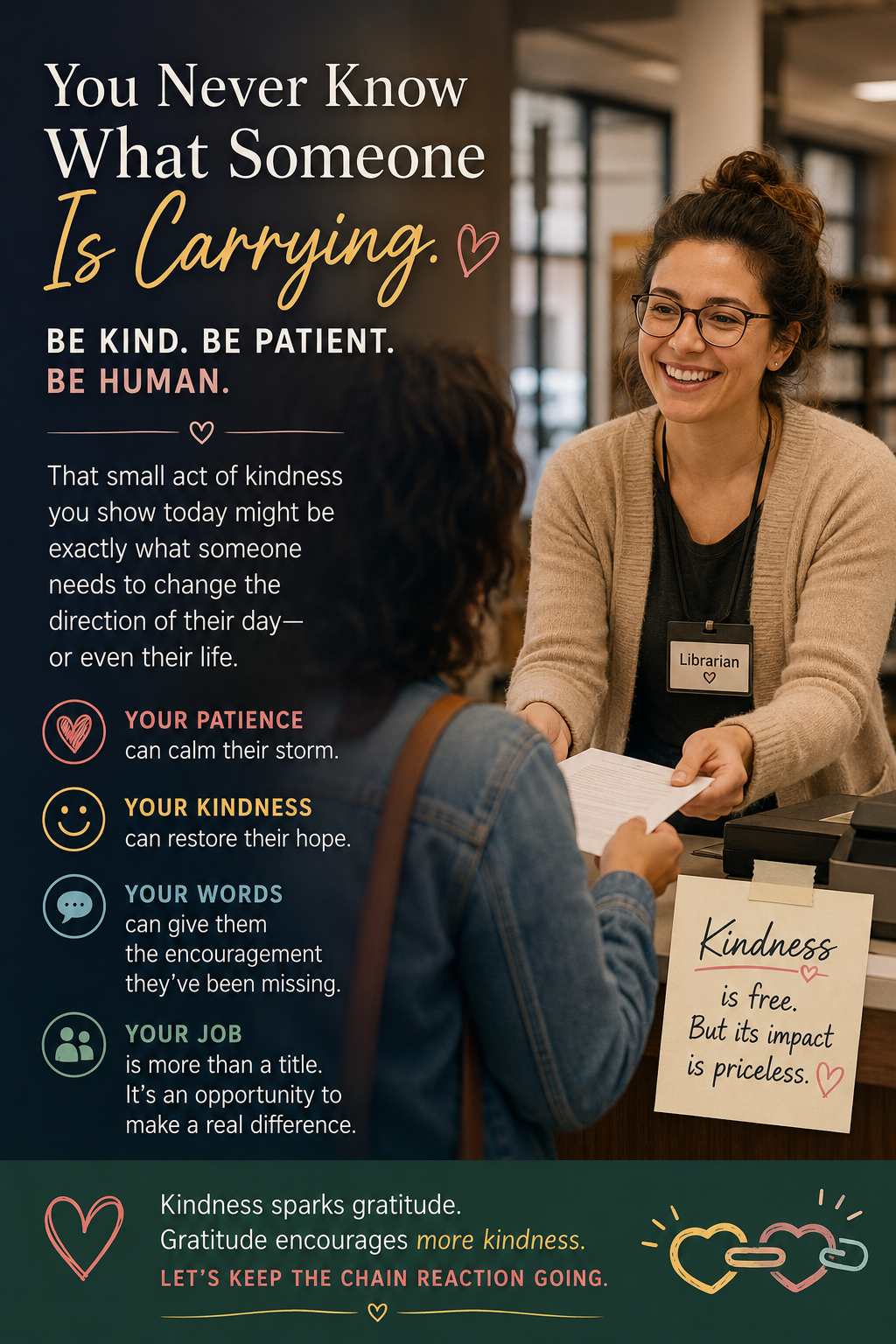
 Yesterday morning, I answered a phone call from my mom.
The moment I picked up, she started yelling. Before I even had a chance to process what was happening, my body reacted. Years of childhood conditioning surfaced instantly. By the time the call ended, I was carrying anger, frustration, and tension. I drove to the library to print some documents. I noticed I was driving faster than usual. I was impatient with slow drivers. My mind was no longer in the present—it was still trapped in that phone call. Then something unexpected happened. The librarian, Helen, helped me print everything I needed. She patiently answered my questions, showed me services I didn’t even know the library offered, and never once made me feel like I was inconveniencing her. She wasn’t trying to change my day. She was simply doing her job. But as I sat in my car afterward, I realized something profound. She didn’t just help me print documents. She fulfilled my emotional needs. In that moment, what I needed most wasn’t faster service or better technology. I needed another human being to meet me with patience, kindness, and gentleness. Without realizing it, she interrupted the emotional pattern I had been stuck in all morning. She reminded me that not everyone I encounter is going to add to my pain. Some people quietly help carry it. I was so grateful that I went back inside to thank her again. She happened to be on her break, so I waited. After about thirty minutes(it's hard to show our gratitude when we are in the hurry.), the manager came out. I told the manager that I had been having a difficult morning and that Helen had made it better simply by being kind and patient. I wanted them to know how important her work really was. As I drove away, another realization came to me. Every one of us has a job that extends far beyond our job title. A financial advisor doesn’t just help people with money. A doctor doesn’t just treat illness. A teacher doesn’t just teach. A cashier doesn’t just scan groceries. A librarian doesn’t just help people find books or print documents. Every day, we meet people carrying burdens we cannot see. Someone may have just lost a loved one. Someone may be overwhelmed with anxiety. Someone may be struggling financially. Someone may be reliving old wounds from a conversation they had only minutes earlier. We rarely know what another person is carrying. Our knowledge and skills are important. But our humanity is even more important. Sometimes the most valuable thing we give someone isn’t our expertise. It’s our patience. Our kindness. Our willingness to make another human being feel seen. One small interaction can interrupt someone’s downward spiral. It can change the direction of their day. Sometimes, it can even change the direction of their life. There’s another lesson I took away from this experience. When someone makes a difference in your life, tell them. Don’t assume they already know. I went back because I wanted Helen to know her kindness mattered. I wasn’t just thanking her—I wanted to encourage her to keep being exactly who she was. Who knows, maybe she was going to need—or had needed—my feedback to make her day! We often underestimate the power of sincere feedback. When we tell someone, “Thank you for your patience,” or, “You made my day,” we’re reinforcing the very qualities that make this world a better place. Kindness deserves to be acknowledged. Encouragement helps kindness grow. Think about a child growing up. A child who is consistently encouraged and appreciated is more likely to develop confidence and believe in themselves. When those moments are missing, some people carry self-doubt into adulthood and spend years searching for the validation they never received. Adults aren’t so different. We all need to know that what we do matters. Your words of appreciation might be exactly what someone needs to continue showing up with compassion tomorrow. Helen interrupted my emotional spiral with kindness. I tried to interrupt her day with gratitude. Kindness sparked gratitude, and gratitude encourages more kindness. That’s how compassion spreads—not through grand gestures, but through ordinary people who choose to acknowledge the good they see in one another. Never underestimate the impact of simply being kind. Every day, we have the choice to make someone’s day or break their day. We can be a positive trigger or a negative trigger, especially with the ones that are close to us. Which one do you want to be? You may think you’re just doing your job. Someone else may remember it as the moment they needed it most.
0 Comments
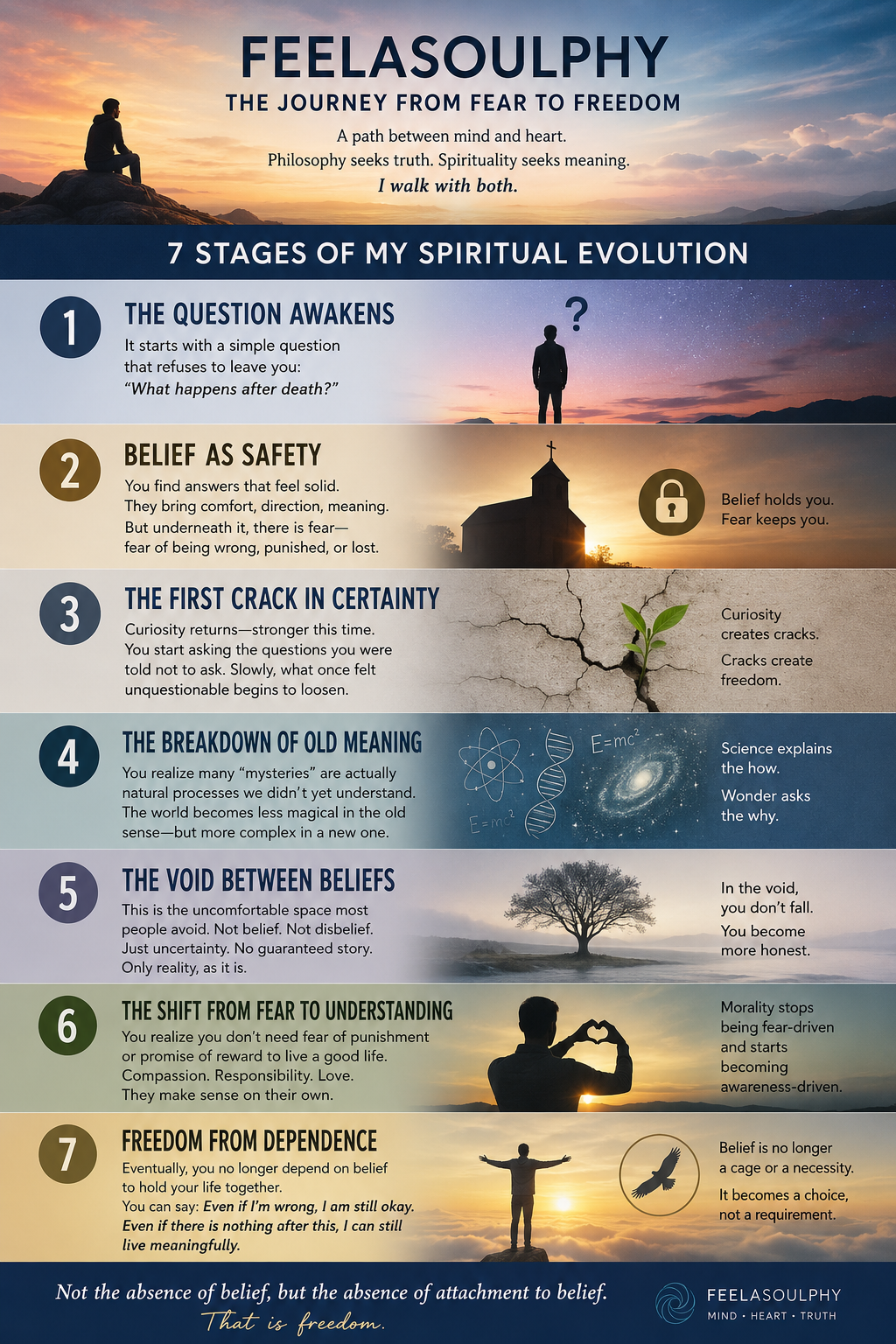 7 Stages of My Spiritual Evolution...To Be Continued... There was a time when I believed life could be neatly categorized. Philosophy belonged to the mind. Spirituality belonged to the heart. One searched for truth through logic, questioning, and reason. The other trusted intuition, meaning, and unseen connection. For a long time, I treated them as separate worlds. Almost like two different languages trying to describe existence. But life doesn’t stay in boxes for long. And neither did I. The Early Search: Fear Disguised as Faith My journey didn’t begin in clarity. It began in curiosity — and uncertainty about what happens after death. That question, once planted, doesn’t leave quietly. It grows into others: What is real? What is God? What is truth? What happens when we die? Eventually, I found myself inside Christianity. And for a while, it gave structure to the unknown. It gave answers where there were none. It gave direction where I felt lost. But underneath it, there was something I didn’t fully recognize at the time: fear. Fear of punishment. Fear of being wrong. Fear of what happens if belief collapses. And fear is a powerful teacher — but not always a truthful one. It can shape belief into something rigid, something protective rather than something alive. At some point, I started to notice that my relationship with belief wasn’t fully free. It was anchored in consequences, not understanding. And once you see that, you can’t unsee it. The Breaking Open: Science, Philosophy, and Unraveling Certainty “Did God create us in His image, or did we create God in ours?” And perhaps beneath both lies an even deeper question: “Did God create us… or did we create God?” - Feelasoulphy The next stage of my journey was not spiritual at all — at least not in the traditional sense. It was analytical. I began studying science, philosophy, and research around consciousness. I explored near-death experiences, reincarnation theories, and scientific perspectives on spirituality. Not to reinforce belief — but to challenge it. Slowly, the world I once saw as “miraculous” became increasingly explainable. The mechanisms of life, the brain, perception, evolution — all of it revealed patterns that didn’t require supernatural explanation. And something shifted in me. I started realizing that many things once attributed to God were actually natural processes we had not yet understood. But instead of closing the mystery, this opened a different one: Even if we understand how something works… we still don’t fully understand why anything exists at all. Science explains mechanisms. But it does not fully explain existence itself. That realization didn’t push me back into certainty. It pushed me deeper into humility. The Transition: Letting Belief Stop Being a Crutch Over time, something unexpected happened. My need for belief as emotional security began to fade. I stopped needing a specific story about what happens after death in order to live meaningfully now. That was a turning point. I reached a place where I could say: Even if there is no God… Even if there is no afterlife… I can still live a good, conscious, and meaningful life. Not because I was forcing myself to be strong — but because I genuinely understood why compassion, love, and responsibility matter. Not from fear. Not from reward. But from clarity. And when belief is no longer required to behave well, something subtle happens inside a person. The mind becomes lighter. The heart becomes less defended. And truth becomes less threatening. The Shift: From Dependency to Freedom At some point, I realized I no longer depended on belief in God or the afterlife to guide my actions. And that changed everything. Because belief stopped being a psychological structure holding me together. It became something I could examine freely. I was no longer afraid of my worldview collapsing. I was no longer attached to it as identity. I could question it, challenge it, even let it dissolve — and I would still be okay. That is when I first felt something I can only describe as freedom. Not freedom from meaning. But freedom from fear-based meaning. Feelasoulphy: A Middle Path This is where the idea of Feelasoulphy emerged for me. A bridge between:
Not as a contradiction — but as integration. Because I’ve come to see that philosophy without feeling becomes empty abstraction. And spirituality without inquiry becomes fragile belief. We are not meant to live in only one half of ourselves. We are meant to become whole. Fear-Based Belief vs Freedom-Based Belief One of the clearest distinctions I’ve learned is this: There is a kind of belief that is built on fear:
And there is a kind of belief — or perhaps a way of being — that is built on freedom:
Fear-based belief needs certainty to feel safe. Freedom-based understanding can hold uncertainty without collapsing. That difference changes everything. The Question I Keep Returning To I don’t claim to know what happens after death. I don’t claim to fully understand consciousness or the origin of reality. But I also no longer need those answers to live well. And maybe that is the real shift. Not from belief to disbelief. But from dependence to independence. And from independence… to a quieter possibility: That perhaps meaning is not something we receive from certainty, but something we embody through awareness. Where I Am Now Today, I feel something simple but profound: I am okay not knowing. Not in resignation — but in openness. I can explore spirituality without needing it to be “true in the ultimate sense.” I can study science without needing it to erase mystery. I can live ethically without needing fear as motivation. And most importantly, I can question everything — without losing myself in the process. That, to me, is freedom. Not the absence of belief. But the absence of attachment to belief. And in that space… life feels strangely more real than ever.  “What if the world was always this vivid—and we just forgot to pay attention?” Most of us eat distracted. We’re watching TV. Scrolling. Talking over dinner. We don’t even taste our food. But one day, I learned what it was like to really eat. I was on an edible. I remember biting into a kiwi. Suddenly, it was electric. Juicy. Tart. Sweet. The texture of the seeds. The smell of the fruit. Every sense was awake. Even watching a movie, I felt more emotional, more attuned to what was happening on screen. It was like my empathy was dialed up—I could sense what the characters felt. It was such a strange gift. Why did this happen? It turns out this isn’t magic. It’s attention. Edibles (like cannabis) can reduce activity in the default mode network (DMN)—the part of the brain responsible for mind-wandering and constant self-narration. When the DMN quiets down, sensory networks become more active. Emotions and empathy rise to the surface. In other words: When you’re really here, you really feel. Eating is special Eating is one of the few everyday activities that naturally engages all our senses: Sight: color, shape, presentation. Smell: aroma. Taste: layers of flavor. Touch: texture, weight. Sound: crunch, slurp, chew. It’s designed to be immersive. But we numb it by multitasking and rushing. When you actually focus? It’s an experience. It’s not just food—it’s people This kind of presence doesn’t just change eating. It changes how we connect with others. When you really listen to someone—without waiting to talk, without checking your phone—you hear them on a different level. You notice subtle emotions in their voice. You see the story in their eyes. You feel with them, not just next to them. Presence is the foundation of empathy. And empathy is what deepens connection. Science agrees Mindfulness meditation reduces DMN activity, just like certain drugs can—but without side effects. It increases interoceptive awareness (body sensations) and sensory acuity. It also strengthens brain regions linked to empathy and compassion (anterior cingulate, insula). Long-term meditation practice literally rewires the brain for presence. Drugs vs. Meditation Drugs can open the door to this state. They show you how present you could be. But they don’t train you to stay there. Meditation does. Presence practice does. It’s a lifelong shift, not a temporary escape. Try This: A Mindful Eating Practice Pick something simple. A kiwi. An apple. Chocolate. Look at it carefully. Color. Shape. Smell it. Take a slow bite. Chew carefully. Feel the texture. Notice the sound. Taste all the flavors. Keep bringing your mind back when it drifts. This isn’t just about food. It’s a training ground for attention. A Practice for Connection Next time you’re with someone: Put the phone away. Look them in the eyes. Really listen. Notice tone, words, pauses. Feel what they’re feeling. Watch how the conversation changes. Watch how you change. Final Reflection That kiwi taught me that life is always offering something beautiful—if I’m willing to really show up for it. Food can be spiritual. Conversations can be sacred. This moment can be everything. Presence turns ordinary life into holy ground. 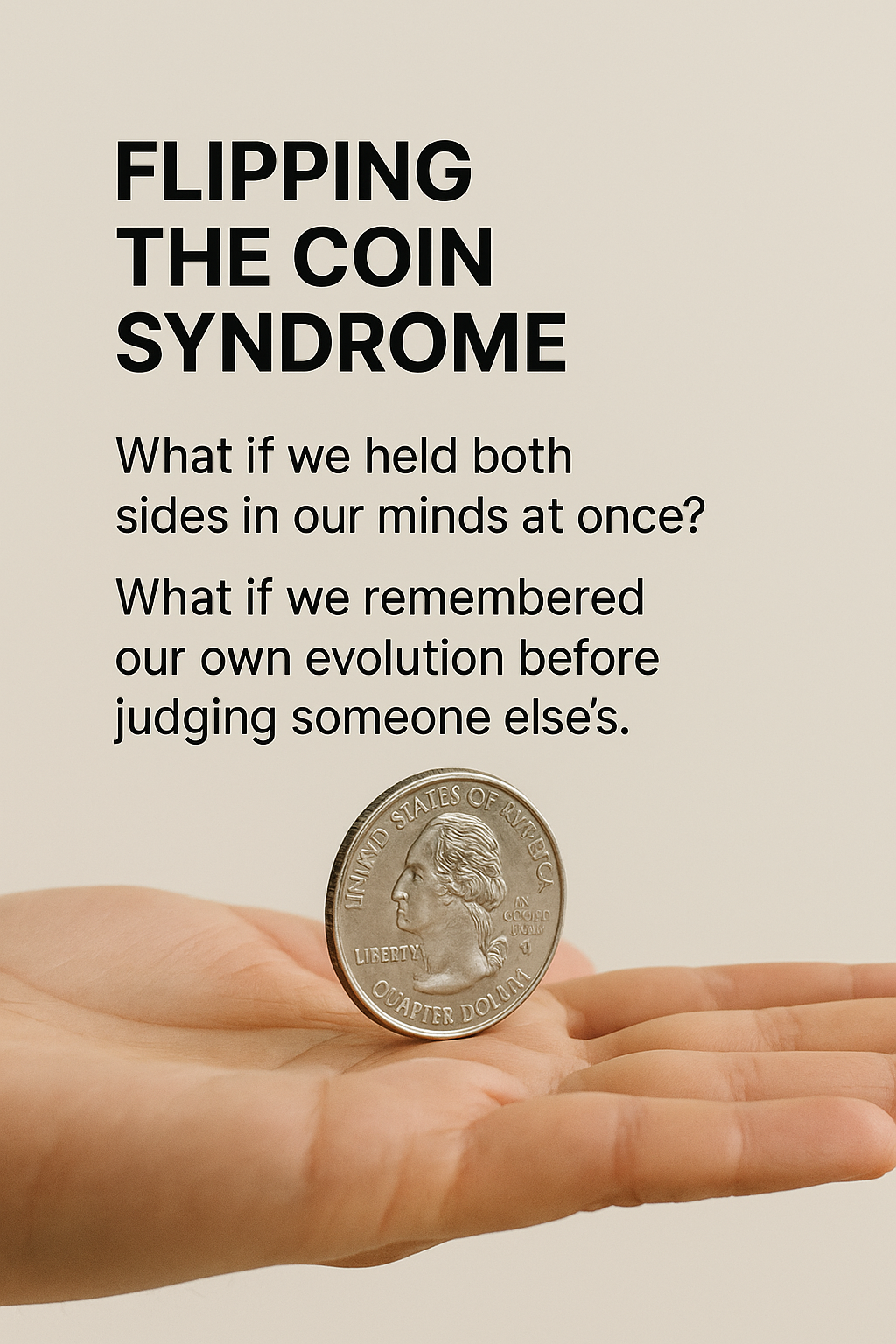 Have you ever noticed how easy it is to forget what you once believed? We humans have a strange habit I call “Flipping the Coin Syndrome.” We treat our beliefs like a coin in our hand. When we’re staring at one side—the side we now agree with—it feels like the only truth. We forget that the other side even exists. When we learn something new, it’s as if the old belief evaporates. We distance ourselves from it. We disown it. And then, ironically, we often start judging anyone who still holds that old view—as if we were never like them. We forget that the coin still has two sides. Think about it:
In all these cases, the judgment carries a kind of convenient amnesia. It’s as if we want to deny the simple truth that we once stood exactly where they’re standing now. Why do we do this? Perhaps because it’s uncomfortable to hold both sides of the coin in our mind at once. To admit that both perspectives have a reality to them. That our past self wasn’t simply “wrong,” but growing. That the people we’re judging are simply in process, just like we are. We prefer certainty. Simplicity. The security of believing: “Now I’m right. Then I was wrong.” “I’m enlightened. They’re lost.” But reality is rarely so neat. The Cost of Forgetting When we forget the other side of the coin, we don’t just lose empathy for others. We lose humility. We lose the chance to see ourselves as travelers on a path rather than owners of the truth. We also close the door on learning even more. Because what if the side we’re dismissing still has something to teach us? Holding Both Sides What if, instead, we practiced remembering? Remembering where we used to be. Remembering that growth is messy and slow. Remembering that certainty can be a cage. Imagine looking at someone you’re tempted to judge and asking: “What did it feel like to see the world the way they do?” “What did I need when I was there?” “How would I have wanted someone to treat me?” That’s not weakness. It’s wisdom. An Invitation We don’t have to flatten complexity. We can hold it. We can remember both sides of the coin at once. We can let our past selves humble us. We can let other people’s current struggles soften us. We can be firm in our values without forgetting our own evolution. Judgment shrinks the world. Compassion expands it. If you find yourself flipping the coin today, try holding it steady in your palm. Look at both sides. See the whole picture. You might find that truth is bigger than you thought. What’s a belief you’ve changed your mind about? How do you treat people who still hold the view you used to? 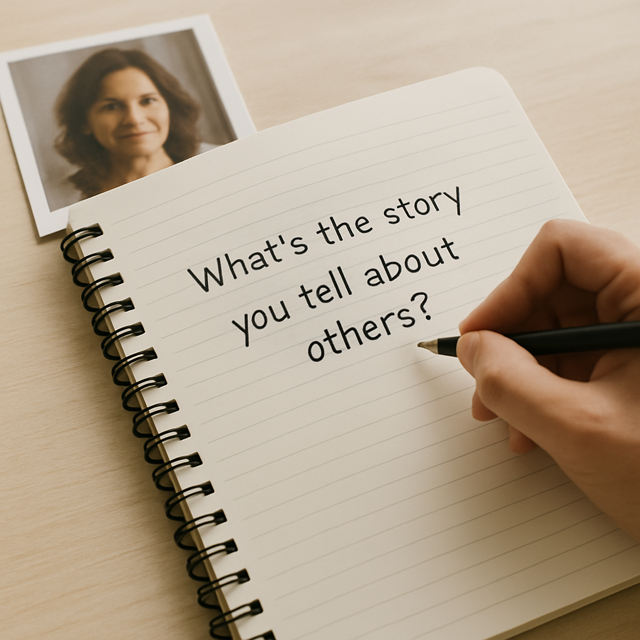 (Part of The Story Series) Introduction: Why This Story Matters We often believe that the state of our relationships depends on how others behave. But in truth, much of it depends on the story we’ve created about them in our mind. “She’s cold and doesn’t care about me.” “He’s manipulative.” “They always try to control me.” “They’re selfish. They’ll never change.” These stories may contain truths. They may have grown from real pain, real betrayal, or real patterns we’ve observed over time. But here’s what’s also true: The story we tell about someone becomes the lens through which we see them. And over time, that lens becomes a wall. It holds us back from forgiveness. It keeps us distant from people we may still care about. It locks us in resentment and prevents us from healing. Sometimes, these stories even bleed into how we relate to other people, causing patterns of mistrust, avoidance, or guardedness in entirely new relationships. What’s Happening in the Mind When you’ve been hurt, your mind forms a narrative to protect you. It says: “This is what they did. This is who they are. And I won’t let it happen again.” The brain links pain with identity: “This person caused this pain — therefore, they are dangerous.” It’s a survival instinct — but it can become a spiritual and emotional prison. Even if the story is partly true (e.g. “they are manipulative”), it becomes an identity label. And when we see someone only through their ego patterns, we stop seeing their humanity. An Example: The Manipulator Let’s say someone in your life constantly manipulates you. It’s exhausting. It’s real. You’ve felt used, maybe even emotionally twisted. So the story becomes: “They’re a manipulative person who’s always trying to get what they want.” But now pause — and go deeper. Ask yourself:
Maybe manipulation was the only way they could get love, safety, or validation when they were young. Maybe they still use it because they don’t know how to ask for their needs honestly. Understanding this doesn’t excuse the behavior — it softens your heart, so you don’t meet pain with more pain. A Powerful Example: The Movie “Pig” In the film Pig, the main character seeks revenge for the loss of his beloved animal. When he finally meets the man who stole from him, he doesn’t attack or retaliate. Instead, he cooks him a meal — a dish tied to a loving memory the man shared with his wife who is now unconscious due to illness. That act bypassed the ego and touched the man’s heart. The wall crumbled. Emotion broke through. And healing began. This is what happens when we stop fighting the ego and begin speaking to the soul. Compassion is Not Weakness This work is not about denying your hurt, or pretending everything’s okay. It’s not about letting people continue to harm you. It’s about choosing to see the full picture, so your responses come from clarity, not pain. You can:
Why This Work Is Hard (and Worth It) Some people may still trigger you. You may rewrite the story one day, then snap back into the old version the next. That’s okay. It’s all part of reconditioning the mind. You’re not trying to erase the old story in one sitting. You’re practicing a new way of seeing. And with practice, you’ll return to your heart more easily and more often. Your Reflection Practice Choose someone in your life who is important to you — especially someone with whom you’ve had conflict, distance, or emotional pain. This can be someone from the past or present. Then journal through the following prompts:
Your Assignment
Closing Thought When you change your story about others, you don’t just heal the relationship — you heal your own heart. You stop carrying old pain forward. You soften the space between you and them. And even if they never change, you do. And that change? That peace? That shift in energy? It changes everything. Read: Part 1: The Story We Tell About Ourselves Part 3: The Story We Tell About the World  Community Garden, South Laguna Bluff, California, USA What if you could tune into the same brainwave frequency as monks during moments of enlightenment? What if insight wasn’t just mental — but divine? This is where Gamma comes in. Often overlooked in everyday life, Gamma is the brainwave state linked to the highest forms of consciousness, the aha! moments that feel like downloads from beyond, and even spiritual awakening. But Gamma doesn’t show up randomly. It’s a state you can prepare for — and invite. What Are Gamma Waves? Gamma brainwaves range from 30 to 100 Hz, the fastest of all brain frequencies. These waves are associated with:
When you experience a sudden epiphany — the kind that changes your life — you’re likely in a gamma burst. It’s your brain creating an instantaneous global connection, fusing memory, insight, emotion, and intuition into one flash of clarity. Gamma in Mystics, Monks, and Moments of Awakening In groundbreaking research, neuroscientists observed elevated gamma activity in the brains of advanced Tibetan monks during meditation. These monks weren’t just calm — they were in a state of profound, expansive awareness. Love-based meditations, in particular, triggered the most powerful gamma waves. These findings suggest that gamma isn’t just about cognition. It may be the neural signature of transcendence — the bridge between the personal and the divine. How Gamma and Alpha Work Together Think of Alpha as the fertile ground. It’s where you relax, open your awareness, and quiet the noise. Gamma is the lightning strike. It’s the moment the insight arrives, fully formed. Together, they form the perfect flow state:
Your goal isn’t to chase Gamma — but to create the conditions for it to arise. Practices That Induce Gamma States You don’t have to live in a monastery to access gamma. These practices have been shown to boost gamma activity and support spiritual downloads: 1. Insight Meditation Rather than emptying the mind, this style focuses attention on a single subject (a question, concept, or sensation) while observing arising insights without judgment. It combines clarity with curiosity — a recipe for gamma bursts. 2. Breathwork Rhythmic or conscious breathing techniques can alter brainwave patterns, especially when paired with emotional release. Gamma often appears after strong somatic breakthroughs. 3. Deep Focus (Flow States) When fully immersed in a creative, intellectual, or physical activity, your brain can enter “flow” — a state associated with both alpha and gamma synchronization. 4. Acts of Love and Compassion Heart-based states (like gratitude, empathy, and unconditional love) elevate not just your mood, but your frequency. Studies show these emotions correlate with increased gamma activity and neural coherence. How to Invite Gamma Into Your Daily Life The more often you create space, the more likely your brain is to deliver insight. Here’s how to build a gamma-friendly lifestyle: Stillness Windows Designate sacred “alpha zones” during your day — no phone, no noise, just presence. These might include:
See more details about Alpha Brainwave in Part 2. Ask Powerful Questions Gamma breakthroughs often follow curious inquiry. Use questions like:
Let the answers come later — in a flash. Final Insight: Epiphanies Are Spiritual Invitations Gamma is more than a brainwave. It’s a state of divine intelligence. It’s when the veil thins… and something greater than you whispers through the neurons. When you get the message, don’t just admire it — act on it. Because real transformation doesn’t happen when you understand something. It happens when you become it. Read: Part 1: The Neuroscience of Epiphanies: Why Sudden Realizations Can Change Your Life Instantly Part 2: Relax to Receive — Why the Alpha Brainwave Is the Gateway to Spiritual Insight Part 4: The Portal of Dreams - How Theta Brainwaves Reveal Your Soul's Voice Part 5: Breaking Free from Mental Noise - Escapting Beta Overdrive to Find Peace Part 6: The State Shifter - How to Move Between Brainwave States to Master Your Mind & Life  Pinnacles National Park, California, USA What if God experiences life through us, and through our ability to love and forgive, we experience God? This profound idea redefines compassion, empathy, and forgiveness as not just moral virtues but spiritual practices that bring us closer to the divine. By embodying these qualities, we dissolve the illusion of separateness and open ourselves to the truth of oneness. God’s Infinite Experience If God is infinite and all-encompassing, then every experience—joy, sorrow, love, and pain—flows through God. Imagine God not as a distant observer but as an intimate participant, feeling the world through our eyes, hearts, and actions. This perspective explains the boundless forgiveness and compassion often attributed to God. How could a being that experiences life through all of us condemn? Judgment fades in the presence of deep understanding, and divine compassion becomes the natural response to human imperfection. Compassion: The Gateway to Oneness Compassion, empathy, and forgiveness are often seen as acts of kindness toward others, but they are also pathways to divine connection. When we forgive someone, we see beyond their actions and connect with their humanity. When we empathize, we transcend the boundaries of self and other, recognizing that their pain is not separate from our own. In these moments, we step into the divine flow of oneness. We aren’t just connecting with another person; we’re aligning with the essence of God. Experiencing God Through Action Many seek to understand God through prayer, meditation, or scripture. While these practices are invaluable, there’s another, often overlooked way to experience the divine: by embodying God-like qualities. • Compassion: When we offer compassion to others, we act as vessels of divine love. We create a space where others feel seen, understood, and accepted—just as God does for us. • Forgiveness: Forgiveness isn’t about excusing harm but about freeing ourselves from the chains of resentment. In forgiving, we reflect God’s infinite capacity for understanding. • Empathy: When we feel another’s pain as our own, we dissolve the illusion of separateness and touch the truth of our interconnectedness. By embodying these qualities, we don’t just know God; we experience God within and through us. Barriers to Divine Connection If compassion and forgiveness bring us closer to God, then what happens when we act without them? Judgment, anger, and resentment create a sense of separation—not just between ourselves and others but also between ourselves and the divine. These barriers are illusions, but they feel real because they’re rooted in the ego’s desire to protect its identity. The antidote is simple yet profound: practice compassion, even when it feels difficult. Forgive, even when it feels undeserved. In doing so, we don’t just heal relationships; we also heal the separation within ourselves and reconnect with God’s presence. Living as the Divine To live compassionately is to embody the essence of God. When we approach the world with love, empathy, and forgiveness, we become reflections of the divine. And in those moments, we don’t just sense God—we become one with God. So, the next time you feel compassion for someone, realize that you’re not just being kind; you’re touching the infinite. And when you forgive, remember that you’re stepping into the boundless love that flows through all of creation. By aligning with these divine qualities, we move closer to the truth of oneness—where God is not something we reach for, but something we are. A Call to Action Take a moment today to reflect: where in your life can you offer more compassion or forgiveness? Perhaps it’s toward a loved one, a stranger, or even yourself. Try to embody that divine quality and notice the shift it creates—not just in the world around you, but in your own heart. If this message resonates with you, I’d love to hear your thoughts or experiences. How have you experienced compassion as a spiritual practice? Let’s continue this conversation about oneness and divine connection in the comments below. 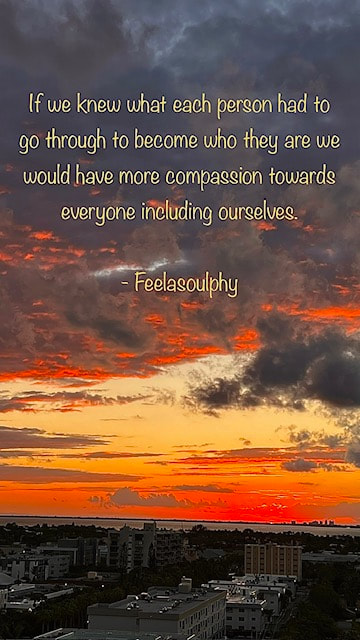 If we knew what each person had to go through to become who they are we would have had more compassion towards everyone including ourselves. - Feelasoulphy |
AuthorFeelasoulphy Categories
All
Archives
March 2026
|
 RSS Feed