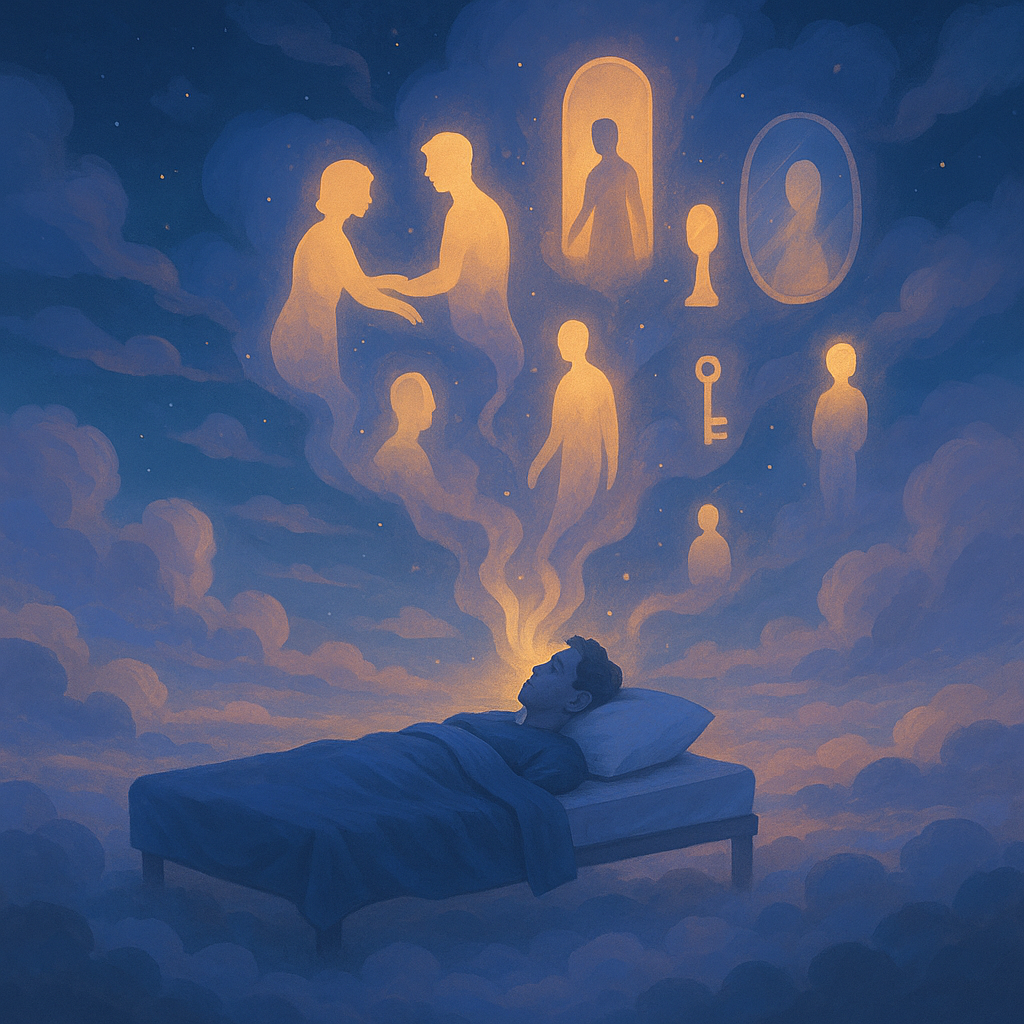
 Use your dreams to track your healing, rewiring, and evolution. Here’s a little-known truth: If you behave differently in your dreams than you did in the past… that means you’ve already reconditioned your mind. You’ve rewired your brain on a deep, subconscious level. Why? Because dreams are not random. They are generated by your subconscious, the part of your mind that stores your emotional patterns, core beliefs, traumas, and triggers—long after your conscious mind has moved on. So when a situation shows up again in a dream—an ex, a fear, a fight—and this time you respond calmly or wisely or with power, you didn’t just dream it. You became it. Psychological Insight: Behavior Shift in Dreams = Subconscious Rewiring In behavioral psychology, our reactions are often automatic—especially under stress. Dreams simulate stress, emotion, and choice in surreal ways. If your instinctual response in a dream changes, it means your internal conditioning has shifted. You didn’t “decide” to change in the dream. You just acted. That’s how you know the change is real—it bypassed the thinking mind. Neuroscience Supports This Too
Dreams as a Spiritual Classroom Most things that happen in our dreams will never happen in real life. And that’s what makes them so valuable. They give you emotional simulations—safe environments to re-experience old wounds, future scenarios, or alternate versions of the self. Why did I make that choice in the dream? Would I act the same in real life? Why or why not? Since all the characters are projections of your perception of the world, every interaction is a conversation with yourself. Create a Morning Dream Practice (Before You Forget!)
My Personal Discovery I once watched a movie before bed and dreamed of an ex I hadn’t thought of in years. The dream wasn’t about her—it was about an unresolved emotion the movie triggered. I analyzed the dream the next morning, traced the emotion back to the memory, and felt it fully. That’s when it lifted. I let it go, completely. That one dream gave me more healing than months of overthinking. Final Thought: When your dreams start changing, your healing is already happening. You don’t need proof from the outside world—your subconscious has spoken. Use your dreams like a mirror. Learn from them. Talk to them. Let them show you what still hurts, and celebrate when something no longer does. Because when you act differently in a dream… you are no longer the same.
1 Comment
 Sunset at James Lick Observatory, Mt. Hamilton, San Jose, California, USA Our minds are a complex system of two primary components: the conscious and the subconscious. While they work together seamlessly, each has distinct roles depending on the state we are in—awake, asleep, or meditating. Understanding this dynamic can help us tap into deeper insights and maximize our mental potential. The Roles of Conscious and Subconscious Minds Conscious Mind: • The seat of focus, logic, and deliberate thought. • Active during tasks requiring attention, problem-solving, and decision-making. Subconscious Mind: • A vast memory bank, storing all experiences, emotions, and information. • Operates automatically, running habits, retrieving memories, and processing emotions in the background. How the Two Minds Interact 1. In Daily Life: • When awake and focused, the conscious mind leads, while the subconscious supports by providing background data (e.g., recalling memories or automatic skills). • Example: Driving a familiar route while consciously thinking about other things relies heavily on the subconscious. 2. In Sleep and Dreams: • During sleep, the subconscious dominates, creating dreams by piecing together fragmented memories. • The conscious mind typically takes a backseat unless you experience lucid dreaming, where awareness emerges within the dream state. 3. In Relaxed States: • When relaxed, such as in the alpha brainwave state, the subconscious becomes more active. This is why daydreaming and wandering thoughts occur effortlessly. • The conscious mind shifts to an observer role, which allows for contemplation and creative connections. Meditation: A Bridge Between the Two Minds Meditation offers a unique opportunity to balance the two minds: • The conscious mind quiets down, stepping into the role of a calm observer. • The subconscious becomes more accessible, revealing forgotten memories or making unexpected connections. In this state, insights often emerge because the subconscious processes information in a non-linear way, free from the constraints of conscious logic. Writing down these realizations after meditation ensures they don’t fade away. Epiphanies and Creative Breakthroughs Ever had a great idea seemingly out of nowhere? That’s the result of your subconscious working in the background. Even when the conscious mind moves on to something else, the subconscious continues processing information. When the two minds synchronize, this background processing can deliver surprising insights or solutions. This explains why moments of clarity often occur during relaxed states, like taking a walk, showering, or meditating. The Subconscious as a Memory Bank The subconscious is like a hard drive—it stores everything, but it isn’t always organized. • Dreams, for instance, can feel chaotic because the subconscious tries to link unrelated memories. • Without conscious intervention, it can seem as if the subconscious has “a mind of its own,” creating unexpected scenarios that even surprise us. By taking time to reflect, meditate, or write down these thoughts, we can give structure to this vast storehouse of information. Practical Takeaways 1. Meditate Regularly: • Use meditation to quiet the conscious mind and gain access to subconscious insights. • Don’t try to analyze during meditation—just observe. 2. Write Things Down: • Whether it’s a dream, a random thought, or a moment of clarity, writing helps organize subconscious material for conscious analysis later. 3. Leverage Relaxed States: • Activities like walking, daydreaming, or light meditation allow the subconscious to take the lead. These moments often spark creativity or problem-solving. 4. Trust the Process: • Understand that the subconscious works in the background, even when you’re not aware of it. By consciously creating time for relaxation, you open the door to unexpected insights. Conclusion The interplay between the conscious and subconscious mind is a remarkable system of balance. By learning how to work with both—letting the subconscious process while the conscious observes and organizes—we can achieve greater clarity, creativity, and self-awareness. |
AuthorFeelasoulphy Categories
All
Archives
March 2026
|
 RSS Feed