 “What if the world was always this vivid—and we just forgot to pay attention?” Most of us eat distracted. We’re watching TV. Scrolling. Talking over dinner. We don’t even taste our food. But one day, I learned what it was like to really eat. I was on an edible. I remember biting into a kiwi. Suddenly, it was electric. Juicy. Tart. Sweet. The texture of the seeds. The smell of the fruit. Every sense was awake. Even watching a movie, I felt more emotional, more attuned to what was happening on screen. It was like my empathy was dialed up—I could sense what the characters felt. It was such a strange gift. Why did this happen? It turns out this isn’t magic. It’s attention. Edibles (like cannabis) can reduce activity in the default mode network (DMN)—the part of the brain responsible for mind-wandering and constant self-narration. When the DMN quiets down, sensory networks become more active. Emotions and empathy rise to the surface. In other words: When you’re really here, you really feel. Eating is special Eating is one of the few everyday activities that naturally engages all our senses: Sight: color, shape, presentation. Smell: aroma. Taste: layers of flavor. Touch: texture, weight. Sound: crunch, slurp, chew. It’s designed to be immersive. But we numb it by multitasking and rushing. When you actually focus? It’s an experience. It’s not just food—it’s people This kind of presence doesn’t just change eating. It changes how we connect with others. When you really listen to someone—without waiting to talk, without checking your phone—you hear them on a different level. You notice subtle emotions in their voice. You see the story in their eyes. You feel with them, not just next to them. Presence is the foundation of empathy. And empathy is what deepens connection. Science agrees Mindfulness meditation reduces DMN activity, just like certain drugs can—but without side effects. It increases interoceptive awareness (body sensations) and sensory acuity. It also strengthens brain regions linked to empathy and compassion (anterior cingulate, insula). Long-term meditation practice literally rewires the brain for presence. Drugs vs. Meditation Drugs can open the door to this state. They show you how present you could be. But they don’t train you to stay there. Meditation does. Presence practice does. It’s a lifelong shift, not a temporary escape. Try This: A Mindful Eating Practice Pick something simple. A kiwi. An apple. Chocolate. Look at it carefully. Color. Shape. Smell it. Take a slow bite. Chew carefully. Feel the texture. Notice the sound. Taste all the flavors. Keep bringing your mind back when it drifts. This isn’t just about food. It’s a training ground for attention. A Practice for Connection Next time you’re with someone: Put the phone away. Look them in the eyes. Really listen. Notice tone, words, pauses. Feel what they’re feeling. Watch how the conversation changes. Watch how you change. Final Reflection That kiwi taught me that life is always offering something beautiful—if I’m willing to really show up for it. Food can be spiritual. Conversations can be sacred. This moment can be everything. Presence turns ordinary life into holy ground.
0 Comments
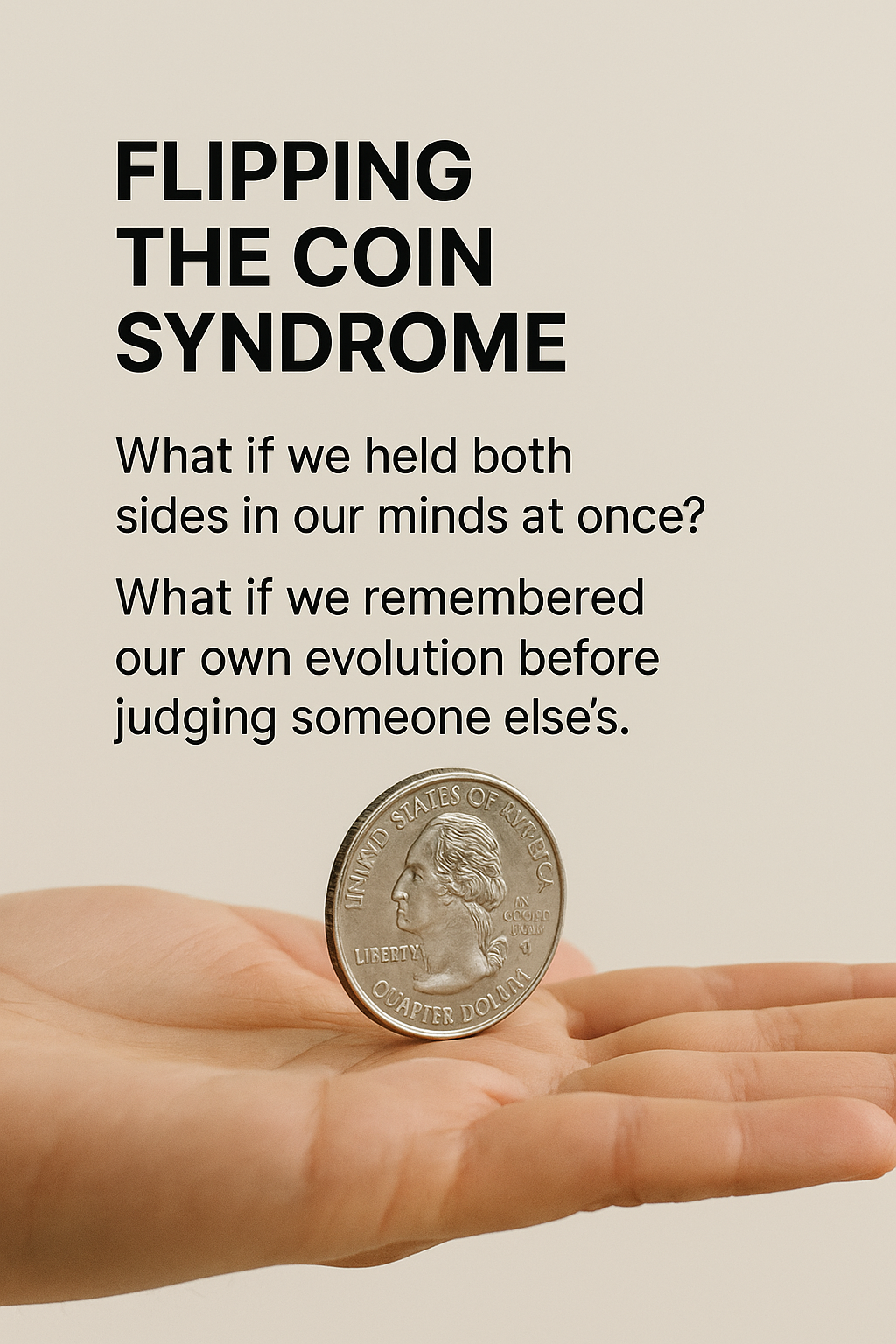 Have you ever noticed how easy it is to forget what you once believed? We humans have a strange habit I call “Flipping the Coin Syndrome.” We treat our beliefs like a coin in our hand. When we’re staring at one side—the side we now agree with—it feels like the only truth. We forget that the other side even exists. When we learn something new, it’s as if the old belief evaporates. We distance ourselves from it. We disown it. And then, ironically, we often start judging anyone who still holds that old view—as if we were never like them. We forget that the coin still has two sides. Think about it:
In all these cases, the judgment carries a kind of convenient amnesia. It’s as if we want to deny the simple truth that we once stood exactly where they’re standing now. Why do we do this? Perhaps because it’s uncomfortable to hold both sides of the coin in our mind at once. To admit that both perspectives have a reality to them. That our past self wasn’t simply “wrong,” but growing. That the people we’re judging are simply in process, just like we are. We prefer certainty. Simplicity. The security of believing: “Now I’m right. Then I was wrong.” “I’m enlightened. They’re lost.” But reality is rarely so neat. The Cost of Forgetting When we forget the other side of the coin, we don’t just lose empathy for others. We lose humility. We lose the chance to see ourselves as travelers on a path rather than owners of the truth. We also close the door on learning even more. Because what if the side we’re dismissing still has something to teach us? Holding Both Sides What if, instead, we practiced remembering? Remembering where we used to be. Remembering that growth is messy and slow. Remembering that certainty can be a cage. Imagine looking at someone you’re tempted to judge and asking: “What did it feel like to see the world the way they do?” “What did I need when I was there?” “How would I have wanted someone to treat me?” That’s not weakness. It’s wisdom. An Invitation We don’t have to flatten complexity. We can hold it. We can remember both sides of the coin at once. We can let our past selves humble us. We can let other people’s current struggles soften us. We can be firm in our values without forgetting our own evolution. Judgment shrinks the world. Compassion expands it. If you find yourself flipping the coin today, try holding it steady in your palm. Look at both sides. See the whole picture. You might find that truth is bigger than you thought. What’s a belief you’ve changed your mind about? How do you treat people who still hold the view you used to?  (Part of The Story Series) Introduction: Why This Story Matters We often believe that the state of our relationships depends on how others behave. But in truth, much of it depends on the story we’ve created about them in our mind. “She’s cold and doesn’t care about me.” “He’s manipulative.” “They always try to control me.” “They’re selfish. They’ll never change.” These stories may contain truths. They may have grown from real pain, real betrayal, or real patterns we’ve observed over time. But here’s what’s also true: The story we tell about someone becomes the lens through which we see them. And over time, that lens becomes a wall. It holds us back from forgiveness. It keeps us distant from people we may still care about. It locks us in resentment and prevents us from healing. Sometimes, these stories even bleed into how we relate to other people, causing patterns of mistrust, avoidance, or guardedness in entirely new relationships. What’s Happening in the Mind When you’ve been hurt, your mind forms a narrative to protect you. It says: “This is what they did. This is who they are. And I won’t let it happen again.” The brain links pain with identity: “This person caused this pain — therefore, they are dangerous.” It’s a survival instinct — but it can become a spiritual and emotional prison. Even if the story is partly true (e.g. “they are manipulative”), it becomes an identity label. And when we see someone only through their ego patterns, we stop seeing their humanity. An Example: The Manipulator Let’s say someone in your life constantly manipulates you. It’s exhausting. It’s real. You’ve felt used, maybe even emotionally twisted. So the story becomes: “They’re a manipulative person who’s always trying to get what they want.” But now pause — and go deeper. Ask yourself:
Maybe manipulation was the only way they could get love, safety, or validation when they were young. Maybe they still use it because they don’t know how to ask for their needs honestly. Understanding this doesn’t excuse the behavior — it softens your heart, so you don’t meet pain with more pain. A Powerful Example: The Movie “Pig” In the film Pig, the main character seeks revenge for the loss of his beloved animal. When he finally meets the man who stole from him, he doesn’t attack or retaliate. Instead, he cooks him a meal — a dish tied to a loving memory the man shared with his wife who is now unconscious due to illness. That act bypassed the ego and touched the man’s heart. The wall crumbled. Emotion broke through. And healing began. This is what happens when we stop fighting the ego and begin speaking to the soul. Compassion is Not Weakness This work is not about denying your hurt, or pretending everything’s okay. It’s not about letting people continue to harm you. It’s about choosing to see the full picture, so your responses come from clarity, not pain. You can:
Why This Work Is Hard (and Worth It) Some people may still trigger you. You may rewrite the story one day, then snap back into the old version the next. That’s okay. It’s all part of reconditioning the mind. You’re not trying to erase the old story in one sitting. You’re practicing a new way of seeing. And with practice, you’ll return to your heart more easily and more often. Your Reflection Practice Choose someone in your life who is important to you — especially someone with whom you’ve had conflict, distance, or emotional pain. This can be someone from the past or present. Then journal through the following prompts:
Your Assignment
Closing Thought When you change your story about others, you don’t just heal the relationship — you heal your own heart. You stop carrying old pain forward. You soften the space between you and them. And even if they never change, you do. And that change? That peace? That shift in energy? It changes everything. Read: Part 1: The Story We Tell About Ourselves Part 3: The Story We Tell About the World  Pinnacles National Park, California, USA What if God experiences life through us, and through our ability to love and forgive, we experience God? This profound idea redefines compassion, empathy, and forgiveness as not just moral virtues but spiritual practices that bring us closer to the divine. By embodying these qualities, we dissolve the illusion of separateness and open ourselves to the truth of oneness. God’s Infinite Experience If God is infinite and all-encompassing, then every experience—joy, sorrow, love, and pain—flows through God. Imagine God not as a distant observer but as an intimate participant, feeling the world through our eyes, hearts, and actions. This perspective explains the boundless forgiveness and compassion often attributed to God. How could a being that experiences life through all of us condemn? Judgment fades in the presence of deep understanding, and divine compassion becomes the natural response to human imperfection. Compassion: The Gateway to Oneness Compassion, empathy, and forgiveness are often seen as acts of kindness toward others, but they are also pathways to divine connection. When we forgive someone, we see beyond their actions and connect with their humanity. When we empathize, we transcend the boundaries of self and other, recognizing that their pain is not separate from our own. In these moments, we step into the divine flow of oneness. We aren’t just connecting with another person; we’re aligning with the essence of God. Experiencing God Through Action Many seek to understand God through prayer, meditation, or scripture. While these practices are invaluable, there’s another, often overlooked way to experience the divine: by embodying God-like qualities. • Compassion: When we offer compassion to others, we act as vessels of divine love. We create a space where others feel seen, understood, and accepted—just as God does for us. • Forgiveness: Forgiveness isn’t about excusing harm but about freeing ourselves from the chains of resentment. In forgiving, we reflect God’s infinite capacity for understanding. • Empathy: When we feel another’s pain as our own, we dissolve the illusion of separateness and touch the truth of our interconnectedness. By embodying these qualities, we don’t just know God; we experience God within and through us. Barriers to Divine Connection If compassion and forgiveness bring us closer to God, then what happens when we act without them? Judgment, anger, and resentment create a sense of separation—not just between ourselves and others but also between ourselves and the divine. These barriers are illusions, but they feel real because they’re rooted in the ego’s desire to protect its identity. The antidote is simple yet profound: practice compassion, even when it feels difficult. Forgive, even when it feels undeserved. In doing so, we don’t just heal relationships; we also heal the separation within ourselves and reconnect with God’s presence. Living as the Divine To live compassionately is to embody the essence of God. When we approach the world with love, empathy, and forgiveness, we become reflections of the divine. And in those moments, we don’t just sense God—we become one with God. So, the next time you feel compassion for someone, realize that you’re not just being kind; you’re touching the infinite. And when you forgive, remember that you’re stepping into the boundless love that flows through all of creation. By aligning with these divine qualities, we move closer to the truth of oneness—where God is not something we reach for, but something we are. A Call to Action Take a moment today to reflect: where in your life can you offer more compassion or forgiveness? Perhaps it’s toward a loved one, a stranger, or even yourself. Try to embody that divine quality and notice the shift it creates—not just in the world around you, but in your own heart. If this message resonates with you, I’d love to hear your thoughts or experiences. How have you experienced compassion as a spiritual practice? Let’s continue this conversation about oneness and divine connection in the comments below. |
AuthorFeelasoulphy Categories
All
Archives
March 2026
|
 RSS Feed