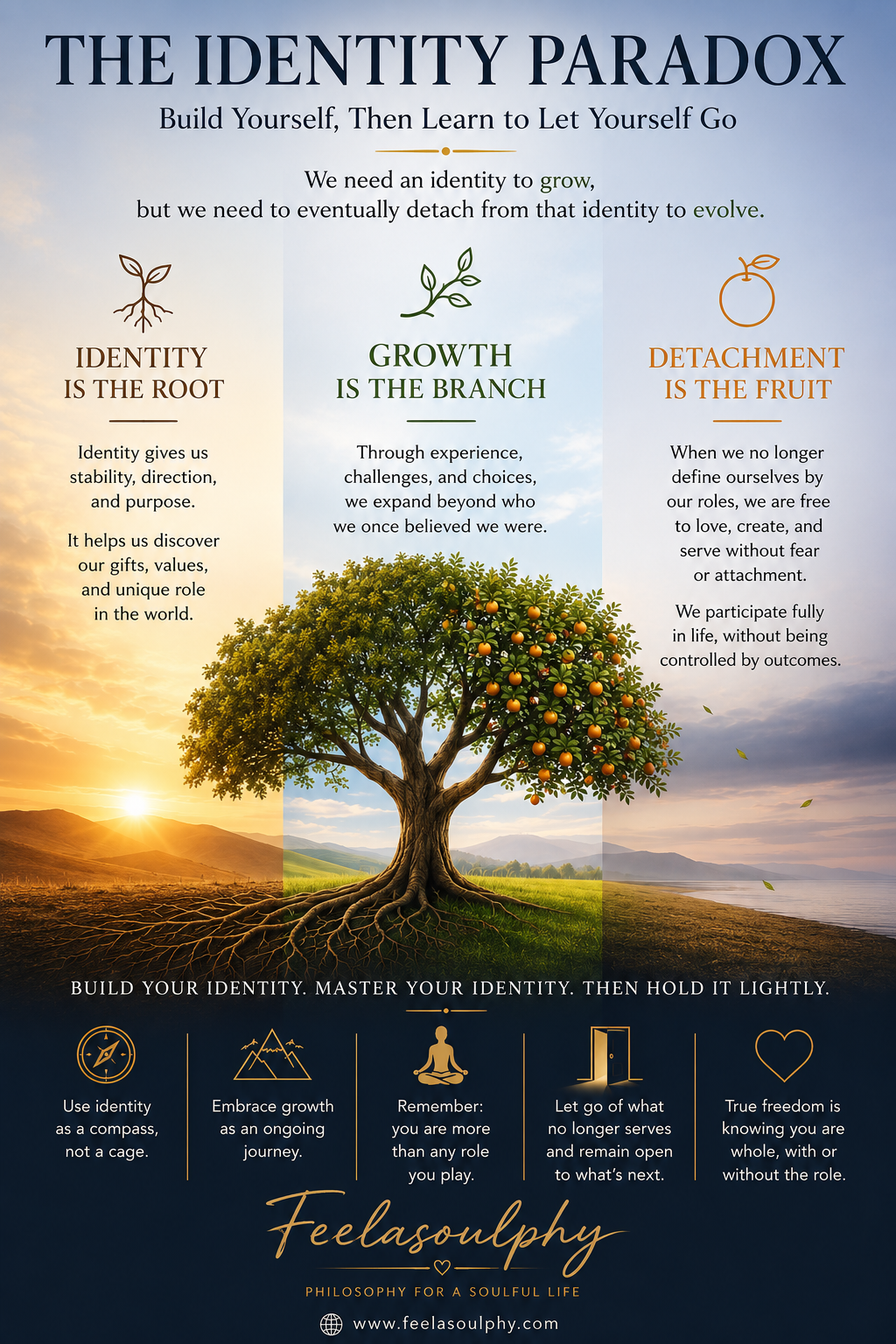
 One of the greatest paradoxes of human growth is this:
We need an identity to grow, but we need to eventually detach from that identity to evolve. Identity is a powerful force. It gives us direction, meaning, and a sense of purpose. It answers the question: “Who am I, and how do I contribute to this world?” A child begins this journey by discovering the self. “I am creative.” “I am intelligent.” “I am a helper.” “I am a leader.” As we grow older, we continue building identities through our experiences: “I am a teacher.” “I am an entrepreneur.” “I am a parent.” “I am an artist.” “I am a healer.” These identities are not the enemy. They are essential parts of our development. They help us discover our gifts, develop discipline, and create meaningful contributions to the world. But every tool that helps us build can also become something that limits us if we become attached to it. The same identity that gives us purpose can eventually become the source of our suffering. A teacher may spend decades finding meaning through teaching. But when the classroom disappears, when there are no more students, or when retirement arrives, they may ask: "Who am I now?" An entrepreneur may build a successful company and gain recognition from the world. But when the business struggles, they may feel as if they themselves are failing. A person who dedicates their life to helping others may discover that they feel empty when nobody needs their help. The problem is not the role. The problem is confusing the role with the self. We forget that identity is something we create and express. It is not the entirety of who we are. A teacher is not valuable because they have students. A leader is not valuable because people follow them. A healer is not valuable because others depend on them. Their value exists before the role begins and remains after the role ends. Identity Is the Root. Growth Is the Branch. Detachment Is the Fruit. A tree needs roots before it can reach toward the sky. Without roots, it cannot grow. Identity is the root. It gives us stability. It anchors us. It allows us to discover our strengths and develop our unique expression in the world. But a tree does not exist only to grow roots. The roots are there to support expansion. Growth is the branch. Through experiences, challenges, successes, and failures, we expand beyond our original understanding of ourselves. We discover that we are capable of more than we once imagined. The child becomes the adult. The student becomes the teacher. The follower becomes the leader. But even branches are not the final destination. Eventually, we must produce fruit. Detachment is the fruit. Detachment does not mean abandoning our identity or losing passion for what we do. It means we can fully embrace our role without being imprisoned by it. A person who is attached says: "I am a teacher, therefore I must always teach to be whole." A person who is free says: "Teaching is one beautiful expression of who I am, but my existence is greater than this role." A person who is attached says: "I need success to know I am worthy." A person who is free says: "I will pursue excellence, but my worth does not rise and fall with my achievements." True detachment allows us to participate fully in life without being controlled by the outcomes. The Spiritual Evolution of Identity Many spiritual traditions teach that suffering comes from attachment. But attachment does not only happen with material possessions. We can become attached to ideas, beliefs, relationships, and even our own image of ourselves. Sometimes the strongest attachment is to the identity we are most proud of. “I am the successful one.” “I am the wise one.” “I am the person who helps everyone.” “I am the awakened one.” Even a spiritual identity can become another form of ego if we cling to it. The final stage of growth is not becoming someone special. It is realizing that beneath all identities, there is a deeper awareness that has always been present. We are not only the roles we play. We are the consciousness experiencing those roles. The Freedom of Holding Identity Lightly The goal is not to destroy the ego or eliminate identity. A person without a developed identity may lack direction. A person trapped by identity may lack freedom. The wisdom is to build the self, but hold it lightly. Become a great teacher, but remember you are more than a teacher. Become a great leader, but remember you are more than a leader. Become successful, but remember success is something you experience, not something you are. Life is a journey of becoming. First, we build ourselves. Then, we refine ourselves. Finally, we discover that the self we built was only one expression of something much greater. The deepest freedom comes when we can say: "I can fully embrace who I am today while remaining open to who I may become tomorrow." Build your identity. Master your identity. Then learn to let it go. Because the person who is attached to an identity can only live within its boundaries. But the person who is free can use any identity as a doorway to express the infinite possibilities within.
0 Comments
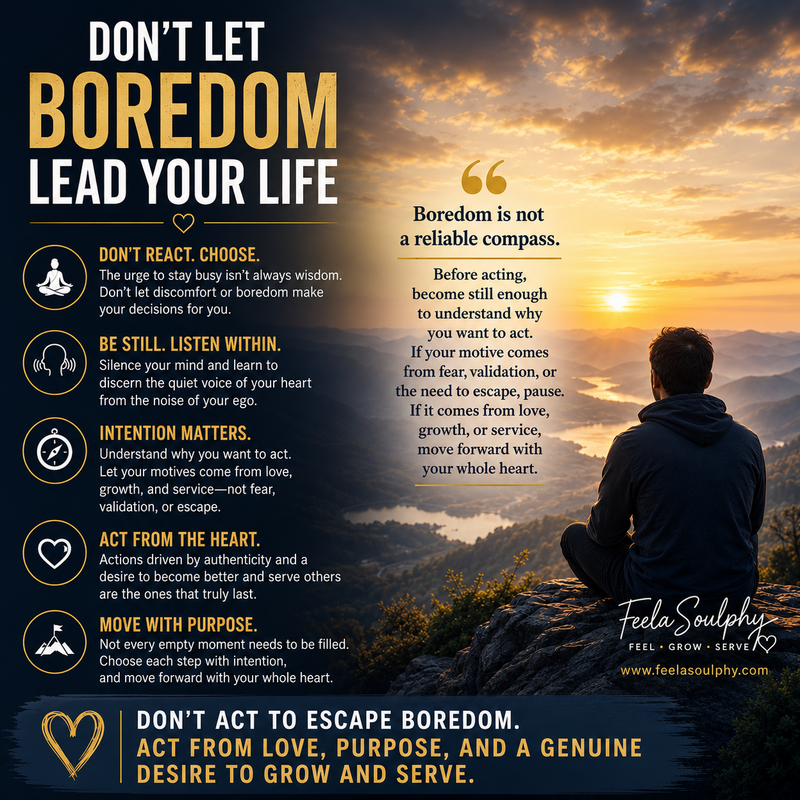 Don’t fill your time simply because you’re bored.
The urge to stay busy isn’t always wisdom. Often, it’s simply discomfort looking for an escape. When you allow that feeling to direct your choices, you’re reacting instead of choosing. Your ego—not your heart—begins to lead the way. Instead, be still. Be patient. Create space for silence. In that silence, learn to distinguish between the quiet voice of your heart and the endless noise of your restless mind. One leads you toward purpose. The other only seeks distraction. Stillness isn’t the opposite of action. It is what allows you to understand why you want to act. The reason behind your actions matters more than the actions themselves. If your motivation comes from loneliness, the need for validation, fear of missing out, or the desire to prove something, your enthusiasm will eventually fade. Ego can fuel ambition, but it rarely brings lasting peace or fulfillment. But when your actions are born from authenticity, love, curiosity, and a sincere desire to become a better person and to serve others, they are sustained by something much deeper. They no longer feel like obligations. They become expressions of who you are. Not every empty moment needs to be filled. A meaningful life isn’t built by filling every moment; it’s built by choosing each moment with intention. Sometimes the wisest thing you can do is pause—not because you’re waiting for life to happen, but because you’re making sure your next step is guided by purpose rather than restlessness. Boredom is not a reliable compass. Before acting, become still enough to understand why you want to act. If your motive comes from fear, validation, or the need to escape, pause. If it comes from love, growth, or service, move forward with your whole heart. Don’t act to escape boredom. Act from love, purpose, and a genuine desire to grow and serve. 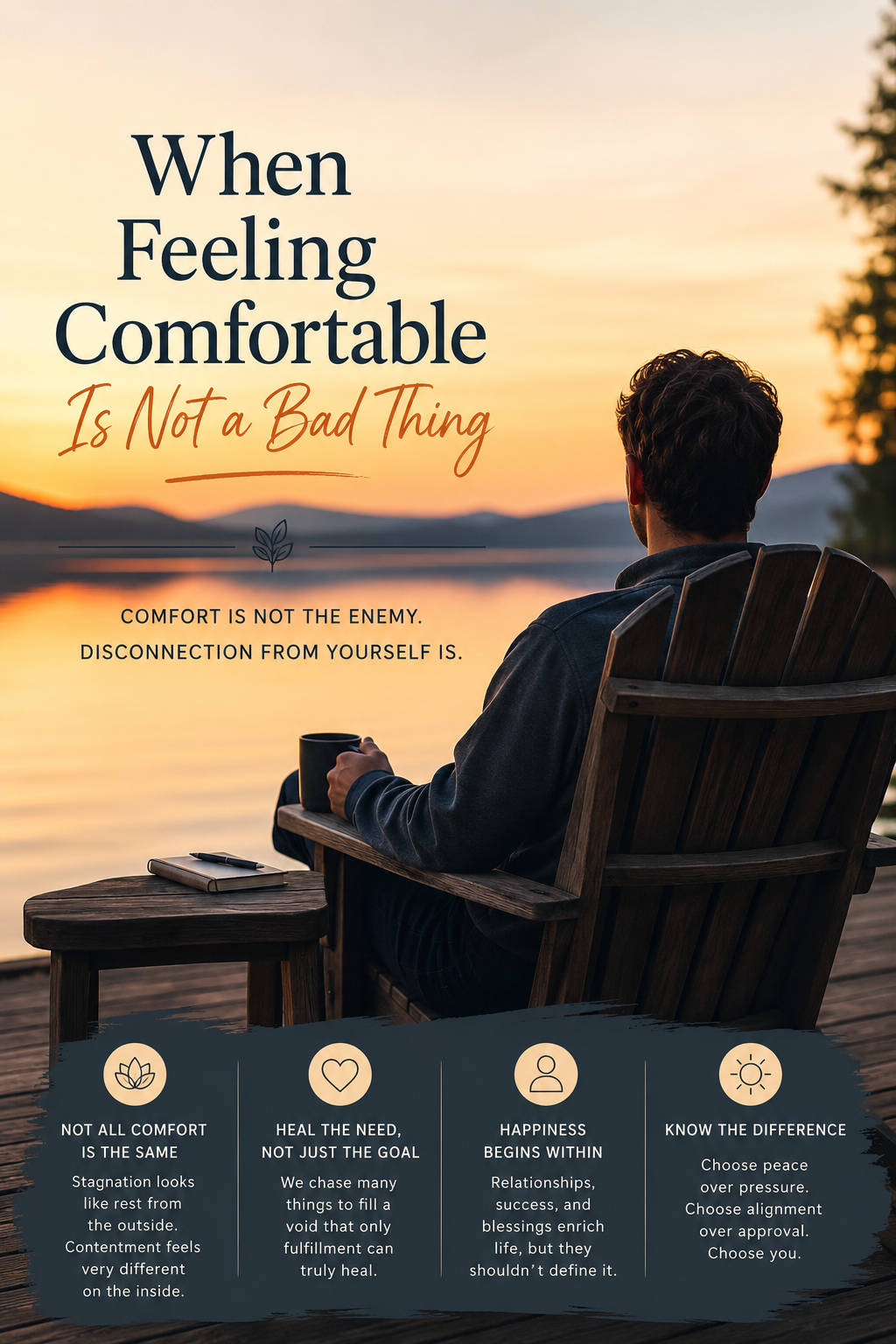 We live in a culture that is obsessed with growth.
Everywhere we look, we are told to work harder, hustle more, achieve bigger goals, and continuously improve ourselves. Social media is filled with messages encouraging us to leave our comfort zones because staying comfortable is often portrayed as the beginning of decline. The underlying message is clear: "If you're not moving forward, you're falling behind." But what if this belief is not always true? What if there are times when feeling comfortable is not a sign of laziness, complacency, or a lack of ambition? What if comfort is sometimes a sign that we have finally found peace? The Fear of Being Comfortable Many people are afraid of becoming too comfortable. They worry that if they stop striving, they will stop growing. If they stop achieving, they will lose their purpose. If they stop chasing goals, their lives will somehow become meaningless. As a result, they constantly search for the next mountain to climb. A promotion. A larger business. More money. More recognition. More accomplishments. There is nothing inherently wrong with pursuing these things. The question is why we pursue them. Are we driven by genuine passion? Or are we trying to fill a void within ourselves? Sometimes ambition is an expression of our purpose. Other times, ambition is simply insecurity wearing a disguise. Comfort Can Mean Two Very Different Things Not all comfort is created equal. There is a form of comfort that comes from avoidance. A person may avoid challenges because they are afraid of failure, rejection, or uncertainty. This type of comfort keeps people stuck. It prevents growth and limits their potential. But there is another form of comfort that comes from contentment. This comfort arises when a person no longer feels compelled to prove their worth through endless achievement. They recognize that their value does not increase with every accomplishment or decrease with every failure. They are comfortable not because they have given up on life, but because they have made peace with themselves. From the outside, these two forms of comfort can look exactly the same. Internally, they are worlds apart. The Business Owner Who Changed His Mind Imagine a man who has always dreamed of starting his own business. For years he tells himself that one day he will prove to everyone that he is capable of succeeding. He imagines the respect, admiration, and validation that will come with building something successful. Then something unexpected happens. He meets the love of his life. Over time, he becomes happier than he has ever been. His need to prove himself begins to fade. The urgency to start the business disappears. What happened? Many people would immediately conclude that he became complacent. But perhaps something deeper occurred. Maybe the business was never his true dream. Maybe it was an attempt to satisfy an emotional need. Maybe he wasn't seeking success. Maybe he was seeking love, acceptance, and belonging. Once those needs were met through a meaningful relationship, the desire to prove himself lost its power. The business was not abandoned. The wound behind it was healed. A Word of Caution There is an important distinction here. If his happiness depends entirely on the relationship, then the foundation remains fragile. If the relationship ends, he may once again feel incomplete. The old desire to prove himself may return stronger than before. He may now feel compelled to prove something not only to himself, but also to his former partner. This reveals that the source of happiness was still external. The relationship merely replaced one dependency with another. True contentment cannot rest entirely upon another person, achievement, possession, or circumstance. Anything that can be taken away cannot be the foundation of lasting happiness. Happiness From Within This does not mean relationships, success, and accomplishments are unimportant. They enrich our lives. They bring joy, meaning, and fulfillment. But they should add to our happiness, not create it. When happiness comes primarily from external circumstances, life becomes a constant struggle to maintain those circumstances. When happiness arises from within, external blessings become gifts rather than necessities. You enjoy them deeply, but you do not depend on them for your sense of self. You appreciate success without needing it. You cherish relationships without clinging to them. You pursue goals without attaching your worth to the outcome. The Real Question Perhaps the problem is not that people become too comfortable. Perhaps the problem is that we rarely stop to examine why we are striving in the first place. Sometimes growth is necessary. Sometimes rest is necessary. Sometimes the most profound transformation occurs not when we achieve something new, but when we realize we no longer need to prove anything at all. The challenge is learning the difference between comfort that comes from fear and comfort that comes from peace. One keeps us asleep. The other is a sign that we have finally come home to ourselves. 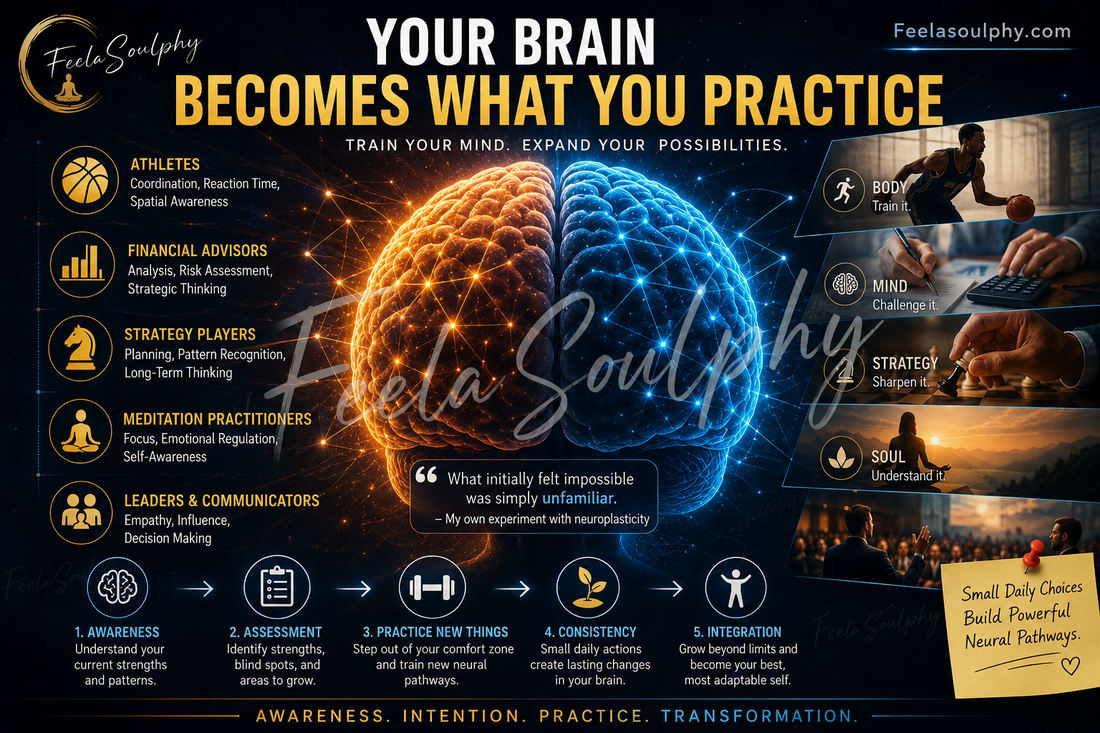 Most people understand that exercise changes the body.
Far fewer realize that every activity they engage in changes the brain. Your profession, hobbies, routines, conversations, and even the thoughts you repeatedly think are strengthening specific neural pathways. Over time, those pathways become the lens through which you experience the world. In a very real sense, your brain becomes what you practice. The Hidden Specialization of the Human Brain A basketball player develops different neural pathways than an accountant. A musician develops different pathways than a soldier. A chess player develops different pathways than a meditation practitioner. This doesn't necessarily mean one person is more intelligent than another. It means their brains have become optimized for different functions. A financial advisor may quickly recognize risk, opportunity, and long-term consequences. A basketball player may instantly process movement, timing, and spatial relationships. A musician may hear subtle patterns and variations others miss. A meditator may notice thoughts and emotions arising before they become reactions. Each person is seeing the same world through a brain that has been trained differently. The brain adapts to whatever it repeatedly does. This process is known as neuroplasticity. The more frequently a neural pathway is used, the stronger and more efficient it becomes. Like a trail through a forest, repeated use transforms a narrow path into a well-traveled road. My Own Experiment With Neuroplasticity Years ago, I unintentionally tested this principle myself. I was setting up a computer in my room. Because of the way the desk was positioned, the modom had to sit on the left side. The problem was that the mouse cable was too short for me to comfortably use it with my right hand. Most people would have moved the desk. Instead, I saw an opportunity. I had always wondered whether I could train my non-dominant hand, so I decided to use the mouse with my left hand. At first it felt awkward and frustrating. Simple tasks required concentration. My movements were slower and less accurate. My brain constantly wanted to return to the familiar pathways it had spent years developing. But I kept practicing. Eventually, something changed. The movements became smoother. The effort disappeared. What once felt impossible became natural. Today, I can comfortably use a mouse with either hand. That experience taught me a lesson I have never forgotten: What initially felt impossible was simply unfamiliar. The limitation wasn't physical. It was neurological. My brain simply needed time to build new pathways. The same principle applies to communication, confidence, meditation, relationships, leadership, public speaking, creativity, and countless other skills. Many things we believe we cannot do are often things we have not practiced long enough to develop. The Strengths and Blind Spots of Specialization Every specialization creates strengths. But every specialization can also create blind spots. An accountant may become highly analytical but struggle to stop overthinking. A soldier may develop exceptional situational awareness but remain hypervigilant in safe environments. An entrepreneur may constantly search for opportunities and find it difficult to relax. A spiritual seeker may spend so much time looking inward that practical action gets neglected. The same pathways that create expertise can also create limitations. This is why personal growth often requires us to step outside what feels natural. Growth begins where familiarity ends. Discover Your Brain's Specialty Before developing new abilities, identify what your brain is already training every day. Ask yourself:
Your answers reveal the pathways that have been strengthened through years of repetition. Most people already have a specialty. Very few are consciously aware of it. The Brain Expansion Framework If you want to become more adaptable, creative, and well-rounded, deliberately train abilities outside your normal strengths. Think of this as cross-training for the brain. Step 1: Identify Your Dominant Strength Determine the area where you spend most of your mental energy. Are you primarily:
This is likely the area where your strongest neural pathways exist. Step 2: Train the Opposite Growth often comes from developing what you naturally avoid. If you're analytical:
If you're highly physical:
If you're highly social:
If you're naturally introspective:
Step 3: Become a Beginner Again One of the healthiest things you can do for your brain is regularly place yourself in situations where you are not already competent. Beginners create new neural pathways. Experts often repeat existing ones. Stay a student. Step 4: Embrace the Awkward Stage Most people quit during the exact phase where the brain is beginning to change. Awkwardness is not evidence that you cannot do something. Awkwardness is evidence that your brain is learning. The discomfort you feel is often the sensation of growth. Simple Ways to Train New Parts of Your Brain You don't need a complete life overhaul. Start small. Try:
Every new challenge encourages the brain to form new connections. Small experiments performed consistently create lasting change. The Real Purpose of Growth Many people focus on improving their circumstances. Far fewer focus on improving the instrument through which they experience those circumstances. Every activity is training your brain. Every habit is reinforcing a pathway. Every repeated thought is strengthening a pattern. The question is not whether your brain is changing. The question is what it is changing into. Ask yourself: What part of my brain am I training every day? And perhaps more importantly: What part of myself have I neglected? Your greatest growth may not come from becoming better at what you already do. It may come from developing the abilities you have never given yourself permission to explore. Because in the end, we do not simply become what we believe. We become what we repeatedly practice. 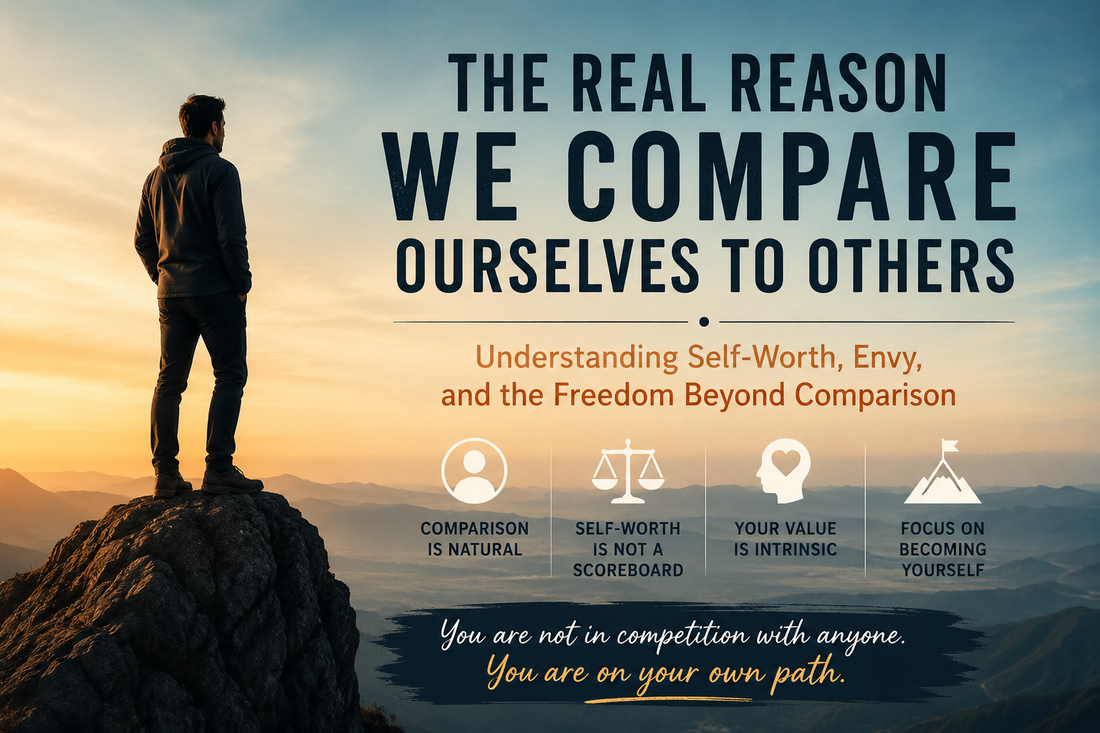 Most people believe comparison is the problem. We hear phrases like: "Stop comparing yourself to others." "Stay in your own lane." "Comparison is the thief of joy." While these statements contain wisdom, they often fail to address the deeper issue. The truth is that comparison itself is not the problem. The real problem is what comparison threatens. For most of us, comparison threatens our sense of self-worth. Comparison Is Natural The human mind compares things constantly. It compares prices before making a purchase. It compares routes before taking a trip. It compares options before making decisions. Comparison is simply a mental tool. Without comparison, we would struggle to navigate everyday life. The problem begins when we stop comparing things and start comparing our value. Instead of observing differences, we begin measuring ourselves against others. Suddenly, comparison is no longer about information. It becomes about identity. The Hidden Equation Many people unconsciously live by an equation they never chose: Self-Worth = My Value Relative to Others The equation is rarely spoken aloud, but it quietly influences how we feel. If someone is more successful, we feel smaller. If someone is more attractive, we feel less desirable. If someone is wealthier, we feel less accomplished. If someone appears more enlightened, we feel less spiritual. The moment another person rises, our value appears to fall. But is that actually true? Consider two scenarios. In the first scenario, you earn $500,000 a year while everyone around you earns $100,000. In the second scenario, you earn $500,000 a year while everyone around you earns $5 million. Your income has not changed. Your life has not changed. Your achievements have not changed. Only your position within the social hierarchy has changed. Yet many people would feel more successful in the first scenario and less successful in the second. Why? Because the feeling of worth was never coming from the achievement itself. It was coming from comparison. What Is Self-Worth? This is where things become interesting. Most people spend their lives trying to increase their self-worth. But few stop to ask: What is self-worth? Can your worth actually increase? Can it decrease? Can another person's success diminish your value? Can another person's beauty make you less beautiful? Can another person's intelligence make you less intelligent? If your worth can be reduced simply because someone else possesses more of something, then your worth was never truly yours. It was dependent upon external conditions. It was conditional. And anything conditional can be taken away. The Endless Chase The ego loves comparison because comparison creates hierarchy. Hierarchy creates winners and losers. And if there are winners, then perhaps one day we can become one. This creates an endless pursuit. "I'll be worthy when I become successful." "I'll be worthy when I make more money." "I'll be worthy when people recognize me." "I'll be worthy when I find my purpose." "I'll be worthy when I become enlightened." Yet every time one goal is achieved, another appears. The finish line keeps moving. The person may become more accomplished, but they rarely become more whole. This is why some of the most successful people in the world still struggle with envy, insecurity, and self-doubt. They improved their position in the hierarchy but never questioned the hierarchy itself. What Comparison Is Really Protecting When comparison hurts, it is usually protecting an identity. It is protecting a story about who we believe we are. When someone else's success triggers us, we can ask: What am I making this mean about me? Often the answer reveals the deeper fear. Perhaps we fear being insignificant. Perhaps we fear being left behind. Perhaps we fear not being enough. Perhaps we fear that our value depends on being exceptional. Comparison is not creating these fears. It is exposing them. The discomfort we feel is often an invitation to investigate the foundation upon which our identity is built. A Different Way of Living Imagine asking a different question. Instead of: "Am I better than others?" Ask: "Am I becoming more fully myself?" The first question creates competition. The second creates growth. The first depends on what others are doing. The second depends on what you are doing. The first produces envy. The second produces fulfillment. A rose does not compare itself to an oak tree. A mountain does not compare itself to the ocean. Each expresses its nature completely. Neither gains value by becoming the other. Human beings often suffer because we forget this. We spend so much time trying to become someone else that we never fully become ourselves. The End of Envy Many people want to eliminate envy. But envy is often a symptom, not the cause. The cause is the belief that another person's success says something about our worth. Once that belief dissolves, envy begins to lose its foundation. What remains is something entirely different. Admiration instead of jealousy. Inspiration instead of resentment. Appreciation instead of competition. You can witness greatness without feeling diminished by it. You can celebrate another person's success without questioning your own value. You can appreciate beauty without feeling less beautiful. You can honor another person's gifts without denying your own. A Question Worth Contemplating If you were the only person on Earth, would you still have worth? If the answer is yes, then your worth cannot come from comparison. And if your worth does not come from comparison, then comparison loses its power to threaten you. Perhaps freedom is not found in eliminating comparison. Perhaps freedom is found in realizing that your value was never dependent on comparison in the first place. 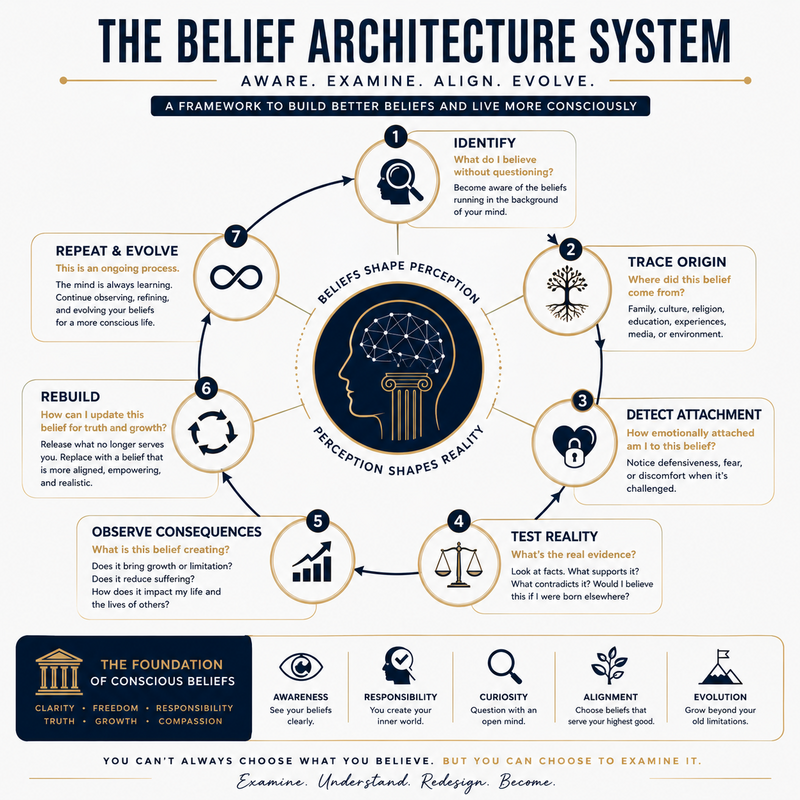 The Belief Achitecture System (BAS) Most people assume their beliefs are their own. But if you observe closely, something unsettling becomes clear: A large portion of what we call “personal belief” is inherited conditioning that we never consciously examined. From family, culture, religion, education, media, and lived experience—we absorb frameworks of meaning long before we are aware enough to question them. In that sense, we do not begin life by thinking. We begin life by absorbing. And what we absorb becomes the invisible architecture of perception. Beliefs Are Not Just Thoughts — They Are Operating Systems A belief is not simply an idea in the mind. It is a filter through which reality is interpreted. It influences:
Most importantly, beliefs do not announce themselves. They operate silently in the background, shaping behavior while remaining largely invisible to the thinker. This is why two people can experience the same event and walk away with completely different realities. They are not seeing reality directly. They are seeing it through belief systems. The Illusion of “My Beliefs” We often say: “these are my beliefs” But the word my deserves closer inspection. How many of these beliefs were actually chosen consciously? How many were:
Even beliefs we think we arrived at independently are often built on earlier assumptions we never questioned. True originality of belief is rare. Most belief is inheritance layered upon inheritance. When Beliefs Become Identity The most important transformation in human psychology happens when belief becomes identity. At that point: “I believe this” becomes “This is who I am.” And once belief becomes identity, it stops being flexible. Because now, to question the belief feels like questioning the self. This is why people become defensive, emotional, or even hostile when core beliefs are challenged. They are no longer protecting an idea. They are protecting their identity structure and the foundation upon which they have built their lives. To them, the collapse of that belief system may feel like a threat to their very existence. This is also where human growth often slows down. Because identity resists change even when reality demands it. Collective Belief: When Mind Becomes Culture Beliefs do not only operate individually. When shared across groups, they scale into something far more powerful: collective consciousness. Collective belief is what creates:
For example, a company like Coca-Cola is not just selling a drink. It is selling a shared emotional association:
Over time, repeated exposure turns meaning into perceived reality. People do not just consume the product. They consume the story attached to it. And that story becomes self-reinforcing because millions of people agree on it simultaneously. This is the essence of collective belief: When enough minds agree on a meaning, that meaning begins to function as reality. For good or for harm, this mechanism scales everything in human civilization. A Simple Personal Example: Conditioned Preference For years, I held a simple belief: Pizza and hamburgers “needed” Coca-Cola. Not because I consciously decided this. But because my mind learned a pattern: greasy food → Coke → satisfaction The carbonation, sweetness, and sensory contrast reinforced the experience. Repetition solidified the association. Eventually, it stopped feeling like a preference. It felt like the correct pairing. But nothing about that pairing was objectively necessary. It was learned. This is important because it reveals something deeper: If even taste can be conditioned… then what else in life is operating on unexamined conditioning? The Belief Architecture System (BAS) If beliefs shape perception, and perception shapes reality, then beliefs must be examined like a system—not blindly followed. Here is a simple framework: 1. Identify What do I believe without questioning? 2. Trace Origin Where did this belief come from? 3. Detect Attachment Do I become emotional when this belief is challenged? 4. Test Reality What evidence supports or contradicts it? 5. Observe Consequences Does this belief create expansion or limitation in my life? 6. Rebuild Update the belief without ego attachment. 7. Repeat Because the mind is always learning—whether we are aware of it or not. Why This Matters Most people do not suffer because they think incorrectly. They suffer because they never examine the system behind their thinking. An unconscious belief is not just an idea. It is a program running the mind. And unexamined programs eventually become lived reality. The goal is not to eliminate beliefs. That is impossible. The goal is to transform belief from unconscious inheritance into conscious design. Because once a belief is seen clearly, it stops controlling you in the same way. And at that point, something fundamental changes: You are no longer just a product of inherited perception. You become an active participant in how perception is formed. Closing Reflection The deepest question is not: “What do I believe?” But rather: “Which beliefs am I currently living inside without knowing it?” Because the moment that question becomes real… the architecture of the mind begins to reveal itself. And once you see the architecture, you are no longer fully trapped inside it. 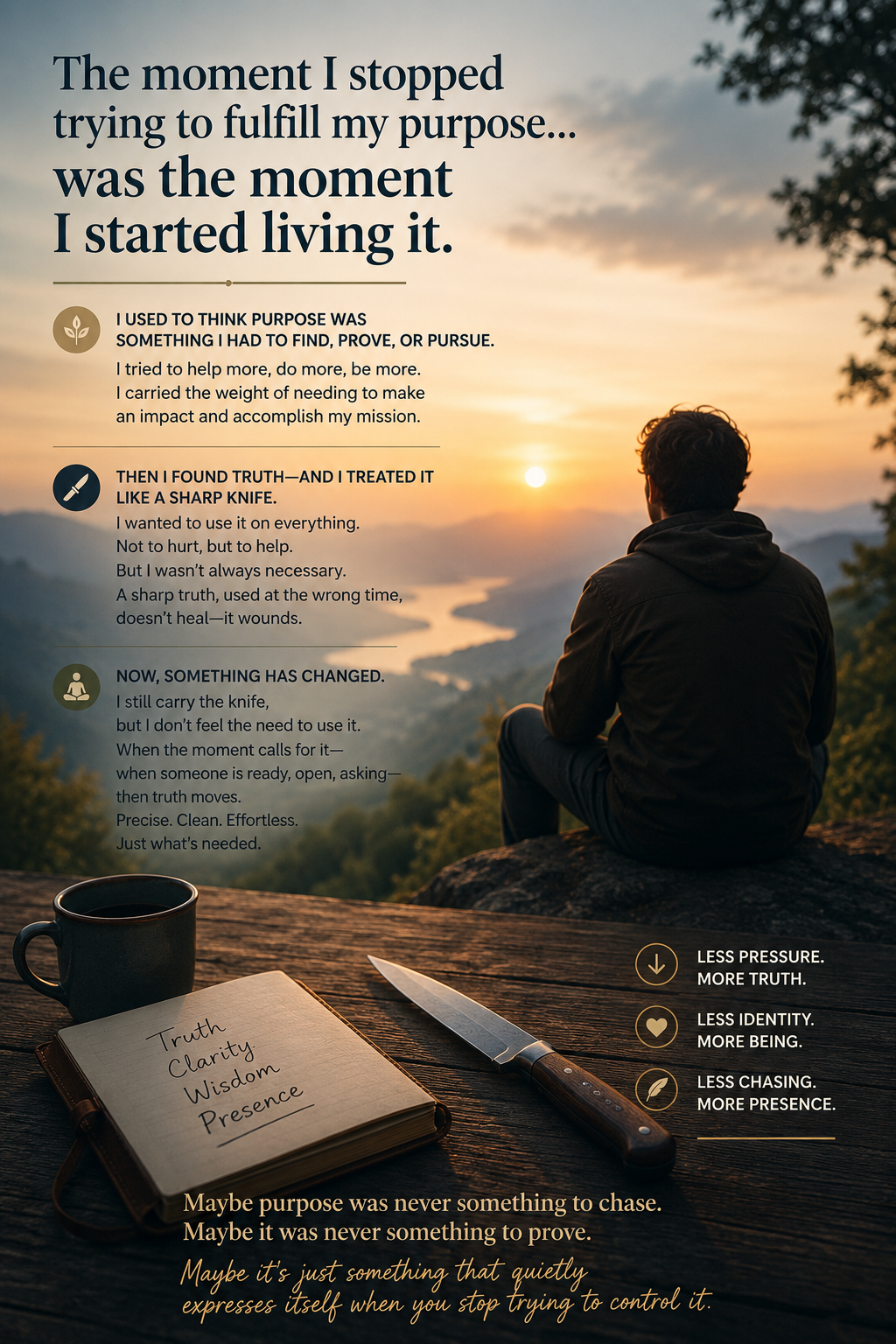 The moment I stopped trying to fulfill my purpose… was the moment I started living it.
For a long time, I carried this quiet pressure: That I was meant to do something meaningful. That I had a mission I needed to accomplish. That my life had to amount to something bigger than myself. It sounds noble… but it’s heavy. Because hidden inside that belief was fear-- Fear of not doing enough. Fear of wasting my life. Fear of not becoming who I thought I was supposed to be. So I tried. I looked for ways to help. I pushed myself to show up. I chased opportunities to make an impact. And when I discovered truth—real clarity, real insight-- it felt like I had found a sharp knife. Something powerful. Something that could cut through illusion. So I used it. In conversations. In people’s beliefs. In the way they saw themselves and the world. Not to hurt—but to help. At least… that’s what I told myself. But the truth is, when something is new and powerful, you feel the need to prove it works. So I cut into everything. And sometimes… I was right. But I wasn’t always necessary. That’s the part no one talks about. A sharp truth, used at the wrong time, doesn’t heal—it wounds. Not because it’s false, but because it’s forced. The more I tried to live my purpose, the more I was acting from pressure—not truth. Then something shifted. I stopped forcing it. Stopped chasing it. Stopped needing to be “the person who helps.” And in that space… something unexpected happened: I didn’t lose my desire to help. I just lost the need to. I still carry the knife. But I don’t feel the need to use it. Now, when someone needs me—I’m there. Fully. But I no longer carry the weight of having to fix, save, or prove anything. I wait. And when the moment truly calls for it-- when someone is ready, open, asking-- Then truth moves. Precise. Clean. Effortless. No force. No pressure. Just what’s needed. Maybe purpose was never something to chase. Maybe it was never something to prove. Maybe it’s just something that quietly expresses itself when you stop trying to control it. Less pressure. More truth. Less identity. More being. And strangely… that feels like freedom. 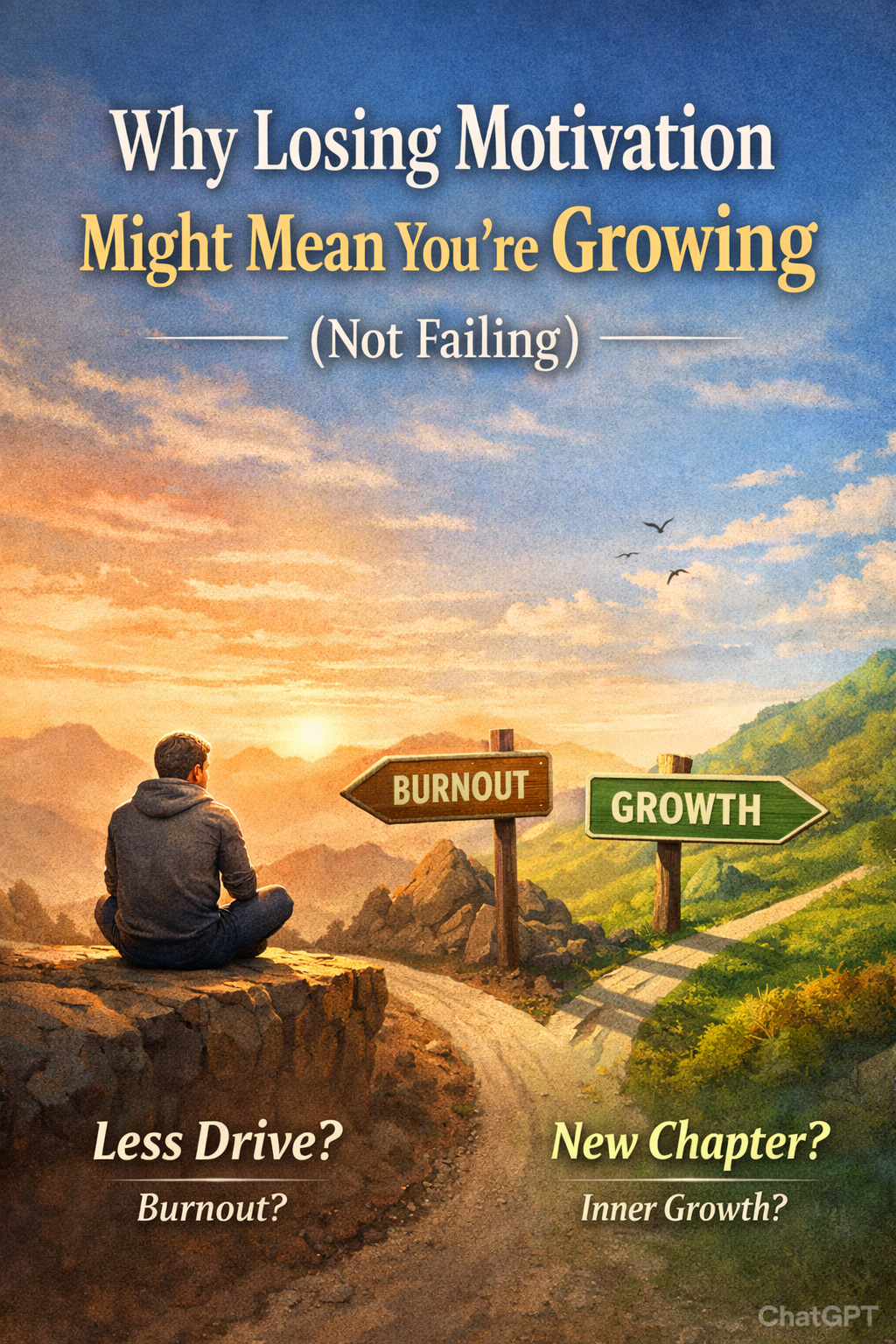 There is a phase of inner growth that rarely gets discussed—because it doesn’t look impressive. Ambition fades. The drive to achieve quiets down. The urge to become someone loosens its grip. And instead of clarity, many people feel unease. Am I evolving… or am I giving up? Is this peace—or fear disguised as contentment? This question doesn’t arise at the beginning of self-development. It appears after years of inner work, when ego has softened but purpose hasn’t yet redefined itself. The Role of Ambition in Human Development Ambition is not the enemy. Early in life, it serves an essential function. We strive in order to:
The problem isn’t ambition—it’s never knowing when to take it down. What Changes When Ego Softens If inner work is genuine, something subtle but radical happens: You no longer need achievement to validate your existence. This often shows up as:
They assume: “If my ambition is fading, something must be wrong.” In reality, something important is reorganizing. Rest vs Retreat: The Critical Distinction From the outside, rest and retreat look identical. Less output. More solitude. Fewer goals. Internally, they are opposites.
A simple test: If life gently asked something of me tomorrow, would I be open to it? A relaxed yes signals rest. A tight no signals retreat. The danger isn’t resting. The danger is mistaking withdrawal for wisdom. What Replaces Ambition After Ego Work When ego-driven ambition dissolves, one of three things replaces it:
A call does not demand constant productivity. It arrives with clarity and lightness. It asks for action—and then releases you again. From the outside, this looks inconsistent. From the inside, it feels precise. Why Many “Successful” People Never Reach This Stage Many high achievers don’t mind working all the time because stopping would force them to sit with themselves. Busyness becomes:
There’s a difference between capacity for work and compulsion to work. Losing the second while keeping the first is growth. The Real Risk at This Stage The risk is not doing less. The risk is using contentment as insulation. When “I’m fine the way I am” becomes a shield against engagement, life slowly thins out. The answer is not forcing ambition back. It’s remaining available. A Simple Operating Principle For this phase of life: Only act on what arrives with clarity and lightness. Not excitement. Not obligation. Not fear. Lightness. If nothing arrives, live fully anyway. Stillness is not a waiting room. It’s part of the work. A Short Mirror (Read slowly) Don’t answer these questions quickly. Notice what happens before the answer forms.
Only signals. Whatever you notice is the information. The Quiet Truth You are not here to maximize output. You are here to minimize distortion. When distortion falls away, contribution becomes inevitable—but no longer constant. And if you step forward again, it won’t be to become someone. It will be because silence finished saying what it could.  The Flower Fields, Calsbad, California, USA The Spiritual Purpose Behind Our Shifting Passions, Identities, and Paths Have you ever looked back at your life and wondered, “Who was I back then?” Maybe you went through a spiritual phase, a fitness phase, a minimalist phase, a business-building phase, or even a wild-and-free phase. And now, you’re in an entirely different chapter — with different passions, desires, and even a different sense of self. You’re not flaky. You’re evolving. You’re not lost. You’re learning. You’re not inconsistent. You’re in a phase — and that’s not only normal, it’s necessary. Phases Are How the Soul Grows From a spiritual lens, our souls incarnate with a plan — not a rigid blueprint, but a flexible curriculum. The soul doesn’t want sameness, it wants expansion. And how do we expand? Through experience. Each phase you’ve been through — no matter how random or unrelated it seemed at the time — held a piece of your puzzle. Some taught you discipline. Others cracked your heart open. Some helped you build, while others taught you how to let go. From the soul’s perspective, there’s no such thing as “wasted time.” Only lessons. The Psychology of Phases: You’re Wired to Shift Neurologically speaking, we’re not meant to stay in one mode of operation forever. The human brain is shaped by neuroplasticity, which means it constantly adapts, rewires, and reshapes itself based on what you focus on. When you go through a phase, you’re literally forming new neural pathways. You’re reprogramming your mind. This isn’t failure — it’s progress. Yes, society often glorifies “consistency” and “persistence,” but it forgets that adaptability is just as powerful a form of intelligence. The oak tree is sturdy, but the bamboo survives the storm. When to Shift, When to Stay Here’s the part many people get stuck on — how do you know when it’s time to move on, and when you’re just bored or avoiding something uncomfortable? True soul-guided shifts feel expansive, even if they’re scary. Avoidant shifts feel relieving at first but leave you feeling hollow. Some things are meant to be completed. They require your full presence and persistence — not because you’re “supposed to stick with it,” but because there’s a deep soul lesson embedded in the completion, not the escape. The Gift of Many Selves You are not here to be one fixed character your whole life. You’re a multidimensional being having a multidimensional experience. The version of you who loved painting at 20, the one who dove into meditation at 30, and the one now craving simplicity and nature — they’re all you. None of them were wrong or off-path. They were stepping stones. They were phases. They were part of the unfolding. Imagine doing only one thing your entire life — thinking the same, acting the same, dressing the same, believing the same. That’s not consistency. That’s stagnation. The river flows because it moves. A Reminder for the Multi-Passionate Souls So if you’ve ever been made to feel like you “change too much,” here’s your permission slip: You’re not meant to stay the same. You’re meant to stay true. And “true” will look different depending on the season of your soul. The world needs stable builders and daring shapeshifters. We need the ones who master one path for 40 years — and the ones who master the art of reinvention every 5. What matters most is that you’re conscious of your direction. Let your phases be sacred. Let your seasons be teachers. But also learn to listen: Which ones are calling you to finish the lesson? And which ones are whispering: It’s time to begin again? Final Thought: Phases Are Not Detours They’re the journey itself. Just make sure you’re not jumping ship because of discomfort… And you’re not staying out of fear of change. Complete what you came to complete. And when it’s done — don’t be afraid to move on. Because the next phase might just be the one that unlocks everything. 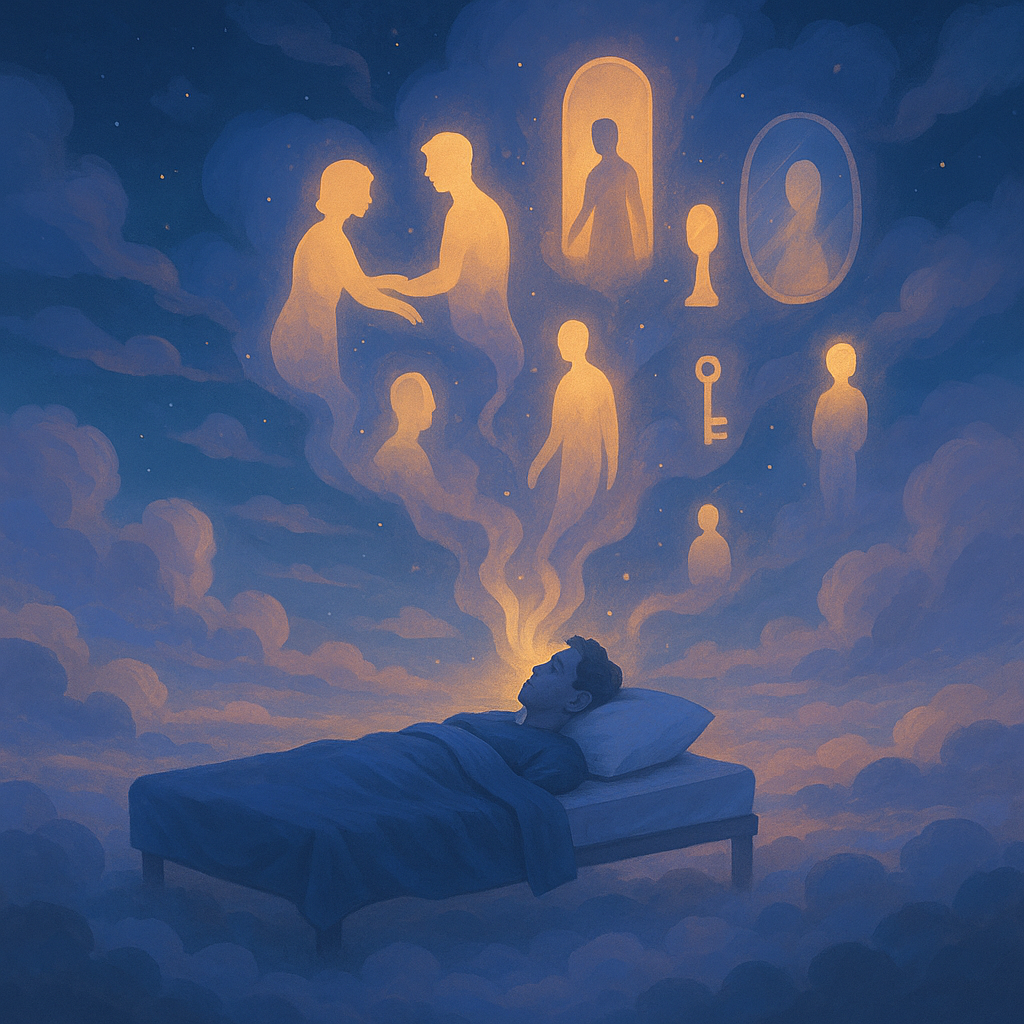 Use your dreams to track your healing, rewiring, and evolution. Here’s a little-known truth: If you behave differently in your dreams than you did in the past… that means you’ve already reconditioned your mind. You’ve rewired your brain on a deep, subconscious level. Why? Because dreams are not random. They are generated by your subconscious, the part of your mind that stores your emotional patterns, core beliefs, traumas, and triggers—long after your conscious mind has moved on. So when a situation shows up again in a dream—an ex, a fear, a fight—and this time you respond calmly or wisely or with power, you didn’t just dream it. You became it. Psychological Insight: Behavior Shift in Dreams = Subconscious Rewiring In behavioral psychology, our reactions are often automatic—especially under stress. Dreams simulate stress, emotion, and choice in surreal ways. If your instinctual response in a dream changes, it means your internal conditioning has shifted. You didn’t “decide” to change in the dream. You just acted. That’s how you know the change is real—it bypassed the thinking mind. Neuroscience Supports This Too
Dreams as a Spiritual Classroom Most things that happen in our dreams will never happen in real life. And that’s what makes them so valuable. They give you emotional simulations—safe environments to re-experience old wounds, future scenarios, or alternate versions of the self. Why did I make that choice in the dream? Would I act the same in real life? Why or why not? Since all the characters are projections of your perception of the world, every interaction is a conversation with yourself. Create a Morning Dream Practice (Before You Forget!)
My Personal Discovery I once watched a movie before bed and dreamed of an ex I hadn’t thought of in years. The dream wasn’t about her—it was about an unresolved emotion the movie triggered. I analyzed the dream the next morning, traced the emotion back to the memory, and felt it fully. That’s when it lifted. I let it go, completely. That one dream gave me more healing than months of overthinking. Final Thought: When your dreams start changing, your healing is already happening. You don’t need proof from the outside world—your subconscious has spoken. Use your dreams like a mirror. Learn from them. Talk to them. Let them show you what still hurts, and celebrate when something no longer does. Because when you act differently in a dream… you are no longer the same. |
AuthorFeelasoulphy Categories
All
Archives
March 2026
|
 RSS Feed