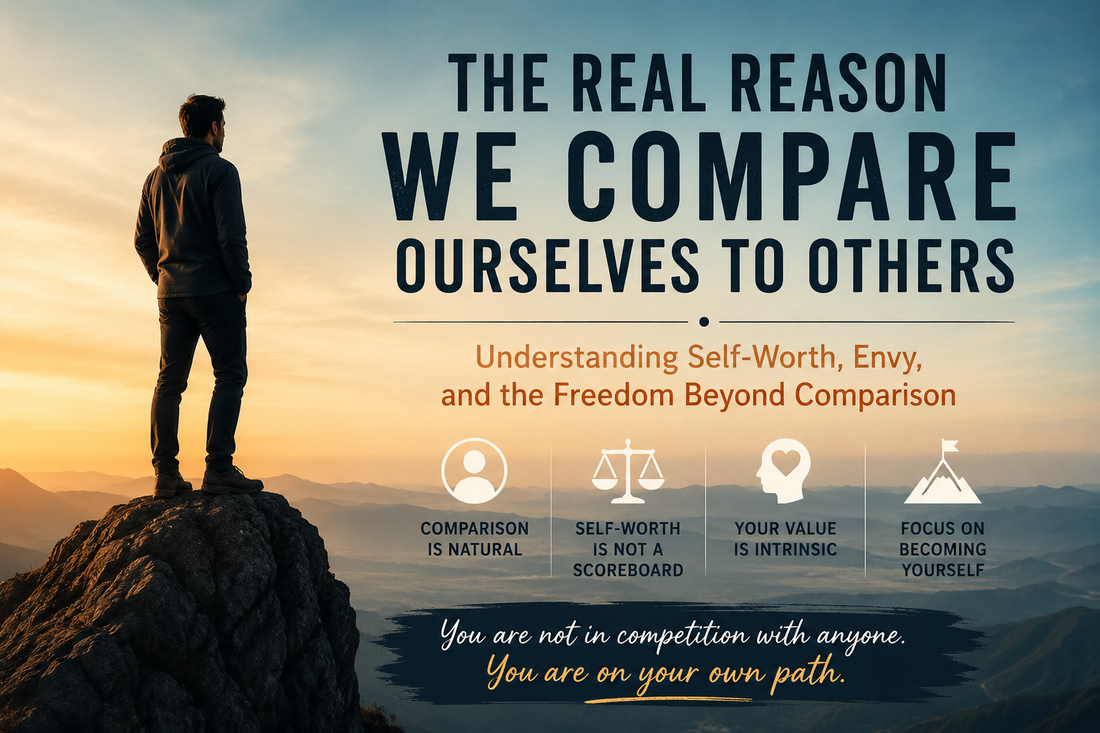
 Most people believe comparison is the problem. We hear phrases like: "Stop comparing yourself to others." "Stay in your own lane." "Comparison is the thief of joy." While these statements contain wisdom, they often fail to address the deeper issue. The truth is that comparison itself is not the problem. The real problem is what comparison threatens. For most of us, comparison threatens our sense of self-worth. Comparison Is Natural The human mind compares things constantly. It compares prices before making a purchase. It compares routes before taking a trip. It compares options before making decisions. Comparison is simply a mental tool. Without comparison, we would struggle to navigate everyday life. The problem begins when we stop comparing things and start comparing our value. Instead of observing differences, we begin measuring ourselves against others. Suddenly, comparison is no longer about information. It becomes about identity. The Hidden Equation Many people unconsciously live by an equation they never chose: Self-Worth = My Value Relative to Others The equation is rarely spoken aloud, but it quietly influences how we feel. If someone is more successful, we feel smaller. If someone is more attractive, we feel less desirable. If someone is wealthier, we feel less accomplished. If someone appears more enlightened, we feel less spiritual. The moment another person rises, our value appears to fall. But is that actually true? Consider two scenarios. In the first scenario, you earn $500,000 a year while everyone around you earns $100,000. In the second scenario, you earn $500,000 a year while everyone around you earns $5 million. Your income has not changed. Your life has not changed. Your achievements have not changed. Only your position within the social hierarchy has changed. Yet many people would feel more successful in the first scenario and less successful in the second. Why? Because the feeling of worth was never coming from the achievement itself. It was coming from comparison. What Is Self-Worth? This is where things become interesting. Most people spend their lives trying to increase their self-worth. But few stop to ask: What is self-worth? Can your worth actually increase? Can it decrease? Can another person's success diminish your value? Can another person's beauty make you less beautiful? Can another person's intelligence make you less intelligent? If your worth can be reduced simply because someone else possesses more of something, then your worth was never truly yours. It was dependent upon external conditions. It was conditional. And anything conditional can be taken away. The Endless Chase The ego loves comparison because comparison creates hierarchy. Hierarchy creates winners and losers. And if there are winners, then perhaps one day we can become one. This creates an endless pursuit. "I'll be worthy when I become successful." "I'll be worthy when I make more money." "I'll be worthy when people recognize me." "I'll be worthy when I find my purpose." "I'll be worthy when I become enlightened." Yet every time one goal is achieved, another appears. The finish line keeps moving. The person may become more accomplished, but they rarely become more whole. This is why some of the most successful people in the world still struggle with envy, insecurity, and self-doubt. They improved their position in the hierarchy but never questioned the hierarchy itself. What Comparison Is Really Protecting When comparison hurts, it is usually protecting an identity. It is protecting a story about who we believe we are. When someone else's success triggers us, we can ask: What am I making this mean about me? Often the answer reveals the deeper fear. Perhaps we fear being insignificant. Perhaps we fear being left behind. Perhaps we fear not being enough. Perhaps we fear that our value depends on being exceptional. Comparison is not creating these fears. It is exposing them. The discomfort we feel is often an invitation to investigate the foundation upon which our identity is built. A Different Way of Living Imagine asking a different question. Instead of: "Am I better than others?" Ask: "Am I becoming more fully myself?" The first question creates competition. The second creates growth. The first depends on what others are doing. The second depends on what you are doing. The first produces envy. The second produces fulfillment. A rose does not compare itself to an oak tree. A mountain does not compare itself to the ocean. Each expresses its nature completely. Neither gains value by becoming the other. Human beings often suffer because we forget this. We spend so much time trying to become someone else that we never fully become ourselves. The End of Envy Many people want to eliminate envy. But envy is often a symptom, not the cause. The cause is the belief that another person's success says something about our worth. Once that belief dissolves, envy begins to lose its foundation. What remains is something entirely different. Admiration instead of jealousy. Inspiration instead of resentment. Appreciation instead of competition. You can witness greatness without feeling diminished by it. You can celebrate another person's success without questioning your own value. You can appreciate beauty without feeling less beautiful. You can honor another person's gifts without denying your own. A Question Worth Contemplating If you were the only person on Earth, would you still have worth? If the answer is yes, then your worth cannot come from comparison. And if your worth does not come from comparison, then comparison loses its power to threaten you. Perhaps freedom is not found in eliminating comparison. Perhaps freedom is found in realizing that your value was never dependent on comparison in the first place.
0 Comments
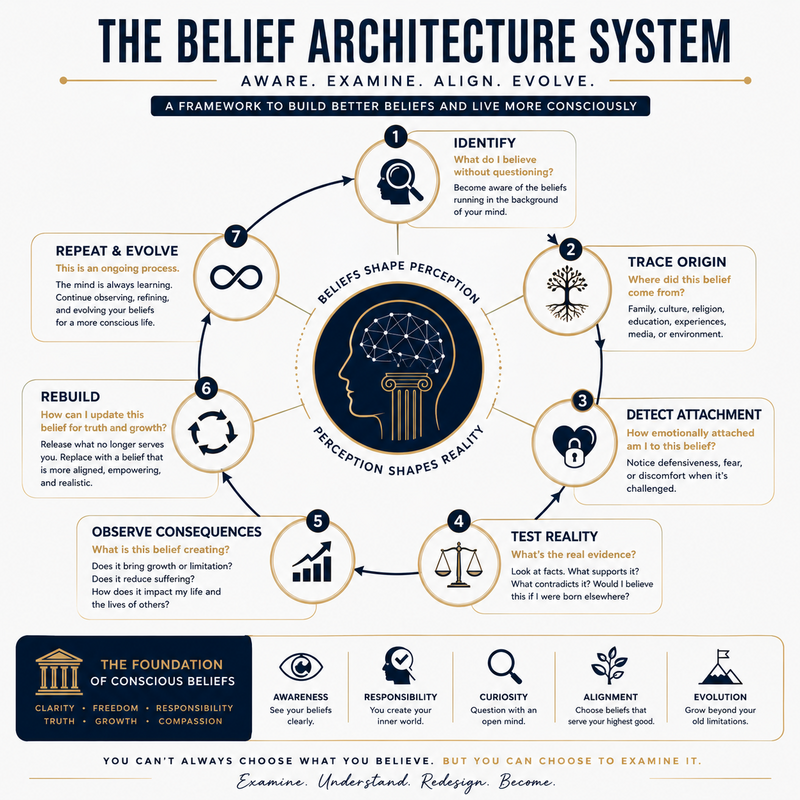 The Belief Achitecture System (BAS) Most people assume their beliefs are their own. But if you observe closely, something unsettling becomes clear: A large portion of what we call “personal belief” is inherited conditioning that we never consciously examined. From family, culture, religion, education, media, and lived experience—we absorb frameworks of meaning long before we are aware enough to question them. In that sense, we do not begin life by thinking. We begin life by absorbing. And what we absorb becomes the invisible architecture of perception. Beliefs Are Not Just Thoughts — They Are Operating Systems A belief is not simply an idea in the mind. It is a filter through which reality is interpreted. It influences:
Most importantly, beliefs do not announce themselves. They operate silently in the background, shaping behavior while remaining largely invisible to the thinker. This is why two people can experience the same event and walk away with completely different realities. They are not seeing reality directly. They are seeing it through belief systems. The Illusion of “My Beliefs” We often say: “these are my beliefs” But the word my deserves closer inspection. How many of these beliefs were actually chosen consciously? How many were:
Even beliefs we think we arrived at independently are often built on earlier assumptions we never questioned. True originality of belief is rare. Most belief is inheritance layered upon inheritance. When Beliefs Become Identity The most important transformation in human psychology happens when belief becomes identity. At that point: “I believe this” becomes “This is who I am.” And once belief becomes identity, it stops being flexible. Because now, to question the belief feels like questioning the self. This is why people become defensive, emotional, or even hostile when core beliefs are challenged. They are no longer protecting an idea. They are protecting their identity structure and the foundation upon which they have built their lives. To them, the collapse of that belief system may feel like a threat to their very existence. This is also where human growth often slows down. Because identity resists change even when reality demands it. Collective Belief: When Mind Becomes Culture Beliefs do not only operate individually. When shared across groups, they scale into something far more powerful: collective consciousness. Collective belief is what creates:
For example, a company like Coca-Cola is not just selling a drink. It is selling a shared emotional association:
Over time, repeated exposure turns meaning into perceived reality. People do not just consume the product. They consume the story attached to it. And that story becomes self-reinforcing because millions of people agree on it simultaneously. This is the essence of collective belief: When enough minds agree on a meaning, that meaning begins to function as reality. For good or for harm, this mechanism scales everything in human civilization. A Simple Personal Example: Conditioned Preference For years, I held a simple belief: Pizza and hamburgers “needed” Coca-Cola. Not because I consciously decided this. But because my mind learned a pattern: greasy food → Coke → satisfaction The carbonation, sweetness, and sensory contrast reinforced the experience. Repetition solidified the association. Eventually, it stopped feeling like a preference. It felt like the correct pairing. But nothing about that pairing was objectively necessary. It was learned. This is important because it reveals something deeper: If even taste can be conditioned… then what else in life is operating on unexamined conditioning? The Belief Architecture System (BAS) If beliefs shape perception, and perception shapes reality, then beliefs must be examined like a system—not blindly followed. Here is a simple framework: 1. Identify What do I believe without questioning? 2. Trace Origin Where did this belief come from? 3. Detect Attachment Do I become emotional when this belief is challenged? 4. Test Reality What evidence supports or contradicts it? 5. Observe Consequences Does this belief create expansion or limitation in my life? 6. Rebuild Update the belief without ego attachment. 7. Repeat Because the mind is always learning—whether we are aware of it or not. Why This Matters Most people do not suffer because they think incorrectly. They suffer because they never examine the system behind their thinking. An unconscious belief is not just an idea. It is a program running the mind. And unexamined programs eventually become lived reality. The goal is not to eliminate beliefs. That is impossible. The goal is to transform belief from unconscious inheritance into conscious design. Because once a belief is seen clearly, it stops controlling you in the same way. And at that point, something fundamental changes: You are no longer just a product of inherited perception. You become an active participant in how perception is formed. Closing Reflection The deepest question is not: “What do I believe?” But rather: “Which beliefs am I currently living inside without knowing it?” Because the moment that question becomes real… the architecture of the mind begins to reveal itself. And once you see the architecture, you are no longer fully trapped inside it. 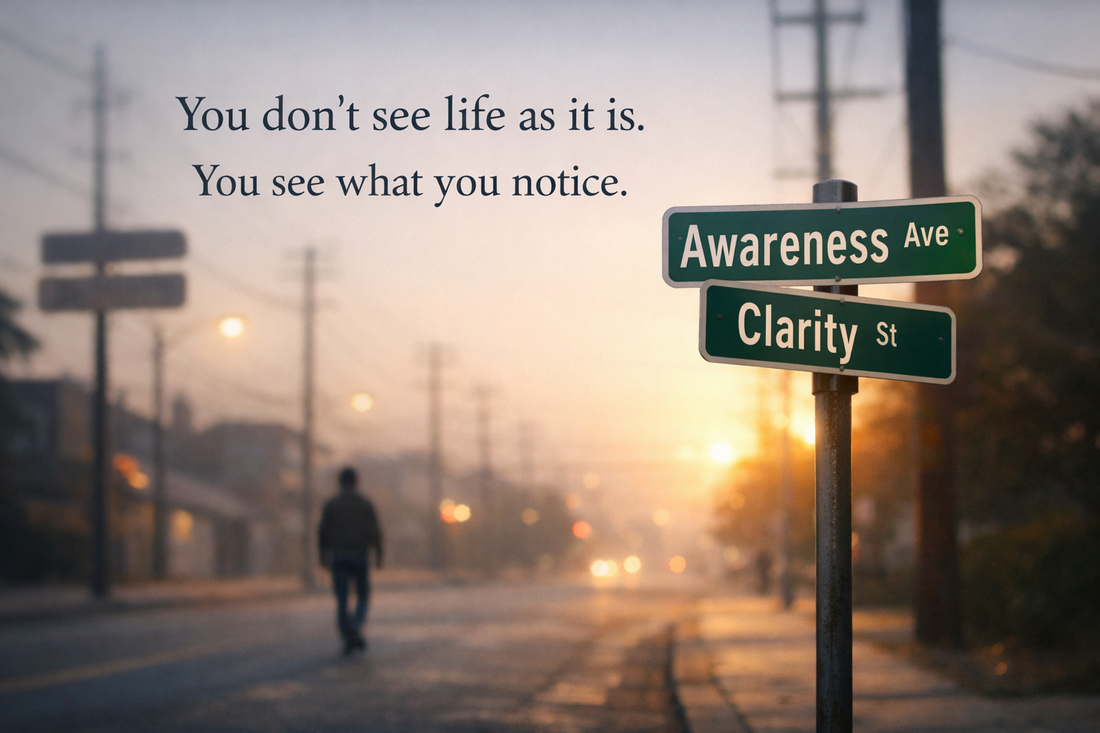 Most people don’t live bad lives. They live unconscious ones. We don’t experience reality as it is--we experience what we pay attention to. Everything else disappears into the background, not because it isn’t there, but because our awareness never stops to notice it. I realized this through a simple experiment. I’ve lived in the same neighborhood for sixteen years, yet I still don’t know the names of some of the cross streets near my home. When I finally slowed down and intentionally paid attention, I remembered the street names immediately. This wasn’t a memory problem. It was an attention problem. That insight opened a larger question: if I can overlook something so basic for years, how many important aspects of my life have I also missed--patterns, emotions, beliefs, opportunities--simply because I wasn’t paying attention? Why Most People Live Unconsciously Living unconsciously isn’t a moral failure. It’s a biological strategy. The brain is designed to conserve energy. Awareness takes effort. Questioning takes effort. So the mind defaults to automation. Our experience of life is shaped by what we attend to. Attention acts as a filter--what passes through becomes our reality. Most people don’t consciously choose that filter. Instead, it’s shaped by:
Over time, this creates a narrow version of reality that feels complete but isn’t. Research in psychology supports this. Daniel Kahneman showed that much of human behavior operates on fast, automatic thinking. We don’t actively choose most of our thoughts--we repeat them. Efficiency keeps us functioning. But it also keeps us asleep. The Hidden Cost of Unconscious Living When we don’t pay attention:
The problem isn’t suffering. The problem is not noticing the cause of suffering. An unconscious life isn’t empty--but it’s limited. Awareness Is Not a Personality Trait--It’s a Skill Here’s the good news: awareness isn’t something you either have or don’t have. It’s a skill. I didn’t need years of meditation or a spiritual retreat to notice the street names. I simply directed my attention deliberately for a moment. That single act revealed something important: unconscious living isn’t permanent. It’s a default setting. Every moment of noticing--your breath, your tension, your thoughts, your reactions--is a small interruption in that default. How Attention Changes Your Life Your life doesn’t change when circumstances change. It changes when attention changes. Most people try to fix their lives by changing external conditions. Fewer people realize that shifting attention alters perception, behavior, and ultimately identity. When you begin to observe instead of react:
This isn’t abstract philosophy. It’s practical awareness. A Simple Practice to Live More Consciously Start small. Pick one ordinary thing today and pay full attention to it--your walk, your breathing, a conversation, the environment around you. No analysis. Just noticing. Then ask yourself: What else in my life have I been moving past without seeing? That question alone begins to wake you up. Final Thought Most people aren’t unconscious because they’re incapable of awareness. They’re unconscious because they were never taught that attention shapes reality. Once you see this, you can’t unsee it. And the real question becomes: What kind of life unfolds when you notice on purpose?  What you are aware of is your reality. Simple sentence. Infinite depth. Reality doesn’t just exist “out there” somewhere waiting to be discovered. It unfolds in here—within the field of your awareness. You could be standing in the same room as another person, breathing the same air, hearing the same sounds, yet living in two entirely different realities. One person feels peace; the other feels anxiety. One sees opportunity; the other sees threat. The outer world is the same, but the inner awareness is not. So what’s real? Both—and neither. Reality, as we experience it, is a mirror reflecting our state of consciousness. Awareness is the light that reveals what’s in the mirror. When the light is dim, the reflection is blurry and distorted. When the light brightens, the truth appears clearer, richer, and more whole. The Power of Awareness Awareness is not just passive observation—it’s participation. The moment you become aware of something, you interact with it. You give it meaning. You bring it into existence for you. That’s why self-awareness is so transformative. When you see your own thoughts clearly, they lose their power to unconsciously steer your emotions and behaviors. When you observe your fears, they stop dictating your choices. What you are aware of, you control; what you are not aware of, controls you. The unexamined parts of the mind—those shadowy regions of pain, resentment, or false belief—still operate, but without your conscious permission. They become the hidden puppeteers of your “reality.” You react, repeat, and relive. The same arguments, same relationships, same emotional loops—different faces, same energy. Only when you become aware of those patterns do you gain the power to change them. Awareness Expands Reality Your awareness defines the edges of your universe. As it expands, so does your world. When you become aware of beauty, life becomes beautiful. When you become aware of love, love surrounds you. When you become aware of the miracle of breath, the simple act of breathing becomes sacred. Spiritual growth isn’t about escaping reality—it’s about waking up to more of it. You start noticing the subtleties: the silence between sounds, the energy behind emotions, the consciousness within every being. You start living not just as a thinker of thoughts but as the observer of the thinker—the still presence that watches everything come and go. And in that stillness, a new kind of peace emerges—not because life got easier, but because your awareness outgrew the chaos. The Practical Side This isn’t just philosophy; it’s profoundly practical. When you shift your awareness, your experience changes. For instance:
Awareness is the ultimate form of freedom. It doesn’t require money, status, or approval—just willingness. The willingness to look. To see. To wake up. The Art of Living Consciously Every day, life invites you to expand your awareness—to step beyond autopilot and into conscious living. You can start small:
As your awareness deepens, you begin to sense something extraordinary: you were never your thoughts, emotions, or circumstances. You were the awareness behind them all—the quiet, luminous presence that has always been watching. That realization changes everything. Because then, your reality no longer happens to you. It happens through you. Final Thought What you are aware of is your reality. So if you want to change your reality, don’t start with the outer world. Start with awareness. Expand it. Deepen it. Guard it like sacred ground. Because awareness isn’t just what you have-- It’s what you are.  Sunset at James Lick Observatory, Mt. Hamilton, San Jose, California, USA Our minds are a complex system of two primary components: the conscious and the subconscious. While they work together seamlessly, each has distinct roles depending on the state we are in—awake, asleep, or meditating. Understanding this dynamic can help us tap into deeper insights and maximize our mental potential. The Roles of Conscious and Subconscious Minds Conscious Mind: • The seat of focus, logic, and deliberate thought. • Active during tasks requiring attention, problem-solving, and decision-making. Subconscious Mind: • A vast memory bank, storing all experiences, emotions, and information. • Operates automatically, running habits, retrieving memories, and processing emotions in the background. How the Two Minds Interact 1. In Daily Life: • When awake and focused, the conscious mind leads, while the subconscious supports by providing background data (e.g., recalling memories or automatic skills). • Example: Driving a familiar route while consciously thinking about other things relies heavily on the subconscious. 2. In Sleep and Dreams: • During sleep, the subconscious dominates, creating dreams by piecing together fragmented memories. • The conscious mind typically takes a backseat unless you experience lucid dreaming, where awareness emerges within the dream state. 3. In Relaxed States: • When relaxed, such as in the alpha brainwave state, the subconscious becomes more active. This is why daydreaming and wandering thoughts occur effortlessly. • The conscious mind shifts to an observer role, which allows for contemplation and creative connections. Meditation: A Bridge Between the Two Minds Meditation offers a unique opportunity to balance the two minds: • The conscious mind quiets down, stepping into the role of a calm observer. • The subconscious becomes more accessible, revealing forgotten memories or making unexpected connections. In this state, insights often emerge because the subconscious processes information in a non-linear way, free from the constraints of conscious logic. Writing down these realizations after meditation ensures they don’t fade away. Epiphanies and Creative Breakthroughs Ever had a great idea seemingly out of nowhere? That’s the result of your subconscious working in the background. Even when the conscious mind moves on to something else, the subconscious continues processing information. When the two minds synchronize, this background processing can deliver surprising insights or solutions. This explains why moments of clarity often occur during relaxed states, like taking a walk, showering, or meditating. The Subconscious as a Memory Bank The subconscious is like a hard drive—it stores everything, but it isn’t always organized. • Dreams, for instance, can feel chaotic because the subconscious tries to link unrelated memories. • Without conscious intervention, it can seem as if the subconscious has “a mind of its own,” creating unexpected scenarios that even surprise us. By taking time to reflect, meditate, or write down these thoughts, we can give structure to this vast storehouse of information. Practical Takeaways 1. Meditate Regularly: • Use meditation to quiet the conscious mind and gain access to subconscious insights. • Don’t try to analyze during meditation—just observe. 2. Write Things Down: • Whether it’s a dream, a random thought, or a moment of clarity, writing helps organize subconscious material for conscious analysis later. 3. Leverage Relaxed States: • Activities like walking, daydreaming, or light meditation allow the subconscious to take the lead. These moments often spark creativity or problem-solving. 4. Trust the Process: • Understand that the subconscious works in the background, even when you’re not aware of it. By consciously creating time for relaxation, you open the door to unexpected insights. Conclusion The interplay between the conscious and subconscious mind is a remarkable system of balance. By learning how to work with both—letting the subconscious process while the conscious observes and organizes—we can achieve greater clarity, creativity, and self-awareness. 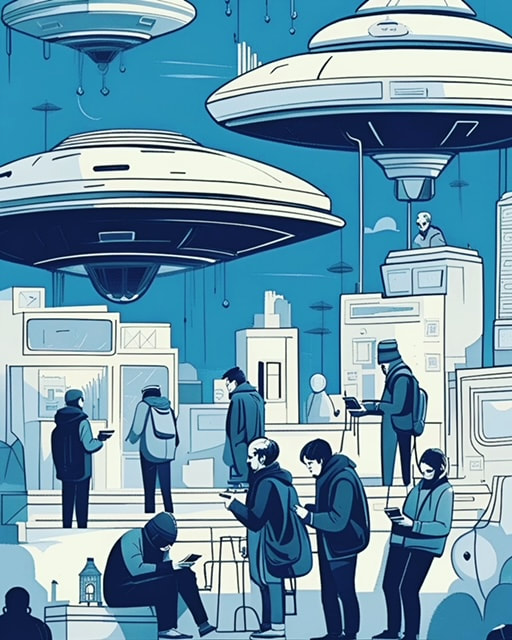 We are conscious beings, living unconsciously. We exist as conscious beings, often navigating life's intricacies unconsciously. Embracing consciousness empowers us to shape our experiences, allowing us to actively choose between living a mindful, intentional life or drifting through existence unaware. - Feelasoulphy 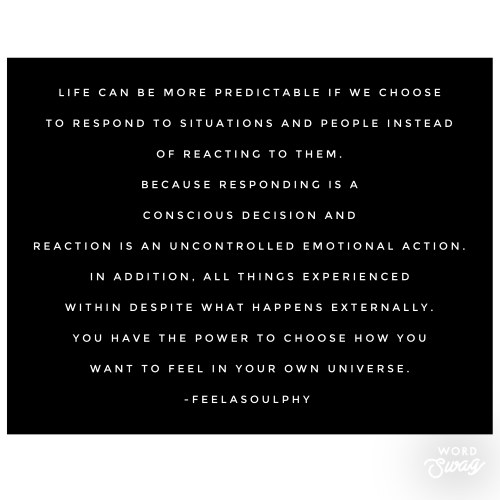 Life can be more predictable if we choose to respond to situations and people instead of reacting to them. Because responding is a conscious decision and reaction is an uncontrolled emotional action. In addition, all things experienced within despite what happens externally. You have the power to choose how you want to feel in your own Universe.
- Feelasoulphy |
AuthorFeelasoulphy Categories
All
Archives
March 2026
|
 RSS Feed