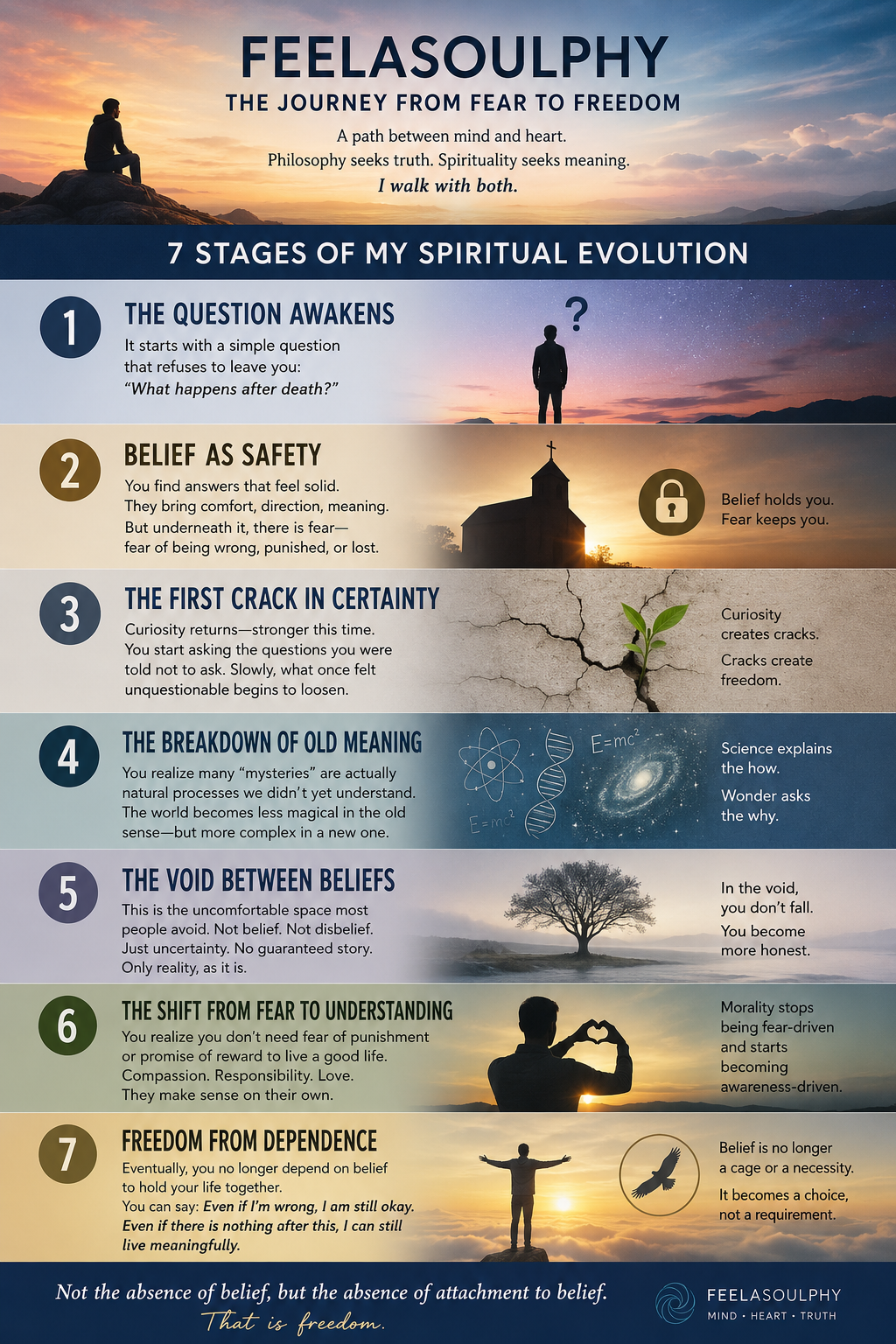
 7 Stages of My Spiritual Evolution...To Be Continued... There was a time when I believed life could be neatly categorized. Philosophy belonged to the mind. Spirituality belonged to the heart. One searched for truth through logic, questioning, and reason. The other trusted intuition, meaning, and unseen connection. For a long time, I treated them as separate worlds. Almost like two different languages trying to describe existence. But life doesn’t stay in boxes for long. And neither did I. The Early Search: Fear Disguised as Faith My journey didn’t begin in clarity. It began in curiosity — and uncertainty about what happens after death. That question, once planted, doesn’t leave quietly. It grows into others: What is real? What is God? What is truth? What happens when we die? Eventually, I found myself inside Christianity. And for a while, it gave structure to the unknown. It gave answers where there were none. It gave direction where I felt lost. But underneath it, there was something I didn’t fully recognize at the time: fear. Fear of punishment. Fear of being wrong. Fear of what happens if belief collapses. And fear is a powerful teacher — but not always a truthful one. It can shape belief into something rigid, something protective rather than something alive. At some point, I started to notice that my relationship with belief wasn’t fully free. It was anchored in consequences, not understanding. And once you see that, you can’t unsee it. The Breaking Open: Science, Philosophy, and Unraveling Certainty “Did God create us in His image, or did we create God in ours?” And perhaps beneath both lies an even deeper question: “Did God create us… or did we create God?” - Feelasoulphy The next stage of my journey was not spiritual at all — at least not in the traditional sense. It was analytical. I began studying science, philosophy, and research around consciousness. I explored near-death experiences, reincarnation theories, and scientific perspectives on spirituality. Not to reinforce belief — but to challenge it. Slowly, the world I once saw as “miraculous” became increasingly explainable. The mechanisms of life, the brain, perception, evolution — all of it revealed patterns that didn’t require supernatural explanation. And something shifted in me. I started realizing that many things once attributed to God were actually natural processes we had not yet understood. But instead of closing the mystery, this opened a different one: Even if we understand how something works… we still don’t fully understand why anything exists at all. Science explains mechanisms. But it does not fully explain existence itself. That realization didn’t push me back into certainty. It pushed me deeper into humility. The Transition: Letting Belief Stop Being a Crutch Over time, something unexpected happened. My need for belief as emotional security began to fade. I stopped needing a specific story about what happens after death in order to live meaningfully now. That was a turning point. I reached a place where I could say: Even if there is no God… Even if there is no afterlife… I can still live a good, conscious, and meaningful life. Not because I was forcing myself to be strong — but because I genuinely understood why compassion, love, and responsibility matter. Not from fear. Not from reward. But from clarity. And when belief is no longer required to behave well, something subtle happens inside a person. The mind becomes lighter. The heart becomes less defended. And truth becomes less threatening. The Shift: From Dependency to Freedom At some point, I realized I no longer depended on belief in God or the afterlife to guide my actions. And that changed everything. Because belief stopped being a psychological structure holding me together. It became something I could examine freely. I was no longer afraid of my worldview collapsing. I was no longer attached to it as identity. I could question it, challenge it, even let it dissolve — and I would still be okay. That is when I first felt something I can only describe as freedom. Not freedom from meaning. But freedom from fear-based meaning. Feelasoulphy: A Middle Path This is where the idea of Feelasoulphy emerged for me. A bridge between:
Not as a contradiction — but as integration. Because I’ve come to see that philosophy without feeling becomes empty abstraction. And spirituality without inquiry becomes fragile belief. We are not meant to live in only one half of ourselves. We are meant to become whole. Fear-Based Belief vs Freedom-Based Belief One of the clearest distinctions I’ve learned is this: There is a kind of belief that is built on fear:
And there is a kind of belief — or perhaps a way of being — that is built on freedom:
Fear-based belief needs certainty to feel safe. Freedom-based understanding can hold uncertainty without collapsing. That difference changes everything. The Question I Keep Returning To I don’t claim to know what happens after death. I don’t claim to fully understand consciousness or the origin of reality. But I also no longer need those answers to live well. And maybe that is the real shift. Not from belief to disbelief. But from dependence to independence. And from independence… to a quieter possibility: That perhaps meaning is not something we receive from certainty, but something we embody through awareness. Where I Am Now Today, I feel something simple but profound: I am okay not knowing. Not in resignation — but in openness. I can explore spirituality without needing it to be “true in the ultimate sense.” I can study science without needing it to erase mystery. I can live ethically without needing fear as motivation. And most importantly, I can question everything — without losing myself in the process. That, to me, is freedom. Not the absence of belief. But the absence of attachment to belief. And in that space… life feels strangely more real than ever.
0 Comments
 Woods Trail, Sierra Azul Preserve, San Jose, California, USA There are many different types of meditation, but the goal is always the same: to achieve a meditative state. Walking meditation is a beautiful practice that not only relaxes your body and mind but can also lead you into deeper states of consciousness, such as Alpha and even Gamma brainwave states, where profound realizations happen. Here’s how to approach it to get the most out of the experience: 1. Choose the Right Trail
2. Minimize Distractions
3. Engage All Six Senses Fully experience your surroundings through:
Take your time. Stop and observe. Take photos if you feel inspired — nature is the ultimate playground for your inner artist.  Beautiful Lupin with patterned water drops on its leaves. 4. Deepen Presence When you relax into the present moment, your experience of nature intensifies — similar to how senses are heightened under the influence of edibles. One reason for this is simple: full concentration on the now magnifies your experience. The vast majority of nature has never been truly experienced by most humans — not because it isn’t beautiful, but because our attention is often elsewhere. 5. Be Mindful
6. Set Intentions, Not Expectations
7. Cultivate a Childlike Curiosity Children are naturally curious — that’s why they learn so quickly and experience so much joy. Scientists and passionate people share this trait too: they remain curious, which keeps their mind and heart alive. Adopt a spirit of curiosity during your walk — it will deepen your experience and open new doors within you. 8. Try New Sensory Exercises
9. Understand Brainwave States Meditation often aims to move your brain into deeper states:
During walking meditation, you’ll likely move in and out of Alpha and Gamma. Let it happen naturally — never force it. Relaxation comes first. Depending on your current mood and state of mind, it might take 20–30 minutes to start feeling relaxed and present. Once in Alpha:
In both states, you’re much more likely to experience epiphanies and “aha” moments — profound realizations that may even be life-changing. 10. Why Epiphanies Happen Normally, our daily lives interrupt our thoughts constantly. We accumulate fragmented, incomplete thoughts that never fully connect. But when the right environment, relaxation, mood, information, and attention come together, your mind naturally makes connections between those fragments — unlocking wisdom already inside you. (I’ll write more about this important process in a future post.) 11. Pace Yourself
Reminders
 A stream running through the forest Suggested Questions and Prompts for Walking Meditation If you feel called to, you can take one or two reflection questions with you on your walk. You can also allow your intuition to guide you naturally without any set focus. Either way, there is no need to force insights or outcomes—set your intention to stay open, curious, and present, and trust that whatever needs to arise will come in its own time. If you want structure, try asking yourself:
Or simply notice and reflect:
Gentle Tips
Remember, the goal is not to force answers but to create the space where answers naturally arise. Final Thoughts Walking meditation is a beautiful practice of reconnecting—with yourself, with nature, and with the present moment. Each walk will be different. Some days you may feel deeply connected and inspired; other days you may simply enjoy a peaceful stroll. Both are valuable. Trust the process. The more you practice, the more natural it becomes to enter deeper states of awareness. Let nature be your guide, your mirror, and your playground. Walk with presence, curiosity, and an open heart—and allow the wisdom within you to arise when the time is right. Also check out this post about The Healing Power of Nature We May Not Know.  patterned water drops on Iris and blades of grass  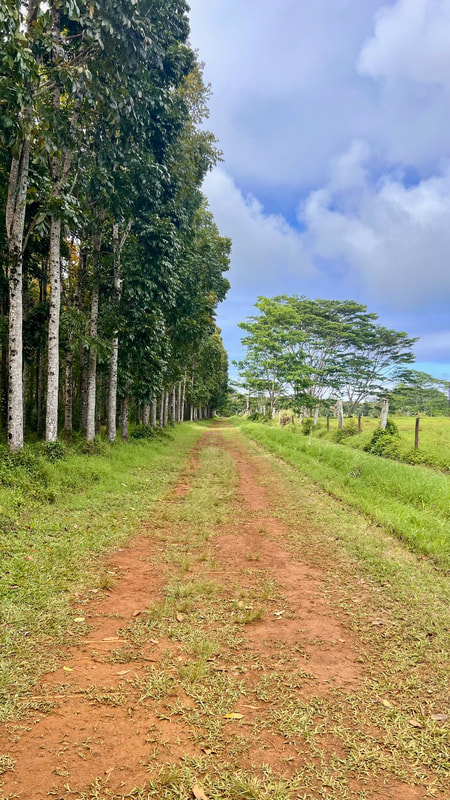 Wai Koa Loop Trail(Stone Dam) in Kilauea, Kauai, USA Have you ever felt stuck in a phase of life and wondered why you’re going through it? You’re not alone. But here’s something to remember: Every season has a purpose. Even the most difficult ones are not without meaning. They often arrive to teach us something our soul needs to grow. Sometimes it’s one big lesson. Sometimes it’s many, unfolding slowly over time. If you ask “What’s wrong with me?” you’ll only find frustration. But if you ask “Why am I going through this season, and what am I meant to learn?”—you begin to shift from confusion to clarity. The secret is to focus on the lesson, not the event. Shift your attention away from the external circumstances and look inward. What patterns are repeating? What emotions are surfacing? What beliefs are being challenged? Awareness Is the Key The lessons of life are always present—but our awareness isn’t always developed enough to see them. That’s why cultivating awareness is essential. When you raise your level of awareness, you begin to recognize the subtle opportunities for growth that were always there. As the saying goes, “When the student is ready, the teacher appears. When the student is truly ready, the teacher disappears.” It’s not about the presence of the teacher—it’s about the readiness and awareness of the student. Once the student begins to see clearly, everything becomes a teacher—even themselves. Why Awareness Calms the Storm When you focus on uncovering the lessons, you naturally feel calmer. You’re no longer fighting your season—you’re learning from it. Emotions no longer run the show. And that’s when something beautiful happens: your prefrontal cortex activates. This is the part of your brain responsible for decision-making, planning, and reasoning. Instead of reacting impulsively, you start to make grounded, intentional choices. This doesn’t mean you shut off your intuition. In fact, the opposite is true. When you’re not clouded by emotional noise, you can actually feel your intuition more clearly. It no longer has to shout over your inner chaos to be heard. Trust Your Season So next time you’re in a tough season, pause. Don’t fight it—feel into it. Learn from it. The purpose will reveal itself… as it always does. You’re not stuck. You’re becoming. You’re not lost. You’re being guided. Everything in your life—especially the difficult seasons—is part of your awakening. If this message resonates with you, share it with someone who might need it right now. And if you’re currently in a tough season, take a breath, and remember: the lesson is not in the storm—it’s in how you move through it. |
AuthorFeelasoulphy Categories
All
Archives
March 2026
|
 RSS Feed