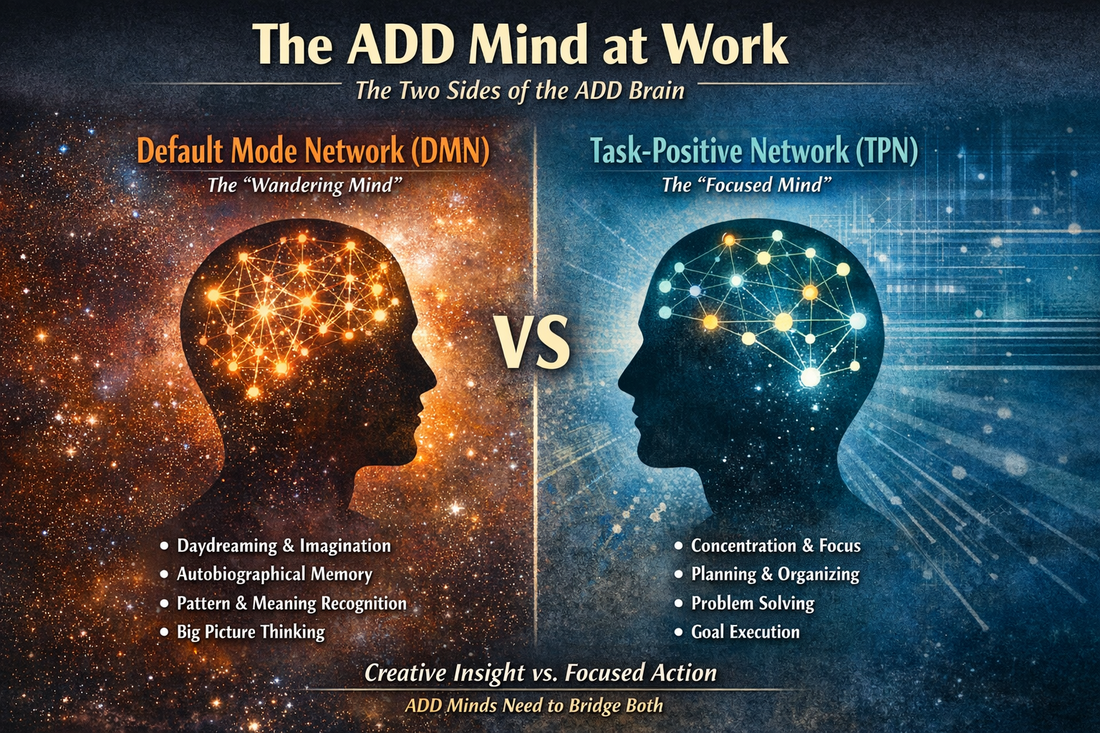
 Most people think ADD is about distraction. It isn’t. It’s about where the mind naturally spends its time—and how poorly modern life understands that territory. Many ADD minds are not failing at focus. They are operating from a different neural home base. That home base has a name: the Default Mode Network. The Default Mode Network: Where the ADD Mind Lives The Default Mode Network (DMN) is a large-scale brain network that becomes active when we are not focused on a specific external task. It lights up when we:
In most people, the DMN quiets down when task-focused networks activate. But in many people with ADD, the DMN remains highly active, even when they are supposed to be “paying attention.” This is why ADD minds:
From the inside, it feels like constant mental motion. But here’s the key point most narratives miss: The DMN is not a defect. It is the neural basis of creativity, identity, empathy, and insight. The Wandering Mind Is Not Broken Because the DMN is involved in autobiographical memory and self-referential processing, ADD minds often think in story, metaphor, and meaning, not steps and checklists. This explains why people with ADD are frequently drawn to:
You learn when each is useful. The Real Breakdown: When DMN Has No Translator ADD minds don’t lack ideas. They have too many, too quickly, with too much depth. The problem begins after insight appears. The DMN is excellent at generating meaning, but it is not designed to package that meaning into deliverables. That job belongs to task-positive networks—the ones responsible for planning, sequencing, and execution. When someone with ADD tries to jump directly from DMN insight to execution, the nervous system often overloads. The result looks like this:
It is a missing translation layer. The Generator–Integrator–Bridger Model ADD minds work best when allowed to cycle through three distinct phases. Problems arise when these phases are forced to overlap. 1. The Generator (DMN-dominant) This is the wandering phase. Ideas arise freely. Connections form unexpectedly. Memories, emotions, and insights surface without invitation. Trying to control this phase kills its value. Its purpose is not productivity. Its purpose is raw material. 2. The Integrator (DMN → Task Network Transition) This is the most overlooked phase—and the one that changes everything. Integration is not execution. It is sense-making. This is where the mind asks:
With it, execution becomes obvious. Most ADD frustration comes from skipping integration entirely. 3. The Bridger (Meaning-Supported Action) This is where insight becomes usable. Bridging is the act of translating understanding into form:
It means coherence. One insight. One form. One version. Completion is not the end of truth. It is how truth moves forward. Why ADD Minds Struggle to Finish ADD minds often abandon projects not because they lack discipline, but because dopamine drops before translation is complete. The idea stays internal too long. The DMN keeps refining. The nervous system tires. Interest fades. Finishing begins to feel artificial—or worse, like betrayal of depth. But completion is not betrayal. It is integration made visible. Soft Structure Works Better Than Discipline Rigid systems exhaust ADD nervous systems. What works instead:
If it feels heavy, the mind will rebel. Every time. Reclaiming Identity The most damaging belief ADD minds carry is this: “I can’t finish things.” A more accurate truth is this: “My mind generates faster than it integrates.” That is not a flaw. That is a role. You are not a factory worker of ideas. You are a translator of meaning. When the mind is respected instead of corrected:
A Final Reframe You don’t need to shut down the Default Mode Network. You don’t need to fight wandering. You don’t need to become someone else. You need a bridge between inner insight and outer form. The wandering mind is not lost. It’s simply waiting to be translated.
0 Comments
Why Slowing Down Feels So Uncomfortable - The Science Behind a Mind That Won’t Let Go of Busyness2/12/2026 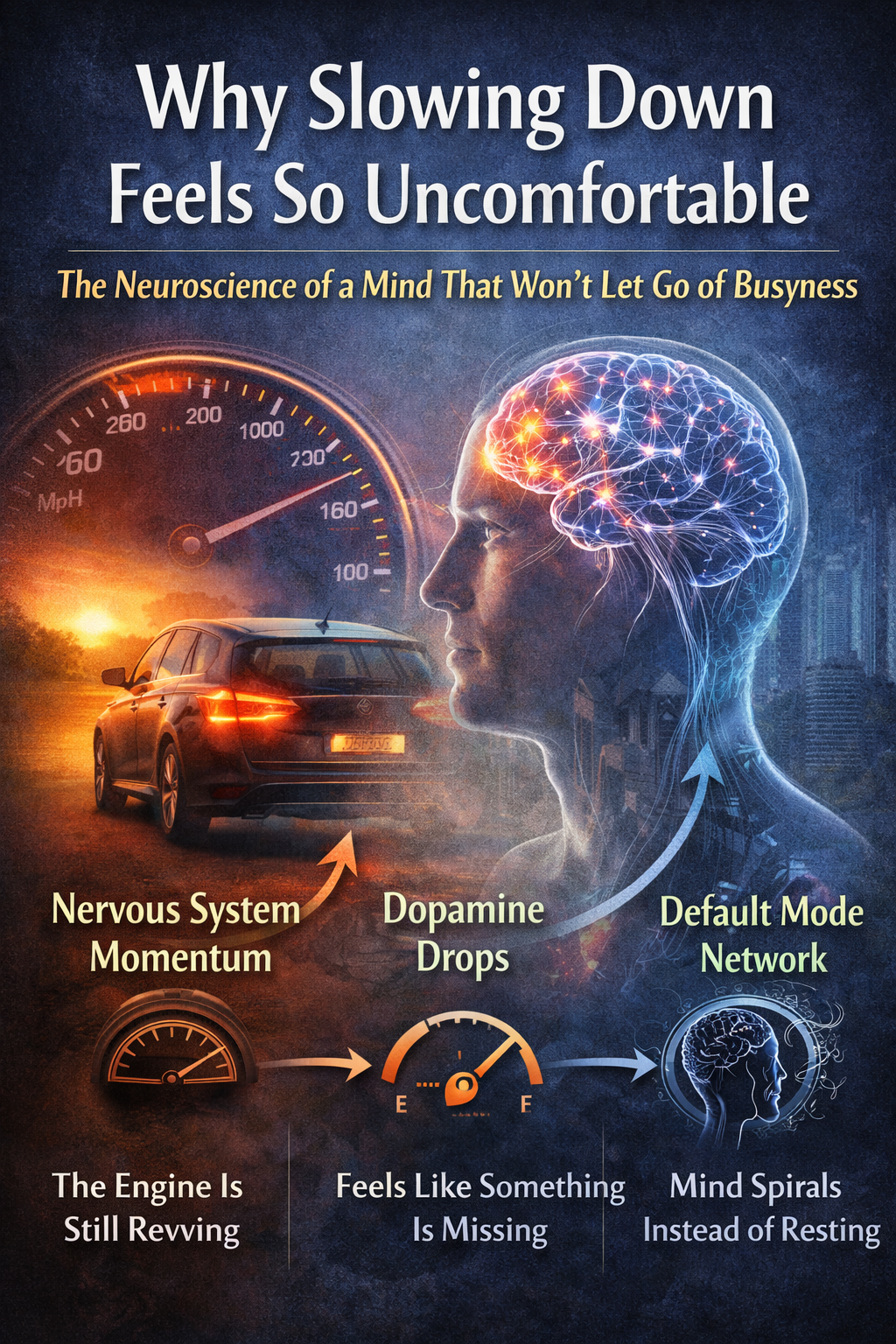 Most people think rest should feel good immediately. But when life finally slows down, something strange happens:
It’s biology. Think of it like driving a car at 100 miles an hour for a long time—and then suddenly slamming the brakes. The wheels stop turning. But the engine is still revving. That “revving” is your nervous system. The nervous system doesn’t switch states instantly When you’re busy for long periods, your body adapts to that pace. Scientifically speaking:
So when external demands suddenly drop:
You didn’t fail at relaxing. Your system just hasn’t downshifted yet. Dopamine is why the mind looks for something to do Dopamine is often misunderstood. It’s not the “pleasure chemical.” It’s the motivation and seeking chemical. During busy periods, dopamine spikes come from:
When that stimulation disappears:
The brain isn’t asking for meaning yet. It’s asking for stimulation. What happens when you stop “doing” When tasks slow down, a brain network called the Default Mode Network (DMN) becomes more active. The DMN is responsible for:
This network is essential—but untrained, it becomes noisy:
So when you stop doing, the mind doesn’t go quiet. It starts talking. That doesn’t mean stillness is bad. It means the mind is entering unfamiliar territory. Why this feels threatening to the system The nervous system learns through repetition. If busyness was associated with:
Then slowing down feels uncertain—even unsafe. The body doesn’t distinguish between: “I don’t know what to do” and “I might be in danger” Both feel like loss of control. So the urge to get busy again isn’t ambition. It’s conditioning. Social media exploits this exact gap This is where modern life complicates things. Social media:
It perfectly fills the uncomfortable space between:
Instead of allowing the nervous system to settle, we hover in between. Not fully busy. Not fully relaxed. Just constantly stimulated enough to avoid stillness. Why slowing down must be intentional at first You can’t think your way into regulation. The nervous system recalibrates through:
This is why rest initially feels uncomfortable—and later becomes nourishing. Stillness is a skill, not a personality trait. The bigger picture Busyness isn’t the enemy. Unconscious busyness is. When you understand what’s happening in the brain and body:
And once that happens? Stillness stops feeling empty. It becomes spacious. Creative. Clarifying. One important real-life example This same mechanism explains why many people struggle after retirement—and why they rush back into the same kind of work they just left. I wrote a separate post on that specifically, because it deserves its own attention. If this resonates, read the companion piece: “Why People Panic After Retirement (And Rush Back to the Same Life)” This post explains how the mind and nervous system work. The other shows what happens when we don’t understand this during major life transitions. Together, they tell the full story. Part 1: The Neuroscience of Epiphanies: Why Sudden Realizations Can Change Your Life Instantly5/17/2025  Redwood Trees at Land of Medicine Buddha, Soquel, California, USA Have you ever had a moment where everything just clicked? A realization so powerful it felt like the universe grabbed your shoulders and shouted, “Wake up! This is what you’ve been missing!” Maybe it was about your purpose. A relationship. A pattern you finally saw clearly for the first time. In that moment, you didn’t just understand something—you felt it in your bones. You were energized, maybe even overwhelmed. But most of all, you felt pulled to act. Not tomorrow. Not next week. But right now. That, my friend, is the power of an epiphany. And there’s a fascinating mix of spiritual alignment and brain chemistry happening behind the scenes when it occurs. What Actually Happens During an Epiphany? Science has finally caught up with what mystics and meditators have known for centuries: - Real insights are not just intellectual—they are neural, emotional, and energetic. Here’s what your brain is actually doing during a breakthrough moment: 1. You Enter a Relaxed “Alpha” Brainwave State (8–12 Hz) This is the incubation phase. It happens when you’re walking in nature, meditating, daydreaming, or simply doing nothing. Your mind is relaxed and open. It’s not busy solving or forcing—it’s just being. In this alpha state, the brain suppresses surface-level noise and opens to deeper, more creative connections. This is why so many people say they get their best ideas in the shower. - Alpha is the fertile soil where insight begins to grow. 2. A Sudden Burst of Gamma Waves (30–80 Hz) Then it happens: the famous “A-ha!” moment. Your brain rapidly links previously unconnected ideas, lighting up with a gamma burst. It’s as if puzzle pieces scattered across your life suddenly snap together. This is the moment where insight, intuition, and higher consciousness converge. Gamma is the flash of clarity—the epiphany itself. 3. Dopamine Says: “This Is Important—Do Something Now” This gamma burst is immediately followed by a release of dopamine, the brain’s motivation chemical. Dopamine doesn’t just feel good. It tags this moment as significant and urgent. That’s why your epiphany often feels so compelling—it’s chemically driving you to act now, not later. But here’s the catch: That window is short. If you don’t act, capture, or commit to something right away, the insight fades. It goes back into the subconscious like a dream you didn’t write down. How to Turn Epiphanies Into Lasting Change Breakthroughs are magical—but they’re also fleeting. To make them count, you need a system to catch and anchor them in your daily life. Here’s a simple 4-step method to do just that: 1. Create Space for Insight (Alpha State)
When your mind quiets, your soul speaks. 2. Catch the Spark (Gamma Burst) Keep a system ready:
The moment you feel the insight, write it down. Don’t worry about polishing it—just capture the energy and essence. 3. Act While Dopamine Is High Make a micro-commitment:
This is how breakthroughs become momentum. 4. Review at Night (Theta Integration) Before bed, revisit your insight. This taps into the theta brainwave state, ideal for memory and emotional consolidation. You’re reinforcing the epiphany as part of your identity and wiring it into your subconscious. Why This Matters—Spiritually and Scientifically In spiritual language, we call these moments:
In neuroscience, they’re:
It’s the same phenomenon through different lenses. You’re accessing higher consciousness and rewiring your brain at the same time. Final Thought Transformation doesn’t always come through effort. Sometimes it comes in a single moment of clarity—when you’re still enough to hear the truth. So the next time that lightning bolt of awareness strikes—don’t brush it off. Pause. Capture it. Act on it. That’s not just a thought—it’s a message from your higher self saying: “This is the moment. Go.” Reflect & Share What’s one insight or epiphany that changed your life? Leave a comment below or journal about it today. Let your breakthrough become someone else’s lightbulb. Read: Part 2: Relax to Receive - Why the Alpha is the Gateway to Spiritual Insight Part 3: Tapping the Divine Frequency, Gamma, Spiritual Downloads, and the Mystic Mind Part 4: The Portal of Dreams - How Theta Brainwaves Reveal Your Soul's Voice Part 5: Breaking Free from Mental Noise - Escapting Beta Overdrive to Find Peace Part 6: The State Shifter - How to Move Between Brainwave States to Master Your Mind & Life |
AuthorFeelasoulphy Categories
All
Archives
March 2026
|
 RSS Feed