Why Slowing Down Feels So Uncomfortable - The Science Behind a Mind That Won’t Let Go of Busyness2/12/2026 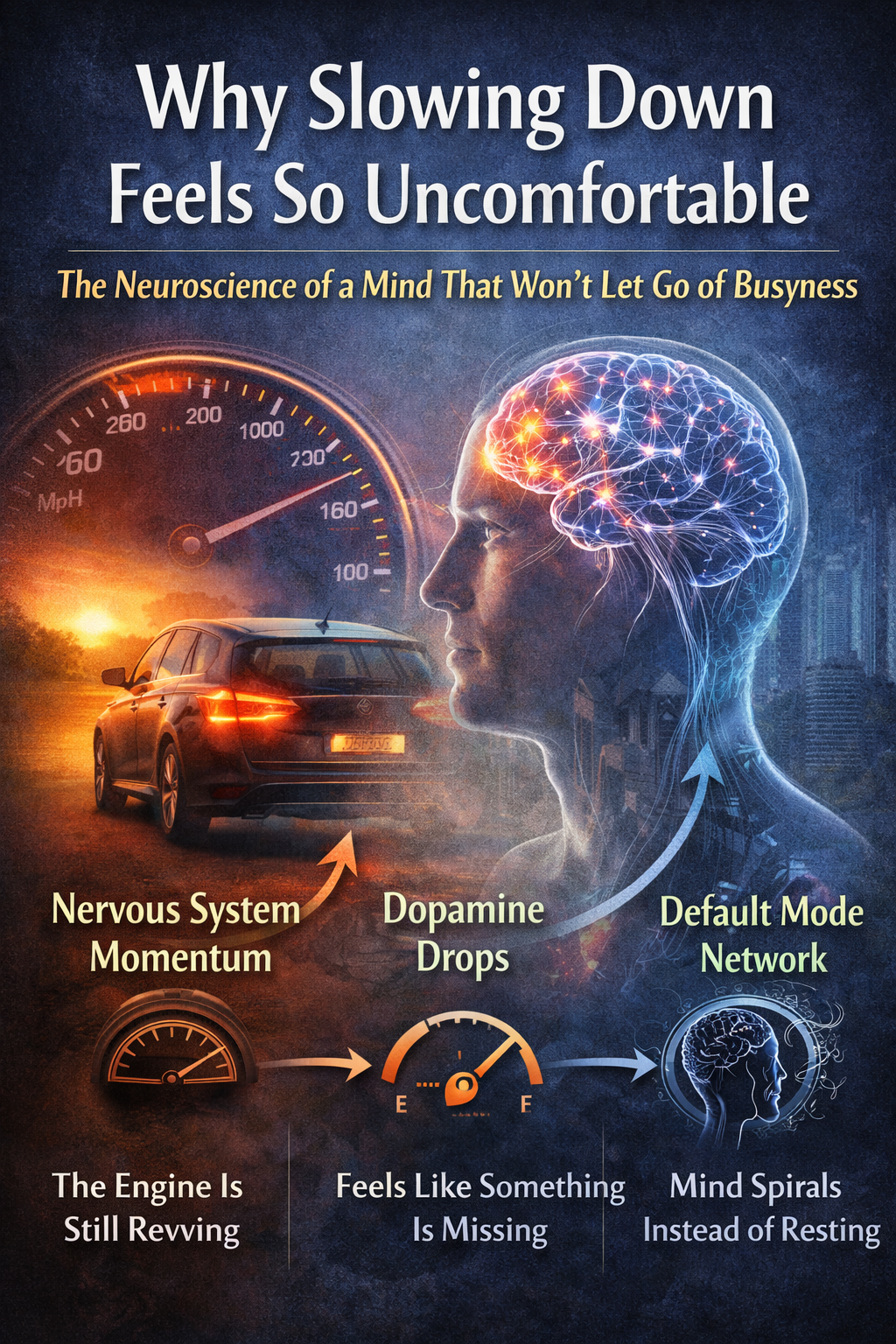 Most people think rest should feel good immediately. But when life finally slows down, something strange happens:
It’s biology. Think of it like driving a car at 100 miles an hour for a long time—and then suddenly slamming the brakes. The wheels stop turning. But the engine is still revving. That “revving” is your nervous system. The nervous system doesn’t switch states instantly When you’re busy for long periods, your body adapts to that pace. Scientifically speaking:
So when external demands suddenly drop:
You didn’t fail at relaxing. Your system just hasn’t downshifted yet. Dopamine is why the mind looks for something to do Dopamine is often misunderstood. It’s not the “pleasure chemical.” It’s the motivation and seeking chemical. During busy periods, dopamine spikes come from:
When that stimulation disappears:
The brain isn’t asking for meaning yet. It’s asking for stimulation. What happens when you stop “doing” When tasks slow down, a brain network called the Default Mode Network (DMN) becomes more active. The DMN is responsible for:
This network is essential—but untrained, it becomes noisy:
So when you stop doing, the mind doesn’t go quiet. It starts talking. That doesn’t mean stillness is bad. It means the mind is entering unfamiliar territory. Why this feels threatening to the system The nervous system learns through repetition. If busyness was associated with:
Then slowing down feels uncertain—even unsafe. The body doesn’t distinguish between: “I don’t know what to do” and “I might be in danger” Both feel like loss of control. So the urge to get busy again isn’t ambition. It’s conditioning. Social media exploits this exact gap This is where modern life complicates things. Social media:
It perfectly fills the uncomfortable space between:
Instead of allowing the nervous system to settle, we hover in between. Not fully busy. Not fully relaxed. Just constantly stimulated enough to avoid stillness. Why slowing down must be intentional at first You can’t think your way into regulation. The nervous system recalibrates through:
This is why rest initially feels uncomfortable—and later becomes nourishing. Stillness is a skill, not a personality trait. The bigger picture Busyness isn’t the enemy. Unconscious busyness is. When you understand what’s happening in the brain and body:
And once that happens? Stillness stops feeling empty. It becomes spacious. Creative. Clarifying. One important real-life example This same mechanism explains why many people struggle after retirement—and why they rush back into the same kind of work they just left. I wrote a separate post on that specifically, because it deserves its own attention. If this resonates, read the companion piece: “Why People Panic After Retirement (And Rush Back to the Same Life)” This post explains how the mind and nervous system work. The other shows what happens when we don’t understand this during major life transitions. Together, they tell the full story.
0 Comments
Leave a Reply. |
AuthorFeelasoulphy Categories
All
Archives
March 2026
|
 RSS Feed