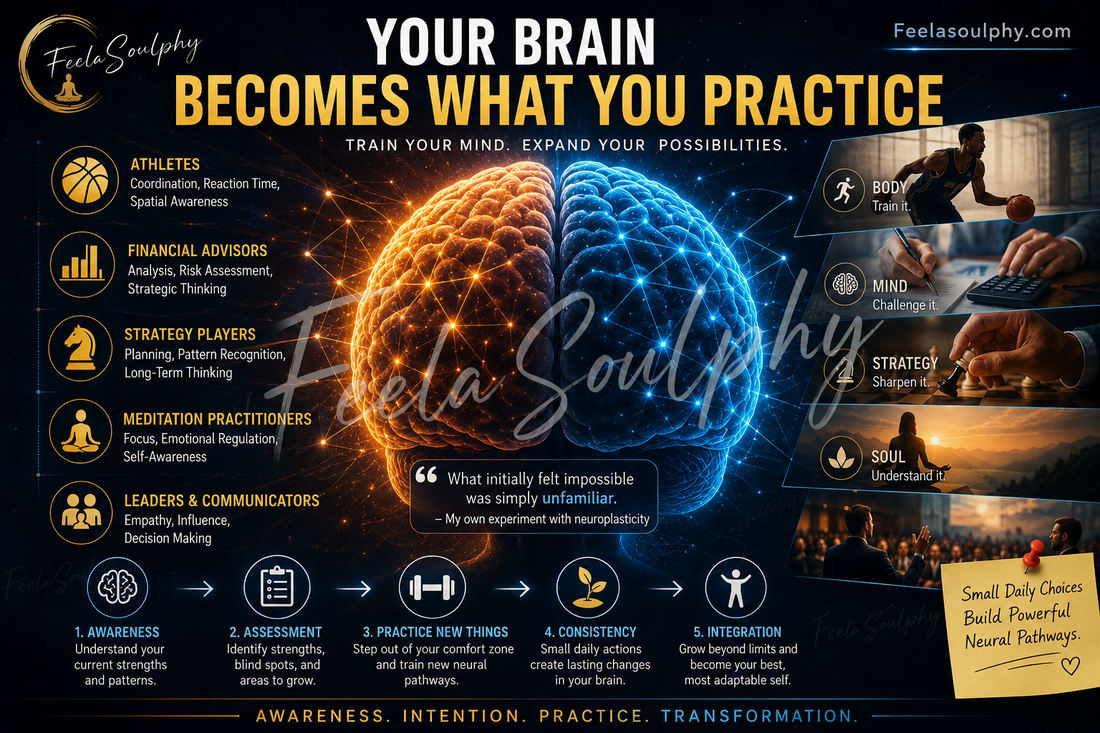
 Most people understand that exercise changes the body.
Far fewer realize that every activity they engage in changes the brain. Your profession, hobbies, routines, conversations, and even the thoughts you repeatedly think are strengthening specific neural pathways. Over time, those pathways become the lens through which you experience the world. In a very real sense, your brain becomes what you practice. The Hidden Specialization of the Human Brain A basketball player develops different neural pathways than an accountant. A musician develops different pathways than a soldier. A chess player develops different pathways than a meditation practitioner. This doesn't necessarily mean one person is more intelligent than another. It means their brains have become optimized for different functions. A financial advisor may quickly recognize risk, opportunity, and long-term consequences. A basketball player may instantly process movement, timing, and spatial relationships. A musician may hear subtle patterns and variations others miss. A meditator may notice thoughts and emotions arising before they become reactions. Each person is seeing the same world through a brain that has been trained differently. The brain adapts to whatever it repeatedly does. This process is known as neuroplasticity. The more frequently a neural pathway is used, the stronger and more efficient it becomes. Like a trail through a forest, repeated use transforms a narrow path into a well-traveled road. My Own Experiment With Neuroplasticity Years ago, I unintentionally tested this principle myself. I was setting up a computer in my room. Because of the way the desk was positioned, the modom had to sit on the left side. The problem was that the mouse cable was too short for me to comfortably use it with my right hand. Most people would have moved the desk. Instead, I saw an opportunity. I had always wondered whether I could train my non-dominant hand, so I decided to use the mouse with my left hand. At first it felt awkward and frustrating. Simple tasks required concentration. My movements were slower and less accurate. My brain constantly wanted to return to the familiar pathways it had spent years developing. But I kept practicing. Eventually, something changed. The movements became smoother. The effort disappeared. What once felt impossible became natural. Today, I can comfortably use a mouse with either hand. That experience taught me a lesson I have never forgotten: What initially felt impossible was simply unfamiliar. The limitation wasn't physical. It was neurological. My brain simply needed time to build new pathways. The same principle applies to communication, confidence, meditation, relationships, leadership, public speaking, creativity, and countless other skills. Many things we believe we cannot do are often things we have not practiced long enough to develop. The Strengths and Blind Spots of Specialization Every specialization creates strengths. But every specialization can also create blind spots. An accountant may become highly analytical but struggle to stop overthinking. A soldier may develop exceptional situational awareness but remain hypervigilant in safe environments. An entrepreneur may constantly search for opportunities and find it difficult to relax. A spiritual seeker may spend so much time looking inward that practical action gets neglected. The same pathways that create expertise can also create limitations. This is why personal growth often requires us to step outside what feels natural. Growth begins where familiarity ends. Discover Your Brain's Specialty Before developing new abilities, identify what your brain is already training every day. Ask yourself:
Your answers reveal the pathways that have been strengthened through years of repetition. Most people already have a specialty. Very few are consciously aware of it. The Brain Expansion Framework If you want to become more adaptable, creative, and well-rounded, deliberately train abilities outside your normal strengths. Think of this as cross-training for the brain. Step 1: Identify Your Dominant Strength Determine the area where you spend most of your mental energy. Are you primarily:
This is likely the area where your strongest neural pathways exist. Step 2: Train the Opposite Growth often comes from developing what you naturally avoid. If you're analytical:
If you're highly physical:
If you're highly social:
If you're naturally introspective:
Step 3: Become a Beginner Again One of the healthiest things you can do for your brain is regularly place yourself in situations where you are not already competent. Beginners create new neural pathways. Experts often repeat existing ones. Stay a student. Step 4: Embrace the Awkward Stage Most people quit during the exact phase where the brain is beginning to change. Awkwardness is not evidence that you cannot do something. Awkwardness is evidence that your brain is learning. The discomfort you feel is often the sensation of growth. Simple Ways to Train New Parts of Your Brain You don't need a complete life overhaul. Start small. Try:
Every new challenge encourages the brain to form new connections. Small experiments performed consistently create lasting change. The Real Purpose of Growth Many people focus on improving their circumstances. Far fewer focus on improving the instrument through which they experience those circumstances. Every activity is training your brain. Every habit is reinforcing a pathway. Every repeated thought is strengthening a pattern. The question is not whether your brain is changing. The question is what it is changing into. Ask yourself: What part of my brain am I training every day? And perhaps more importantly: What part of myself have I neglected? Your greatest growth may not come from becoming better at what you already do. It may come from developing the abilities you have never given yourself permission to explore. Because in the end, we do not simply become what we believe. We become what we repeatedly practice.
0 Comments
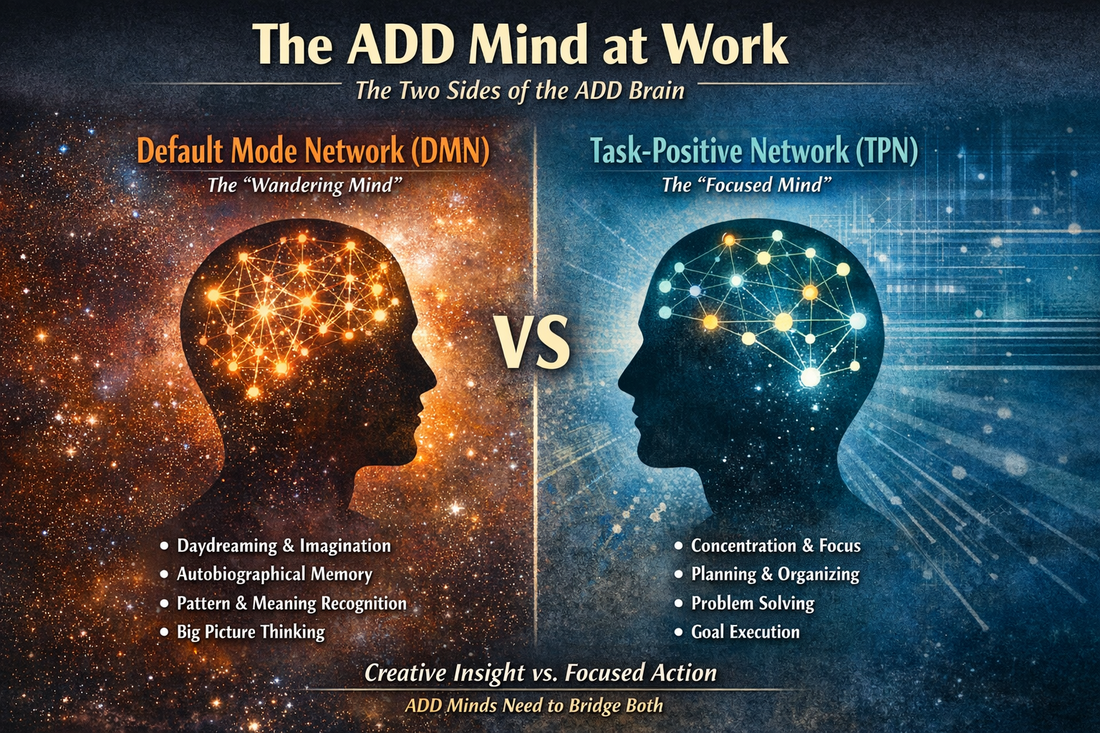 Most people think ADD is about distraction. It isn’t. It’s about where the mind naturally spends its time—and how poorly modern life understands that territory. Many ADD minds are not failing at focus. They are operating from a different neural home base. That home base has a name: the Default Mode Network. The Default Mode Network: Where the ADD Mind Lives The Default Mode Network (DMN) is a large-scale brain network that becomes active when we are not focused on a specific external task. It lights up when we:
In most people, the DMN quiets down when task-focused networks activate. But in many people with ADD, the DMN remains highly active, even when they are supposed to be “paying attention.” This is why ADD minds:
From the inside, it feels like constant mental motion. But here’s the key point most narratives miss: The DMN is not a defect. It is the neural basis of creativity, identity, empathy, and insight. The Wandering Mind Is Not Broken Because the DMN is involved in autobiographical memory and self-referential processing, ADD minds often think in story, metaphor, and meaning, not steps and checklists. This explains why people with ADD are frequently drawn to:
You learn when each is useful. The Real Breakdown: When DMN Has No Translator ADD minds don’t lack ideas. They have too many, too quickly, with too much depth. The problem begins after insight appears. The DMN is excellent at generating meaning, but it is not designed to package that meaning into deliverables. That job belongs to task-positive networks—the ones responsible for planning, sequencing, and execution. When someone with ADD tries to jump directly from DMN insight to execution, the nervous system often overloads. The result looks like this:
It is a missing translation layer. The Generator–Integrator–Bridger Model ADD minds work best when allowed to cycle through three distinct phases. Problems arise when these phases are forced to overlap. 1. The Generator (DMN-dominant) This is the wandering phase. Ideas arise freely. Connections form unexpectedly. Memories, emotions, and insights surface without invitation. Trying to control this phase kills its value. Its purpose is not productivity. Its purpose is raw material. 2. The Integrator (DMN → Task Network Transition) This is the most overlooked phase—and the one that changes everything. Integration is not execution. It is sense-making. This is where the mind asks:
With it, execution becomes obvious. Most ADD frustration comes from skipping integration entirely. 3. The Bridger (Meaning-Supported Action) This is where insight becomes usable. Bridging is the act of translating understanding into form:
It means coherence. One insight. One form. One version. Completion is not the end of truth. It is how truth moves forward. Why ADD Minds Struggle to Finish ADD minds often abandon projects not because they lack discipline, but because dopamine drops before translation is complete. The idea stays internal too long. The DMN keeps refining. The nervous system tires. Interest fades. Finishing begins to feel artificial—or worse, like betrayal of depth. But completion is not betrayal. It is integration made visible. Soft Structure Works Better Than Discipline Rigid systems exhaust ADD nervous systems. What works instead:
If it feels heavy, the mind will rebel. Every time. Reclaiming Identity The most damaging belief ADD minds carry is this: “I can’t finish things.” A more accurate truth is this: “My mind generates faster than it integrates.” That is not a flaw. That is a role. You are not a factory worker of ideas. You are a translator of meaning. When the mind is respected instead of corrected:
A Final Reframe You don’t need to shut down the Default Mode Network. You don’t need to fight wandering. You don’t need to become someone else. You need a bridge between inner insight and outer form. The wandering mind is not lost. It’s simply waiting to be translated. Why Slowing Down Feels So Uncomfortable - The Science Behind a Mind That Won’t Let Go of Busyness2/12/2026 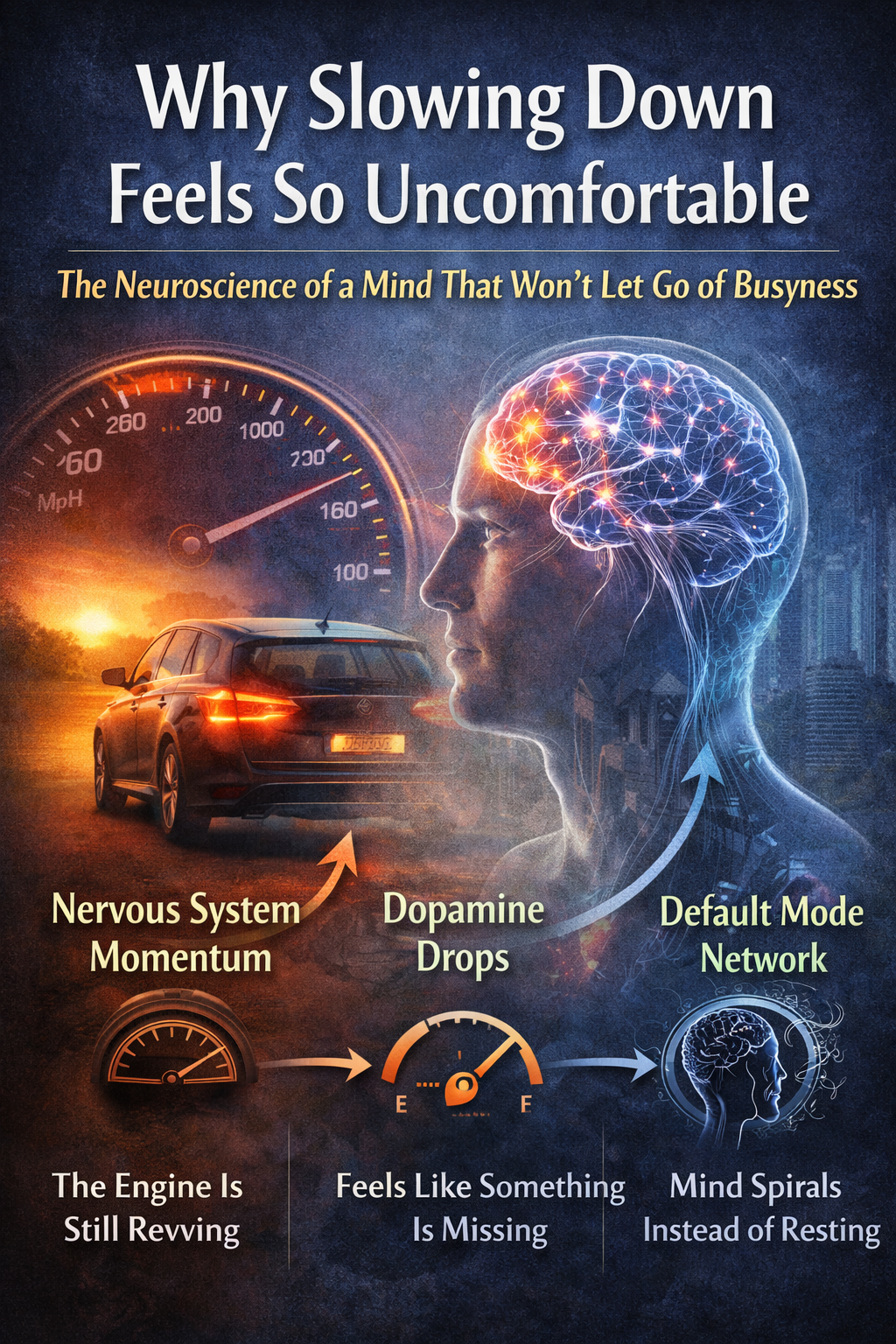 Most people think rest should feel good immediately. But when life finally slows down, something strange happens:
It’s biology. Think of it like driving a car at 100 miles an hour for a long time—and then suddenly slamming the brakes. The wheels stop turning. But the engine is still revving. That “revving” is your nervous system. The nervous system doesn’t switch states instantly When you’re busy for long periods, your body adapts to that pace. Scientifically speaking:
So when external demands suddenly drop:
You didn’t fail at relaxing. Your system just hasn’t downshifted yet. Dopamine is why the mind looks for something to do Dopamine is often misunderstood. It’s not the “pleasure chemical.” It’s the motivation and seeking chemical. During busy periods, dopamine spikes come from:
When that stimulation disappears:
The brain isn’t asking for meaning yet. It’s asking for stimulation. What happens when you stop “doing” When tasks slow down, a brain network called the Default Mode Network (DMN) becomes more active. The DMN is responsible for:
This network is essential—but untrained, it becomes noisy:
So when you stop doing, the mind doesn’t go quiet. It starts talking. That doesn’t mean stillness is bad. It means the mind is entering unfamiliar territory. Why this feels threatening to the system The nervous system learns through repetition. If busyness was associated with:
Then slowing down feels uncertain—even unsafe. The body doesn’t distinguish between: “I don’t know what to do” and “I might be in danger” Both feel like loss of control. So the urge to get busy again isn’t ambition. It’s conditioning. Social media exploits this exact gap This is where modern life complicates things. Social media:
It perfectly fills the uncomfortable space between:
Instead of allowing the nervous system to settle, we hover in between. Not fully busy. Not fully relaxed. Just constantly stimulated enough to avoid stillness. Why slowing down must be intentional at first You can’t think your way into regulation. The nervous system recalibrates through:
This is why rest initially feels uncomfortable—and later becomes nourishing. Stillness is a skill, not a personality trait. The bigger picture Busyness isn’t the enemy. Unconscious busyness is. When you understand what’s happening in the brain and body:
And once that happens? Stillness stops feeling empty. It becomes spacious. Creative. Clarifying. One important real-life example This same mechanism explains why many people struggle after retirement—and why they rush back into the same kind of work they just left. I wrote a separate post on that specifically, because it deserves its own attention. If this resonates, read the companion piece: “Why People Panic After Retirement (And Rush Back to the Same Life)” This post explains how the mind and nervous system work. The other shows what happens when we don’t understand this during major life transitions. Together, they tell the full story.  The Flower Fields, Calsbad, California, USA The Spiritual Purpose Behind Our Shifting Passions, Identities, and Paths Have you ever looked back at your life and wondered, “Who was I back then?” Maybe you went through a spiritual phase, a fitness phase, a minimalist phase, a business-building phase, or even a wild-and-free phase. And now, you’re in an entirely different chapter — with different passions, desires, and even a different sense of self. You’re not flaky. You’re evolving. You’re not lost. You’re learning. You’re not inconsistent. You’re in a phase — and that’s not only normal, it’s necessary. Phases Are How the Soul Grows From a spiritual lens, our souls incarnate with a plan — not a rigid blueprint, but a flexible curriculum. The soul doesn’t want sameness, it wants expansion. And how do we expand? Through experience. Each phase you’ve been through — no matter how random or unrelated it seemed at the time — held a piece of your puzzle. Some taught you discipline. Others cracked your heart open. Some helped you build, while others taught you how to let go. From the soul’s perspective, there’s no such thing as “wasted time.” Only lessons. The Psychology of Phases: You’re Wired to Shift Neurologically speaking, we’re not meant to stay in one mode of operation forever. The human brain is shaped by neuroplasticity, which means it constantly adapts, rewires, and reshapes itself based on what you focus on. When you go through a phase, you’re literally forming new neural pathways. You’re reprogramming your mind. This isn’t failure — it’s progress. Yes, society often glorifies “consistency” and “persistence,” but it forgets that adaptability is just as powerful a form of intelligence. The oak tree is sturdy, but the bamboo survives the storm. When to Shift, When to Stay Here’s the part many people get stuck on — how do you know when it’s time to move on, and when you’re just bored or avoiding something uncomfortable? True soul-guided shifts feel expansive, even if they’re scary. Avoidant shifts feel relieving at first but leave you feeling hollow. Some things are meant to be completed. They require your full presence and persistence — not because you’re “supposed to stick with it,” but because there’s a deep soul lesson embedded in the completion, not the escape. The Gift of Many Selves You are not here to be one fixed character your whole life. You’re a multidimensional being having a multidimensional experience. The version of you who loved painting at 20, the one who dove into meditation at 30, and the one now craving simplicity and nature — they’re all you. None of them were wrong or off-path. They were stepping stones. They were phases. They were part of the unfolding. Imagine doing only one thing your entire life — thinking the same, acting the same, dressing the same, believing the same. That’s not consistency. That’s stagnation. The river flows because it moves. A Reminder for the Multi-Passionate Souls So if you’ve ever been made to feel like you “change too much,” here’s your permission slip: You’re not meant to stay the same. You’re meant to stay true. And “true” will look different depending on the season of your soul. The world needs stable builders and daring shapeshifters. We need the ones who master one path for 40 years — and the ones who master the art of reinvention every 5. What matters most is that you’re conscious of your direction. Let your phases be sacred. Let your seasons be teachers. But also learn to listen: Which ones are calling you to finish the lesson? And which ones are whispering: It’s time to begin again? Final Thought: Phases Are Not Detours They’re the journey itself. Just make sure you’re not jumping ship because of discomfort… And you’re not staying out of fear of change. Complete what you came to complete. And when it’s done — don’t be afraid to move on. Because the next phase might just be the one that unlocks everything.  Use your dreams to track your healing, rewiring, and evolution. Here’s a little-known truth: If you behave differently in your dreams than you did in the past… that means you’ve already reconditioned your mind. You’ve rewired your brain on a deep, subconscious level. Why? Because dreams are not random. They are generated by your subconscious, the part of your mind that stores your emotional patterns, core beliefs, traumas, and triggers—long after your conscious mind has moved on. So when a situation shows up again in a dream—an ex, a fear, a fight—and this time you respond calmly or wisely or with power, you didn’t just dream it. You became it. Psychological Insight: Behavior Shift in Dreams = Subconscious Rewiring In behavioral psychology, our reactions are often automatic—especially under stress. Dreams simulate stress, emotion, and choice in surreal ways. If your instinctual response in a dream changes, it means your internal conditioning has shifted. You didn’t “decide” to change in the dream. You just acted. That’s how you know the change is real—it bypassed the thinking mind. Neuroscience Supports This Too
Dreams as a Spiritual Classroom Most things that happen in our dreams will never happen in real life. And that’s what makes them so valuable. They give you emotional simulations—safe environments to re-experience old wounds, future scenarios, or alternate versions of the self. Why did I make that choice in the dream? Would I act the same in real life? Why or why not? Since all the characters are projections of your perception of the world, every interaction is a conversation with yourself. Create a Morning Dream Practice (Before You Forget!)
My Personal Discovery I once watched a movie before bed and dreamed of an ex I hadn’t thought of in years. The dream wasn’t about her—it was about an unresolved emotion the movie triggered. I analyzed the dream the next morning, traced the emotion back to the memory, and felt it fully. That’s when it lifted. I let it go, completely. That one dream gave me more healing than months of overthinking. Final Thought: When your dreams start changing, your healing is already happening. You don’t need proof from the outside world—your subconscious has spoken. Use your dreams like a mirror. Learn from them. Talk to them. Let them show you what still hurts, and celebrate when something no longer does. Because when you act differently in a dream… you are no longer the same.  “What if the world was always this vivid—and we just forgot to pay attention?” Most of us eat distracted. We’re watching TV. Scrolling. Talking over dinner. We don’t even taste our food. But one day, I learned what it was like to really eat. I was on an edible. I remember biting into a kiwi. Suddenly, it was electric. Juicy. Tart. Sweet. The texture of the seeds. The smell of the fruit. Every sense was awake. Even watching a movie, I felt more emotional, more attuned to what was happening on screen. It was like my empathy was dialed up—I could sense what the characters felt. It was such a strange gift. Why did this happen? It turns out this isn’t magic. It’s attention. Edibles (like cannabis) can reduce activity in the default mode network (DMN)—the part of the brain responsible for mind-wandering and constant self-narration. When the DMN quiets down, sensory networks become more active. Emotions and empathy rise to the surface. In other words: When you’re really here, you really feel. Eating is special Eating is one of the few everyday activities that naturally engages all our senses: Sight: color, shape, presentation. Smell: aroma. Taste: layers of flavor. Touch: texture, weight. Sound: crunch, slurp, chew. It’s designed to be immersive. But we numb it by multitasking and rushing. When you actually focus? It’s an experience. It’s not just food—it’s people This kind of presence doesn’t just change eating. It changes how we connect with others. When you really listen to someone—without waiting to talk, without checking your phone—you hear them on a different level. You notice subtle emotions in their voice. You see the story in their eyes. You feel with them, not just next to them. Presence is the foundation of empathy. And empathy is what deepens connection. Science agrees Mindfulness meditation reduces DMN activity, just like certain drugs can—but without side effects. It increases interoceptive awareness (body sensations) and sensory acuity. It also strengthens brain regions linked to empathy and compassion (anterior cingulate, insula). Long-term meditation practice literally rewires the brain for presence. Drugs vs. Meditation Drugs can open the door to this state. They show you how present you could be. But they don’t train you to stay there. Meditation does. Presence practice does. It’s a lifelong shift, not a temporary escape. Try This: A Mindful Eating Practice Pick something simple. A kiwi. An apple. Chocolate. Look at it carefully. Color. Shape. Smell it. Take a slow bite. Chew carefully. Feel the texture. Notice the sound. Taste all the flavors. Keep bringing your mind back when it drifts. This isn’t just about food. It’s a training ground for attention. A Practice for Connection Next time you’re with someone: Put the phone away. Look them in the eyes. Really listen. Notice tone, words, pauses. Feel what they’re feeling. Watch how the conversation changes. Watch how you change. Final Reflection That kiwi taught me that life is always offering something beautiful—if I’m willing to really show up for it. Food can be spiritual. Conversations can be sacred. This moment can be everything. Presence turns ordinary life into holy ground. Part 6: The State Shifter — How to Move Between Brainwave States to Master Your Mind & Life6/12/2025  Tunnel Trail at Pinnacles National Park, California, USA We’ve explored the brain’s core frequencies — from deep Theta to elevated Gamma. You now understand that your brain isn’t locked in one state — it’s a dynamic instrument, constantly tuning itself based on your environment, focus, and internal habits. Here’s the empowering truth: You can learn to consciously shift between brainwave states to support whatever your life calls for — whether it’s insight, creativity, relaxation, connection, or action. This is the art of becoming a State Shifter — a person who moves fluidly between levels of consciousness with skill and intention. Let’s explore how. Recognizing What State You’re In Awareness is the first step. Here’s a simple guide to recognizing your current state: State How It Feels Common Signs Beta Alert, busy, scattered Mental chatter, worry, multitasking, social engagement Alpha Calm, present, open Flow state, gentle focus, relaxed body Theta Dreamy, intuitive, spacious Hypnagogic images, insights, inner voice emerges Gamma Elevated, deeply connected, clear “Aha” moments, unity experiences, love, rapid learning Delta Deep sleep, healing Not consciously accessible unless trained (lucid sleep/yoga nidra) Pay attention throughout your day. Ask yourself: “What state am I in right now? Is it helping or hindering what I need to do?” Self-awareness is the master key. Tools to Enter or Exit Each State Here’s a practical toolkit to help you shift as needed: To Exit Beta (Calm the Mind):
To Enter Alpha (Flow & Relaxed Focus):
To Enter Theta (Subconscious Access):
To Enter Gamma (Peak States & Spiritual Connection):
To Return to Beta (Productive Action):
Using State Awareness for Life Mastery Why does this matter? Because knowing how to shift states allows you to:
Real-Life Examples Public Speaking:
Conflict Resolution:
Decision Making:
Creativity (Writing, Art, Innovation):
Final Thought: Your Mind Is a Multidimensional Instrument Most people live trapped in one narrow band of brainwave activity — usually stuck in chronic Beta. But when you learn to move skillfully between states, you unlock an incredible range of capacities: Wisdom Creativity Healing Productivity Spiritual insight You become not just a thinker — but an artist of consciousness. And the more you practice, the more fluid and natural this shifting becomes. Remember: You are not your thoughts. You are the awareness that can move through thought, silence, insight, and beyond — at will. Part 6 Bonus: The State Shifter Cheat Sheet + Guided Practice Quick Reference: Brainwave States & How to Access Them State Best For How It Feels How to Enter Beta (12–30 Hz) Focus, logic, action Alert, thinking, busy Bright light, caffeine, movement, goal setting Alpha (8–12 Hz) Flow, calm, receptivity Relaxed focus, present Breathwork, hot shower, 5→1 countdown, silent driving Theta (4–8 Hz) Insight, healing, Dreamy, slowed, Hypnagogic journaling, body scan, subconscious intuitive meditation after waking reprogramming Gamma (30–100 Hz) Peak performance, Clear unified, elevated Focused love, deep insight, heart coherence, inspired spiritual downloads Guided Meditation Script: “Shift Your State in 5 Minutes” You can record it in your voice. Use soft ambient music with a slow tempo (~60 bpm) to enhance Alpha/Theta access. Script: “Shift Your State” Welcome to your moment of reset. This short practice will help you shift from stress or overthinking into the state your soul truly needs right now. Find a quiet space. Sit or lie comfortably. Let your hands rest. Close your eyes. Let’s take three deep breaths together: Inhale… Exhale… Again — in… and out… One more… let it go fully. Now gently ask yourself: “What state am I in right now?” Just notice. No judgment. Are you racing? Are you foggy? Are you already calm? Now, bring to mind the state you’d like to shift into. Choose one: calm, creative, focused, open, or connected. Good. Now we’ll begin a countdown to shift you into that state. 5… Release tension in your face and jaw. 4… Let your shoulders drop. Let your belly soften. 3… Bring your awareness to your breath. 2… Feel the ground or chair holding you. 1… Let go. Arrive here. Fully. Now simply breathe in this new state. If you chose calm, let your breath deepen. If you chose focus, feel a slight lift in your spine. If you chose connection, place your hand on your heart. Let the feeling of your chosen state expand. It’s not far away. It’s already within you — just a frequency shift away. Breathe into it. Let it anchor. [Pause 30–60 seconds in silence or soft background music] Now take one last breath… And when you’re ready, open your eyes -- carrying this new state with you. You’ve just shifted your frequency. You are not stuck. You are powerful. And you can return here — anytime. Read: Part 1: The Neuroscience of Epiphanies: Why Sudden Realizations Can Change Your Life Instantly Part 2: Relax to Receive - Why the Alpha Brainwave Is the Gateway to Spiritual Insight Part 3: Tapping the Divine Frequency - Gamma, Spiritual Downloads, and the Mystical Mind Part 4: The Portal of Dreams - How Theta Brainwaves Reveal Your Soul's Voice Part 5: Breaking Free from Mental Noise - Escapting Beta Overdrive to Find Peace  Lassen Volcanic National Park, California, USA Have you ever felt like your mind just won’t shut up? One thought leads to another… then another… and suddenly you’re not here anymore. You’re in your head, planning, worrying, analyzing, replaying. This is the grip of Beta brainwaves — the default setting of a society built on productivity, pressure, and problem-solving. Let’s unpack why beta dominates so many minds today — and how you can consciously shift out of it when needed. What Are Beta Brainwaves? Beta waves range from 12 to 30 Hz and are associated with:
In moderation, beta is great. It’s what helps you write an email, drive safely, or give a presentation. But when we get stuck in high beta, we enter the zone of hypervigilance and chronic stress. The Overthinking Trap: When Beta Becomes a Cage The modern world keeps us in high beta almost nonstop:
When beta overactivity becomes chronic, it creates:
Why? Because beta is the brainwave of survival. Your nervous system is on guard. Your body is bracing for attack. Your mind is rehearsing “what if” scenarios to stay one step ahead. But here’s the problem: when you’re in survival mode, you can’t access peace, creativity, or spiritual insight. You’re not in harmony — you’re in defense. Downshifting from Beta to Alpha or Theta The good news? You can train your brain to shift down from beta to more relaxed states like Alpha or Theta, where insight, peace, and clarity naturally emerge. Here’s one of the simplest techniques to help you break the beta loop: Technique: Counting Backward from 5 to 1 This deceptively simple practice is incredibly powerful. How it works:
Why it works scientifically:
Think of it as your internal elevator. Every time you count down, you descend from the “penthouse” of thinking into the “heart-level” of being. More Tools to Escape Beta Overdrive Besides the countdown, here are additional practices to break the cycle of mental noise:
Using Beta Consciously — Not Compulsively Beta isn’t bad. In fact, it’s a gift when used intentionally. In lower ranges, beta allows you to:
The key is to use beta as a tool, not live there as your home. When you learn to toggle between brainwave states, you’re no longer controlled by your thoughts — you become the master of your mind. Final Thought: Silence Is Not Laziness — It’s Wisdom In a world that worships speed, being still looks lazy. But nothing is more productive than training your brain to listen — not just think. When you shift out of beta and into a deeper state, you make space for:
Break the loop. Count down. Tune in. You’ll find that your soul isn’t lost — it’s just been waiting for the noise to quiet down. Guided Meditation: “From Noise to Now” (Beta to Alpha in 5 Steps) This meditation is designed to help you shift out of an overthinking mind and into a state of calm presence using a simple but powerful countdown technique. It works best if you can sit or lie somewhere quiet without distractions. Let’s begin. Close your eyes. Take a deep breath in through the nose… And let it out slowly through the mouth. Again… Inhale… And exhale… Let your body settle. Let your shoulders drop. Let your jaw relax. Let yourself land — here and now. Notice your thoughts, not with judgment, but curiosity. They may still be moving quickly. That’s okay. You’re not here to stop the thoughts — just to slow down and reconnect with stillness. Now, gently bring your attention to the space behind your forehead… Feel the energy of thinking. That mental buzz or tension. Now imagine we’re going to slowly turn down the volume -- not by force, but by shifting frequency. We’ll begin a countdown from 5 to 1, and with each number, your body will relax deeper, and your mind will soften and open. 5… Feel yourself softening. The thinking slows just a little. Your breath is steady. Let go of your outer world. 4… Your body feels heavier now. The space behind your eyes is wide and calm. You’re safe to relax. 3… Your mind may try to grab another thought — let it go. You’re drifting now… Deeper into yourself. Breath is smooth. Shoulders are soft. 2… You’re beginning to feel a gentle quiet within. The mental noise is fading… And a calm clarity is arriving. 1… You’ve arrived. Not in some faraway place, But right here — fully present. Your body is calm. Your mind is soft. You’ve entered the Alpha state. Rest here for a moment. Feel what it’s like to just be. No fixing. No analyzing. Just being. If a thought arises, let it pass like a cloud. Return to the feeling of your breath. Return to the stillness between the thoughts. Now gently bring your awareness back to your body. Wiggle your fingers and toes. Take a deep breath in… And a slow exhale out. When you’re ready, open your eyes. You’ve shifted your state — from mental noise to presence. Read: Part 1: The Neuroscience of Epiphanies: Why Sudden Realizations Can Change Your Life Instantly Part 2: Relax to Receive - Why the Alpha Brainwave Is the Gateway to Spiritual Insight Part 3: Tapping the Divine Frequency - Gamma, Spiritual Downloads, and the Mystical Mind Part 4: The Portal of Dreams - How Theta Brainwaves Reveal Your Soul's Voice Part 6: The State Shifter - How to Move Between Brainwave States to Master Your Mind & Life  A bird resting on top of the tree at Montage Laguna Beach, Laguna, California, USA In a noisy world that glorifies mental stimulation and constant doing, relaxation has become a radical act. But it’s in this relaxation—this soft, alert stillness—that your most profound insights begin to emerge. Welcome to the alpha brainwave state: the fertile ground for creativity, intuition, and spiritual downloads. What Are Alpha Brainwaves? Alpha waves are brain frequencies between 8–12 Hz, most active when you’re:
This is the sweet spot between wakefulness and sleep, between effort and surrender. It’s not passive—it’s receptive. And it opens a bridge between your conscious and subconscious mind. Why Alpha Unlocks Spiritual and Creative Flow When you’re in alpha:
This is why many spiritual practices—like meditation, prayer, journaling, or walking in nature—naturally bring you into this state. You’re no longer in “problem-solving mode” (beta). You’re available for something deeper. Alpha is the portal through which insight travels. The space that invites a gamma burst of realization. How to Enter the Alpha State in Daily Life You don’t need a retreat, incense, or silence to access alpha. You just need moments of presence, where the conscious mind lets go. Here are simple, everyday ways to drop into alpha: 1. Hot Shower Meditation Let hot water run down the back of your head and neck. This stimulates the parasympathetic nervous system, relaxing the brain and body while quieting the mind. You’re not just cleaning your body—you’re resetting your brain. Many people get their best ideas in the shower for this very reason. 2. Driving in Silence If you’re familiar with the route, your conscious mind goes on autopilot. This opens up mental bandwidth for the subconscious mind to surface. Ever noticed how deep insights hit you while driving alone on a quiet road—or stuck in traffic? That’s alpha working through stillness and rhythm. 3. Early Morning Stillness (Alpha on Wake-Up) When you first wake up, you’re naturally in alpha/theta. Avoid grabbing your phone. Instead, lie still, observe your thoughts, and ask questions. This is one of the most spiritually potent moments of the day. 4. Nature Walks Without Your Phone Let your senses guide you. No music. No distractions. Just pure presence. Nature entrains the body and mind to calm, rhythmic patterns—instantly inducing alpha. 5. Eating Alone in Silence Put your phone away. Be fully present with the textures, flavors, and sensations of your meal. This deepens awareness and reconnects you with your senses. Some even compare it to the slow, heightened mindfulness of eating edibles—without the altered state. You become the observer, not just the consumer. 6. Free Journaling or Brain Dumping Let your thoughts flow without judgment or editing. When the conscious mind stops filtering, deep truths rise from below. This is often when insight, emotional clarity, and spiritual messages come through. 7. Brushing Teeth or Doing Chores in Silence Doing mundane tasks like brushing teeth, folding laundry, or washing dishes without background noise occupies the conscious mind just enough to let the subconscious seep through. Think of it as keeping your ego busy so your soul can sneak in. 8. Bathroom Breaks Without Your Phone Use bathroom time as a mini meditation. Avoid distractions unless you’re jotting down a note that came through. These “micro-moments of stillness” allow your brain to reset and reconnect. 9. Lo-fi or Alpha Binaural Beats Listening to music in the 8–12 Hz range can entrain your brain to alpha waves. Great during journaling, meditation, or light creative work. What Blocks the Alpha State?
Alpha can’t be forced—it must be invited. It thrives in space, ease, and quiet focus. Final Thought “Alpha is where your soul can finally get a word in.” We often search for answers with the volume turned up too loud. But the voice of truth is quiet—and it speaks when you’re still. Give your mind space to breathe. The insight you’re looking for is already waiting… behind the noise. Read: Part 1: The Neuroscience of Epiphanies: Why Sudden Realizations Can Change Your Life Instantly Part 3: Tapping the Divine Frequency - Gamma, Spiritual Downloads, and the Mystical Mind Part 4: The Portal of Dreams - How Theta Brainwaves Reveal Your Soul's Voice Part 5: Breaking Free from Mental Noise - Escapting Beta Overdrive to Find Peace Part 6: The State Shifter - How to Move Between Brainwave States to Master Your Mind & Life Part 1: The Neuroscience of Epiphanies: Why Sudden Realizations Can Change Your Life Instantly5/17/2025  Redwood Trees at Land of Medicine Buddha, Soquel, California, USA Have you ever had a moment where everything just clicked? A realization so powerful it felt like the universe grabbed your shoulders and shouted, “Wake up! This is what you’ve been missing!” Maybe it was about your purpose. A relationship. A pattern you finally saw clearly for the first time. In that moment, you didn’t just understand something—you felt it in your bones. You were energized, maybe even overwhelmed. But most of all, you felt pulled to act. Not tomorrow. Not next week. But right now. That, my friend, is the power of an epiphany. And there’s a fascinating mix of spiritual alignment and brain chemistry happening behind the scenes when it occurs. What Actually Happens During an Epiphany? Science has finally caught up with what mystics and meditators have known for centuries: - Real insights are not just intellectual—they are neural, emotional, and energetic. Here’s what your brain is actually doing during a breakthrough moment: 1. You Enter a Relaxed “Alpha” Brainwave State (8–12 Hz) This is the incubation phase. It happens when you’re walking in nature, meditating, daydreaming, or simply doing nothing. Your mind is relaxed and open. It’s not busy solving or forcing—it’s just being. In this alpha state, the brain suppresses surface-level noise and opens to deeper, more creative connections. This is why so many people say they get their best ideas in the shower. - Alpha is the fertile soil where insight begins to grow. 2. A Sudden Burst of Gamma Waves (30–80 Hz) Then it happens: the famous “A-ha!” moment. Your brain rapidly links previously unconnected ideas, lighting up with a gamma burst. It’s as if puzzle pieces scattered across your life suddenly snap together. This is the moment where insight, intuition, and higher consciousness converge. Gamma is the flash of clarity—the epiphany itself. 3. Dopamine Says: “This Is Important—Do Something Now” This gamma burst is immediately followed by a release of dopamine, the brain’s motivation chemical. Dopamine doesn’t just feel good. It tags this moment as significant and urgent. That’s why your epiphany often feels so compelling—it’s chemically driving you to act now, not later. But here’s the catch: That window is short. If you don’t act, capture, or commit to something right away, the insight fades. It goes back into the subconscious like a dream you didn’t write down. How to Turn Epiphanies Into Lasting Change Breakthroughs are magical—but they’re also fleeting. To make them count, you need a system to catch and anchor them in your daily life. Here’s a simple 4-step method to do just that: 1. Create Space for Insight (Alpha State)
When your mind quiets, your soul speaks. 2. Catch the Spark (Gamma Burst) Keep a system ready:
The moment you feel the insight, write it down. Don’t worry about polishing it—just capture the energy and essence. 3. Act While Dopamine Is High Make a micro-commitment:
This is how breakthroughs become momentum. 4. Review at Night (Theta Integration) Before bed, revisit your insight. This taps into the theta brainwave state, ideal for memory and emotional consolidation. You’re reinforcing the epiphany as part of your identity and wiring it into your subconscious. Why This Matters—Spiritually and Scientifically In spiritual language, we call these moments:
In neuroscience, they’re:
It’s the same phenomenon through different lenses. You’re accessing higher consciousness and rewiring your brain at the same time. Final Thought Transformation doesn’t always come through effort. Sometimes it comes in a single moment of clarity—when you’re still enough to hear the truth. So the next time that lightning bolt of awareness strikes—don’t brush it off. Pause. Capture it. Act on it. That’s not just a thought—it’s a message from your higher self saying: “This is the moment. Go.” Reflect & Share What’s one insight or epiphany that changed your life? Leave a comment below or journal about it today. Let your breakthrough become someone else’s lightbulb. Read: Part 2: Relax to Receive - Why the Alpha is the Gateway to Spiritual Insight Part 3: Tapping the Divine Frequency, Gamma, Spiritual Downloads, and the Mystic Mind Part 4: The Portal of Dreams - How Theta Brainwaves Reveal Your Soul's Voice Part 5: Breaking Free from Mental Noise - Escapting Beta Overdrive to Find Peace Part 6: The State Shifter - How to Move Between Brainwave States to Master Your Mind & Life |
AuthorFeelasoulphy Categories
All
Archives
March 2026
|
 RSS Feed