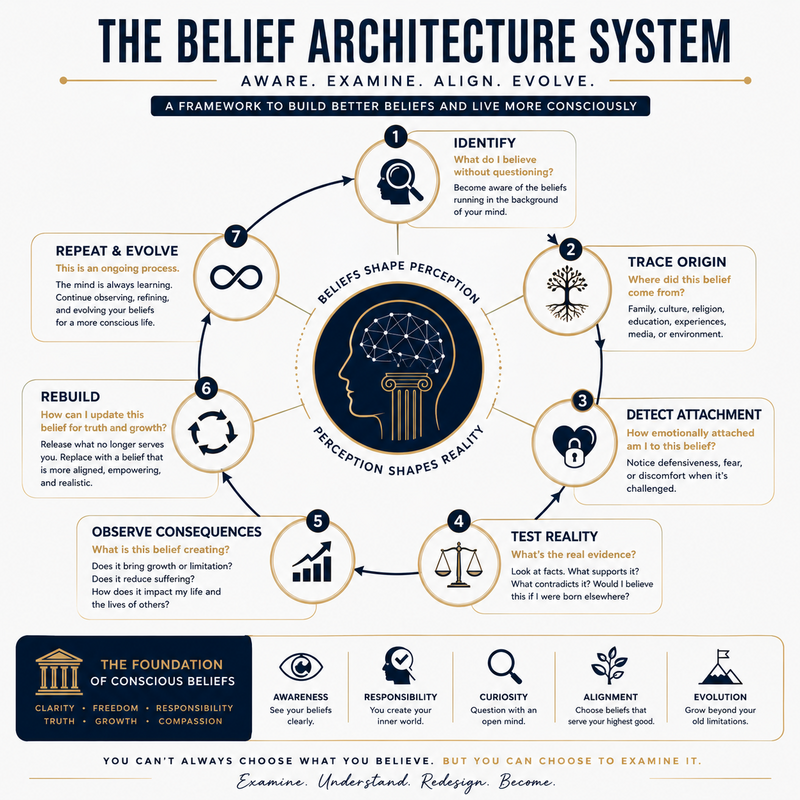
 The Belief Achitecture System (BAS) Most people assume their beliefs are their own. But if you observe closely, something unsettling becomes clear: A large portion of what we call “personal belief” is inherited conditioning that we never consciously examined. From family, culture, religion, education, media, and lived experience—we absorb frameworks of meaning long before we are aware enough to question them. In that sense, we do not begin life by thinking. We begin life by absorbing. And what we absorb becomes the invisible architecture of perception. Beliefs Are Not Just Thoughts — They Are Operating Systems A belief is not simply an idea in the mind. It is a filter through which reality is interpreted. It influences:
Most importantly, beliefs do not announce themselves. They operate silently in the background, shaping behavior while remaining largely invisible to the thinker. This is why two people can experience the same event and walk away with completely different realities. They are not seeing reality directly. They are seeing it through belief systems. The Illusion of “My Beliefs” We often say: “these are my beliefs” But the word my deserves closer inspection. How many of these beliefs were actually chosen consciously? How many were:
Even beliefs we think we arrived at independently are often built on earlier assumptions we never questioned. True originality of belief is rare. Most belief is inheritance layered upon inheritance. When Beliefs Become Identity The most important transformation in human psychology happens when belief becomes identity. At that point: “I believe this” becomes “This is who I am.” And once belief becomes identity, it stops being flexible. Because now, to question the belief feels like questioning the self. This is why people become defensive, emotional, or even hostile when core beliefs are challenged. They are no longer protecting an idea. They are protecting their identity structure and the foundation upon which they have built their lives. To them, the collapse of that belief system may feel like a threat to their very existence. This is also where human growth often slows down. Because identity resists change even when reality demands it. Collective Belief: When Mind Becomes Culture Beliefs do not only operate individually. When shared across groups, they scale into something far more powerful: collective consciousness. Collective belief is what creates:
For example, a company like Coca-Cola is not just selling a drink. It is selling a shared emotional association:
Over time, repeated exposure turns meaning into perceived reality. People do not just consume the product. They consume the story attached to it. And that story becomes self-reinforcing because millions of people agree on it simultaneously. This is the essence of collective belief: When enough minds agree on a meaning, that meaning begins to function as reality. For good or for harm, this mechanism scales everything in human civilization. A Simple Personal Example: Conditioned Preference For years, I held a simple belief: Pizza and hamburgers “needed” Coca-Cola. Not because I consciously decided this. But because my mind learned a pattern: greasy food → Coke → satisfaction The carbonation, sweetness, and sensory contrast reinforced the experience. Repetition solidified the association. Eventually, it stopped feeling like a preference. It felt like the correct pairing. But nothing about that pairing was objectively necessary. It was learned. This is important because it reveals something deeper: If even taste can be conditioned… then what else in life is operating on unexamined conditioning? The Belief Architecture System (BAS) If beliefs shape perception, and perception shapes reality, then beliefs must be examined like a system—not blindly followed. Here is a simple framework: 1. Identify What do I believe without questioning? 2. Trace Origin Where did this belief come from? 3. Detect Attachment Do I become emotional when this belief is challenged? 4. Test Reality What evidence supports or contradicts it? 5. Observe Consequences Does this belief create expansion or limitation in my life? 6. Rebuild Update the belief without ego attachment. 7. Repeat Because the mind is always learning—whether we are aware of it or not. Why This Matters Most people do not suffer because they think incorrectly. They suffer because they never examine the system behind their thinking. An unconscious belief is not just an idea. It is a program running the mind. And unexamined programs eventually become lived reality. The goal is not to eliminate beliefs. That is impossible. The goal is to transform belief from unconscious inheritance into conscious design. Because once a belief is seen clearly, it stops controlling you in the same way. And at that point, something fundamental changes: You are no longer just a product of inherited perception. You become an active participant in how perception is formed. Closing Reflection The deepest question is not: “What do I believe?” But rather: “Which beliefs am I currently living inside without knowing it?” Because the moment that question becomes real… the architecture of the mind begins to reveal itself. And once you see the architecture, you are no longer fully trapped inside it.
0 Comments
 Some people thrive on ambition and achievement, while others feel strangely unmotivated by goals that once seemed meaningful. If you’re highly self-aware, this isn’t a flaw—it’s a signal. As awareness deepens, ego-driven motivation begins to collapse, and the effort behind achievement suddenly feels heavier than the reward. This article explores why high awareness can kill motivation, the hidden difference between ego-based striving and truth-driven expression, and how alignment—not ambition—becomes the real force that moves you forward. Why Some People Don’t Feel the Weight of Work Some people don’t seem to mind the work it takes to achieve in life. They push, grind, build, chase—and they often accomplish a lot. That’s because most achievement is ego-driven. The ego runs on:
Effort feels invisible when the ego is excited. Why Awareness Changes Everything As awareness increases, the illusion weakens. You begin to see:
So when a new project or desire appears, you don’t just see the starting point—you see the entire arc: effort → achievement → short-lived high → restlessness → another goal. And a quiet question emerges: Why start something that won’t actually fulfill me? This hesitation isn’t laziness. It’s clarity. Why It Felt Easier When You Were Younger When you’re younger, desire is simpler. You want something, you work for it, you get it, you feel better—at least for a while. The emotional return feels worth the effort, so you don’t even register the work involved. Back then:
The spell is broken. Ego-Driven Action vs Truth-Driven Expression This is the distinction most people never learn to make. Ego-Driven Action
Even when successful, it often leaves a subtle emptiness. Something feels off—because the action wasn’t aligned with your deepest belief. It was aligned with maintaining an identity. Truth-Driven Expression
When you act from truth, you operate from your pure belief system, not the ego. For example: If I’m honest with myself and recognize that buying a new piece of clothing is purely to satisfy my ego, that awareness changes the choice. Now I hold a clean belief: This is ego-driven. If I go through with it anyway, it feels like subtle self-betrayal—disalignment. But if I honor that belief and choose differently, I experience integrity. Truth creates alignment. Ego creates performance. Why You Hesitate to Start Once you’ve tasted alignment, ego goals feel heavy. You don’t resist work. You resist work that isn’t true. You’re no longer motivated by:
You’re moved by:
And aligned action, while often quieter, feels clean. Self-Reflection: Are You Unmotivated or Just Done With Illusion? Ask yourself—honestly:
These questions require brutal honesty. Without it, clarity gets mislabeled as laziness. The Provocative Truth High awareness kills ego motivation. That’s the price of seeing clearly. Once you recognize the cycle—effort, achievement, dissatisfaction—you can’t unknow it. And when ego stops driving you, nothing external can push you anymore. Now only alignment moves you. That’s dangerous. Because when you can’t lie to yourself, you’re left with two options:
Most people go back to chasing. Very few choose alignment—because it demands honesty over ambition. And once you see the difference, there’s no going back.  A "Solid" rock at Pinnacle National Park, California, USA Have you ever wondered how something as solid as a table or a rock can be made up of tiny particles and energy? Science tells us that what we perceive as solid is far from what it seems—and some theories even suggest our reality might be like a hologram. Let’s explore this fascinating idea in simple terms and touch on one of the most famous experiments that shakes up how we view reality: the double-slit experiment and quantum entanglement. Why Does Everything Feel Solid? Here’s the mind-blowing truth: everything in the universe is made of atoms, and atoms are about 99.999999% empty space! If they’re mostly empty space, why do things feel solid? It’s all about forces and energy: • Atoms are surrounded by electrons, tiny negatively charged particles. When two objects come into “contact,” their electrons repel each other because like charges repel. This creates an invisible force that keeps things from passing through each other. Imagine trying to push the negative ends of two magnests together-they resisit each other, creating an invisible force. The same thing happens at the atomic level when you touch an object! • What we perceive as “solidness” is really the sensation of this electromagnetic repulsion. So, solidity is an illusion created by energy interactions at the atomic level. Why Do Some Things Feel More Solid Than Others? Not everything feels equally solid because: 1. Density: Some materials, like metal, have atoms packed tightly together, creating more resistance when you touch them. Less dense materials, like foam, have more empty space between atoms, making them feel softer. 2. Bonds: Strong atomic bonds, like those in diamonds, make objects feel harder, while weaker bonds, like in rubber, allow objects to bend and feel less rigid. The Double-Slit Experiment: Does Reality Depend on Observation? Now let’s dive into an experiment that challenges how we understand reality: the double-slit experiment. 1. The Setup: • Imagine firing tiny particles (like electrons or photons) at a wall with two slits. • If no one observes them, these particles behave like waves, creating an interference pattern on the wall behind the slits. This pattern suggests that the particles travel through both slits simultaneously as a wave. 2. The Twist: • When scientists observe which slit the particle goes through, the interference pattern disappears. Instead, the particles behave like tiny objects, going through one slit or the other. 3. The Implication: This experiment suggests that the act of observation changes the behavior of particles. Reality at the quantum level doesn’t “solidify” into one outcome until it is observed. In other words, our perception plays a role in shaping reality itself! Quantum Entanglement: Everything Is Connected Now, let’s take it a step further with quantum entanglement. When two particles become “entangled,” their states are linked, no matter how far apart they are. If you measure one particle, the other instantly “knows” and adjusts its state accordingly—even if they’re light-years apart! Here’s what makes this fascinating: • This connection happens faster than the speed of light, defying our understanding of space and time. • It suggests that the universe is deeply interconnected at a fundamental level. In a way, quantum entanglement shows that distance is an illusion. Everything is part of the same unified energy field, and what happens to one part of the universe can influence another, no matter how far apart they seem. Is Reality Like a Hologram? Here’s where things get even more interesting. Some scientists propose that our entire universe might function like a hologram: • A hologram is a 3D image created from patterns on a 2D surface. • The holographic principle suggests that all the information needed to create our 3D universe is encoded on a 2D “surface” at the edge of the universe. If this is true, what we experience as solid objects, space, and time might actually be a projection of something deeper—an interplay of energy and information. What Does This Mean for Us? 1. Reality Is Deeper Than It Seems: Quantum physics shows us that what we perceive as “solid” is really energy and forces interacting. At the deepest level, reality is more like a web of possibilities. 2. Interconnection: Quantum entanglement reveals that we are all connected in ways we can’t fully see or understand. The energy flowing through you is part of the same universe that connects everything else. 3. The Illusion of Solidity: The world feels solid and separate, but at its core, it’s all vibrating energy fields and interactions. Many spiritual traditions describe this as maya, or the illusion of the material world. The Big Picture Our perception of the world is shaped by how our senses interpret energy and forces. Science tells us that solidity is an illusion, particles behave differently when observed, and everything in the universe might be interconnected through quantum entanglement. These ideas blur the line between science and spirituality, inviting us to explore reality’s mysteries. So, the next time you touch something “solid,” take a moment to reflect: you’re not just interacting with matter—you’re engaging with the energetic forces and connections that make up the universe. What do you think? Could the reality you experience be shaped by something far more mysterious than you’ve imagined? 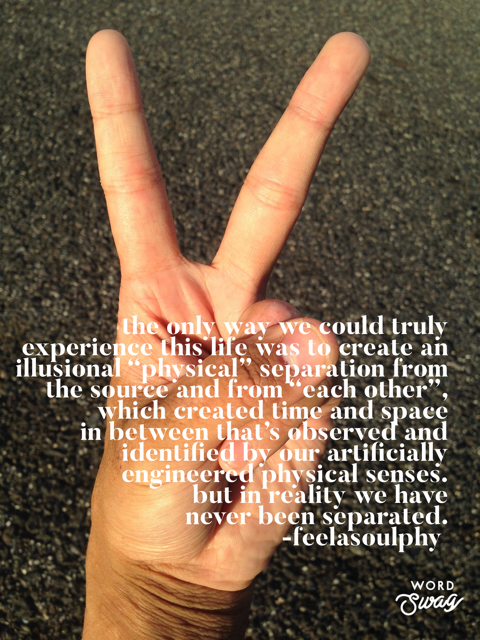 The only way we could truly experience this life was to create an illusional “physical” separation from the Source and from “each other”, which created time and space in between that’s observed and identified by our artificially engineered physical senses. But in reality we have never been separated. -FeelaSoulphy |
AuthorFeelasoulphy Categories
All
Archives
March 2026
|
 RSS Feed