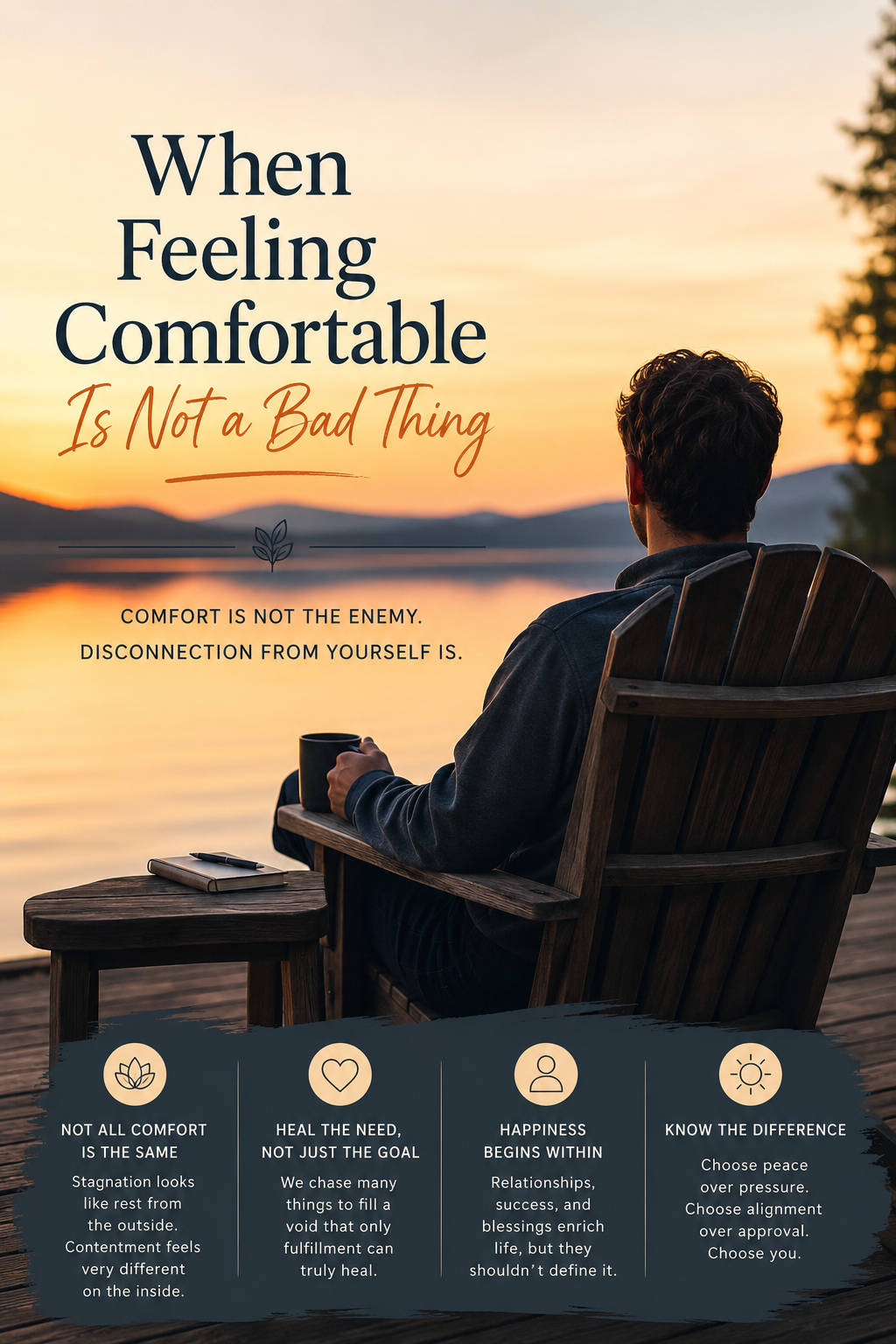
 We live in a culture that is obsessed with growth.
Everywhere we look, we are told to work harder, hustle more, achieve bigger goals, and continuously improve ourselves. Social media is filled with messages encouraging us to leave our comfort zones because staying comfortable is often portrayed as the beginning of decline. The underlying message is clear: "If you're not moving forward, you're falling behind." But what if this belief is not always true? What if there are times when feeling comfortable is not a sign of laziness, complacency, or a lack of ambition? What if comfort is sometimes a sign that we have finally found peace? The Fear of Being Comfortable Many people are afraid of becoming too comfortable. They worry that if they stop striving, they will stop growing. If they stop achieving, they will lose their purpose. If they stop chasing goals, their lives will somehow become meaningless. As a result, they constantly search for the next mountain to climb. A promotion. A larger business. More money. More recognition. More accomplishments. There is nothing inherently wrong with pursuing these things. The question is why we pursue them. Are we driven by genuine passion? Or are we trying to fill a void within ourselves? Sometimes ambition is an expression of our purpose. Other times, ambition is simply insecurity wearing a disguise. Comfort Can Mean Two Very Different Things Not all comfort is created equal. There is a form of comfort that comes from avoidance. A person may avoid challenges because they are afraid of failure, rejection, or uncertainty. This type of comfort keeps people stuck. It prevents growth and limits their potential. But there is another form of comfort that comes from contentment. This comfort arises when a person no longer feels compelled to prove their worth through endless achievement. They recognize that their value does not increase with every accomplishment or decrease with every failure. They are comfortable not because they have given up on life, but because they have made peace with themselves. From the outside, these two forms of comfort can look exactly the same. Internally, they are worlds apart. The Business Owner Who Changed His Mind Imagine a man who has always dreamed of starting his own business. For years he tells himself that one day he will prove to everyone that he is capable of succeeding. He imagines the respect, admiration, and validation that will come with building something successful. Then something unexpected happens. He meets the love of his life. Over time, he becomes happier than he has ever been. His need to prove himself begins to fade. The urgency to start the business disappears. What happened? Many people would immediately conclude that he became complacent. But perhaps something deeper occurred. Maybe the business was never his true dream. Maybe it was an attempt to satisfy an emotional need. Maybe he wasn't seeking success. Maybe he was seeking love, acceptance, and belonging. Once those needs were met through a meaningful relationship, the desire to prove himself lost its power. The business was not abandoned. The wound behind it was healed. A Word of Caution There is an important distinction here. If his happiness depends entirely on the relationship, then the foundation remains fragile. If the relationship ends, he may once again feel incomplete. The old desire to prove himself may return stronger than before. He may now feel compelled to prove something not only to himself, but also to his former partner. This reveals that the source of happiness was still external. The relationship merely replaced one dependency with another. True contentment cannot rest entirely upon another person, achievement, possession, or circumstance. Anything that can be taken away cannot be the foundation of lasting happiness. Happiness From Within This does not mean relationships, success, and accomplishments are unimportant. They enrich our lives. They bring joy, meaning, and fulfillment. But they should add to our happiness, not create it. When happiness comes primarily from external circumstances, life becomes a constant struggle to maintain those circumstances. When happiness arises from within, external blessings become gifts rather than necessities. You enjoy them deeply, but you do not depend on them for your sense of self. You appreciate success without needing it. You cherish relationships without clinging to them. You pursue goals without attaching your worth to the outcome. The Real Question Perhaps the problem is not that people become too comfortable. Perhaps the problem is that we rarely stop to examine why we are striving in the first place. Sometimes growth is necessary. Sometimes rest is necessary. Sometimes the most profound transformation occurs not when we achieve something new, but when we realize we no longer need to prove anything at all. The challenge is learning the difference between comfort that comes from fear and comfort that comes from peace. One keeps us asleep. The other is a sign that we have finally come home to ourselves.
1 Comment
 Some people thrive on ambition and achievement, while others feel strangely unmotivated by goals that once seemed meaningful. If you’re highly self-aware, this isn’t a flaw—it’s a signal. As awareness deepens, ego-driven motivation begins to collapse, and the effort behind achievement suddenly feels heavier than the reward. This article explores why high awareness can kill motivation, the hidden difference between ego-based striving and truth-driven expression, and how alignment—not ambition—becomes the real force that moves you forward. Why Some People Don’t Feel the Weight of Work Some people don’t seem to mind the work it takes to achieve in life. They push, grind, build, chase—and they often accomplish a lot. That’s because most achievement is ego-driven. The ego runs on:
Effort feels invisible when the ego is excited. Why Awareness Changes Everything As awareness increases, the illusion weakens. You begin to see:
So when a new project or desire appears, you don’t just see the starting point—you see the entire arc: effort → achievement → short-lived high → restlessness → another goal. And a quiet question emerges: Why start something that won’t actually fulfill me? This hesitation isn’t laziness. It’s clarity. Why It Felt Easier When You Were Younger When you’re younger, desire is simpler. You want something, you work for it, you get it, you feel better—at least for a while. The emotional return feels worth the effort, so you don’t even register the work involved. Back then:
The spell is broken. Ego-Driven Action vs Truth-Driven Expression This is the distinction most people never learn to make. Ego-Driven Action
Even when successful, it often leaves a subtle emptiness. Something feels off—because the action wasn’t aligned with your deepest belief. It was aligned with maintaining an identity. Truth-Driven Expression
When you act from truth, you operate from your pure belief system, not the ego. For example: If I’m honest with myself and recognize that buying a new piece of clothing is purely to satisfy my ego, that awareness changes the choice. Now I hold a clean belief: This is ego-driven. If I go through with it anyway, it feels like subtle self-betrayal—disalignment. But if I honor that belief and choose differently, I experience integrity. Truth creates alignment. Ego creates performance. Why You Hesitate to Start Once you’ve tasted alignment, ego goals feel heavy. You don’t resist work. You resist work that isn’t true. You’re no longer motivated by:
You’re moved by:
And aligned action, while often quieter, feels clean. Self-Reflection: Are You Unmotivated or Just Done With Illusion? Ask yourself—honestly:
These questions require brutal honesty. Without it, clarity gets mislabeled as laziness. The Provocative Truth High awareness kills ego motivation. That’s the price of seeing clearly. Once you recognize the cycle—effort, achievement, dissatisfaction—you can’t unknow it. And when ego stops driving you, nothing external can push you anymore. Now only alignment moves you. That’s dangerous. Because when you can’t lie to yourself, you’re left with two options:
Most people go back to chasing. Very few choose alignment—because it demands honesty over ambition. And once you see the difference, there’s no going back. 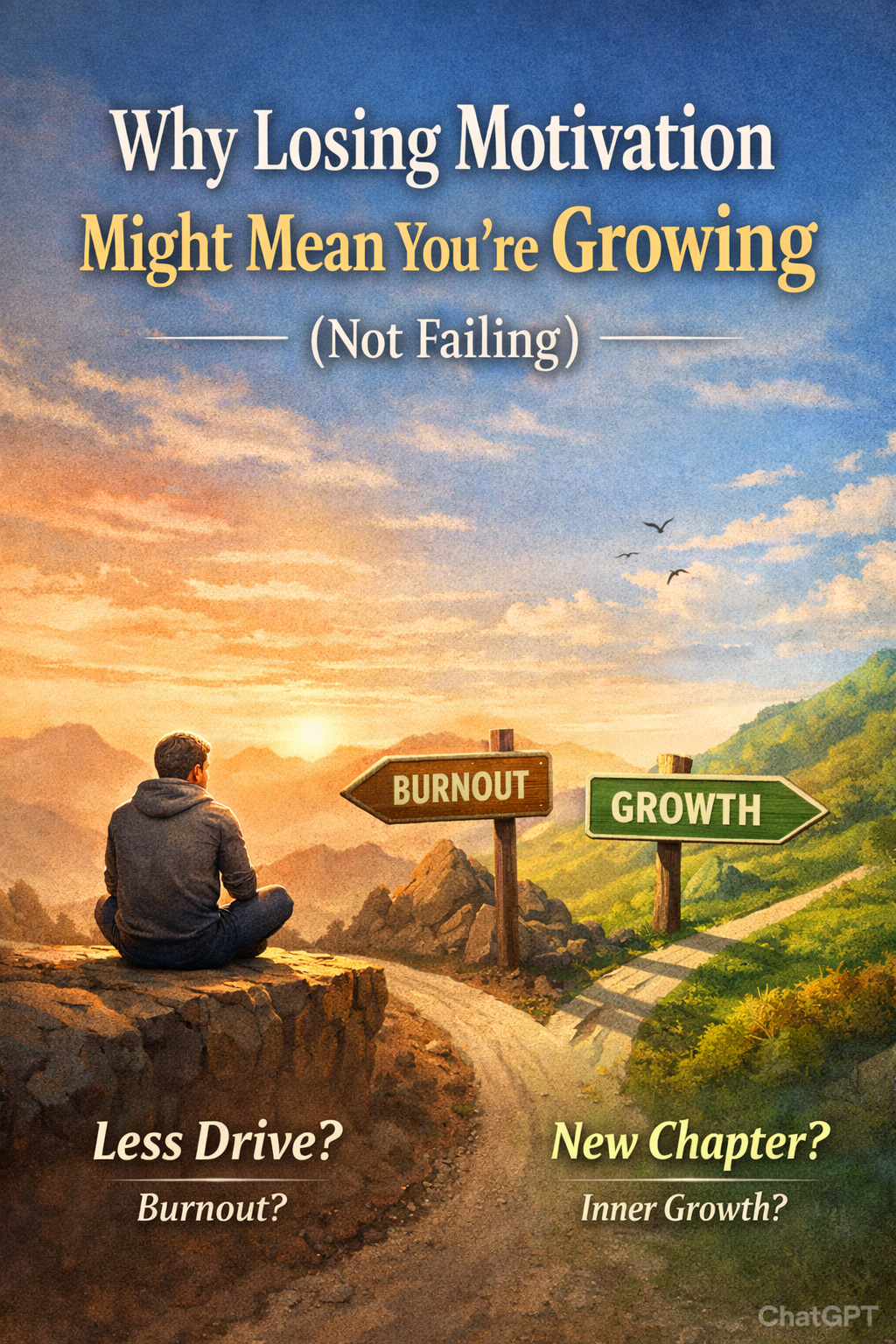 There is a phase of inner growth that rarely gets discussed—because it doesn’t look impressive. Ambition fades. The drive to achieve quiets down. The urge to become someone loosens its grip. And instead of clarity, many people feel unease. Am I evolving… or am I giving up? Is this peace—or fear disguised as contentment? This question doesn’t arise at the beginning of self-development. It appears after years of inner work, when ego has softened but purpose hasn’t yet redefined itself. The Role of Ambition in Human Development Ambition is not the enemy. Early in life, it serves an essential function. We strive in order to:
The problem isn’t ambition—it’s never knowing when to take it down. What Changes When Ego Softens If inner work is genuine, something subtle but radical happens: You no longer need achievement to validate your existence. This often shows up as:
They assume: “If my ambition is fading, something must be wrong.” In reality, something important is reorganizing. Rest vs Retreat: The Critical Distinction From the outside, rest and retreat look identical. Less output. More solitude. Fewer goals. Internally, they are opposites.
A simple test: If life gently asked something of me tomorrow, would I be open to it? A relaxed yes signals rest. A tight no signals retreat. The danger isn’t resting. The danger is mistaking withdrawal for wisdom. What Replaces Ambition After Ego Work When ego-driven ambition dissolves, one of three things replaces it:
A call does not demand constant productivity. It arrives with clarity and lightness. It asks for action—and then releases you again. From the outside, this looks inconsistent. From the inside, it feels precise. Why Many “Successful” People Never Reach This Stage Many high achievers don’t mind working all the time because stopping would force them to sit with themselves. Busyness becomes:
There’s a difference between capacity for work and compulsion to work. Losing the second while keeping the first is growth. The Real Risk at This Stage The risk is not doing less. The risk is using contentment as insulation. When “I’m fine the way I am” becomes a shield against engagement, life slowly thins out. The answer is not forcing ambition back. It’s remaining available. A Simple Operating Principle For this phase of life: Only act on what arrives with clarity and lightness. Not excitement. Not obligation. Not fear. Lightness. If nothing arrives, live fully anyway. Stillness is not a waiting room. It’s part of the work. A Short Mirror (Read slowly) Don’t answer these questions quickly. Notice what happens before the answer forms.
Only signals. Whatever you notice is the information. The Quiet Truth You are not here to maximize output. You are here to minimize distortion. When distortion falls away, contribution becomes inevitable—but no longer constant. And if you step forward again, it won’t be to become someone. It will be because silence finished saying what it could. |
AuthorFeelasoulphy Categories
All
Archives
March 2026
|
 RSS Feed