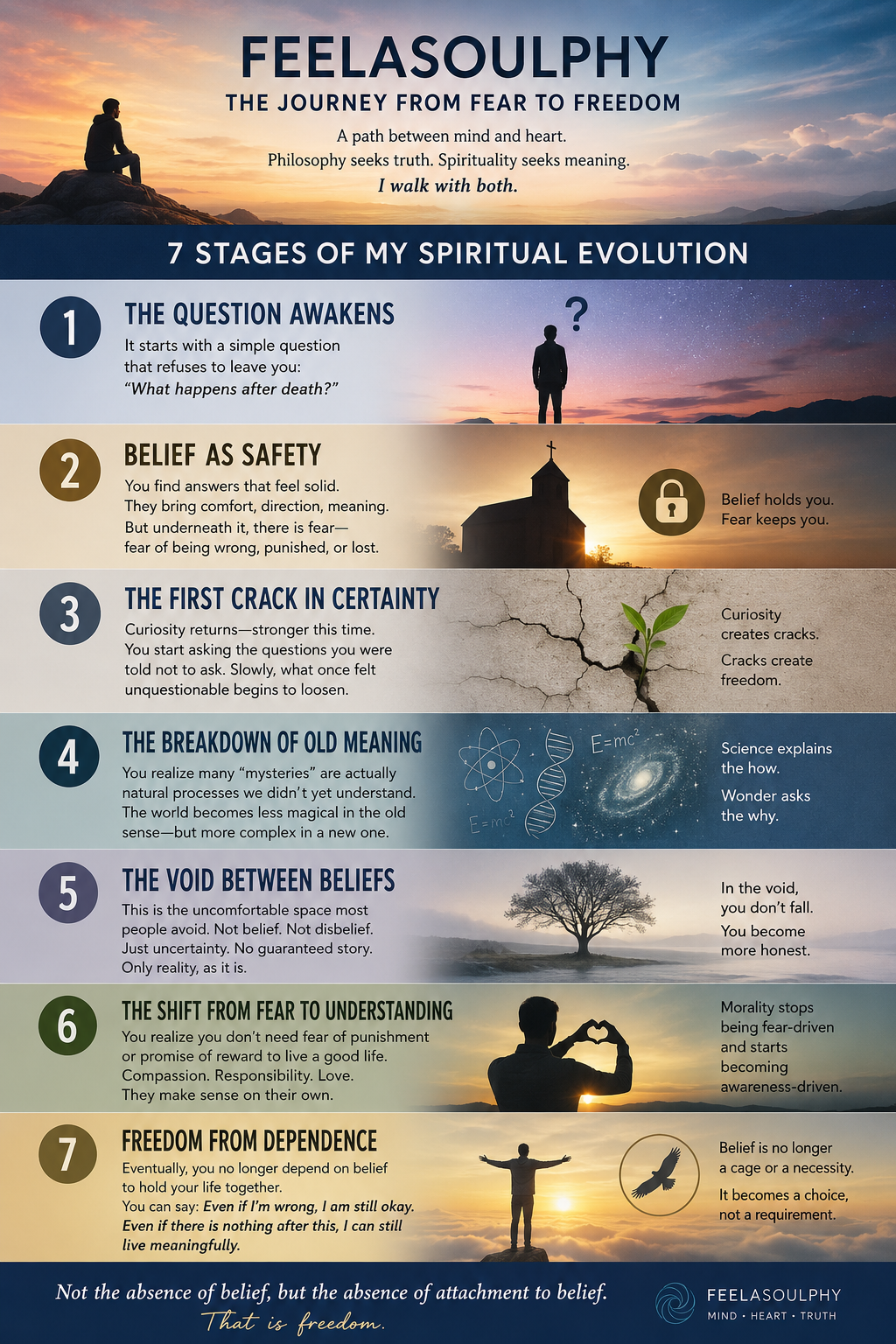
 7 Stages of My Spiritual Evolution...To Be Continued... There was a time when I believed life could be neatly categorized. Philosophy belonged to the mind. Spirituality belonged to the heart. One searched for truth through logic, questioning, and reason. The other trusted intuition, meaning, and unseen connection. For a long time, I treated them as separate worlds. Almost like two different languages trying to describe existence. But life doesn’t stay in boxes for long. And neither did I. The Early Search: Fear Disguised as Faith My journey didn’t begin in clarity. It began in curiosity — and uncertainty about what happens after death. That question, once planted, doesn’t leave quietly. It grows into others: What is real? What is God? What is truth? What happens when we die? Eventually, I found myself inside Christianity. And for a while, it gave structure to the unknown. It gave answers where there were none. It gave direction where I felt lost. But underneath it, there was something I didn’t fully recognize at the time: fear. Fear of punishment. Fear of being wrong. Fear of what happens if belief collapses. And fear is a powerful teacher — but not always a truthful one. It can shape belief into something rigid, something protective rather than something alive. At some point, I started to notice that my relationship with belief wasn’t fully free. It was anchored in consequences, not understanding. And once you see that, you can’t unsee it. The Breaking Open: Science, Philosophy, and Unraveling Certainty “Did God create us in His image, or did we create God in ours?” And perhaps beneath both lies an even deeper question: “Did God create us… or did we create God?” - Feelasoulphy The next stage of my journey was not spiritual at all — at least not in the traditional sense. It was analytical. I began studying science, philosophy, and research around consciousness. I explored near-death experiences, reincarnation theories, and scientific perspectives on spirituality. Not to reinforce belief — but to challenge it. Slowly, the world I once saw as “miraculous” became increasingly explainable. The mechanisms of life, the brain, perception, evolution — all of it revealed patterns that didn’t require supernatural explanation. And something shifted in me. I started realizing that many things once attributed to God were actually natural processes we had not yet understood. But instead of closing the mystery, this opened a different one: Even if we understand how something works… we still don’t fully understand why anything exists at all. Science explains mechanisms. But it does not fully explain existence itself. That realization didn’t push me back into certainty. It pushed me deeper into humility. The Transition: Letting Belief Stop Being a Crutch Over time, something unexpected happened. My need for belief as emotional security began to fade. I stopped needing a specific story about what happens after death in order to live meaningfully now. That was a turning point. I reached a place where I could say: Even if there is no God… Even if there is no afterlife… I can still live a good, conscious, and meaningful life. Not because I was forcing myself to be strong — but because I genuinely understood why compassion, love, and responsibility matter. Not from fear. Not from reward. But from clarity. And when belief is no longer required to behave well, something subtle happens inside a person. The mind becomes lighter. The heart becomes less defended. And truth becomes less threatening. The Shift: From Dependency to Freedom At some point, I realized I no longer depended on belief in God or the afterlife to guide my actions. And that changed everything. Because belief stopped being a psychological structure holding me together. It became something I could examine freely. I was no longer afraid of my worldview collapsing. I was no longer attached to it as identity. I could question it, challenge it, even let it dissolve — and I would still be okay. That is when I first felt something I can only describe as freedom. Not freedom from meaning. But freedom from fear-based meaning. Feelasoulphy: A Middle Path This is where the idea of Feelasoulphy emerged for me. A bridge between:
Not as a contradiction — but as integration. Because I’ve come to see that philosophy without feeling becomes empty abstraction. And spirituality without inquiry becomes fragile belief. We are not meant to live in only one half of ourselves. We are meant to become whole. Fear-Based Belief vs Freedom-Based Belief One of the clearest distinctions I’ve learned is this: There is a kind of belief that is built on fear:
And there is a kind of belief — or perhaps a way of being — that is built on freedom:
Fear-based belief needs certainty to feel safe. Freedom-based understanding can hold uncertainty without collapsing. That difference changes everything. The Question I Keep Returning To I don’t claim to know what happens after death. I don’t claim to fully understand consciousness or the origin of reality. But I also no longer need those answers to live well. And maybe that is the real shift. Not from belief to disbelief. But from dependence to independence. And from independence… to a quieter possibility: That perhaps meaning is not something we receive from certainty, but something we embody through awareness. Where I Am Now Today, I feel something simple but profound: I am okay not knowing. Not in resignation — but in openness. I can explore spirituality without needing it to be “true in the ultimate sense.” I can study science without needing it to erase mystery. I can live ethically without needing fear as motivation. And most importantly, I can question everything — without losing myself in the process. That, to me, is freedom. Not the absence of belief. But the absence of attachment to belief. And in that space… life feels strangely more real than ever.
0 Comments
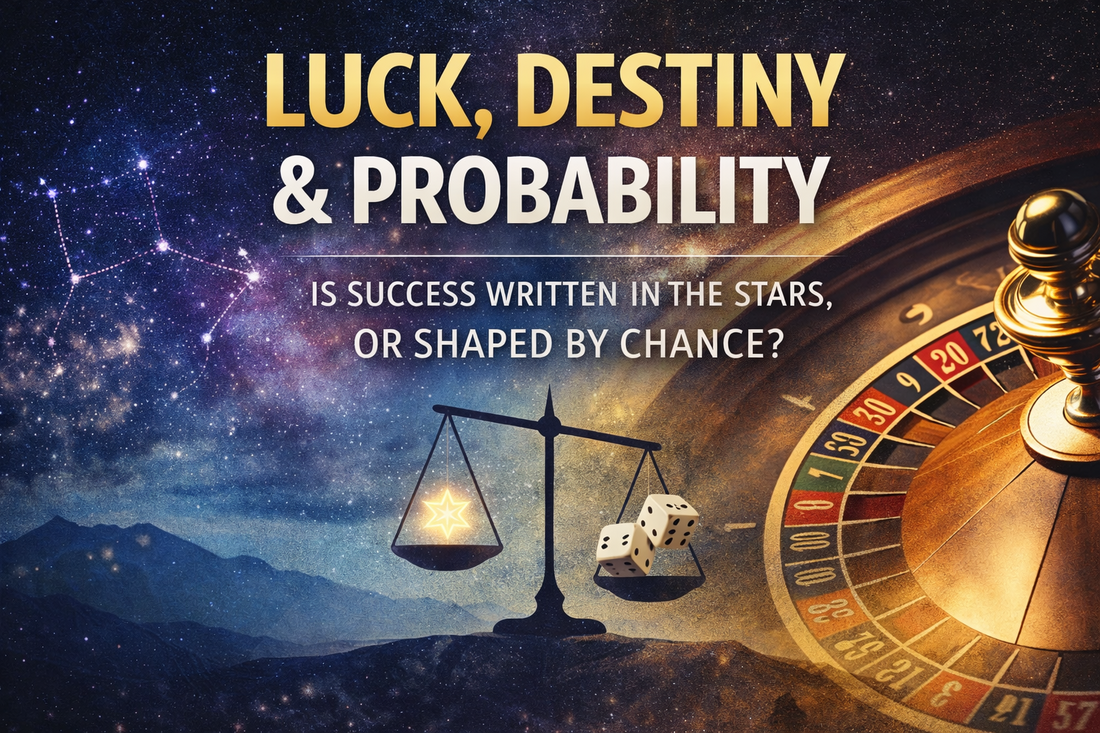 Is success written in destiny, or is it the result of probability and preparation? After years in financial advising, investing, and observing human behavior under pressure, I’ve come to believe that luck is real — but misunderstood. Success isn’t fate. It’s what happens when skill, emotional stability, and time intersect with randomness. There’s a dangerous myth about success. Some say it’s destiny. Others say it’s hustle. Most secretly believe it’s luck. After watching nearly 90% of new financial advisors leave the industry, I can say this confidently: If destiny exists, it favors those who refuse to exit. Early in my career, I wasn’t sure I would survive. The rejection was constant. Results were inconsistent. I saw intelligent, capable people quit. I stayed. Not because I knew I’d win. But because I didn’t want a temporary downturn to make a permanent decision for me. Over time, my skills sharpened. My emotional control strengthened. My pattern recognition improved. The business grew — slowly, then meaningfully. Looking back, I can see moments that changed everything. At the time, they looked ordinary. That’s the part most people misunderstand about luck. Gambling, Variance, and the Illusion of Control Before I deeply understood markets, I used to gamble casually. I noticed something: luck fluctuates. When variance turned negative, I stopped. When things were favorable, I pressed cautiously. I didn’t chase losses. I didn’t assume a hot streak would last forever. When friends and I pooled money at slot machines, it wasn’t about multiplying luck. It was about extending time. More time meant more exposure to positive swings. Back then, I thought I was reading luck. Now I understand: I was managing variance. That’s different. Luck isn’t a force you feel. It’s randomness you survive. Investing: Where Destiny Meets Probability In markets, people often believe they failed because they entered at the wrong time. But I’ve seen clients invest at market peaks and still build significant wealth — simply because they stayed invested. Historically, the S&P 500 has endured wars, recessions, inflation shocks, crashes, and global crises — yet long-term growth persisted. If you zoom in, it looks chaotic. If you zoom out, it looks directional. Was that destiny? Or was it probability compounded over time? The investor who panic sells during a downturn converts temporary volatility into permanent loss. The investor who stays allows probability to unfold. Time is the bridge between randomness and outcome. Destiny Is Just Probability You Stayed Around For Here’s the philosophical edge most people avoid: We call something destiny when we can no longer see the branches that could have gone differently. If I had quit in year three, no one would call my current position fate. It would be a story that ended quietly. Success feels destined in hindsight. But in real time, it’s just repeated exposure to uncertainty. The ones who last long enough experience enough variance for positive asymmetry to occur. That’s not mystical. It’s mathematical. The Real Success Formula After years of observation, here’s the cleanest model I can offer: Success = Exposure × Skill × Emotional Stability + Variance Variance is unavoidable. Skill is learnable. Emotional stability is trainable. Exposure is a choice. You cannot eliminate randomness. But you can increase your capacity to withstand it. Early in my career, opportunity knocked and I didn’t recognize it. Now I do. Not because the universe chose me. But because experience refined my perception. The Balance Between Surrender and Control Here’s where philosophy matters. If you believe everything is destiny, you become passive. If you believe everything is control, you become arrogant. The truth lives between them. You control preparation. You do not control timing. You control discipline. You do not control cycles. You control whether you stay. You do not control when probability turns favorable. That balance is mature power. Luck is real. But luck alone doesn’t create durable success. Readiness does. Emotional endurance does. Time does. Destiny may write the weather. You still have to build the boat. |
AuthorFeelasoulphy Categories
All
Archives
March 2026
|
 RSS Feed