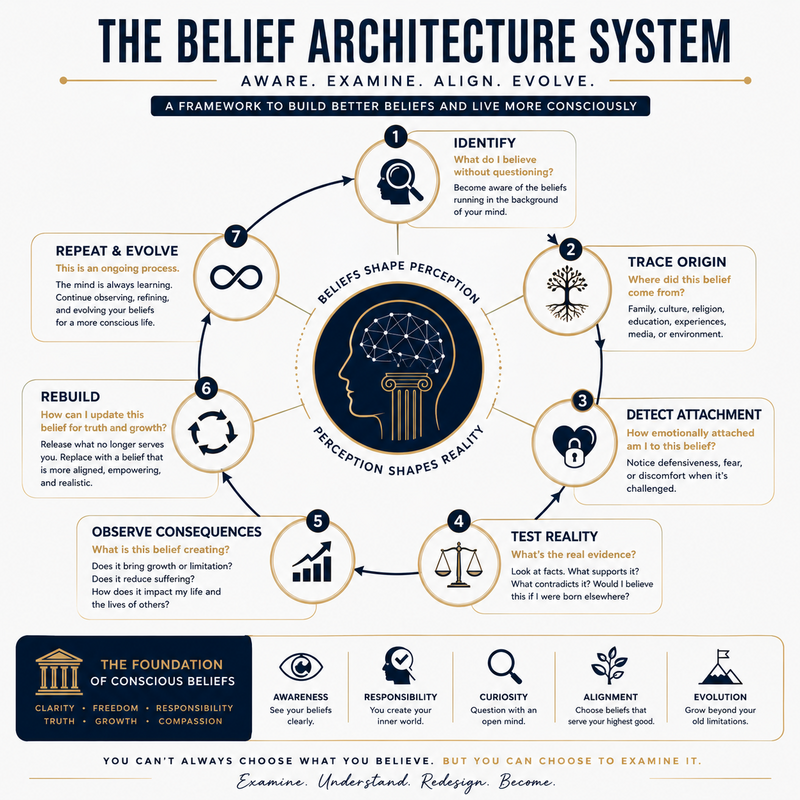
 The Belief Achitecture System (BAS) Most people assume their beliefs are their own. But if you observe closely, something unsettling becomes clear: A large portion of what we call “personal belief” is inherited conditioning that we never consciously examined. From family, culture, religion, education, media, and lived experience—we absorb frameworks of meaning long before we are aware enough to question them. In that sense, we do not begin life by thinking. We begin life by absorbing. And what we absorb becomes the invisible architecture of perception. Beliefs Are Not Just Thoughts — They Are Operating Systems A belief is not simply an idea in the mind. It is a filter through which reality is interpreted. It influences:
Most importantly, beliefs do not announce themselves. They operate silently in the background, shaping behavior while remaining largely invisible to the thinker. This is why two people can experience the same event and walk away with completely different realities. They are not seeing reality directly. They are seeing it through belief systems. The Illusion of “My Beliefs” We often say: “these are my beliefs” But the word my deserves closer inspection. How many of these beliefs were actually chosen consciously? How many were:
Even beliefs we think we arrived at independently are often built on earlier assumptions we never questioned. True originality of belief is rare. Most belief is inheritance layered upon inheritance. When Beliefs Become Identity The most important transformation in human psychology happens when belief becomes identity. At that point: “I believe this” becomes “This is who I am.” And once belief becomes identity, it stops being flexible. Because now, to question the belief feels like questioning the self. This is why people become defensive, emotional, or even hostile when core beliefs are challenged. They are no longer protecting an idea. They are protecting their identity structure and the foundation upon which they have built their lives. To them, the collapse of that belief system may feel like a threat to their very existence. This is also where human growth often slows down. Because identity resists change even when reality demands it. Collective Belief: When Mind Becomes Culture Beliefs do not only operate individually. When shared across groups, they scale into something far more powerful: collective consciousness. Collective belief is what creates:
For example, a company like Coca-Cola is not just selling a drink. It is selling a shared emotional association:
Over time, repeated exposure turns meaning into perceived reality. People do not just consume the product. They consume the story attached to it. And that story becomes self-reinforcing because millions of people agree on it simultaneously. This is the essence of collective belief: When enough minds agree on a meaning, that meaning begins to function as reality. For good or for harm, this mechanism scales everything in human civilization. A Simple Personal Example: Conditioned Preference For years, I held a simple belief: Pizza and hamburgers “needed” Coca-Cola. Not because I consciously decided this. But because my mind learned a pattern: greasy food → Coke → satisfaction The carbonation, sweetness, and sensory contrast reinforced the experience. Repetition solidified the association. Eventually, it stopped feeling like a preference. It felt like the correct pairing. But nothing about that pairing was objectively necessary. It was learned. This is important because it reveals something deeper: If even taste can be conditioned… then what else in life is operating on unexamined conditioning? The Belief Architecture System (BAS) If beliefs shape perception, and perception shapes reality, then beliefs must be examined like a system—not blindly followed. Here is a simple framework: 1. Identify What do I believe without questioning? 2. Trace Origin Where did this belief come from? 3. Detect Attachment Do I become emotional when this belief is challenged? 4. Test Reality What evidence supports or contradicts it? 5. Observe Consequences Does this belief create expansion or limitation in my life? 6. Rebuild Update the belief without ego attachment. 7. Repeat Because the mind is always learning—whether we are aware of it or not. Why This Matters Most people do not suffer because they think incorrectly. They suffer because they never examine the system behind their thinking. An unconscious belief is not just an idea. It is a program running the mind. And unexamined programs eventually become lived reality. The goal is not to eliminate beliefs. That is impossible. The goal is to transform belief from unconscious inheritance into conscious design. Because once a belief is seen clearly, it stops controlling you in the same way. And at that point, something fundamental changes: You are no longer just a product of inherited perception. You become an active participant in how perception is formed. Closing Reflection The deepest question is not: “What do I believe?” But rather: “Which beliefs am I currently living inside without knowing it?” Because the moment that question becomes real… the architecture of the mind begins to reveal itself. And once you see the architecture, you are no longer fully trapped inside it.
0 Comments
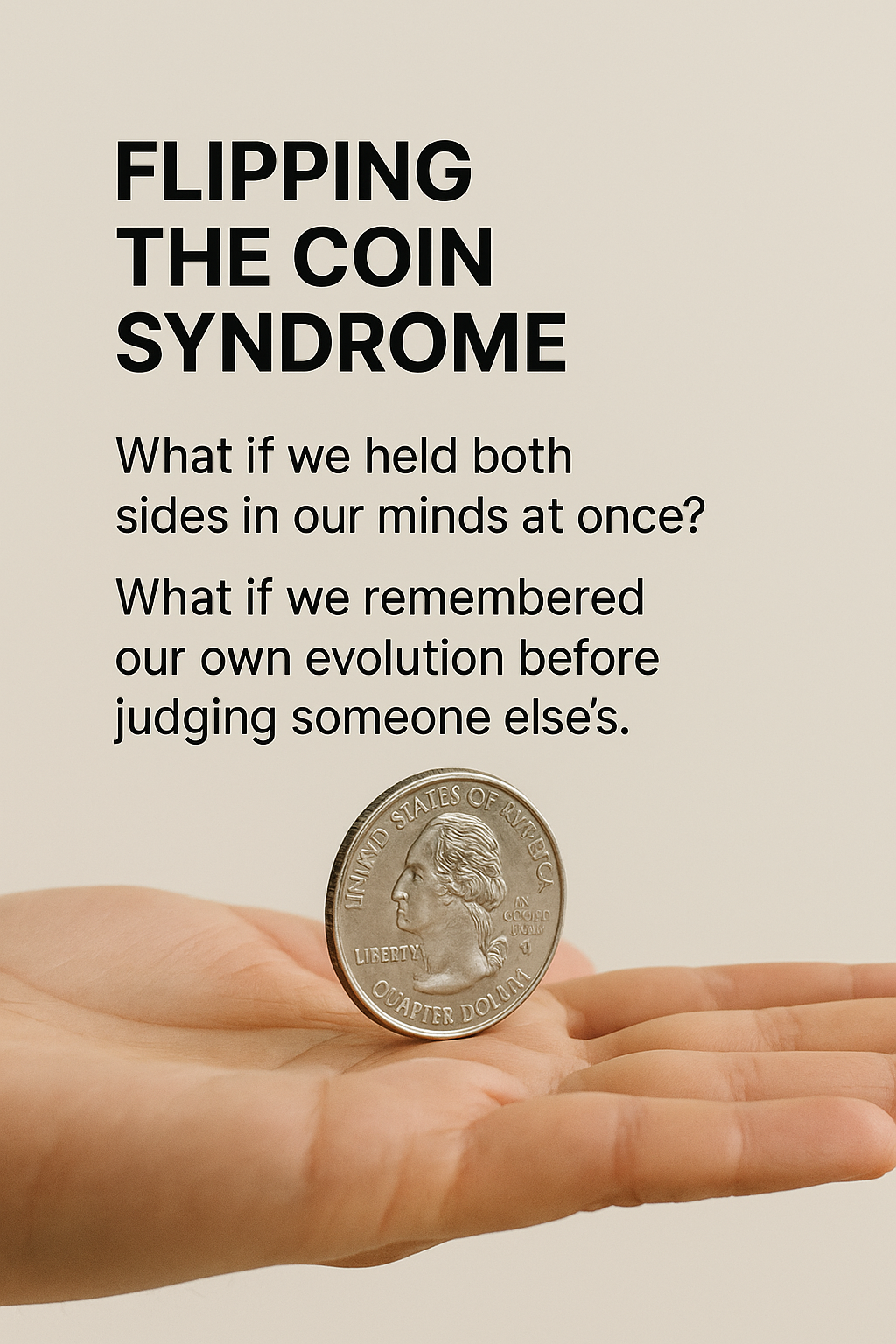 Have you ever noticed how easy it is to forget what you once believed? We humans have a strange habit I call “Flipping the Coin Syndrome.” We treat our beliefs like a coin in our hand. When we’re staring at one side—the side we now agree with—it feels like the only truth. We forget that the other side even exists. When we learn something new, it’s as if the old belief evaporates. We distance ourselves from it. We disown it. And then, ironically, we often start judging anyone who still holds that old view—as if we were never like them. We forget that the coin still has two sides. Think about it:
In all these cases, the judgment carries a kind of convenient amnesia. It’s as if we want to deny the simple truth that we once stood exactly where they’re standing now. Why do we do this? Perhaps because it’s uncomfortable to hold both sides of the coin in our mind at once. To admit that both perspectives have a reality to them. That our past self wasn’t simply “wrong,” but growing. That the people we’re judging are simply in process, just like we are. We prefer certainty. Simplicity. The security of believing: “Now I’m right. Then I was wrong.” “I’m enlightened. They’re lost.” But reality is rarely so neat. The Cost of Forgetting When we forget the other side of the coin, we don’t just lose empathy for others. We lose humility. We lose the chance to see ourselves as travelers on a path rather than owners of the truth. We also close the door on learning even more. Because what if the side we’re dismissing still has something to teach us? Holding Both Sides What if, instead, we practiced remembering? Remembering where we used to be. Remembering that growth is messy and slow. Remembering that certainty can be a cage. Imagine looking at someone you’re tempted to judge and asking: “What did it feel like to see the world the way they do?” “What did I need when I was there?” “How would I have wanted someone to treat me?” That’s not weakness. It’s wisdom. An Invitation We don’t have to flatten complexity. We can hold it. We can remember both sides of the coin at once. We can let our past selves humble us. We can let other people’s current struggles soften us. We can be firm in our values without forgetting our own evolution. Judgment shrinks the world. Compassion expands it. If you find yourself flipping the coin today, try holding it steady in your palm. Look at both sides. See the whole picture. You might find that truth is bigger than you thought. What’s a belief you’ve changed your mind about? How do you treat people who still hold the view you used to? |
AuthorFeelasoulphy Categories
All
Archives
March 2026
|
 RSS Feed