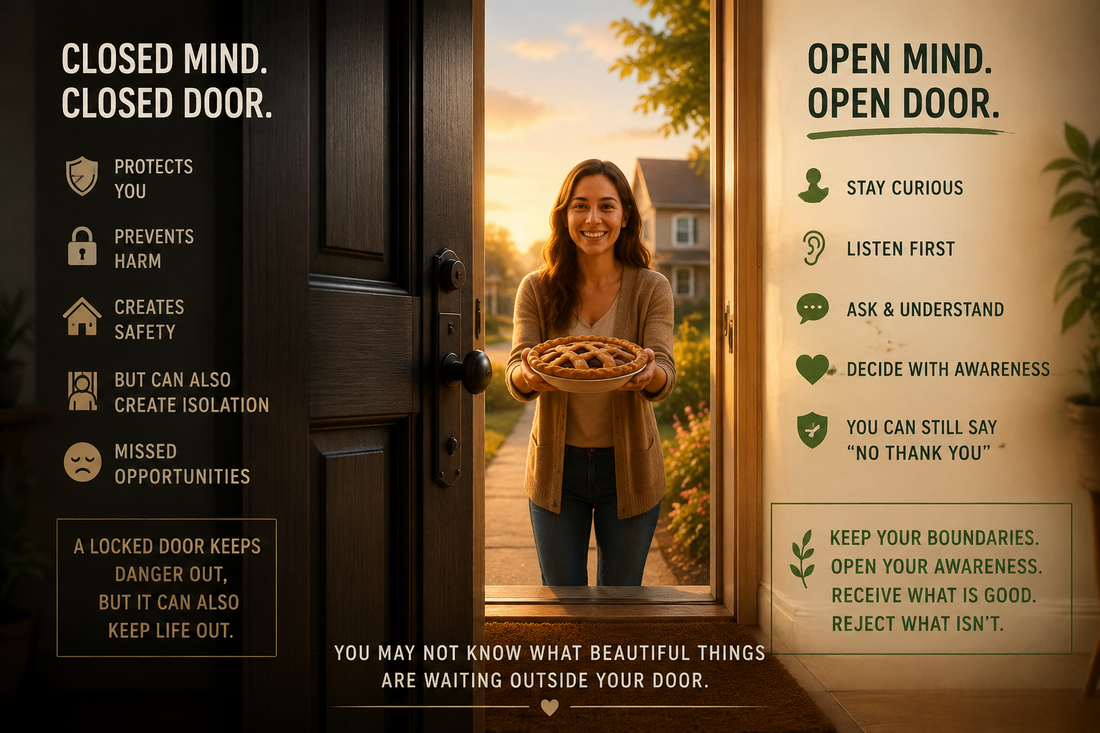
 People often misunderstand what it means to be open-minded. Being open-minded does not mean believing everything people tell you. It does not mean removing boundaries, becoming vulnerable to manipulation, or allowing everyone unrestricted access to your life. An open mind is not a house without doors. It is a house with doors that can open. We all have doors and locks for a reason. Locks protect us from danger, theft, manipulation, and harm. Boundaries are healthy. In many situations, they are necessary. But problems begin when we become so closed that we rarely open the door at all. Imagine your neighbor knocks on your door holding a pie. You assume they are trying to sell you something or waste your time, so you ignore them. Later, you discover they simply wanted to share your favorite pie with you, freely and without hidden intentions. This is what a closed mind often does. It rejects possibilities before even looking through the window. Many people live psychologically this way. Their mind automatically assumes danger, criticism, manipulation, or conflict before communication even begins. Over time, the door remains shut so often that they unknowingly trap themselves inside their own mental and emotional house. And eventually, something else begins to happen. When communication feels impossible, people sometimes become more forceful in their attempts to get through the door. This is an important psychological dynamic many people overlook. The more rigidly one person closes themselves off, the more persistent another person may become. Then the more persistent that person becomes, the more defensive the other person feels. This creates a cycle of resistance and pressure. Defensiveness invites force. Force invites more defensiveness. This does not justify violating boundaries or forcing ourselves into people’s lives. Forced entry is rarely healthy. But understanding the psychology behind human interactions helps us become more aware of why these dynamics happen in the first place. Many conflicts are not created by disagreement itself. They are created by the inability to tolerate discomfort, rejection, uncertainty, or lack of control. One person says: “You must let me in.” The other says: “Nobody gets in.” Both are often reacting from fear. A healthy interaction looks different. A healthy mind says: “You may knock. I may listen. Neither of us is entitled to control the other.” That is true openness. You can open the door without surrendering your home. You can listen without agreeing. You can hear someone out and still say: “No thank you.” “I respectfully disagree.” “This is not for me.” The difference is that the decision comes from awareness instead of fear. Many people confuse strong boundaries with emotional walls. But there is a difference between protection and isolation. A weak house has no doors. A prison house never opens its doors. A healthy house has locks, windows, conversations, and choice. This applies not only to the person inside the house, but also to the person outside trying to enter. Some people become so desperate to be heard, understood, or accepted that they begin pushing harder and harder against other people’s boundaries. But force almost always creates resistance. Sometimes the wisest response is to knock gently, speak honestly, and walk away peacefully if the door does not open. Not every closed door is meant to be forced open. The deeper lesson is not simply about open-mindedness. It is about awareness. When we understand the psychology behind defensiveness, persistence, fear, pressure, and resistance, we begin changing the way we interact with each other. Instead of reacting automatically, we begin observing the dynamics taking place beneath the surface. A defensive person may already feel invaded before anyone invaded them. An aggressive person may already feel ignored before anyone rejected them. Awareness allows us to pause and ask: “What is actually happening here beneath the behavior?” That question alone can transform relationships. A locked door may protect you from danger. But if it never opens, it may also keep out love, wisdom, connection, opportunity, and growth. So keep your doors. Keep your locks. But when someone knocks, answer the door. Listen first. Observe carefully. Then decide. You may discover that not everyone outside your house came to take something from you. Some came bearing gifts.
0 Comments
 Bay Bridge, San Francisco-Oakland, California, USA Growing Up Without Boundaries: My Personal Story Growing up in an authoritative household, I never really had the space to explore my own preferences. My mother made the decisions for me—what I should do, feel, and want. There was no room for my opinions. That pattern shaped me into someone incredibly easygoing—too easygoing, to the point where I didn’t know where I ended and others began. I became someone who just went along with whatever others wanted, thinking that was the path of least resistance. And sure, on one hand, it made me flexible and able to enjoy almost any situation. But the cost? I lost touch with what I wanted. The Cost of Not Having Boundaries I struggled with making decisions. I’d let others take the lead—not out of respect, but out of habit and fear of conflict. I didn’t speak up when something bothered me. And when people—often unknowingly—crossed lines I didn’t even know I had, I’d silently stew. I’d build resentment. And then, instead of addressing the issue, I’d retreat. I became passive-aggressive, slowly backing out of relationships without ever really explaining why. What Healthy Boundaries Really Mean It took me years to realize: boundaries aren’t walls to keep people out. They’re bridges to help others meet us where we are. But to even build that bridge, we have to know where we stand. Boundaries Are a Form of Self-Love and Self-Respect One of the most powerful truths I’ve learned is this: boundaries are not just about protecting yourself from others. They are acts of self-love and self-respect. When you set a boundary, you are sending a message to yourself and the world: "I matter. My feelings, my needs, and my energy deserve to be honored." This is not selfish—it’s sacred. Without boundaries, we give too much, we say yes when we mean no, we bend until we break. And slowly, we disconnect from ourselves. But when we start setting healthy limits, we rebuild that connection. We begin to treat ourselves the way we want others to treat us. And something beautiful happens: when we respect ourselves, others learn to respect us too. Setting boundaries isn’t just about making your life more peaceful—it’s about making your relationships more authentic. When people know what you need and where you stand, they can engage with you honestly, without guessing or overstepping. It’s not only a gift to yourself; it’s a gift to everyone you love. Loving yourself enough to set boundaries is one of the most courageous and compassionate things you can do—not just for you, but for everyone around you. Why Self-Awareness Comes First The first step to creating healthy personal boundaries is self-awareness. We can’t communicate what we need until we understand what makes us feel seen, respected, and safe. Sometimes, what we call a boundary is actually a wound—a sore spot from the past. If someone’s words or actions offend us, it’s worth asking: is this about them, or is it a reflection of something I haven’t healed yet? When we don't do that inner work, we risk setting boundaries based on fear, not freedom. We might end up pushing away the very experiences and people who could help us grow. Examples of Healthy vs. Unhealthy Boundaries That’s why I believe in healthy boundaries—those that are rooted in clarity, not confusion. Here are a few examples: Unhealthy Boundary: “I never let anyone get close to me because I don’t want to be hurt.” Healthy Boundary: “I take my time getting to know people and only open up when I feel emotionally safe.” Unhealthy Boundary: “If someone says something I don’t like, I cut them off immediately.” Healthy Boundary: “If something upsets me, I take a moment to reflect and then have a calm conversation about it.” Unhealthy Boundary: “I let people do whatever they want so I don’t cause drama.” Healthy Boundary: “I express my needs clearly and respectfully, knowing that honest communication builds stronger connections.” How to Communicate Boundaries Effectively Once you've done the inner work and become clear on what your boundaries are, the next step is learning how to express them in a way that is both firm and compassionate. Here are a few proven methods for communicating personal boundaries: 1. Use "I" Statements This helps reduce defensiveness and keeps the focus on your feelings.
2. Be Direct, Not Aggressive Kindness and firmness can coexist. Express your needs without attacking.
3. Set Clear Consequences Boundaries without consequences are just suggestions.
4. Repeat and Reinforce You might have to restate your boundary more than once.
Final Thoughts: Practice Makes Progress Boundaries aren’t about creating distance. They’re about creating clarity. They let others know how to love and respect us. And they teach us how to love and respect ourselves. So if you’ve struggled with boundaries like I have, be gentle with yourself. You’re not broken. You’re learning. Boundaries aren’t something you suddenly master—they’re something you practice. And the more you practice, the more your relationships—starting with the one you have with yourself—begin to thrive. |
AuthorFeelasoulphy Categories
All
Archives
March 2026
|
 RSS Feed