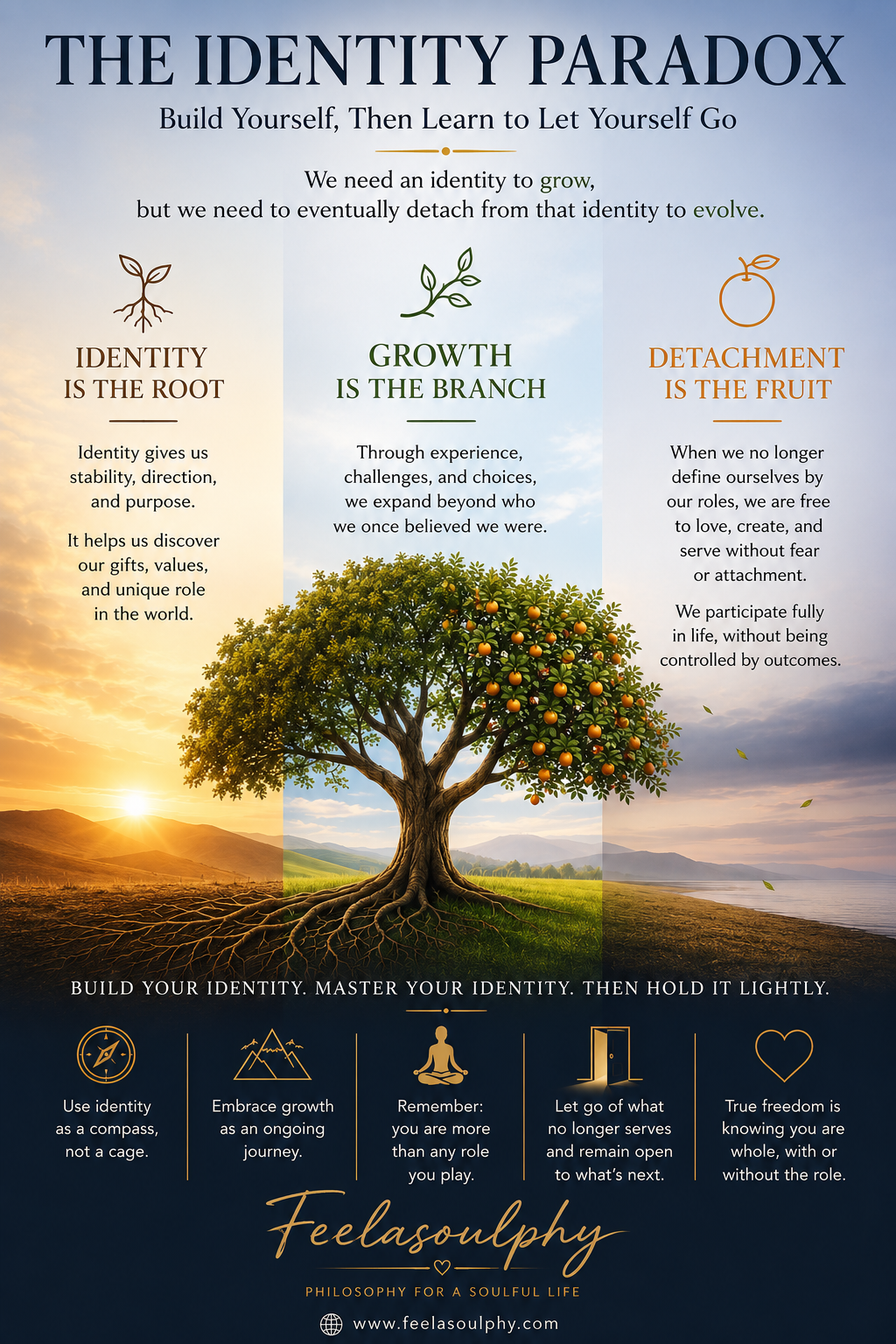
 One of the greatest paradoxes of human growth is this:
We need an identity to grow, but we need to eventually detach from that identity to evolve. Identity is a powerful force. It gives us direction, meaning, and a sense of purpose. It answers the question: “Who am I, and how do I contribute to this world?” A child begins this journey by discovering the self. “I am creative.” “I am intelligent.” “I am a helper.” “I am a leader.” As we grow older, we continue building identities through our experiences: “I am a teacher.” “I am an entrepreneur.” “I am a parent.” “I am an artist.” “I am a healer.” These identities are not the enemy. They are essential parts of our development. They help us discover our gifts, develop discipline, and create meaningful contributions to the world. But every tool that helps us build can also become something that limits us if we become attached to it. The same identity that gives us purpose can eventually become the source of our suffering. A teacher may spend decades finding meaning through teaching. But when the classroom disappears, when there are no more students, or when retirement arrives, they may ask: "Who am I now?" An entrepreneur may build a successful company and gain recognition from the world. But when the business struggles, they may feel as if they themselves are failing. A person who dedicates their life to helping others may discover that they feel empty when nobody needs their help. The problem is not the role. The problem is confusing the role with the self. We forget that identity is something we create and express. It is not the entirety of who we are. A teacher is not valuable because they have students. A leader is not valuable because people follow them. A healer is not valuable because others depend on them. Their value exists before the role begins and remains after the role ends. Identity Is the Root. Growth Is the Branch. Detachment Is the Fruit. A tree needs roots before it can reach toward the sky. Without roots, it cannot grow. Identity is the root. It gives us stability. It anchors us. It allows us to discover our strengths and develop our unique expression in the world. But a tree does not exist only to grow roots. The roots are there to support expansion. Growth is the branch. Through experiences, challenges, successes, and failures, we expand beyond our original understanding of ourselves. We discover that we are capable of more than we once imagined. The child becomes the adult. The student becomes the teacher. The follower becomes the leader. But even branches are not the final destination. Eventually, we must produce fruit. Detachment is the fruit. Detachment does not mean abandoning our identity or losing passion for what we do. It means we can fully embrace our role without being imprisoned by it. A person who is attached says: "I am a teacher, therefore I must always teach to be whole." A person who is free says: "Teaching is one beautiful expression of who I am, but my existence is greater than this role." A person who is attached says: "I need success to know I am worthy." A person who is free says: "I will pursue excellence, but my worth does not rise and fall with my achievements." True detachment allows us to participate fully in life without being controlled by the outcomes. The Spiritual Evolution of Identity Many spiritual traditions teach that suffering comes from attachment. But attachment does not only happen with material possessions. We can become attached to ideas, beliefs, relationships, and even our own image of ourselves. Sometimes the strongest attachment is to the identity we are most proud of. “I am the successful one.” “I am the wise one.” “I am the person who helps everyone.” “I am the awakened one.” Even a spiritual identity can become another form of ego if we cling to it. The final stage of growth is not becoming someone special. It is realizing that beneath all identities, there is a deeper awareness that has always been present. We are not only the roles we play. We are the consciousness experiencing those roles. The Freedom of Holding Identity Lightly The goal is not to destroy the ego or eliminate identity. A person without a developed identity may lack direction. A person trapped by identity may lack freedom. The wisdom is to build the self, but hold it lightly. Become a great teacher, but remember you are more than a teacher. Become a great leader, but remember you are more than a leader. Become successful, but remember success is something you experience, not something you are. Life is a journey of becoming. First, we build ourselves. Then, we refine ourselves. Finally, we discover that the self we built was only one expression of something much greater. The deepest freedom comes when we can say: "I can fully embrace who I am today while remaining open to who I may become tomorrow." Build your identity. Master your identity. Then learn to let it go. Because the person who is attached to an identity can only live within its boundaries. But the person who is free can use any identity as a doorway to express the infinite possibilities within.
0 Comments
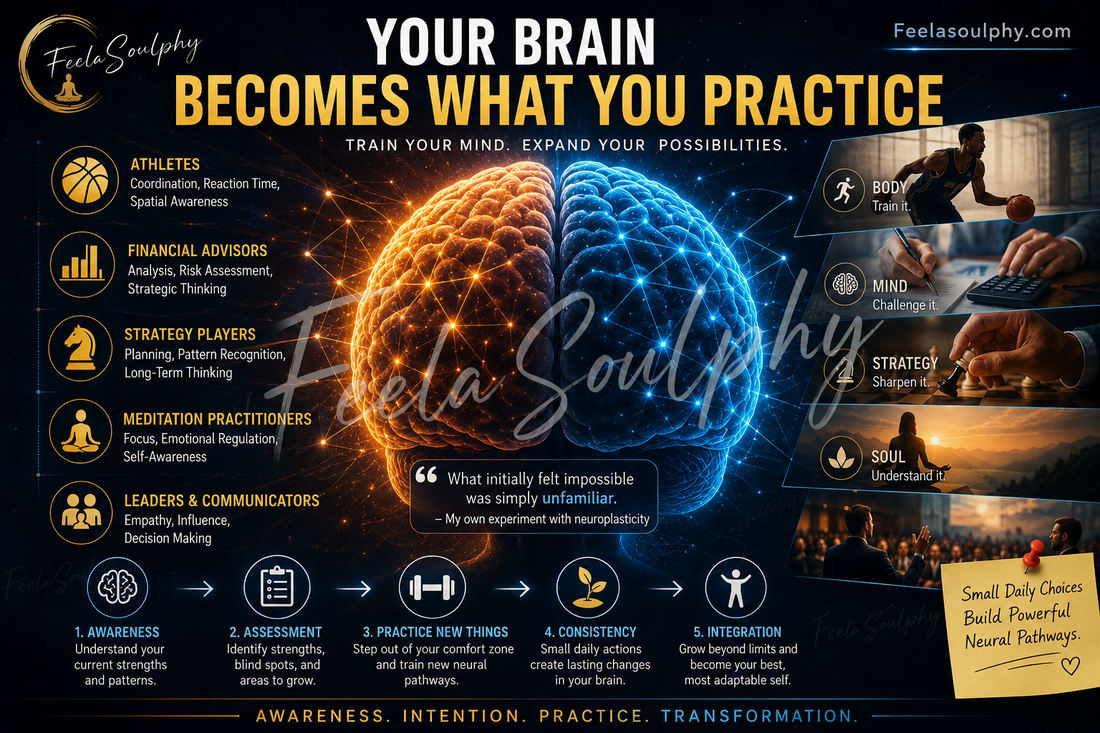 Most people understand that exercise changes the body.
Far fewer realize that every activity they engage in changes the brain. Your profession, hobbies, routines, conversations, and even the thoughts you repeatedly think are strengthening specific neural pathways. Over time, those pathways become the lens through which you experience the world. In a very real sense, your brain becomes what you practice. The Hidden Specialization of the Human Brain A basketball player develops different neural pathways than an accountant. A musician develops different pathways than a soldier. A chess player develops different pathways than a meditation practitioner. This doesn't necessarily mean one person is more intelligent than another. It means their brains have become optimized for different functions. A financial advisor may quickly recognize risk, opportunity, and long-term consequences. A basketball player may instantly process movement, timing, and spatial relationships. A musician may hear subtle patterns and variations others miss. A meditator may notice thoughts and emotions arising before they become reactions. Each person is seeing the same world through a brain that has been trained differently. The brain adapts to whatever it repeatedly does. This process is known as neuroplasticity. The more frequently a neural pathway is used, the stronger and more efficient it becomes. Like a trail through a forest, repeated use transforms a narrow path into a well-traveled road. My Own Experiment With Neuroplasticity Years ago, I unintentionally tested this principle myself. I was setting up a computer in my room. Because of the way the desk was positioned, the modom had to sit on the left side. The problem was that the mouse cable was too short for me to comfortably use it with my right hand. Most people would have moved the desk. Instead, I saw an opportunity. I had always wondered whether I could train my non-dominant hand, so I decided to use the mouse with my left hand. At first it felt awkward and frustrating. Simple tasks required concentration. My movements were slower and less accurate. My brain constantly wanted to return to the familiar pathways it had spent years developing. But I kept practicing. Eventually, something changed. The movements became smoother. The effort disappeared. What once felt impossible became natural. Today, I can comfortably use a mouse with either hand. That experience taught me a lesson I have never forgotten: What initially felt impossible was simply unfamiliar. The limitation wasn't physical. It was neurological. My brain simply needed time to build new pathways. The same principle applies to communication, confidence, meditation, relationships, leadership, public speaking, creativity, and countless other skills. Many things we believe we cannot do are often things we have not practiced long enough to develop. The Strengths and Blind Spots of Specialization Every specialization creates strengths. But every specialization can also create blind spots. An accountant may become highly analytical but struggle to stop overthinking. A soldier may develop exceptional situational awareness but remain hypervigilant in safe environments. An entrepreneur may constantly search for opportunities and find it difficult to relax. A spiritual seeker may spend so much time looking inward that practical action gets neglected. The same pathways that create expertise can also create limitations. This is why personal growth often requires us to step outside what feels natural. Growth begins where familiarity ends. Discover Your Brain's Specialty Before developing new abilities, identify what your brain is already training every day. Ask yourself:
Your answers reveal the pathways that have been strengthened through years of repetition. Most people already have a specialty. Very few are consciously aware of it. The Brain Expansion Framework If you want to become more adaptable, creative, and well-rounded, deliberately train abilities outside your normal strengths. Think of this as cross-training for the brain. Step 1: Identify Your Dominant Strength Determine the area where you spend most of your mental energy. Are you primarily:
This is likely the area where your strongest neural pathways exist. Step 2: Train the Opposite Growth often comes from developing what you naturally avoid. If you're analytical:
If you're highly physical:
If you're highly social:
If you're naturally introspective:
Step 3: Become a Beginner Again One of the healthiest things you can do for your brain is regularly place yourself in situations where you are not already competent. Beginners create new neural pathways. Experts often repeat existing ones. Stay a student. Step 4: Embrace the Awkward Stage Most people quit during the exact phase where the brain is beginning to change. Awkwardness is not evidence that you cannot do something. Awkwardness is evidence that your brain is learning. The discomfort you feel is often the sensation of growth. Simple Ways to Train New Parts of Your Brain You don't need a complete life overhaul. Start small. Try:
Every new challenge encourages the brain to form new connections. Small experiments performed consistently create lasting change. The Real Purpose of Growth Many people focus on improving their circumstances. Far fewer focus on improving the instrument through which they experience those circumstances. Every activity is training your brain. Every habit is reinforcing a pathway. Every repeated thought is strengthening a pattern. The question is not whether your brain is changing. The question is what it is changing into. Ask yourself: What part of my brain am I training every day? And perhaps more importantly: What part of myself have I neglected? Your greatest growth may not come from becoming better at what you already do. It may come from developing the abilities you have never given yourself permission to explore. Because in the end, we do not simply become what we believe. We become what we repeatedly practice. 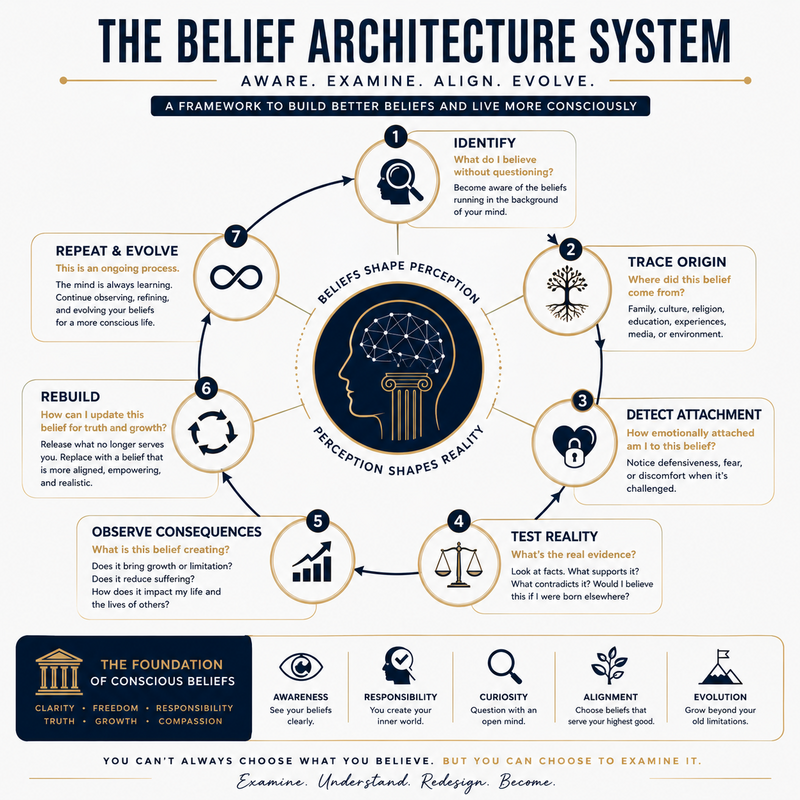 The Belief Achitecture System (BAS) Most people assume their beliefs are their own. But if you observe closely, something unsettling becomes clear: A large portion of what we call “personal belief” is inherited conditioning that we never consciously examined. From family, culture, religion, education, media, and lived experience—we absorb frameworks of meaning long before we are aware enough to question them. In that sense, we do not begin life by thinking. We begin life by absorbing. And what we absorb becomes the invisible architecture of perception. Beliefs Are Not Just Thoughts — They Are Operating Systems A belief is not simply an idea in the mind. It is a filter through which reality is interpreted. It influences:
Most importantly, beliefs do not announce themselves. They operate silently in the background, shaping behavior while remaining largely invisible to the thinker. This is why two people can experience the same event and walk away with completely different realities. They are not seeing reality directly. They are seeing it through belief systems. The Illusion of “My Beliefs” We often say: “these are my beliefs” But the word my deserves closer inspection. How many of these beliefs were actually chosen consciously? How many were:
Even beliefs we think we arrived at independently are often built on earlier assumptions we never questioned. True originality of belief is rare. Most belief is inheritance layered upon inheritance. When Beliefs Become Identity The most important transformation in human psychology happens when belief becomes identity. At that point: “I believe this” becomes “This is who I am.” And once belief becomes identity, it stops being flexible. Because now, to question the belief feels like questioning the self. This is why people become defensive, emotional, or even hostile when core beliefs are challenged. They are no longer protecting an idea. They are protecting their identity structure and the foundation upon which they have built their lives. To them, the collapse of that belief system may feel like a threat to their very existence. This is also where human growth often slows down. Because identity resists change even when reality demands it. Collective Belief: When Mind Becomes Culture Beliefs do not only operate individually. When shared across groups, they scale into something far more powerful: collective consciousness. Collective belief is what creates:
For example, a company like Coca-Cola is not just selling a drink. It is selling a shared emotional association:
Over time, repeated exposure turns meaning into perceived reality. People do not just consume the product. They consume the story attached to it. And that story becomes self-reinforcing because millions of people agree on it simultaneously. This is the essence of collective belief: When enough minds agree on a meaning, that meaning begins to function as reality. For good or for harm, this mechanism scales everything in human civilization. A Simple Personal Example: Conditioned Preference For years, I held a simple belief: Pizza and hamburgers “needed” Coca-Cola. Not because I consciously decided this. But because my mind learned a pattern: greasy food → Coke → satisfaction The carbonation, sweetness, and sensory contrast reinforced the experience. Repetition solidified the association. Eventually, it stopped feeling like a preference. It felt like the correct pairing. But nothing about that pairing was objectively necessary. It was learned. This is important because it reveals something deeper: If even taste can be conditioned… then what else in life is operating on unexamined conditioning? The Belief Architecture System (BAS) If beliefs shape perception, and perception shapes reality, then beliefs must be examined like a system—not blindly followed. Here is a simple framework: 1. Identify What do I believe without questioning? 2. Trace Origin Where did this belief come from? 3. Detect Attachment Do I become emotional when this belief is challenged? 4. Test Reality What evidence supports or contradicts it? 5. Observe Consequences Does this belief create expansion or limitation in my life? 6. Rebuild Update the belief without ego attachment. 7. Repeat Because the mind is always learning—whether we are aware of it or not. Why This Matters Most people do not suffer because they think incorrectly. They suffer because they never examine the system behind their thinking. An unconscious belief is not just an idea. It is a program running the mind. And unexamined programs eventually become lived reality. The goal is not to eliminate beliefs. That is impossible. The goal is to transform belief from unconscious inheritance into conscious design. Because once a belief is seen clearly, it stops controlling you in the same way. And at that point, something fundamental changes: You are no longer just a product of inherited perception. You become an active participant in how perception is formed. Closing Reflection The deepest question is not: “What do I believe?” But rather: “Which beliefs am I currently living inside without knowing it?” Because the moment that question becomes real… the architecture of the mind begins to reveal itself. And once you see the architecture, you are no longer fully trapped inside it. 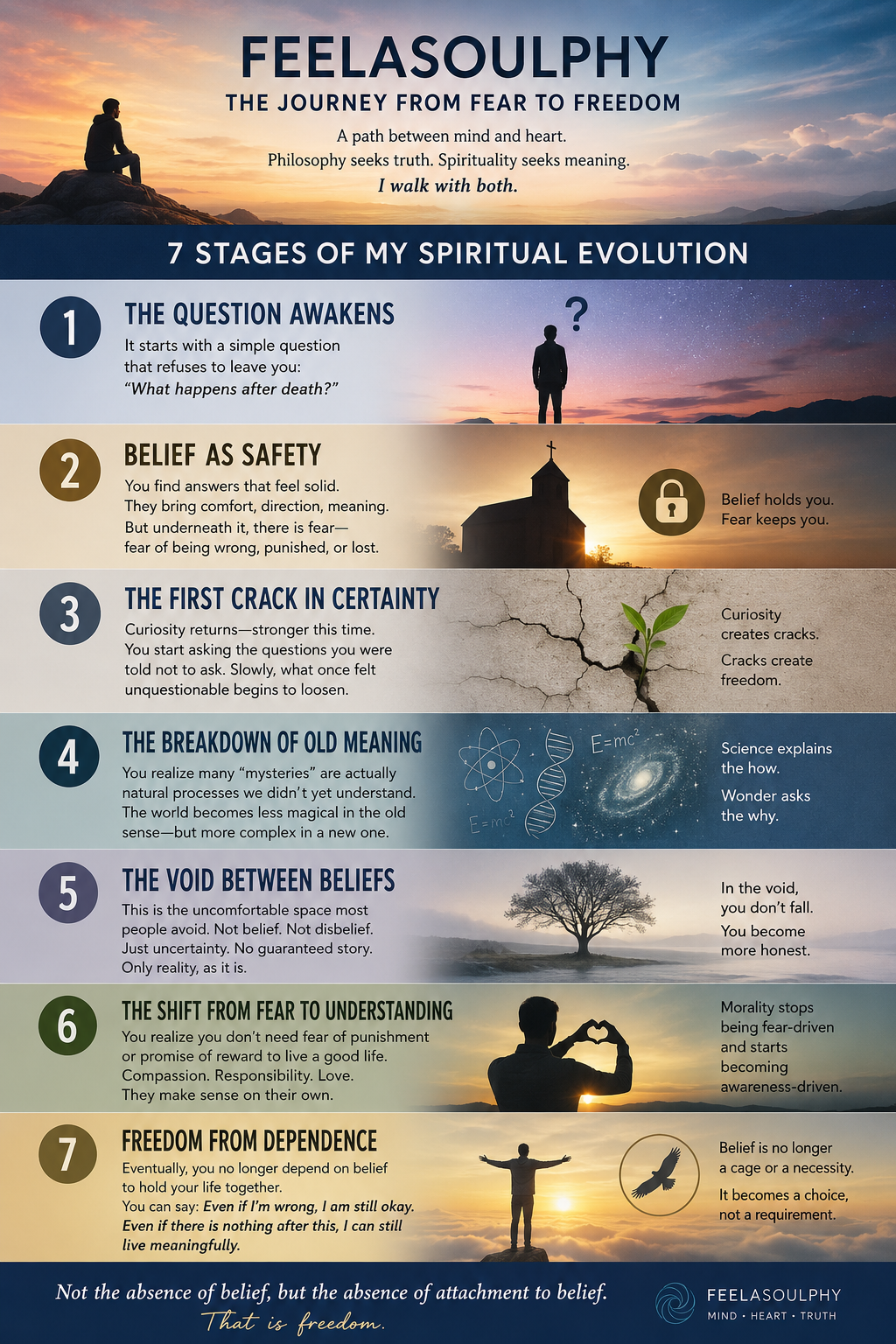 7 Stages of My Spiritual Evolution...To Be Continued... There was a time when I believed life could be neatly categorized. Philosophy belonged to the mind. Spirituality belonged to the heart. One searched for truth through logic, questioning, and reason. The other trusted intuition, meaning, and unseen connection. For a long time, I treated them as separate worlds. Almost like two different languages trying to describe existence. But life doesn’t stay in boxes for long. And neither did I. The Early Search: Fear Disguised as Faith My journey didn’t begin in clarity. It began in curiosity — and uncertainty about what happens after death. That question, once planted, doesn’t leave quietly. It grows into others: What is real? What is God? What is truth? What happens when we die? Eventually, I found myself inside Christianity. And for a while, it gave structure to the unknown. It gave answers where there were none. It gave direction where I felt lost. But underneath it, there was something I didn’t fully recognize at the time: fear. Fear of punishment. Fear of being wrong. Fear of what happens if belief collapses. And fear is a powerful teacher — but not always a truthful one. It can shape belief into something rigid, something protective rather than something alive. At some point, I started to notice that my relationship with belief wasn’t fully free. It was anchored in consequences, not understanding. And once you see that, you can’t unsee it. The Breaking Open: Science, Philosophy, and Unraveling Certainty “Did God create us in His image, or did we create God in ours?” And perhaps beneath both lies an even deeper question: “Did God create us… or did we create God?” - Feelasoulphy The next stage of my journey was not spiritual at all — at least not in the traditional sense. It was analytical. I began studying science, philosophy, and research around consciousness. I explored near-death experiences, reincarnation theories, and scientific perspectives on spirituality. Not to reinforce belief — but to challenge it. Slowly, the world I once saw as “miraculous” became increasingly explainable. The mechanisms of life, the brain, perception, evolution — all of it revealed patterns that didn’t require supernatural explanation. And something shifted in me. I started realizing that many things once attributed to God were actually natural processes we had not yet understood. But instead of closing the mystery, this opened a different one: Even if we understand how something works… we still don’t fully understand why anything exists at all. Science explains mechanisms. But it does not fully explain existence itself. That realization didn’t push me back into certainty. It pushed me deeper into humility. The Transition: Letting Belief Stop Being a Crutch Over time, something unexpected happened. My need for belief as emotional security began to fade. I stopped needing a specific story about what happens after death in order to live meaningfully now. That was a turning point. I reached a place where I could say: Even if there is no God… Even if there is no afterlife… I can still live a good, conscious, and meaningful life. Not because I was forcing myself to be strong — but because I genuinely understood why compassion, love, and responsibility matter. Not from fear. Not from reward. But from clarity. And when belief is no longer required to behave well, something subtle happens inside a person. The mind becomes lighter. The heart becomes less defended. And truth becomes less threatening. The Shift: From Dependency to Freedom At some point, I realized I no longer depended on belief in God or the afterlife to guide my actions. And that changed everything. Because belief stopped being a psychological structure holding me together. It became something I could examine freely. I was no longer afraid of my worldview collapsing. I was no longer attached to it as identity. I could question it, challenge it, even let it dissolve — and I would still be okay. That is when I first felt something I can only describe as freedom. Not freedom from meaning. But freedom from fear-based meaning. Feelasoulphy: A Middle Path This is where the idea of Feelasoulphy emerged for me. A bridge between:
Not as a contradiction — but as integration. Because I’ve come to see that philosophy without feeling becomes empty abstraction. And spirituality without inquiry becomes fragile belief. We are not meant to live in only one half of ourselves. We are meant to become whole. Fear-Based Belief vs Freedom-Based Belief One of the clearest distinctions I’ve learned is this: There is a kind of belief that is built on fear:
And there is a kind of belief — or perhaps a way of being — that is built on freedom:
Fear-based belief needs certainty to feel safe. Freedom-based understanding can hold uncertainty without collapsing. That difference changes everything. The Question I Keep Returning To I don’t claim to know what happens after death. I don’t claim to fully understand consciousness or the origin of reality. But I also no longer need those answers to live well. And maybe that is the real shift. Not from belief to disbelief. But from dependence to independence. And from independence… to a quieter possibility: That perhaps meaning is not something we receive from certainty, but something we embody through awareness. Where I Am Now Today, I feel something simple but profound: I am okay not knowing. Not in resignation — but in openness. I can explore spirituality without needing it to be “true in the ultimate sense.” I can study science without needing it to erase mystery. I can live ethically without needing fear as motivation. And most importantly, I can question everything — without losing myself in the process. That, to me, is freedom. Not the absence of belief. But the absence of attachment to belief. And in that space… life feels strangely more real than ever. 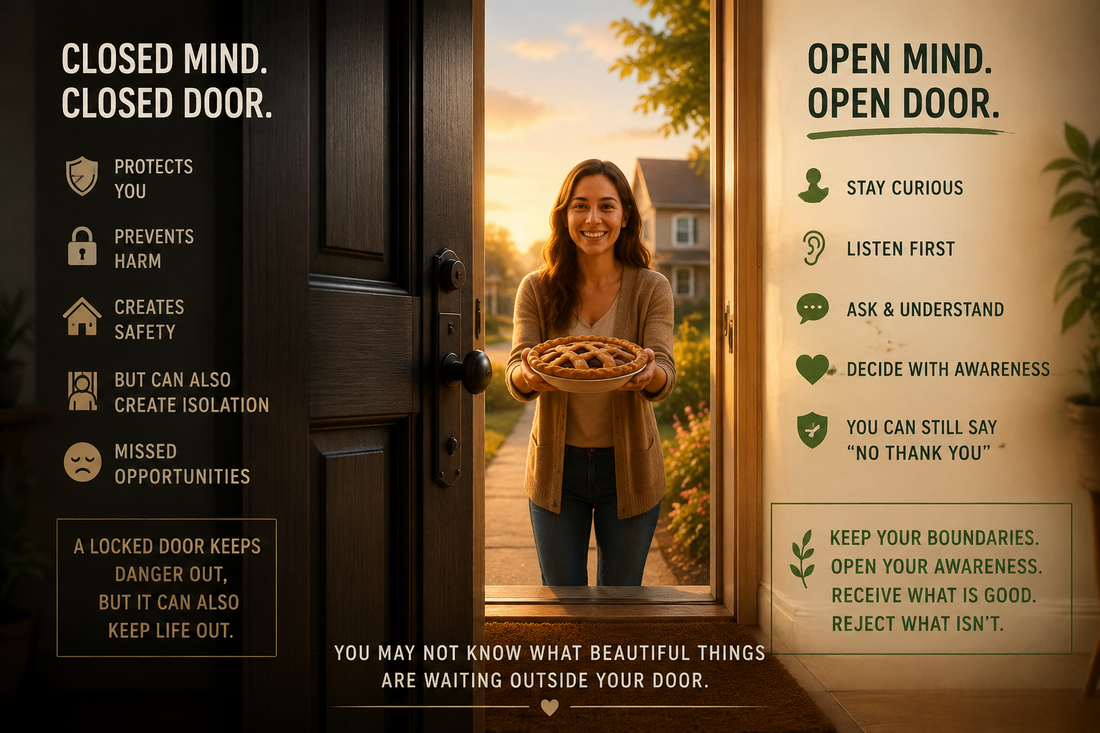 People often misunderstand what it means to be open-minded. Being open-minded does not mean believing everything people tell you. It does not mean removing boundaries, becoming vulnerable to manipulation, or allowing everyone unrestricted access to your life. An open mind is not a house without doors. It is a house with doors that can open. We all have doors and locks for a reason. Locks protect us from danger, theft, manipulation, and harm. Boundaries are healthy. In many situations, they are necessary. But problems begin when we become so closed that we rarely open the door at all. Imagine your neighbor knocks on your door holding a pie. You assume they are trying to sell you something or waste your time, so you ignore them. Later, you discover they simply wanted to share your favorite pie with you, freely and without hidden intentions. This is what a closed mind often does. It rejects possibilities before even looking through the window. Many people live psychologically this way. Their mind automatically assumes danger, criticism, manipulation, or conflict before communication even begins. Over time, the door remains shut so often that they unknowingly trap themselves inside their own mental and emotional house. And eventually, something else begins to happen. When communication feels impossible, people sometimes become more forceful in their attempts to get through the door. This is an important psychological dynamic many people overlook. The more rigidly one person closes themselves off, the more persistent another person may become. Then the more persistent that person becomes, the more defensive the other person feels. This creates a cycle of resistance and pressure. Defensiveness invites force. Force invites more defensiveness. This does not justify violating boundaries or forcing ourselves into people’s lives. Forced entry is rarely healthy. But understanding the psychology behind human interactions helps us become more aware of why these dynamics happen in the first place. Many conflicts are not created by disagreement itself. They are created by the inability to tolerate discomfort, rejection, uncertainty, or lack of control. One person says: “You must let me in.” The other says: “Nobody gets in.” Both are often reacting from fear. A healthy interaction looks different. A healthy mind says: “You may knock. I may listen. Neither of us is entitled to control the other.” That is true openness. You can open the door without surrendering your home. You can listen without agreeing. You can hear someone out and still say: “No thank you.” “I respectfully disagree.” “This is not for me.” The difference is that the decision comes from awareness instead of fear. Many people confuse strong boundaries with emotional walls. But there is a difference between protection and isolation. A weak house has no doors. A prison house never opens its doors. A healthy house has locks, windows, conversations, and choice. This applies not only to the person inside the house, but also to the person outside trying to enter. Some people become so desperate to be heard, understood, or accepted that they begin pushing harder and harder against other people’s boundaries. But force almost always creates resistance. Sometimes the wisest response is to knock gently, speak honestly, and walk away peacefully if the door does not open. Not every closed door is meant to be forced open. The deeper lesson is not simply about open-mindedness. It is about awareness. When we understand the psychology behind defensiveness, persistence, fear, pressure, and resistance, we begin changing the way we interact with each other. Instead of reacting automatically, we begin observing the dynamics taking place beneath the surface. A defensive person may already feel invaded before anyone invaded them. An aggressive person may already feel ignored before anyone rejected them. Awareness allows us to pause and ask: “What is actually happening here beneath the behavior?” That question alone can transform relationships. A locked door may protect you from danger. But if it never opens, it may also keep out love, wisdom, connection, opportunity, and growth. So keep your doors. Keep your locks. But when someone knocks, answer the door. Listen first. Observe carefully. Then decide. You may discover that not everyone outside your house came to take something from you. Some came bearing gifts. 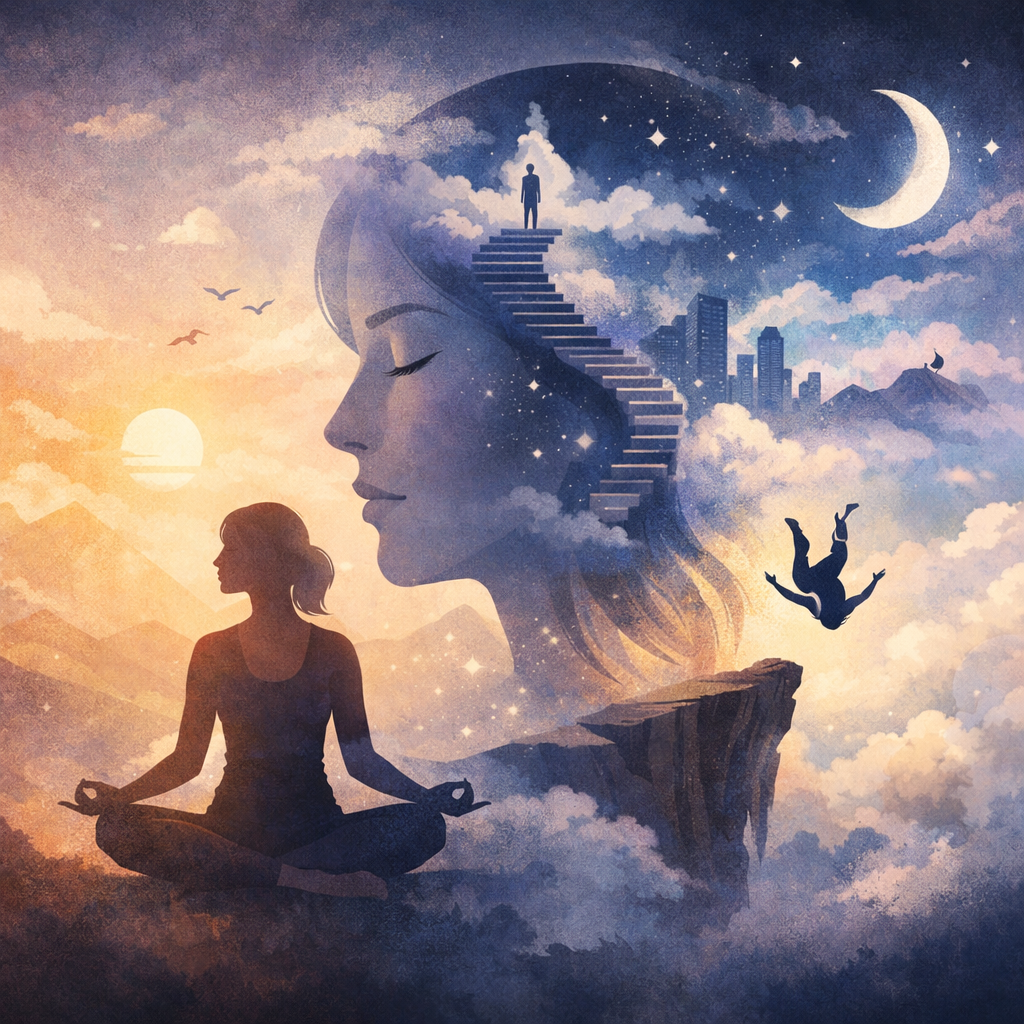 How the Brain Processes Trauma, Anxiety, and Insight When the Ego Is Offline Most people misunderstand dreams because they ask the wrong question. They ask, “What does this dream mean?” When the real question is, “What emotion is being processed?” Dreams are not symbolic riddles or prophetic messages. They are the brain’s emotional maintenance system, running in the background when the conscious mind finally gets out of the way. The events in dreams are not clues about your life. They are containers for emotions already active in your waking state. The Core Principle (this changes everything) Dreams prioritize emotion, not narrative. The brain does not dream to tell stories. It dreams to regulate, consolidate, and integrate emotional information that has not been fully processed while awake. The imagery is secondary. The emotion is primary. Fear, anxiety, grief, shame, anticipation, relief--these are the real data. The dream simply borrows whatever images are available to express them. Why Dream Events Are Misleading (and usually irrelevant) Take a common example: fear of heights. A dream might place you:
This does not mean:
What it does mean is simpler and more precise: The brain needed an image that reliably produces fear. The subconscious doesn’t care about accuracy. It cares about emotional resonance. If fear exists in your waking life--fear of uncertainty, exposure, loss, failure--the brain reaches into its memory archive and grabs whatever already knows how to feel like fear. The context is interchangeable. The emotion is not. Trauma: When the Brain Stops Using Metaphors A fair challenge to this model is trauma dreams. Trauma dreams often replay events literally. Does that contradict this theory? No. It strengthens it. In trauma, the emotional charge is so intense and unresolved that the brain does not need substitute imagery. The original memory is already maximally tagged with fear and threat. This aligns with trauma research associated with Bessel van der Kolk, showing that traumatic memories are stored sensory-first, not narrative-first. In short:
Same function. Different intensity. Anxiety Dreams: The Cleanest Proof Anxiety dreams are the clearest validation of this model. Common anxiety dream themes:
None of these are predictions. None of them are symbolic puzzles. They are emotion generators. Anxiety in waking life is often:
The dream is not saying what you’re afraid of. It’s showing that fear is active. Recurring Dreams = Unintegrated Emotion Recurring dreams don’t mean the universe is nagging you. They mean:
When the waking emotional relationship changes, recurring dreams:
No decoding required. Integration ends repetition. The Dream–Emotion Integration Framework This is where theory becomes practice. Step 1: Ignore the Story Do not analyze symbols. Do not Google meanings. Do not intellectualize. The story is noise. Step 2: Identify the Dominant Emotion Ask:
Name one primary emotion. Step 3: Locate It in Waking Life Ask: “Where in my waking life do I feel this same emotion--without the drama?” Look for:
Step 4: Feel It Without Fixing It This is critical. Don’t solve. Don’t explain. Don’t suppress. Let the emotion be felt consciously. This is integration. Step 5: Watch the Dream Change As emotional integration happens:
The system says: “Handled.” Meditation and Dreams Do the Same Job The difference is timing. Dreams:
Meditation:
When you meditate regularly, especially in stillness, emotional processing happens while awake. That’s why:
Meditation doesn’t eliminate dreams. It reduces emotional backlog. The Unified Model
either asleep or still. The Takeaway Dreams are not trying to teach you something mystical. They are trying to finish something emotional. If you chase symbols, you stay confused. If you track emotion, clarity follows. Dreams aren’t messages. They’re maintenance logs. And meditation is how you read them while awake. Guided Meditation: Observing the Emotional Landscape Find a comfortable position. You can sit upright or lie down. Let your body settle. There is nothing you need to accomplish during this meditation. No goal to reach, no state to force. Just observation. Take a slow breath in through your nose. And gently release it. Allow your breathing to return to its natural rhythm. The breath knows what to do without your help. Now bring your awareness to the weight of your body. Notice how gravity holds you effortlessly. Feel the points where your body touches the chair, the floor, or the bed. Let the muscles soften. Your only task is to observe. Now allow your mind to be exactly as it is. Thoughts may appear. Images may appear. Memories may pass through. Let them come and go the way clouds move through the sky. There is no need to chase them or push them away. Simply notice. Now gently bring your attention to your emotional state. Ask yourself quietly: What emotion is present right now? There is no right answer. Sometimes the emotion is clear. Sometimes it is subtle, like a faint background tone. Maybe it is calm. Maybe curiosity. Maybe tension. Maybe something you can’t quite name yet. Just notice. If a recent dream comes to mind, allow it to appear briefly. Do not analyze the story. Let the images fade and focus only on the feeling that was present in the dream. Ask yourself: What emotion was strongest in that dream? Fear, uncertainty, pressure, sadness, anticipation, relief—whatever it was, simply acknowledge it. Now ask gently: Where in my waking life do I feel this same emotion? Do not force an answer. Let the mind wander naturally. It may show you a situation, a conversation, a relationship, or a subtle pressure you’ve been carrying. If nothing appears, that’s perfectly fine. Stay with the emotion itself. Now shift your attention to your body. Where do you feel this emotion physically? Perhaps in the chest. The stomach. The throat. The shoulders. Rest your awareness there. Do not try to change the sensation. Do not try to solve anything. Simply allow the feeling to exist in the light of awareness. This is how emotions integrate—when they are allowed to be seen without resistance. Stay here for a few breaths. Now let the focus soften again. Allow your mind to drift freely. Sometimes when the mind is relaxed and open, insights appear naturally—like a puzzle quietly solving itself. If an understanding arises, simply observe it. If nothing arises, that is also perfect. The mind continues its work even when we are unaware of it. Trust the process. Take a slow breath in. And gently exhale. Begin to feel the space around you again. Notice the room, the air, the sounds around you. When you are ready, slowly open your eyes. Carry this awareness with you. Remember: Your mind processes experiences both day and night. Dreams do it while you sleep. Meditation allows it to happen while you are awake. Both are simply the mind maintaining balance. 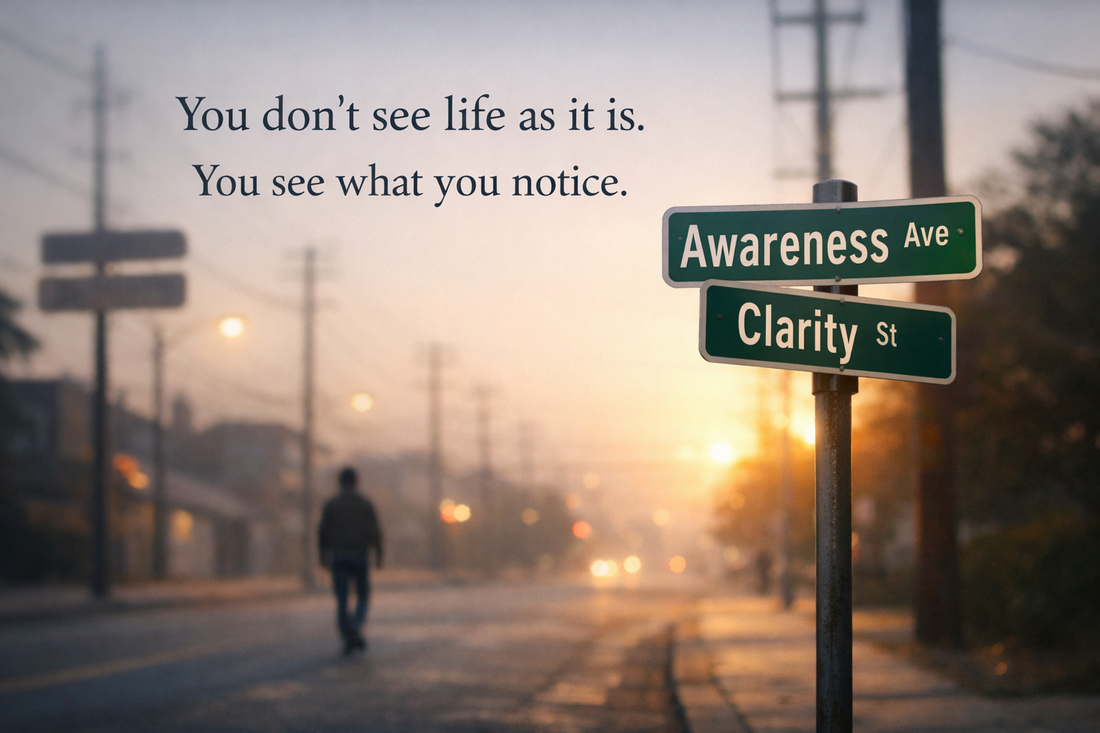 Most people don’t live bad lives. They live unconscious ones. We don’t experience reality as it is--we experience what we pay attention to. Everything else disappears into the background, not because it isn’t there, but because our awareness never stops to notice it. I realized this through a simple experiment. I’ve lived in the same neighborhood for sixteen years, yet I still don’t know the names of some of the cross streets near my home. When I finally slowed down and intentionally paid attention, I remembered the street names immediately. This wasn’t a memory problem. It was an attention problem. That insight opened a larger question: if I can overlook something so basic for years, how many important aspects of my life have I also missed--patterns, emotions, beliefs, opportunities--simply because I wasn’t paying attention? Why Most People Live Unconsciously Living unconsciously isn’t a moral failure. It’s a biological strategy. The brain is designed to conserve energy. Awareness takes effort. Questioning takes effort. So the mind defaults to automation. Our experience of life is shaped by what we attend to. Attention acts as a filter--what passes through becomes our reality. Most people don’t consciously choose that filter. Instead, it’s shaped by:
Over time, this creates a narrow version of reality that feels complete but isn’t. Research in psychology supports this. Daniel Kahneman showed that much of human behavior operates on fast, automatic thinking. We don’t actively choose most of our thoughts--we repeat them. Efficiency keeps us functioning. But it also keeps us asleep. The Hidden Cost of Unconscious Living When we don’t pay attention:
The problem isn’t suffering. The problem is not noticing the cause of suffering. An unconscious life isn’t empty--but it’s limited. Awareness Is Not a Personality Trait--It’s a Skill Here’s the good news: awareness isn’t something you either have or don’t have. It’s a skill. I didn’t need years of meditation or a spiritual retreat to notice the street names. I simply directed my attention deliberately for a moment. That single act revealed something important: unconscious living isn’t permanent. It’s a default setting. Every moment of noticing--your breath, your tension, your thoughts, your reactions--is a small interruption in that default. How Attention Changes Your Life Your life doesn’t change when circumstances change. It changes when attention changes. Most people try to fix their lives by changing external conditions. Fewer people realize that shifting attention alters perception, behavior, and ultimately identity. When you begin to observe instead of react:
This isn’t abstract philosophy. It’s practical awareness. A Simple Practice to Live More Consciously Start small. Pick one ordinary thing today and pay full attention to it--your walk, your breathing, a conversation, the environment around you. No analysis. Just noticing. Then ask yourself: What else in my life have I been moving past without seeing? That question alone begins to wake you up. Final Thought Most people aren’t unconscious because they’re incapable of awareness. They’re unconscious because they were never taught that attention shapes reality. Once you see this, you can’t unsee it. And the real question becomes: What kind of life unfolds when you notice on purpose?  Some people thrive on ambition and achievement, while others feel strangely unmotivated by goals that once seemed meaningful. If you’re highly self-aware, this isn’t a flaw—it’s a signal. As awareness deepens, ego-driven motivation begins to collapse, and the effort behind achievement suddenly feels heavier than the reward. This article explores why high awareness can kill motivation, the hidden difference between ego-based striving and truth-driven expression, and how alignment—not ambition—becomes the real force that moves you forward. Why Some People Don’t Feel the Weight of Work Some people don’t seem to mind the work it takes to achieve in life. They push, grind, build, chase—and they often accomplish a lot. That’s because most achievement is ego-driven. The ego runs on:
Effort feels invisible when the ego is excited. Why Awareness Changes Everything As awareness increases, the illusion weakens. You begin to see:
So when a new project or desire appears, you don’t just see the starting point—you see the entire arc: effort → achievement → short-lived high → restlessness → another goal. And a quiet question emerges: Why start something that won’t actually fulfill me? This hesitation isn’t laziness. It’s clarity. Why It Felt Easier When You Were Younger When you’re younger, desire is simpler. You want something, you work for it, you get it, you feel better—at least for a while. The emotional return feels worth the effort, so you don’t even register the work involved. Back then:
The spell is broken. Ego-Driven Action vs Truth-Driven Expression This is the distinction most people never learn to make. Ego-Driven Action
Even when successful, it often leaves a subtle emptiness. Something feels off—because the action wasn’t aligned with your deepest belief. It was aligned with maintaining an identity. Truth-Driven Expression
When you act from truth, you operate from your pure belief system, not the ego. For example: If I’m honest with myself and recognize that buying a new piece of clothing is purely to satisfy my ego, that awareness changes the choice. Now I hold a clean belief: This is ego-driven. If I go through with it anyway, it feels like subtle self-betrayal—disalignment. But if I honor that belief and choose differently, I experience integrity. Truth creates alignment. Ego creates performance. Why You Hesitate to Start Once you’ve tasted alignment, ego goals feel heavy. You don’t resist work. You resist work that isn’t true. You’re no longer motivated by:
You’re moved by:
And aligned action, while often quieter, feels clean. Self-Reflection: Are You Unmotivated or Just Done With Illusion? Ask yourself—honestly:
These questions require brutal honesty. Without it, clarity gets mislabeled as laziness. The Provocative Truth High awareness kills ego motivation. That’s the price of seeing clearly. Once you recognize the cycle—effort, achievement, dissatisfaction—you can’t unknow it. And when ego stops driving you, nothing external can push you anymore. Now only alignment moves you. That’s dangerous. Because when you can’t lie to yourself, you’re left with two options:
Most people go back to chasing. Very few choose alignment—because it demands honesty over ambition. And once you see the difference, there’s no going back. Why Slowing Down Feels So Uncomfortable - The Science Behind a Mind That Won’t Let Go of Busyness2/12/2026 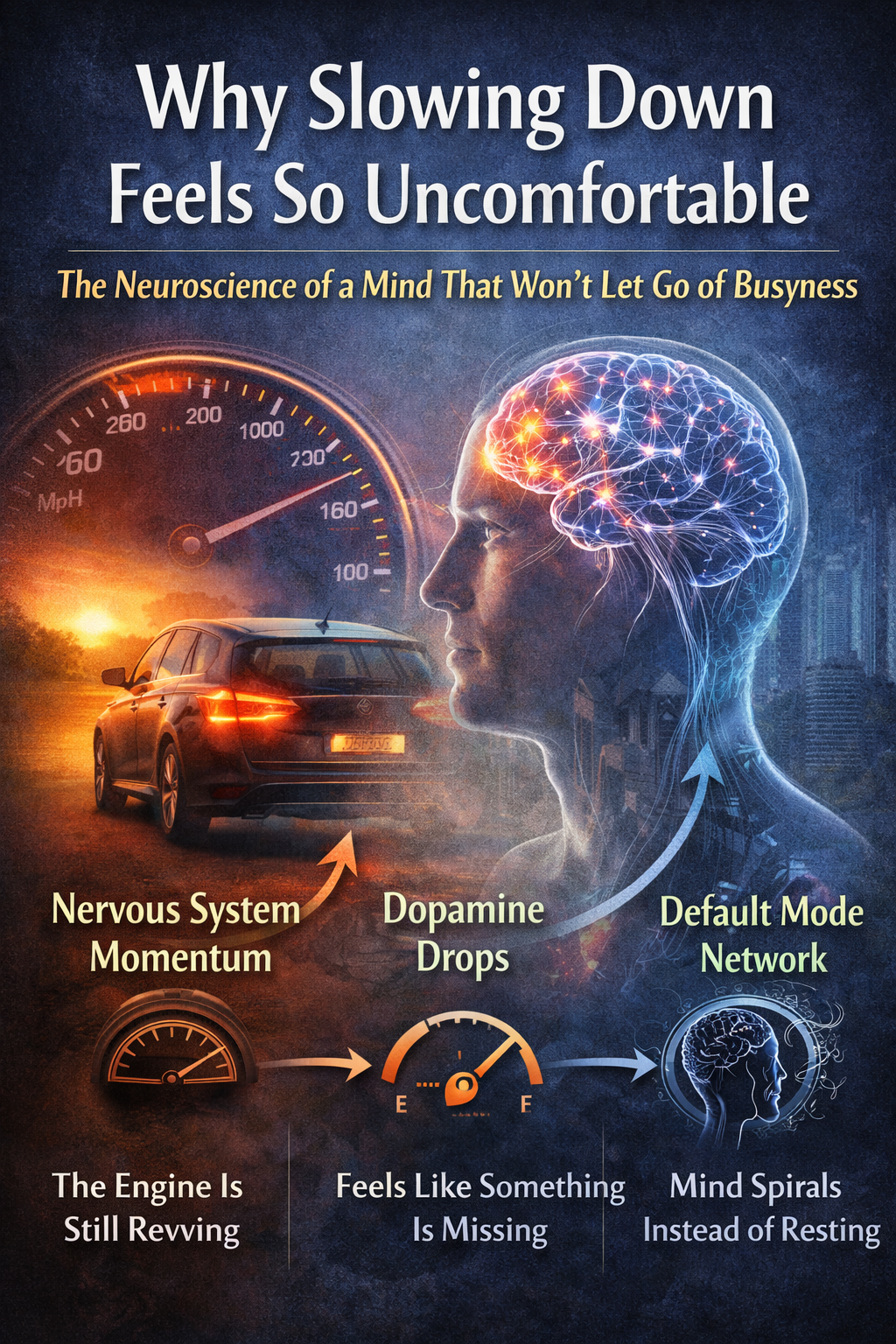 Most people think rest should feel good immediately. But when life finally slows down, something strange happens:
It’s biology. Think of it like driving a car at 100 miles an hour for a long time—and then suddenly slamming the brakes. The wheels stop turning. But the engine is still revving. That “revving” is your nervous system. The nervous system doesn’t switch states instantly When you’re busy for long periods, your body adapts to that pace. Scientifically speaking:
So when external demands suddenly drop:
You didn’t fail at relaxing. Your system just hasn’t downshifted yet. Dopamine is why the mind looks for something to do Dopamine is often misunderstood. It’s not the “pleasure chemical.” It’s the motivation and seeking chemical. During busy periods, dopamine spikes come from:
When that stimulation disappears:
The brain isn’t asking for meaning yet. It’s asking for stimulation. What happens when you stop “doing” When tasks slow down, a brain network called the Default Mode Network (DMN) becomes more active. The DMN is responsible for:
This network is essential—but untrained, it becomes noisy:
So when you stop doing, the mind doesn’t go quiet. It starts talking. That doesn’t mean stillness is bad. It means the mind is entering unfamiliar territory. Why this feels threatening to the system The nervous system learns through repetition. If busyness was associated with:
Then slowing down feels uncertain—even unsafe. The body doesn’t distinguish between: “I don’t know what to do” and “I might be in danger” Both feel like loss of control. So the urge to get busy again isn’t ambition. It’s conditioning. Social media exploits this exact gap This is where modern life complicates things. Social media:
It perfectly fills the uncomfortable space between:
Instead of allowing the nervous system to settle, we hover in between. Not fully busy. Not fully relaxed. Just constantly stimulated enough to avoid stillness. Why slowing down must be intentional at first You can’t think your way into regulation. The nervous system recalibrates through:
This is why rest initially feels uncomfortable—and later becomes nourishing. Stillness is a skill, not a personality trait. The bigger picture Busyness isn’t the enemy. Unconscious busyness is. When you understand what’s happening in the brain and body:
And once that happens? Stillness stops feeling empty. It becomes spacious. Creative. Clarifying. One important real-life example This same mechanism explains why many people struggle after retirement—and why they rush back into the same kind of work they just left. I wrote a separate post on that specifically, because it deserves its own attention. If this resonates, read the companion piece: “Why People Panic After Retirement (And Rush Back to the Same Life)” This post explains how the mind and nervous system work. The other shows what happens when we don’t understand this during major life transitions. Together, they tell the full story. How to Be Alone Without Being Lonely - Awareness, Curiosity, and the Education We Keep Ignoring2/10/2026  Naturally shaped pebbles off a beach in Santa Cruz, California, USA. They are Sandstones, Mudstones, Limestones (with fossils), Cherts. Ages 1 million to over a billion years old. Any idea which one is the oldest? Most people don’t fear being alone. They fear what happens when distractions disappear. Solitude feels empty only when awareness is low. When awareness rises, learning speeds up — and suddenly, being alone becomes alive. The other day, I spent hours alone at the beach. No plan. No productivity agenda. Just attention. What unfolded taught me more than weeks of routine thinking ever could. I watched seagulls fly high into the air carrying mussels, then drop them onto rocks below to crack the shells. Again and again. No frustration. No overthinking. Just experimentation. Gravity became their tool. The rock became their ally. That matters for one simple reason: Many animal species have survived on this planet far longer than humans. Some for millions of years. Some relatively unchanged. They didn’t do that by accident. They figured something out. If we refuse to learn from them, an honest question follows: Who exactly do we think we’re learning from instead? Later that same day, I noticed a man running along the beach — with two crows flying beside him. I didn’t understand it at first. An hour later, they were still together. Then I saw it: he was feeding them as he ran. He had learned how to attract them, how to stay in rhythm with them. That wasn’t dominance. That was relationship. Crows don’t obey. They choose. That scene alone says more about intelligence than most definitions do. In between, I picked up pebbles. Smooth ones. Scarred ones. Some carrying fossil-like imprints of ancient shells. Later, I learned many of these stones began forming 1 million to over a billion years ago — shaped slowly by pressure, water, and time. Holding one felt like holding patience itself. Most people would call that “just a rock.” That’s not accuracy — that’s inattention. Jane Goodall changed how we understand chimpanzees not by imposing theories, but by doing something radical: she stayed curious longer than most people are willing to. She watched. She listened. She allowed understanding to emerge instead of forcing conclusions. And, perhaps most importantly, she genuinely enjoyed being alone in nature and learning from it. That’s what solitude in nature does when awareness is present. And here’s the part we underestimate: Awareness doesn’t just deepen insight — it accelerates learning. When you’re attentive:
This is why “unplugging” works — not because technology is evil, but because disconnection from noise allows reconnection to reality. Or put simply: Disconnect to reconnect. I had been stressed with work for a while. Busy. Productive. Effective — but disconnected from myself and from nature. Solitude in nature didn’t slowly help. It immediately brought me back to life. Not metaphorically. Viscerally. Loneliness comes from disconnection. Solitude comes from engagement. Nature is always teaching. Animals are always demonstrating intelligence, efficiency, cooperation, and presence. The lessons are everywhere. The only requirement is awareness. You don’t need to escape life. You need to pay attention to it. Practical Homework: How to Practice Awareness in Solitude Don’t romanticize this. Practice it. 1. Schedule unstructured alone time No podcasts. No scrolling. No objectives. Go somewhere alive: beach, park, trail, quiet street. 2. Train one sense at a time Spend 5–10 minutes focusing only on:
Awareness grows through specificity. 3. Stay past boredom Watch one thing long enough for it to change. Learning accelerates after the mind stops demanding stimulation. 4. Ask grounded questions Not philosophical ones. Practical ones:
5. Pick up or observe one object — then use AI to learn about it A pebble. A leaf. A shell. A bird. Later, research it. Its age. Its function. Its history. This bridges curiosity, technology, and nature — instead of treating them as opposites. 6. Write down everything you did that day Not just insights — actions:
When I did this, I surprised myself. What felt like “doing nothing” was actually a full, rich, adventurous day. Awareness changes the scoreboard. Do this once a week. That’s enough. Curiosity opens the door. Awareness lets you walk through it. Solitude stops being empty — and becomes education. And eventually, you realize something quietly radical: Being alone isn’t the absence of life. It’s the removal of noise that was keeping you from seeing it. |
AuthorFeelasoulphy Categories
All
Archives
March 2026
|
 RSS Feed