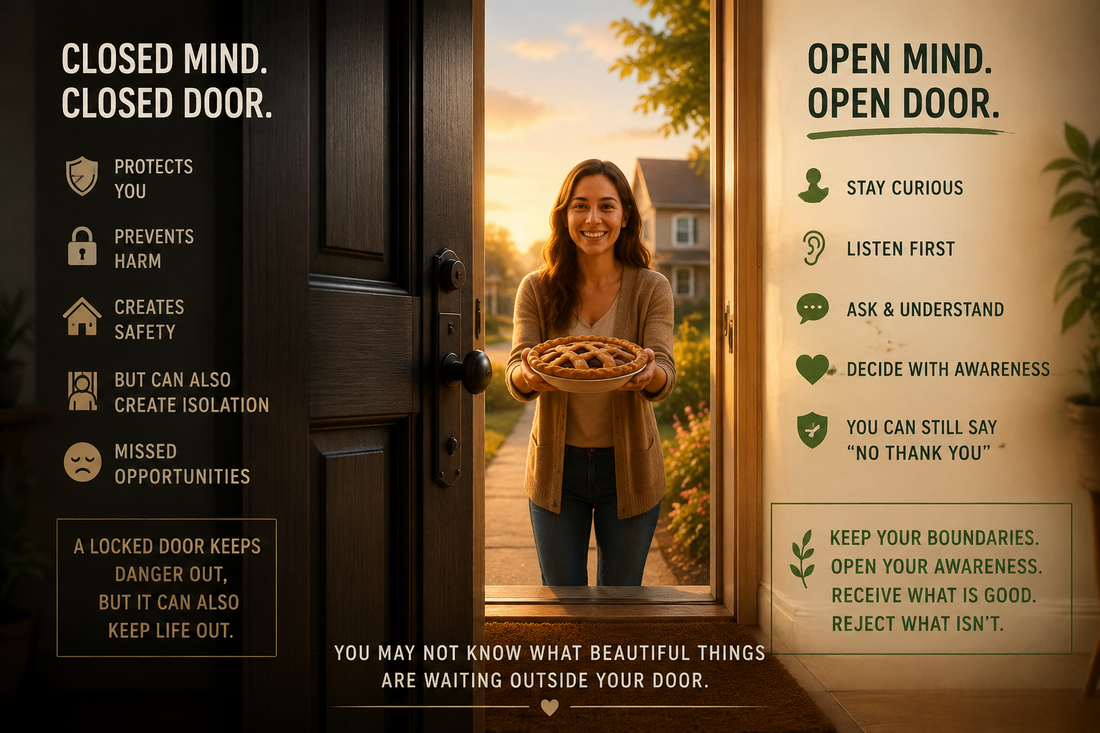
 People often misunderstand what it means to be open-minded. Being open-minded does not mean believing everything people tell you. It does not mean removing boundaries, becoming vulnerable to manipulation, or allowing everyone unrestricted access to your life. An open mind is not a house without doors. It is a house with doors that can open. We all have doors and locks for a reason. Locks protect us from danger, theft, manipulation, and harm. Boundaries are healthy. In many situations, they are necessary. But problems begin when we become so closed that we rarely open the door at all. Imagine your neighbor knocks on your door holding a pie. You assume they are trying to sell you something or waste your time, so you ignore them. Later, you discover they simply wanted to share your favorite pie with you, freely and without hidden intentions. This is what a closed mind often does. It rejects possibilities before even looking through the window. Many people live psychologically this way. Their mind automatically assumes danger, criticism, manipulation, or conflict before communication even begins. Over time, the door remains shut so often that they unknowingly trap themselves inside their own mental and emotional house. And eventually, something else begins to happen. When communication feels impossible, people sometimes become more forceful in their attempts to get through the door. This is an important psychological dynamic many people overlook. The more rigidly one person closes themselves off, the more persistent another person may become. Then the more persistent that person becomes, the more defensive the other person feels. This creates a cycle of resistance and pressure. Defensiveness invites force. Force invites more defensiveness. This does not justify violating boundaries or forcing ourselves into people’s lives. Forced entry is rarely healthy. But understanding the psychology behind human interactions helps us become more aware of why these dynamics happen in the first place. Many conflicts are not created by disagreement itself. They are created by the inability to tolerate discomfort, rejection, uncertainty, or lack of control. One person says: “You must let me in.” The other says: “Nobody gets in.” Both are often reacting from fear. A healthy interaction looks different. A healthy mind says: “You may knock. I may listen. Neither of us is entitled to control the other.” That is true openness. You can open the door without surrendering your home. You can listen without agreeing. You can hear someone out and still say: “No thank you.” “I respectfully disagree.” “This is not for me.” The difference is that the decision comes from awareness instead of fear. Many people confuse strong boundaries with emotional walls. But there is a difference between protection and isolation. A weak house has no doors. A prison house never opens its doors. A healthy house has locks, windows, conversations, and choice. This applies not only to the person inside the house, but also to the person outside trying to enter. Some people become so desperate to be heard, understood, or accepted that they begin pushing harder and harder against other people’s boundaries. But force almost always creates resistance. Sometimes the wisest response is to knock gently, speak honestly, and walk away peacefully if the door does not open. Not every closed door is meant to be forced open. The deeper lesson is not simply about open-mindedness. It is about awareness. When we understand the psychology behind defensiveness, persistence, fear, pressure, and resistance, we begin changing the way we interact with each other. Instead of reacting automatically, we begin observing the dynamics taking place beneath the surface. A defensive person may already feel invaded before anyone invaded them. An aggressive person may already feel ignored before anyone rejected them. Awareness allows us to pause and ask: “What is actually happening here beneath the behavior?” That question alone can transform relationships. A locked door may protect you from danger. But if it never opens, it may also keep out love, wisdom, connection, opportunity, and growth. So keep your doors. Keep your locks. But when someone knocks, answer the door. Listen first. Observe carefully. Then decide. You may discover that not everyone outside your house came to take something from you. Some came bearing gifts.
0 Comments
 Before you answer these questions, I suggest you read the post about Friendship & Love: Needs vs. Alignment. Answer each question based on your most significant relationship (romantic or friendship). Choose the option that feels most true most of the time, not on your best days. 1. When I feel emotionally off, this person primarily… A. Brings relief and calms me down B. Grounds me, but I can regulate myself without them C. Feels essential for me to feel okay 2. If this relationship ended tomorrow, I would feel… A. Deep grief, but still grounded in myself B. Anxiety, panic, or fear about how I’d cope C. Mostly fine—I’d miss them, but my sense of self remains intact 3. My growth and change within this relationship feels… A. Encouraged and supported B. Neutral—it depends on the situation C. Tension-filled or destabilizing 4. When conflict arises, we usually… A. Return to calm and understanding B. Escalate emotionally, then repair C. Avoid, shut down, or spiral 5. I stay in this relationship mainly because… A. I admire who they are and how they live B. It feels familiar and emotionally safe C. I’m afraid of losing what they provide 6. My nervous system around this person feels… A. Calm, open, and steady B. Activated—excited, anxious, or on edge C. Relaxed only when they’re present 7. If my core emotional needs were fully met elsewhere, I would… A. Still choose this relationship B. Be unsure C. Likely drift away 8. This relationship is rooted primarily in… A. Shared values and worldview B. Shared experiences and history C. Shared pain, struggle, or emotional regulation Scoring
Results Interpretation 🟢 Alignment-Based Relationship Your connection is rooted in shared values, respect, and emotional self-responsibility. Needs exist—but they are not the glue. Growth strengthens the bond rather than threatening it. Reflection: This is a relationship of choice, not survival. Protect it by continuing to regulate yourself and communicate honestly. 🟡 Transitional / Mixed Relationship Your relationship contains both need and alignment. This is common—and often temporary. Reflection: You’re likely in a phase where growth is redefining the bond. With conscious self-regulation and honest dialogue, this relationship can evolve in either direction. 🔴 Needs-Based Relationship This connection functions primarily as a regulation strategy. The relationship stabilizes your nervous system more than it expresses shared identity. Reflection: This relationship isn’t “wrong”—it’s informative. It’s pointing you toward inner work that will eventually change how you bond. Growth may transform—or end—the relationship. Both outcomes are valid. Relationships aren’t a test you pass or fail. They’re mirrors that show you where safety still lives outside of you. This quiz doesn’t just measure relationships. It quietly educates the nervous system while doing it.  Most people think relationships fail because of incompatibility. More often, they fail because two nervous systems stop speaking the same language. Polyvagal Theory: Why the Body Decides Before the Mind According to Stephen Porges, our nervous system is constantly asking one unconscious question: Am I safe here? Before thought, before logic, before intention—the body answers first. Polyvagal Theory explains three primary states:
Needs-Based Relationships: Regulation Through Another Person Needs-based relationships often form when one or both people are dysregulated. Someone else becomes:
The nervous system learns: “I feel safe when I’m with them.” This creates powerful bonding—but it’s conditional. If that person:
The nervous system interprets it as threat, not loss. That’s why needs-based relationships often feel:
It’s not just emotional attachment—it’s biological reliance. Alignment-Based Relationships: Co-Regulation Without Dependency Alignment-based relationships emerge when both people can access ventral vagal safety on their own. Here’s the difference:
These relationships activate:
They don’t spike the nervous system. They stabilize it. Which is why they can feel “less exciting” at first—and far more sustaining over time. Why Growth Disrupts Needs-Based Bonds When one person becomes more regulated:
The old attachment loop loses its charge. The other nervous system feels this as:
But what’s really happening is simple: The body no longer needs the same strategy to feel safe. Alignment-based relationships survive this shift. Needs-based ones often fracture under it. Self-Check: Needs or Alignment? Ask your body first. Then your mind.
Your nervous system never lies. It just speaks softly—until you ignore it long enough that it has to shout. Visual Diagram From Need to Alignment: How Relationships Actually Form 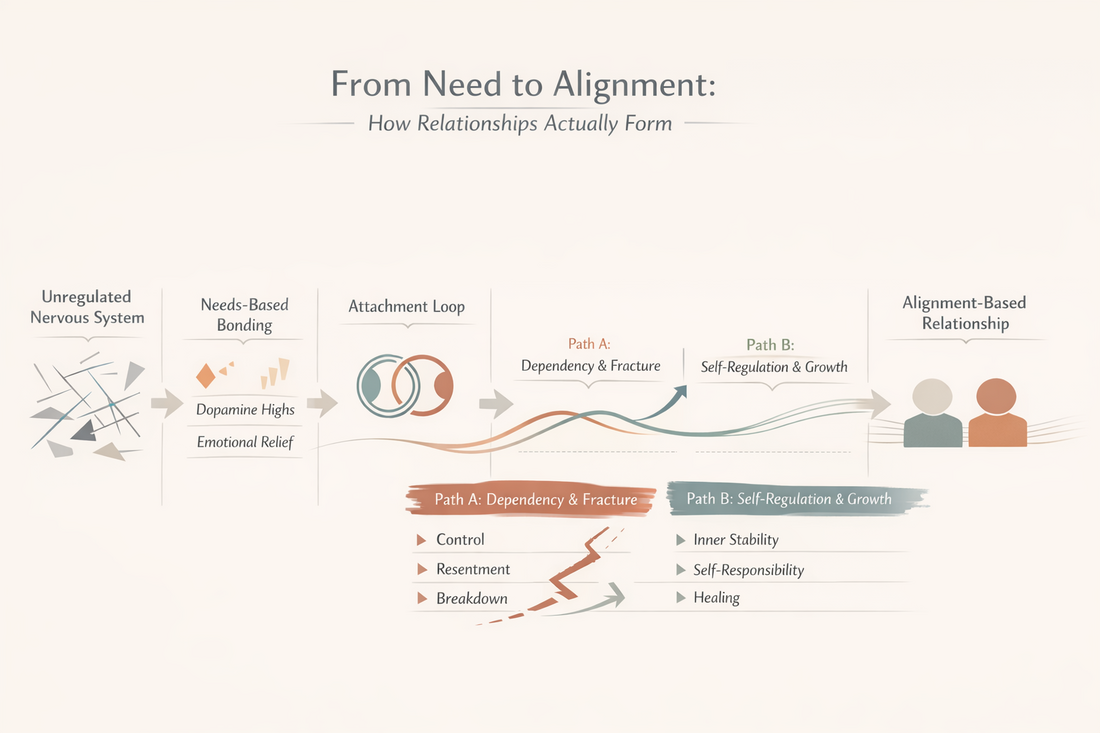 The Deep Reframe Needs-based relationships are survival strategies. Alignment-based relationships are expressions of wholeness. Needs bring people together. Alignment keeps them together. And the real work isn’t fixing relationships. It’s teaching the nervous system that safety can come from within. Once that happens-- connection becomes clean. Love becomes steady. And relationships stop feeling like something you might lose… and start feeling like something you’re free to choose Take this quiz to find out whether your relationship is based on needs or alignment.  What you are aware of is your reality. Simple sentence. Infinite depth. Reality doesn’t just exist “out there” somewhere waiting to be discovered. It unfolds in here—within the field of your awareness. You could be standing in the same room as another person, breathing the same air, hearing the same sounds, yet living in two entirely different realities. One person feels peace; the other feels anxiety. One sees opportunity; the other sees threat. The outer world is the same, but the inner awareness is not. So what’s real? Both—and neither. Reality, as we experience it, is a mirror reflecting our state of consciousness. Awareness is the light that reveals what’s in the mirror. When the light is dim, the reflection is blurry and distorted. When the light brightens, the truth appears clearer, richer, and more whole. The Power of Awareness Awareness is not just passive observation—it’s participation. The moment you become aware of something, you interact with it. You give it meaning. You bring it into existence for you. That’s why self-awareness is so transformative. When you see your own thoughts clearly, they lose their power to unconsciously steer your emotions and behaviors. When you observe your fears, they stop dictating your choices. What you are aware of, you control; what you are not aware of, controls you. The unexamined parts of the mind—those shadowy regions of pain, resentment, or false belief—still operate, but without your conscious permission. They become the hidden puppeteers of your “reality.” You react, repeat, and relive. The same arguments, same relationships, same emotional loops—different faces, same energy. Only when you become aware of those patterns do you gain the power to change them. Awareness Expands Reality Your awareness defines the edges of your universe. As it expands, so does your world. When you become aware of beauty, life becomes beautiful. When you become aware of love, love surrounds you. When you become aware of the miracle of breath, the simple act of breathing becomes sacred. Spiritual growth isn’t about escaping reality—it’s about waking up to more of it. You start noticing the subtleties: the silence between sounds, the energy behind emotions, the consciousness within every being. You start living not just as a thinker of thoughts but as the observer of the thinker—the still presence that watches everything come and go. And in that stillness, a new kind of peace emerges—not because life got easier, but because your awareness outgrew the chaos. The Practical Side This isn’t just philosophy; it’s profoundly practical. When you shift your awareness, your experience changes. For instance:
Awareness is the ultimate form of freedom. It doesn’t require money, status, or approval—just willingness. The willingness to look. To see. To wake up. The Art of Living Consciously Every day, life invites you to expand your awareness—to step beyond autopilot and into conscious living. You can start small:
As your awareness deepens, you begin to sense something extraordinary: you were never your thoughts, emotions, or circumstances. You were the awareness behind them all—the quiet, luminous presence that has always been watching. That realization changes everything. Because then, your reality no longer happens to you. It happens through you. Final Thought What you are aware of is your reality. So if you want to change your reality, don’t start with the outer world. Start with awareness. Expand it. Deepen it. Guard it like sacred ground. Because awareness isn’t just what you have-- It’s what you are. 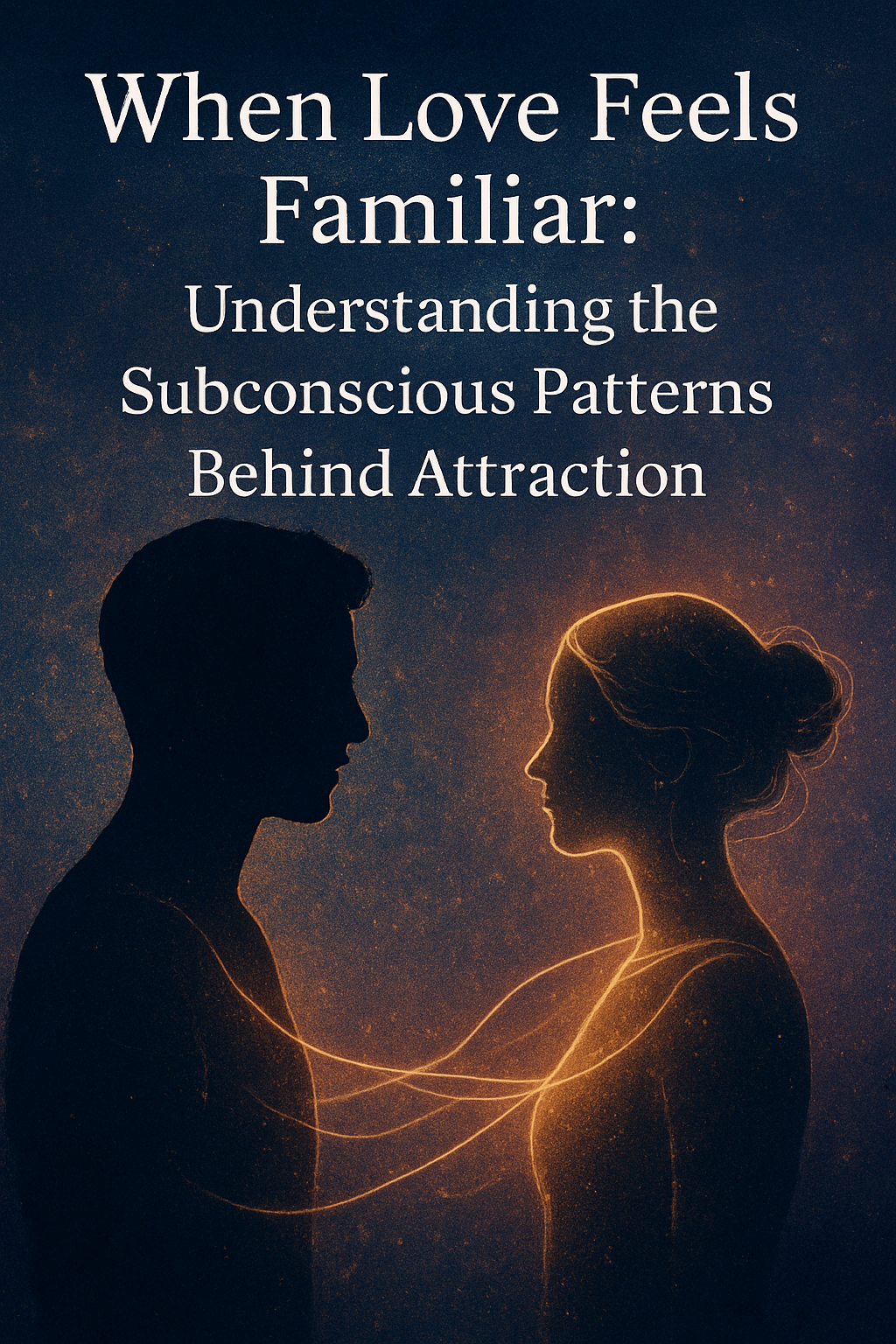 We like to believe we’re fully in control of our decisions — that each choice we make is born of conscious reasoning, logic, or even intuition. But beneath the surface of our awareness lies a vast network of memories, impressions, and emotional imprints that quietly influence almost everything we do. Each personal experience we’ve ever had — especially the emotionally charged ones — leaves a mark in the subconscious mind. Over time, these marks form into conditions, shaping our perceptions, preferences, and even the people we’re drawn to. In truth, we’re not as free as we think. We are, in many ways, walking reflections of our conditioning. Take attraction, for instance. Have you ever wondered why you keep falling for the same type of person, even after realizing that type may not be healthy for you? You may tell yourself, “I’m going to choose differently this time,” yet somehow you end up replaying the same emotional movie with a different actor. That’s not coincidence — that’s your subconscious at work. It already decided what “love” should look and feel like long before your conscious mind got involved. Sometimes, that decision was made in childhood, through observing your parents’ relationship or experiencing certain emotional dynamics yourself. The mind then stores that familiar emotional pattern as comfort, even if it’s toxic. So when you meet someone new, your conscious mind might be scanning for compatibility, but your subconscious is quietly scanning for familiarity. It looks for cues — the tone of their voice, their body language, their scent, their energy. Just one small detail can act as a trigger, instantly recreating the emotional signature of what your subconscious recognizes as “home.” And there it is — that spark. That magnetic pull you can’t explain. You tell yourself it’s chemistry, or fate, or a sign from the universe. But more often than not, it’s a memory disguised as destiny. Let’s paint a real-life example. Imagine a woman named Maya. Her father was emotionally distant but charming in public — the kind of man who could make anyone laugh but never truly opened up at home. Growing up, Maya learned to equate love with earning attention, mistaking emotional unavailability for depth. Years later, she meets Alex — charismatic, magnetic, a little mysterious. From the first conversation, she feels that irresistible connection. “He feels familiar, like we have known each other for years.” she tells her friends, and indeed, he does. Not because he’s her soulmate, but because his mannerisms mirror the emotional rhythm she grew up with. Her subconscious recognizes the dance — a dance of chasing affection, of proving worth — and pulls her toward it. Meanwhile, her conscious mind might whisper, “Be careful, this feels like the last one,” but the subconscious has already taken the wheel. This is how conditioning runs our lives — not out of malice, but out of memory. The subconscious doesn’t care if something is good or bad for you; it only cares if it’s familiar. Breaking the Pattern Awareness is the only true liberation. But awareness doesn’t happen when we’re constantly exposed to triggers. That’s why changing environments can be so powerful. When you step away from the people, places, and patterns that keep stimulating old emotional programs, you give yourself a moment of silence — a space where you can finally hear your own thoughts. In that quiet, the pattern reveals itself. You start to notice what your subconscious reacts to — the type of energy you’re drawn to, the tones that stir emotion, the circumstances that make you feel small or alive. Changing environments doesn’t erase the conditioning, but it weakens its grip. It gives you the breathing room to see it clearly — to respond rather than react. Yet real transformation happens only when you turn toward your triggers, not away from them. When you observe a familiar pull arising and ask, “Why does this feel magnetic to me?” you bring what was hidden into the light. Because here’s the truth: once a trigger is fully understood, it loses its power. What was once automatic becomes a conscious choice. The Path Forward Healing, then, isn’t about avoiding the same mistakes — it’s about understanding why those mistakes felt right to begin with. The subconscious doesn’t need to be destroyed; it needs to be integrated. Its old programs dissolve in the light of awareness, in patient self-observation, and in choosing differently even when the old pattern calls your name. So the next time you feel that unexplainable attraction — that lightning bolt that feels like destiny — pause. Take a breath. Ask yourself: Does this person feel new, or do they feel familiar? If it feels like déjà vu, it might not be love calling. It might be your subconscious asking for closure. And if you can see that clearly, without judgment, you’ve already taken the first step toward freedom — not just from others, but from the invisible forces that once guided your every choice. Reflection Prompts for Awareness Take a few quiet minutes, maybe after meditation or journaling, and reflect on these questions. Don’t rush the answers — let them rise naturally from within you.
🕊️ Awareness is not about judging who you were — it’s about understanding why you were that way. Once you see the roots clearly, the soil of your mind becomes fertile for something new to grow.  Bay Bridge, San Francisco-Oakland, California, USA Growing Up Without Boundaries: My Personal Story Growing up in an authoritative household, I never really had the space to explore my own preferences. My mother made the decisions for me—what I should do, feel, and want. There was no room for my opinions. That pattern shaped me into someone incredibly easygoing—too easygoing, to the point where I didn’t know where I ended and others began. I became someone who just went along with whatever others wanted, thinking that was the path of least resistance. And sure, on one hand, it made me flexible and able to enjoy almost any situation. But the cost? I lost touch with what I wanted. The Cost of Not Having Boundaries I struggled with making decisions. I’d let others take the lead—not out of respect, but out of habit and fear of conflict. I didn’t speak up when something bothered me. And when people—often unknowingly—crossed lines I didn’t even know I had, I’d silently stew. I’d build resentment. And then, instead of addressing the issue, I’d retreat. I became passive-aggressive, slowly backing out of relationships without ever really explaining why. What Healthy Boundaries Really Mean It took me years to realize: boundaries aren’t walls to keep people out. They’re bridges to help others meet us where we are. But to even build that bridge, we have to know where we stand. Boundaries Are a Form of Self-Love and Self-Respect One of the most powerful truths I’ve learned is this: boundaries are not just about protecting yourself from others. They are acts of self-love and self-respect. When you set a boundary, you are sending a message to yourself and the world: "I matter. My feelings, my needs, and my energy deserve to be honored." This is not selfish—it’s sacred. Without boundaries, we give too much, we say yes when we mean no, we bend until we break. And slowly, we disconnect from ourselves. But when we start setting healthy limits, we rebuild that connection. We begin to treat ourselves the way we want others to treat us. And something beautiful happens: when we respect ourselves, others learn to respect us too. Setting boundaries isn’t just about making your life more peaceful—it’s about making your relationships more authentic. When people know what you need and where you stand, they can engage with you honestly, without guessing or overstepping. It’s not only a gift to yourself; it’s a gift to everyone you love. Loving yourself enough to set boundaries is one of the most courageous and compassionate things you can do—not just for you, but for everyone around you. Why Self-Awareness Comes First The first step to creating healthy personal boundaries is self-awareness. We can’t communicate what we need until we understand what makes us feel seen, respected, and safe. Sometimes, what we call a boundary is actually a wound—a sore spot from the past. If someone’s words or actions offend us, it’s worth asking: is this about them, or is it a reflection of something I haven’t healed yet? When we don't do that inner work, we risk setting boundaries based on fear, not freedom. We might end up pushing away the very experiences and people who could help us grow. Examples of Healthy vs. Unhealthy Boundaries That’s why I believe in healthy boundaries—those that are rooted in clarity, not confusion. Here are a few examples: Unhealthy Boundary: “I never let anyone get close to me because I don’t want to be hurt.” Healthy Boundary: “I take my time getting to know people and only open up when I feel emotionally safe.” Unhealthy Boundary: “If someone says something I don’t like, I cut them off immediately.” Healthy Boundary: “If something upsets me, I take a moment to reflect and then have a calm conversation about it.” Unhealthy Boundary: “I let people do whatever they want so I don’t cause drama.” Healthy Boundary: “I express my needs clearly and respectfully, knowing that honest communication builds stronger connections.” How to Communicate Boundaries Effectively Once you've done the inner work and become clear on what your boundaries are, the next step is learning how to express them in a way that is both firm and compassionate. Here are a few proven methods for communicating personal boundaries: 1. Use "I" Statements This helps reduce defensiveness and keeps the focus on your feelings.
2. Be Direct, Not Aggressive Kindness and firmness can coexist. Express your needs without attacking.
3. Set Clear Consequences Boundaries without consequences are just suggestions.
4. Repeat and Reinforce You might have to restate your boundary more than once.
Final Thoughts: Practice Makes Progress Boundaries aren’t about creating distance. They’re about creating clarity. They let others know how to love and respect us. And they teach us how to love and respect ourselves. So if you’ve struggled with boundaries like I have, be gentle with yourself. You’re not broken. You’re learning. Boundaries aren’t something you suddenly master—they’re something you practice. And the more you practice, the more your relationships—starting with the one you have with yourself—begin to thrive. Have you ever wondered why conflict seems inevitable with certain people in your life, especially family members? No matter how much you grow, they still treat you the way they always have—like the child, the troublemaker, or the person they once knew. This disconnect often leads to frustration, misunderstandings, and even emotional pain. The Root of Conflict: A Perception Gap Conflict often arises when who others think we are no longer matches who we have become. They interact with an outdated version of us, while we expect them to see and respect the person we are today. For example, a parent may still treat their adult child like they are incapable, simply because that’s how they remember them. Meanwhile, the child—now grown and independent—resents being treated that way. The result? Repeated arguments, emotional triggers, and a cycle of frustration. This dynamic isn’t just limited to parent-child relationships; it happens in friendships, romantic relationships, and even workplaces. The version of you that people hold in their minds is often based on past interactions, and unless something forces them to update their perception, they continue responding to you in the same old ways. Why People Struggle to See Our Growth People are naturally resistant to change—especially when it comes to relationships. Familiarity feels safe, even if the dynamic is unhealthy. When someone sees you differently, it forces them to question their role in the relationship. For example, a controlling parent might feel less needed if they acknowledge that their child has become independent. A long-time friend may feel threatened if they see you growing in ways they haven’t. A romantic partner may resist change because they fear losing the dynamic they once knew. Without realizing it, people may try to pull you back into old patterns not out of malice, but out of their own fears and insecurities. How We Keep Ourselves Stuck in Old Dynamics Even when we’ve grown, our reactions often reinforce the past version of us. If you’ve always argued with a parent who belittles you, reacting defensively only confirms their belief that you are still the same. If a friend still treats you like the reckless person you used to be, and you get frustrated instead of calmly correcting them, you feed their outdated perception. This is why it’s refreshing to meet new people. They see us as we are today—without the baggage of past interactions. But this doesn’t mean old relationships are doomed. They can be rekindled if both parties become aware of these dynamics. How to Shift the Relationship Dynamic 1. Understand Their Perception • Instead of assuming they are intentionally disrespecting you, recognize that they simply don’t see your growth yet. • Ask yourself: “What version of me do they see?” and “Why might they struggle to update that perception?” 2. Communicate Your Growth • You can’t expect people to just know you’ve changed. Show them through actions and words. • Example: Instead of saying, “I’m not a child anymore,” demonstrate it by handling situations with maturity and confidence. 3. Stop Reacting Like Your Old Self • When you react emotionally in a way that matches their outdated view of you, you reinforce it. • Instead, respond as your present self—with calmness, confidence, and clarity. 4. Give It Time • People don’t change their perceptions overnight. Consistently embody the new version of yourself, and eventually, they will have no choice but to recognize it. Final Thoughts Conflict in relationships isn’t always about who is right or wrong—it’s often about perception gaps. Your growth is real, but the people in your life may not see it yet. Instead of expecting them to automatically adjust, take responsibility for helping them see the new you. The more aware we are of these dynamics, the more power we have to break the cycle and create healthier, more fulfilling relationships.  I often go into nature to observe and learn. I immerse myself in the sounds of the wind rustling through the trees, the melodious chirping of birds, and the rhythmic flow of a nearby stream. It's a symphony that teaches me about the interconnectedness of all living things. We can practice the same thing when we go into a conversation with someone where we expect to listen and learn rather than to tell and teach. By adopting the mindset of genuine curiosity, open-mindedness, and humility, you create an environment that allows you to absorb new perspectives and expand your knowledge. You become receptive to different ideas and insights, recognizing that everyone has a unique experience and valuable insights to offer. This not only will contribute a consistent growth in every aspect of your life but also build many strong and genuine relationships with others. If we pay closer attention to nature/someone by listening and observing her we’d then learn more about nature/that person and build a closer bond with her. - Feelasoulphy  Sometimes we are afraid to look at ourselves in the mirror. Especially in the morning. The bed hair, the bags under the eyes, the new wrinkles showed up overnight, etc. Whatever it is it doesn’t make us feel good about ourselves. We know that before stepping out of the door we must make sure we look at our best. However, we can’t see ourselves unless we have a mirror. And we need a clean one to see clearly because a dirty mirror will not show us everything we need to see. In a healthy relationship, such as a friendship or a romantic relationship, the right partner will help us expose our weaknesses that we can’t detect on our own. This is very much like what a mirror does for our physical appearance but instead it reflects our inner self. Unfortunately, often times in order to bring these deep rooted issues to the surface there’s no better way than conflicts and confrontations; which may involve a lot of intense emotions from both sides. These emotions might be difficult to endure at the moment, however they can be great tools to help us achieve breakthroughs with those unresolved issues that are hindering our growth. Sometimes we may need more than one mirror to look at ourselves from different angles all at once. We need to find the mirrors that will display the true us, even though we might not like what we see at first, however I promise you that a clean mirror will show us exactly what we need to see. Otherwise, we would only be living in our own imaginations. Find the best/clearest mirrors you can find and be the best/clearest mirror you can be. And make sure you take good care of those mirrors and keep them clean to show your appreciations at all times because the better/cleaner the mirror the better you see yourself and your soul’s purposes. - FeelaSoulphy |
AuthorFeelasoulphy Categories
All
Archives
March 2026
|




 RSS Feed