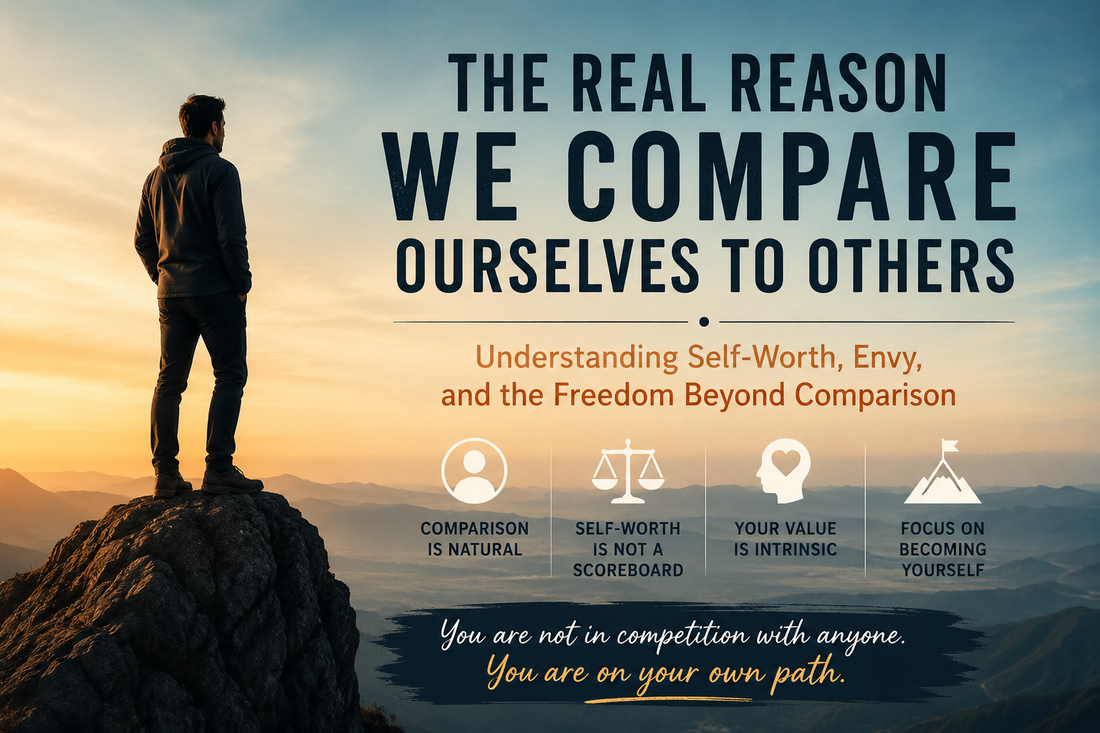
 Most people believe comparison is the problem. We hear phrases like: "Stop comparing yourself to others." "Stay in your own lane." "Comparison is the thief of joy." While these statements contain wisdom, they often fail to address the deeper issue. The truth is that comparison itself is not the problem. The real problem is what comparison threatens. For most of us, comparison threatens our sense of self-worth. Comparison Is Natural The human mind compares things constantly. It compares prices before making a purchase. It compares routes before taking a trip. It compares options before making decisions. Comparison is simply a mental tool. Without comparison, we would struggle to navigate everyday life. The problem begins when we stop comparing things and start comparing our value. Instead of observing differences, we begin measuring ourselves against others. Suddenly, comparison is no longer about information. It becomes about identity. The Hidden Equation Many people unconsciously live by an equation they never chose: Self-Worth = My Value Relative to Others The equation is rarely spoken aloud, but it quietly influences how we feel. If someone is more successful, we feel smaller. If someone is more attractive, we feel less desirable. If someone is wealthier, we feel less accomplished. If someone appears more enlightened, we feel less spiritual. The moment another person rises, our value appears to fall. But is that actually true? Consider two scenarios. In the first scenario, you earn $500,000 a year while everyone around you earns $100,000. In the second scenario, you earn $500,000 a year while everyone around you earns $5 million. Your income has not changed. Your life has not changed. Your achievements have not changed. Only your position within the social hierarchy has changed. Yet many people would feel more successful in the first scenario and less successful in the second. Why? Because the feeling of worth was never coming from the achievement itself. It was coming from comparison. What Is Self-Worth? This is where things become interesting. Most people spend their lives trying to increase their self-worth. But few stop to ask: What is self-worth? Can your worth actually increase? Can it decrease? Can another person's success diminish your value? Can another person's beauty make you less beautiful? Can another person's intelligence make you less intelligent? If your worth can be reduced simply because someone else possesses more of something, then your worth was never truly yours. It was dependent upon external conditions. It was conditional. And anything conditional can be taken away. The Endless Chase The ego loves comparison because comparison creates hierarchy. Hierarchy creates winners and losers. And if there are winners, then perhaps one day we can become one. This creates an endless pursuit. "I'll be worthy when I become successful." "I'll be worthy when I make more money." "I'll be worthy when people recognize me." "I'll be worthy when I find my purpose." "I'll be worthy when I become enlightened." Yet every time one goal is achieved, another appears. The finish line keeps moving. The person may become more accomplished, but they rarely become more whole. This is why some of the most successful people in the world still struggle with envy, insecurity, and self-doubt. They improved their position in the hierarchy but never questioned the hierarchy itself. What Comparison Is Really Protecting When comparison hurts, it is usually protecting an identity. It is protecting a story about who we believe we are. When someone else's success triggers us, we can ask: What am I making this mean about me? Often the answer reveals the deeper fear. Perhaps we fear being insignificant. Perhaps we fear being left behind. Perhaps we fear not being enough. Perhaps we fear that our value depends on being exceptional. Comparison is not creating these fears. It is exposing them. The discomfort we feel is often an invitation to investigate the foundation upon which our identity is built. A Different Way of Living Imagine asking a different question. Instead of: "Am I better than others?" Ask: "Am I becoming more fully myself?" The first question creates competition. The second creates growth. The first depends on what others are doing. The second depends on what you are doing. The first produces envy. The second produces fulfillment. A rose does not compare itself to an oak tree. A mountain does not compare itself to the ocean. Each expresses its nature completely. Neither gains value by becoming the other. Human beings often suffer because we forget this. We spend so much time trying to become someone else that we never fully become ourselves. The End of Envy Many people want to eliminate envy. But envy is often a symptom, not the cause. The cause is the belief that another person's success says something about our worth. Once that belief dissolves, envy begins to lose its foundation. What remains is something entirely different. Admiration instead of jealousy. Inspiration instead of resentment. Appreciation instead of competition. You can witness greatness without feeling diminished by it. You can celebrate another person's success without questioning your own value. You can appreciate beauty without feeling less beautiful. You can honor another person's gifts without denying your own. A Question Worth Contemplating If you were the only person on Earth, would you still have worth? If the answer is yes, then your worth cannot come from comparison. And if your worth does not come from comparison, then comparison loses its power to threaten you. Perhaps freedom is not found in eliminating comparison. Perhaps freedom is found in realizing that your value was never dependent on comparison in the first place.
0 Comments
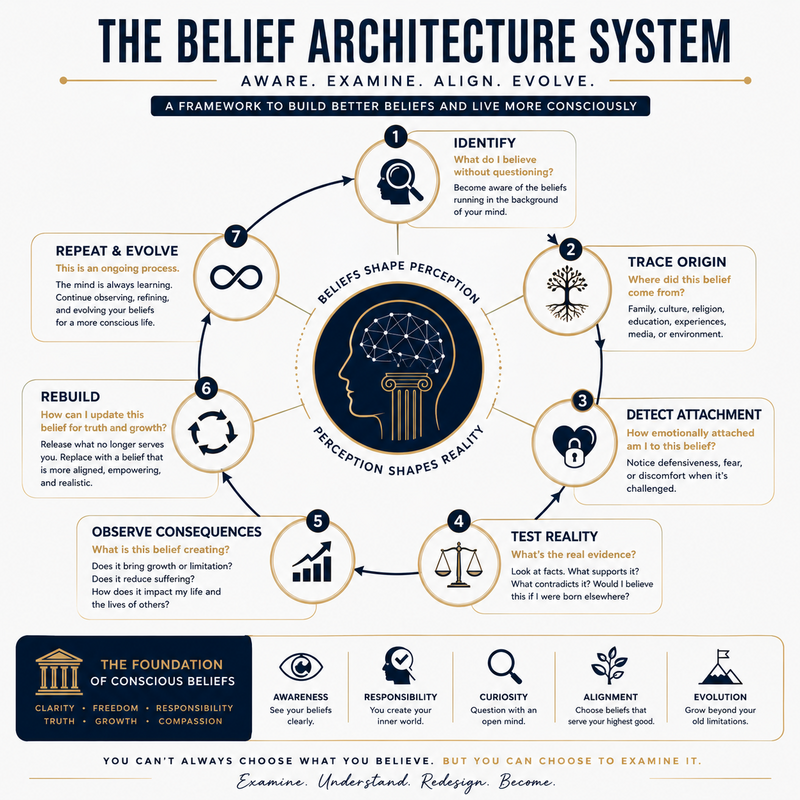 The Belief Achitecture System (BAS) Most people assume their beliefs are their own. But if you observe closely, something unsettling becomes clear: A large portion of what we call “personal belief” is inherited conditioning that we never consciously examined. From family, culture, religion, education, media, and lived experience—we absorb frameworks of meaning long before we are aware enough to question them. In that sense, we do not begin life by thinking. We begin life by absorbing. And what we absorb becomes the invisible architecture of perception. Beliefs Are Not Just Thoughts — They Are Operating Systems A belief is not simply an idea in the mind. It is a filter through which reality is interpreted. It influences:
Most importantly, beliefs do not announce themselves. They operate silently in the background, shaping behavior while remaining largely invisible to the thinker. This is why two people can experience the same event and walk away with completely different realities. They are not seeing reality directly. They are seeing it through belief systems. The Illusion of “My Beliefs” We often say: “these are my beliefs” But the word my deserves closer inspection. How many of these beliefs were actually chosen consciously? How many were:
Even beliefs we think we arrived at independently are often built on earlier assumptions we never questioned. True originality of belief is rare. Most belief is inheritance layered upon inheritance. When Beliefs Become Identity The most important transformation in human psychology happens when belief becomes identity. At that point: “I believe this” becomes “This is who I am.” And once belief becomes identity, it stops being flexible. Because now, to question the belief feels like questioning the self. This is why people become defensive, emotional, or even hostile when core beliefs are challenged. They are no longer protecting an idea. They are protecting their identity structure and the foundation upon which they have built their lives. To them, the collapse of that belief system may feel like a threat to their very existence. This is also where human growth often slows down. Because identity resists change even when reality demands it. Collective Belief: When Mind Becomes Culture Beliefs do not only operate individually. When shared across groups, they scale into something far more powerful: collective consciousness. Collective belief is what creates:
For example, a company like Coca-Cola is not just selling a drink. It is selling a shared emotional association:
Over time, repeated exposure turns meaning into perceived reality. People do not just consume the product. They consume the story attached to it. And that story becomes self-reinforcing because millions of people agree on it simultaneously. This is the essence of collective belief: When enough minds agree on a meaning, that meaning begins to function as reality. For good or for harm, this mechanism scales everything in human civilization. A Simple Personal Example: Conditioned Preference For years, I held a simple belief: Pizza and hamburgers “needed” Coca-Cola. Not because I consciously decided this. But because my mind learned a pattern: greasy food → Coke → satisfaction The carbonation, sweetness, and sensory contrast reinforced the experience. Repetition solidified the association. Eventually, it stopped feeling like a preference. It felt like the correct pairing. But nothing about that pairing was objectively necessary. It was learned. This is important because it reveals something deeper: If even taste can be conditioned… then what else in life is operating on unexamined conditioning? The Belief Architecture System (BAS) If beliefs shape perception, and perception shapes reality, then beliefs must be examined like a system—not blindly followed. Here is a simple framework: 1. Identify What do I believe without questioning? 2. Trace Origin Where did this belief come from? 3. Detect Attachment Do I become emotional when this belief is challenged? 4. Test Reality What evidence supports or contradicts it? 5. Observe Consequences Does this belief create expansion or limitation in my life? 6. Rebuild Update the belief without ego attachment. 7. Repeat Because the mind is always learning—whether we are aware of it or not. Why This Matters Most people do not suffer because they think incorrectly. They suffer because they never examine the system behind their thinking. An unconscious belief is not just an idea. It is a program running the mind. And unexamined programs eventually become lived reality. The goal is not to eliminate beliefs. That is impossible. The goal is to transform belief from unconscious inheritance into conscious design. Because once a belief is seen clearly, it stops controlling you in the same way. And at that point, something fundamental changes: You are no longer just a product of inherited perception. You become an active participant in how perception is formed. Closing Reflection The deepest question is not: “What do I believe?” But rather: “Which beliefs am I currently living inside without knowing it?” Because the moment that question becomes real… the architecture of the mind begins to reveal itself. And once you see the architecture, you are no longer fully trapped inside it. 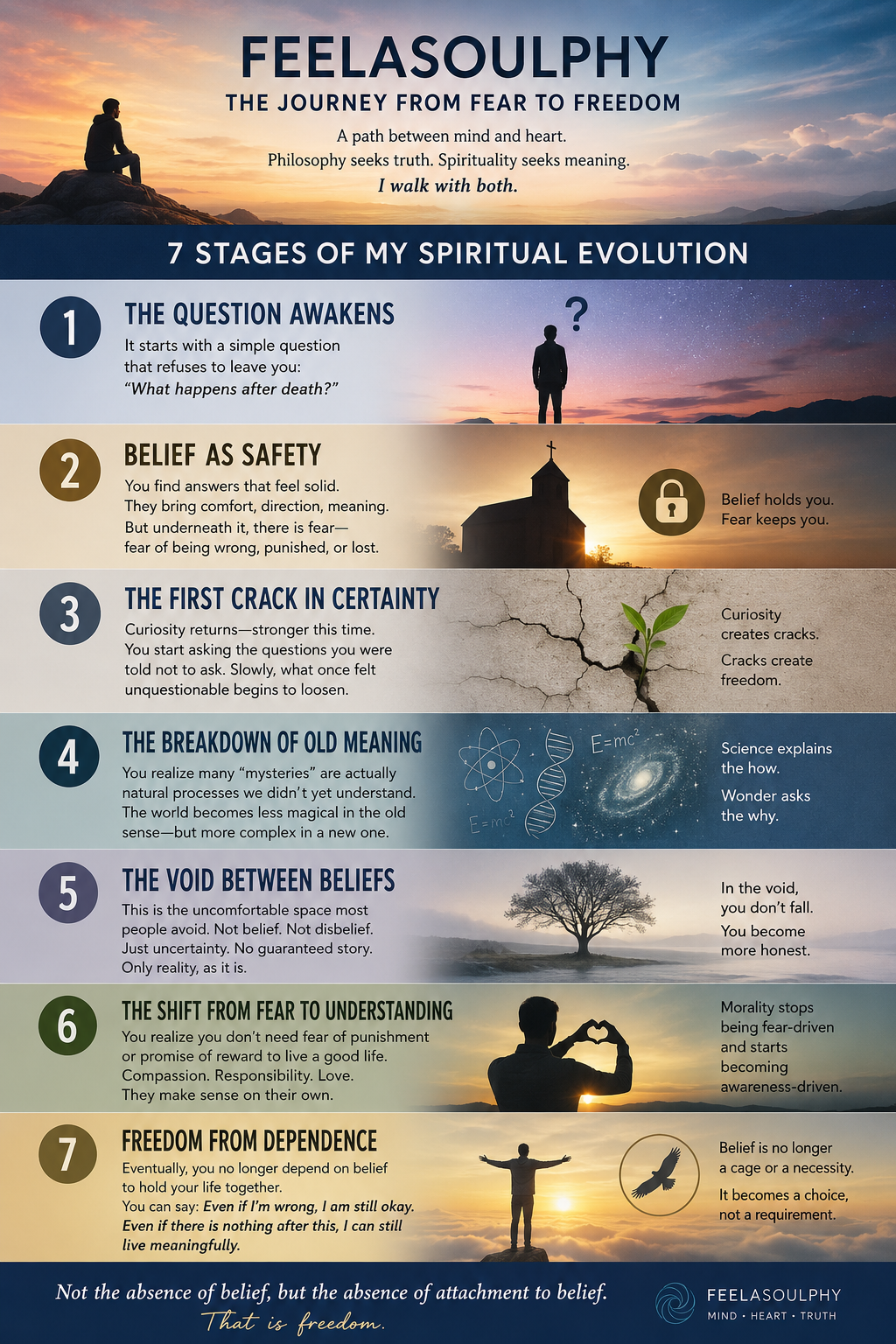 7 Stages of My Spiritual Evolution...To Be Continued... There was a time when I believed life could be neatly categorized. Philosophy belonged to the mind. Spirituality belonged to the heart. One searched for truth through logic, questioning, and reason. The other trusted intuition, meaning, and unseen connection. For a long time, I treated them as separate worlds. Almost like two different languages trying to describe existence. But life doesn’t stay in boxes for long. And neither did I. The Early Search: Fear Disguised as Faith My journey didn’t begin in clarity. It began in curiosity — and uncertainty about what happens after death. That question, once planted, doesn’t leave quietly. It grows into others: What is real? What is God? What is truth? What happens when we die? Eventually, I found myself inside Christianity. And for a while, it gave structure to the unknown. It gave answers where there were none. It gave direction where I felt lost. But underneath it, there was something I didn’t fully recognize at the time: fear. Fear of punishment. Fear of being wrong. Fear of what happens if belief collapses. And fear is a powerful teacher — but not always a truthful one. It can shape belief into something rigid, something protective rather than something alive. At some point, I started to notice that my relationship with belief wasn’t fully free. It was anchored in consequences, not understanding. And once you see that, you can’t unsee it. The Breaking Open: Science, Philosophy, and Unraveling Certainty “Did God create us in His image, or did we create God in ours?” And perhaps beneath both lies an even deeper question: “Did God create us… or did we create God?” - Feelasoulphy The next stage of my journey was not spiritual at all — at least not in the traditional sense. It was analytical. I began studying science, philosophy, and research around consciousness. I explored near-death experiences, reincarnation theories, and scientific perspectives on spirituality. Not to reinforce belief — but to challenge it. Slowly, the world I once saw as “miraculous” became increasingly explainable. The mechanisms of life, the brain, perception, evolution — all of it revealed patterns that didn’t require supernatural explanation. And something shifted in me. I started realizing that many things once attributed to God were actually natural processes we had not yet understood. But instead of closing the mystery, this opened a different one: Even if we understand how something works… we still don’t fully understand why anything exists at all. Science explains mechanisms. But it does not fully explain existence itself. That realization didn’t push me back into certainty. It pushed me deeper into humility. The Transition: Letting Belief Stop Being a Crutch Over time, something unexpected happened. My need for belief as emotional security began to fade. I stopped needing a specific story about what happens after death in order to live meaningfully now. That was a turning point. I reached a place where I could say: Even if there is no God… Even if there is no afterlife… I can still live a good, conscious, and meaningful life. Not because I was forcing myself to be strong — but because I genuinely understood why compassion, love, and responsibility matter. Not from fear. Not from reward. But from clarity. And when belief is no longer required to behave well, something subtle happens inside a person. The mind becomes lighter. The heart becomes less defended. And truth becomes less threatening. The Shift: From Dependency to Freedom At some point, I realized I no longer depended on belief in God or the afterlife to guide my actions. And that changed everything. Because belief stopped being a psychological structure holding me together. It became something I could examine freely. I was no longer afraid of my worldview collapsing. I was no longer attached to it as identity. I could question it, challenge it, even let it dissolve — and I would still be okay. That is when I first felt something I can only describe as freedom. Not freedom from meaning. But freedom from fear-based meaning. Feelasoulphy: A Middle Path This is where the idea of Feelasoulphy emerged for me. A bridge between:
Not as a contradiction — but as integration. Because I’ve come to see that philosophy without feeling becomes empty abstraction. And spirituality without inquiry becomes fragile belief. We are not meant to live in only one half of ourselves. We are meant to become whole. Fear-Based Belief vs Freedom-Based Belief One of the clearest distinctions I’ve learned is this: There is a kind of belief that is built on fear:
And there is a kind of belief — or perhaps a way of being — that is built on freedom:
Fear-based belief needs certainty to feel safe. Freedom-based understanding can hold uncertainty without collapsing. That difference changes everything. The Question I Keep Returning To I don’t claim to know what happens after death. I don’t claim to fully understand consciousness or the origin of reality. But I also no longer need those answers to live well. And maybe that is the real shift. Not from belief to disbelief. But from dependence to independence. And from independence… to a quieter possibility: That perhaps meaning is not something we receive from certainty, but something we embody through awareness. Where I Am Now Today, I feel something simple but profound: I am okay not knowing. Not in resignation — but in openness. I can explore spirituality without needing it to be “true in the ultimate sense.” I can study science without needing it to erase mystery. I can live ethically without needing fear as motivation. And most importantly, I can question everything — without losing myself in the process. That, to me, is freedom. Not the absence of belief. But the absence of attachment to belief. And in that space… life feels strangely more real than ever.  Some people thrive on ambition and achievement, while others feel strangely unmotivated by goals that once seemed meaningful. If you’re highly self-aware, this isn’t a flaw—it’s a signal. As awareness deepens, ego-driven motivation begins to collapse, and the effort behind achievement suddenly feels heavier than the reward. This article explores why high awareness can kill motivation, the hidden difference between ego-based striving and truth-driven expression, and how alignment—not ambition—becomes the real force that moves you forward. Why Some People Don’t Feel the Weight of Work Some people don’t seem to mind the work it takes to achieve in life. They push, grind, build, chase—and they often accomplish a lot. That’s because most achievement is ego-driven. The ego runs on:
Effort feels invisible when the ego is excited. Why Awareness Changes Everything As awareness increases, the illusion weakens. You begin to see:
So when a new project or desire appears, you don’t just see the starting point—you see the entire arc: effort → achievement → short-lived high → restlessness → another goal. And a quiet question emerges: Why start something that won’t actually fulfill me? This hesitation isn’t laziness. It’s clarity. Why It Felt Easier When You Were Younger When you’re younger, desire is simpler. You want something, you work for it, you get it, you feel better—at least for a while. The emotional return feels worth the effort, so you don’t even register the work involved. Back then:
The spell is broken. Ego-Driven Action vs Truth-Driven Expression This is the distinction most people never learn to make. Ego-Driven Action
Even when successful, it often leaves a subtle emptiness. Something feels off—because the action wasn’t aligned with your deepest belief. It was aligned with maintaining an identity. Truth-Driven Expression
When you act from truth, you operate from your pure belief system, not the ego. For example: If I’m honest with myself and recognize that buying a new piece of clothing is purely to satisfy my ego, that awareness changes the choice. Now I hold a clean belief: This is ego-driven. If I go through with it anyway, it feels like subtle self-betrayal—disalignment. But if I honor that belief and choose differently, I experience integrity. Truth creates alignment. Ego creates performance. Why You Hesitate to Start Once you’ve tasted alignment, ego goals feel heavy. You don’t resist work. You resist work that isn’t true. You’re no longer motivated by:
You’re moved by:
And aligned action, while often quieter, feels clean. Self-Reflection: Are You Unmotivated or Just Done With Illusion? Ask yourself—honestly:
These questions require brutal honesty. Without it, clarity gets mislabeled as laziness. The Provocative Truth High awareness kills ego motivation. That’s the price of seeing clearly. Once you recognize the cycle—effort, achievement, dissatisfaction—you can’t unknow it. And when ego stops driving you, nothing external can push you anymore. Now only alignment moves you. That’s dangerous. Because when you can’t lie to yourself, you’re left with two options:
Most people go back to chasing. Very few choose alignment—because it demands honesty over ambition. And once you see the difference, there’s no going back.  (Part of The Story Series) Introduction: Why This Story Matters We don’t just tell ourselves stories about who we are or about the people in our lives. We also hold a powerful story about the world itself. Is it safe or dangerous? Friendly or hostile? Full of opportunity or scarcity? Evolving or falling apart? Most of us rarely realize how deeply these beliefs shape not just our choices, but the very reality we participate in creating. “The world we see is a reflection of how we see it.” How It Works in the Mind Your worldview acts like the largest filter of all — the lens through which you interpret everything.
What’s even more important: your personal worldview doesn’t just stay with you. It spreads to those you influence — friends, family, community. Collectively, our worldviews become the shared story that actually drives history. Historic Examples War Through Story Think of leaders who convinced entire nations that their survival required hating another group.
It all began with a story about the world: “They are dangerous. We must destroy them to survive.” Belief Shapes Discovery In contrast:
The collective view literally changed the map. Personal Example Maybe your parents taught you: “The world is a dangerous place. Don’t trust anyone.” Even if they meant to protect you, you might have lived decades with fear, guardedness, and missed opportunities for connection. Or perhaps you were taught: “The world is full of possibilities. People are mostly good.” This story probably made you more open, curious, and willing to try new things. Why It Matters So Much Your worldview doesn’t just stay in your head. It drives your behavior. It influences others. It becomes self-fulfilling. If enough people see the world as hopeless, they stop trying to improve it. If enough people see the world as capable of change, they act — and the world changes. Analogy: The Collective Mirror Imagine humanity standing before a giant mirror. What we see reflected back isn’t objective reality, but the sum of what we believe about the world. If billions see hostility, they behave defensively — and the world becomes hostile. If billions see possibility, they build bridges, invent, heal, and evolve. Good and Bad Stories About the World Good Examples:
Your Reflection Practice Pick a quiet time and write honestly about these prompts:
Your Assignment
Remember: Changing your story about the world is one way you help change the world itself. Closing Thought “We don’t see the world as it is, we see it as we are.” You have the power to choose how you see — and how you help shape what the world becomes. The story you hold isn’t just for you. It’s part of the story we all share. Let’s make it one worth living in. Read: Part 1: The Story We Tell About Ourselves Part 2: The Story We Tell About Others 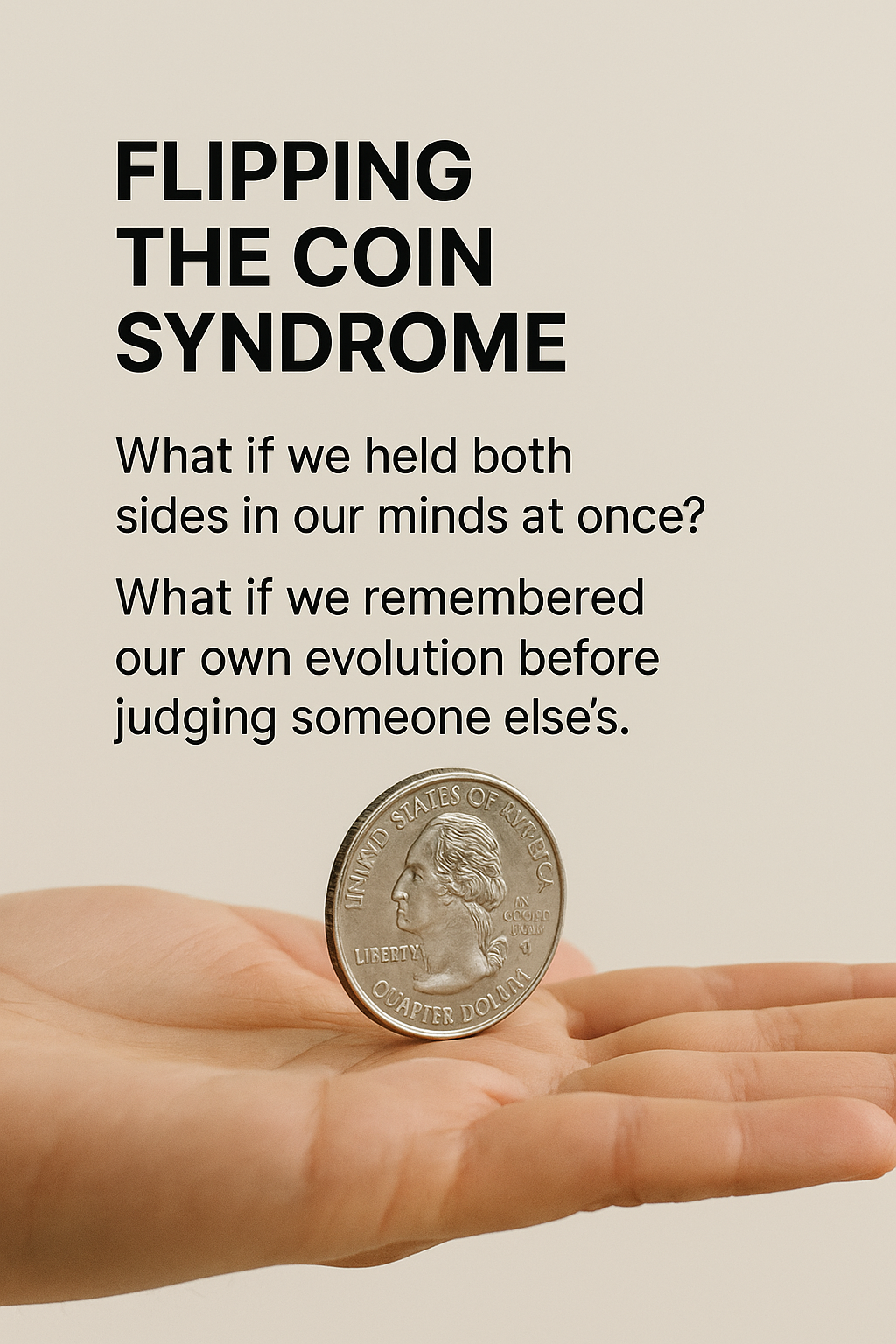 Have you ever noticed how easy it is to forget what you once believed? We humans have a strange habit I call “Flipping the Coin Syndrome.” We treat our beliefs like a coin in our hand. When we’re staring at one side—the side we now agree with—it feels like the only truth. We forget that the other side even exists. When we learn something new, it’s as if the old belief evaporates. We distance ourselves from it. We disown it. And then, ironically, we often start judging anyone who still holds that old view—as if we were never like them. We forget that the coin still has two sides. Think about it:
In all these cases, the judgment carries a kind of convenient amnesia. It’s as if we want to deny the simple truth that we once stood exactly where they’re standing now. Why do we do this? Perhaps because it’s uncomfortable to hold both sides of the coin in our mind at once. To admit that both perspectives have a reality to them. That our past self wasn’t simply “wrong,” but growing. That the people we’re judging are simply in process, just like we are. We prefer certainty. Simplicity. The security of believing: “Now I’m right. Then I was wrong.” “I’m enlightened. They’re lost.” But reality is rarely so neat. The Cost of Forgetting When we forget the other side of the coin, we don’t just lose empathy for others. We lose humility. We lose the chance to see ourselves as travelers on a path rather than owners of the truth. We also close the door on learning even more. Because what if the side we’re dismissing still has something to teach us? Holding Both Sides What if, instead, we practiced remembering? Remembering where we used to be. Remembering that growth is messy and slow. Remembering that certainty can be a cage. Imagine looking at someone you’re tempted to judge and asking: “What did it feel like to see the world the way they do?” “What did I need when I was there?” “How would I have wanted someone to treat me?” That’s not weakness. It’s wisdom. An Invitation We don’t have to flatten complexity. We can hold it. We can remember both sides of the coin at once. We can let our past selves humble us. We can let other people’s current struggles soften us. We can be firm in our values without forgetting our own evolution. Judgment shrinks the world. Compassion expands it. If you find yourself flipping the coin today, try holding it steady in your palm. Look at both sides. See the whole picture. You might find that truth is bigger than you thought. What’s a belief you’ve changed your mind about? How do you treat people who still hold the view you used to? |
AuthorFeelasoulphy Categories
All
Archives
March 2026
|
 RSS Feed