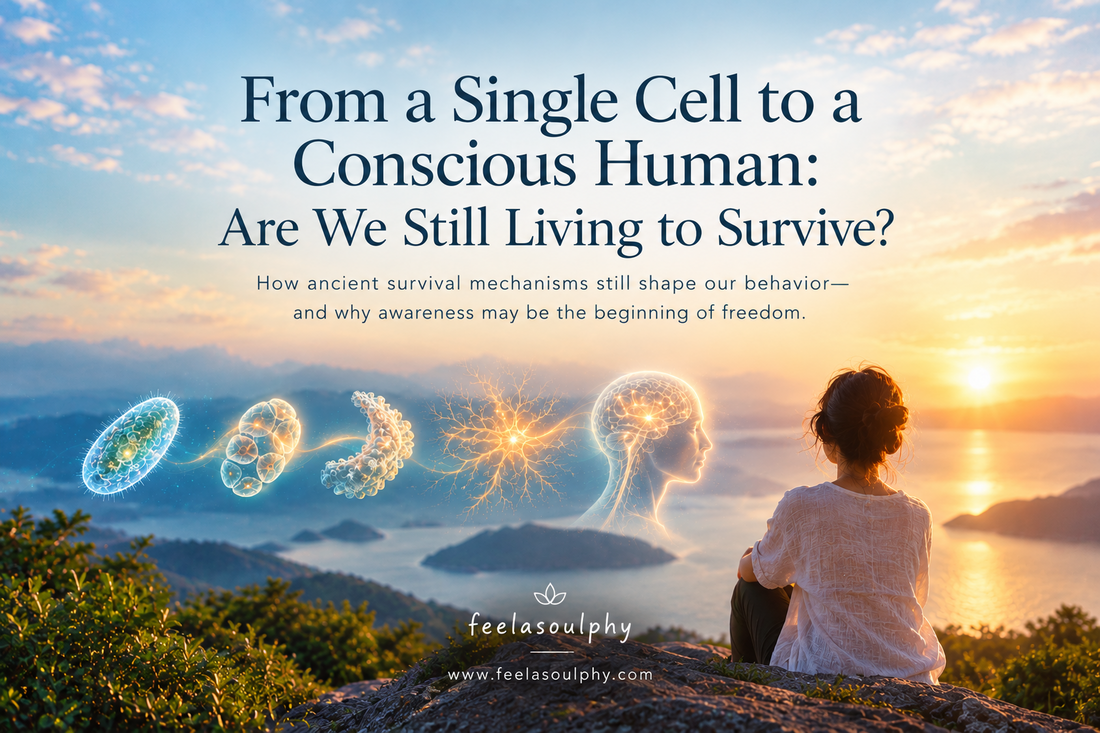
 How ancient survival mechanisms still shape our behavior—and why awareness may be the beginning of freedom. Imagine the first living organism on Earth. No language. No philosophy. No concept of tomorrow. No understanding of death. No question about the meaning of existence. Perhaps it was nothing more than a tiny single-celled organism surrounded by an environment it could barely “understand.” And yet, it had one fundamental problem: it had to keep itself alive.
It had to obtain what sustained it and avoid what damaged it. It didn't need to think about survival; its biology simply responded to its environment. Something beneficial? Move toward it. Something harmful? Move away. Something threatening? Protect itself. There was no meditation between stimulus and response and no philosophical debate. There was simply: Stimulus → Response And that simple relationship became part of the foundation of an extraordinary evolutionary journey. How Did Life Become Better at Surviving? There is an important part of evolution that is easy to misunderstand. When we say an organism “developed” a trait that made it better at surviving, we don't mean the organism consciously decided that it needed a new skill. Evolution doesn't work that way. One of the key ingredients is variation. Individuals within a population are not genetically identical. When organisms reproduce, differences can arise through mutations, recombination, and other biological processes. Most differences may have little consequence. Some may be harmful. Some may happen to be beneficial under particular environmental conditions. Imagine a population of primitive cells living in an environment where nutrients are concentrated in one direction. Suppose one cell happens to have an inherited difference that makes it slightly better at detecting or moving toward those nutrients. That cell has a small advantage. It may obtain more energy, survive longer, and reproduce more successfully. Its descendants inherit that characteristic, while further variation continues to occur. Generation after generation, characteristics that improve survival or reproduction can become more common. The organism didn't consciously learn the trait. The environment filtered the variation. In simplified form: Variation → Selection → Inheritance → Adaptation This process repeated across enormous stretches of time, and life became extraordinarily sophisticated at one thing: survival. From Survival to the Human Brain Over time, organisms evolved increasingly sophisticated ways of sensing and responding to their environments. Then came nervous systems, increasingly complex brains, memory, learning, prediction, emotion, social behavior, and thought. Eventually came humans. But here's the strange thing: the original problem never completely disappeared. We still need food. We still avoid danger. We still seek shelter. We still protect ourselves. We still compete for resources. We still seek connection and belonging. What changed was the sophistication of the machinery—and the environment in which it operates. A single cell might respond to a chemical signal. A human being can respond to an insult. An animal may defend its territory. A human may defend an opinion. An animal may compete for food. A human may compete for wealth, status, recognition, beauty, influence, or social position. The stimulus has changed. The fundamental survival logic has not. And that may explain something fascinating about human behavior: we can be living in an environment that is dramatically safer than the one our ancestors faced while still carrying a nervous system shaped by a very different world. We May Be More Primitive Than We Think Consider something people commonly admire: a person who can deliver a brilliant comeback immediately after being insulted. We might call that person quick-witted, sharp, confident, or strong. And perhaps they are. But why can a fast comeback feel so satisfying? Underneath the sophistication may be an ancient social calculation: “I can defend myself.” In a primitive social environment, responding effectively to aggression could have mattered enormously. Being unable to defend yourself could make you vulnerable. Over time, the expression of defense became more sophisticated. The physical confrontation can become a verbal confrontation. The weapon becomes the argument. The territory becomes reputation. Physical dominance becomes social status. And the instinct remains: “Don't allow yourself to be dominated.” Today, two people can sit safely behind their phones, hundreds or thousands of miles apart, exchanging clever insults. There may be no physical danger whatsoever, yet something inside us can still respond as though something important is at stake. And we may even reward the behavior by saying, “Damn, that comeback was good.” Maybe it was. But it is worth asking: What exactly are we admiring? Are we admiring intelligence and humor, or are we unconsciously admiring someone's ability to defend their psychological territory? Sometimes it may be both. Ancient Survival in Modern Attraction Consider another example. People can be attracted to partners who appear capable of protecting themselves and others. Physical strength can communicate, at a very basic level, “This person can defend us.” But in the modern world, protection doesn't necessarily mean physical strength. It can mean emotional stability, financial competence, confidence, intelligence, social skill, leadership, or the ability to remain calm under pressure and solve problems. The underlying question may still be remarkably ancient: “Can this person handle danger and uncertainty?” In a primitive environment, physical strength could provide an obvious survival advantage. In modern society, the qualities associated with security may be distributed across many different characteristics. This doesn't mean every human preference can be reduced to survival. Human attraction is far too complex for that. But it is worth recognizing how much of what we admire may still carry echoes of our evolutionary past. The expression has changed. The fundamental need for safety and security has not. The Problem Isn't Survival We shouldn't demonize our survival mechanisms. They are extraordinary. They helped keep our ancestors alive, and they still protect us every day. If a car suddenly comes toward you, you don't want to stop and contemplate the metaphysics of transportation. You want to move. Survival mechanisms are useful. The problem isn't that we have survival mechanisms. The problem is that we can become so identified with them that we mistake their reactions for our choices. Someone criticizes you, and your body tightens. You become defensive and feel the urge to strike back. Someone succeeds, and you compare yourself. Someone rejects you, and you withdraw. Your future becomes uncertain, and you worry. Someone challenges your beliefs, and you feel threatened. The ancient question, “Is this safe or dangerous?”, has gradually become, “Does this threaten me?” And “me” can mean much more than our physical body. It can mean our ego, our reputation, our beliefs, our possessions, our relationships, our future, our sense of control, or even our idea of who we think we are. We can spend decades responding to life without ever stopping to ask: “Why am I responding this way?” The Space Between Reaction and Choice This is where being human becomes particularly interesting. A single cell encounters a stimulus and responds according to its biological machinery. Humans have developed something extraordinary: we can observe our own reactions. You can become angry and notice, “I am angry.” You can feel fear and notice, “I am afraid.” You can experience jealousy and notice, “I am feeling jealous.” You can feel the urge to defend yourself and notice, “Something in me wants to defend my identity.” That tiny act of observation creates space. And within that space, something remarkable becomes possible: Choice. Consider two people receiving the same criticism. The first person experiences: Criticism → anger → defense → attack The second experiences: Criticism → anger → awareness → reflection → choice The second person still feels anger. They haven't transcended biology, and they haven't become emotionless. They have simply become aware of what is happening inside them. They may still choose to respond firmly, but the response is no longer necessarily dictated by the first impulse. This is where conscious living begins—not when we stop having emotions, not when we stop experiencing fear, and not when we eliminate our survival instincts, but when we become sufficiently aware of them that we don't automatically obey them. There is a difference between saying, “I am angry,” and recognizing, “Anger is arising in me.” There is a difference between, “I'm afraid,” and, “Fear is present right now.” There is also a difference between, “They disrespected me,” and, “I am experiencing a strong interpretation that I have been disrespected.” The second versions create psychological space, and psychological space creates the possibility of choice. This doesn't mean we should suppress emotions or endlessly analyze every reaction. Sometimes the appropriate response is immediate. Sometimes anger is useful. Sometimes fear is correct. Sometimes you need to defend yourself. Consciousness does not mean becoming passive. It means becoming aware enough to distinguish: “I am choosing this response.” from: “My conditioning chose it for me.” What Do Highly Conscious People Do Differently? Throughout history, contemplative traditions have described people who appear remarkably difficult to provoke. We can also find examples among highly trained meditators, martial artists, therapists, philosophers, and others who have spent years observing their own minds. Does this mean they no longer experience emotion? Not necessarily. There is an important distinction between feeling an emotion and being controlled by an emotion. A person may experience anger without becoming anger. They may experience fear without becoming paralyzed. They may experience pain without immediately turning it into resentment. They may recognize aggression without automatically returning aggression. One possible reason is that deeper awareness can change how an event is interpreted. Imagine someone insults you. Your unconscious mind may interpret it as, “This person is attacking me.” Your identity becomes threatened, and your survival machinery activates. But someone with greater awareness may recognize: “This person is acting from their own conditioning, insecurity, fear, or pain.” The insult is still heard. The behavior may still be unacceptable. But the psychological meaning can change. And when the perceived threat changes, the emotional response can change with it. This doesn't mean such a person becomes passive. Equanimity is not weakness. A conscious person can still establish boundaries. They can walk away. They can say no. They can defend themselves. And if physical danger is real, they can act decisively. The difference is that their action doesn't necessarily come from blind emotional reactivity. They may respond from clarity rather than compulsion. That is a very different kind of strength. Perhaps This Is Part of Human Evolution Biological evolution operates across generations. But humans possess another form of evolution: conscious development. We can observe our patterns, question our assumptions, examine our conditioning, learn new responses, become less reactive, and expand our capacity to tolerate uncertainty. We can recognize when our survival machinery is responding to a psychological threat rather than a physical one. We can choose values over impulses. And perhaps most importantly, we can become aware of the machinery itself. The single cell simply responds to its environment. The animal can learn from its environment. The human can reflect upon its experience. And the conscious human can potentially say: “I see what is happening inside me. I don't have to become it.” Perhaps this is part of what human evolution can mean: from reaction to awareness, from awareness to choice, and from choice to intentional living. You Are Not Your Survival Mechanisms You will still experience fear. You will still experience anger. You will still want approval. You will still feel scarcity. You will still become defensive. You will still sometimes react unconsciously. That's okay. The goal isn't perfection. The goal is to catch yourself a little earlier. Perhaps yesterday you reacted for an hour before becoming aware of what was happening. Tomorrow you notice it after thirty minutes. Eventually, you notice it after five minutes, then perhaps after thirty seconds. And one day, you notice the reaction beginning. That moment of noticing is progress. You are no longer completely lost inside the reaction; you are observing it. And when you can observe something, you have begun creating a relationship with it rather than being completely controlled by it. Catch the Cell For the next seven days, try a simple experiment. You don't need to meditate for an hour or use any special equipment. You simply need to notice. Whenever you experience a strong emotional reaction, pause and take one slow breath. Then ask yourself four questions. What happened? Describe the event without interpretation. For example, “They didn't respond to my message.” Not, “They are ignoring me because they don't care.” Separate the event from the story. What am I feeling? Name the emotion: anger, fear, jealousy, shame, sadness, anxiety, excitement—whatever is actually present. What is my survival system trying to protect? Ask, “What feels threatened right now?” Is it your physical safety, your money, your relationship, your status, your identity, your need to be right, your sense of control, or your need to be accepted? This question can reveal a tremendous amount about ourselves. Finally, ask: What response would I choose if I didn't have to react immediately? Don't ask only, “What do I feel like doing?” Ask, “What do I consciously choose to do?” Then wait. You don't always need to act immediately. Sometimes the most conscious response is no response at all. Notice. Pause. Choose. You can reduce the entire practice to three words: Notice. Pause. Choose. Notice the reaction. Pause before acting. Choose your response. Do this repeatedly and you begin to discover something extraordinary: you are not as free as you may have assumed—but you are also not as trapped as you may have believed. Much of your behavior has been shaped by biology, conditioning, memories, experiences, culture, fears, beliefs, and unconscious patterns. But awareness allows you to see those forces. And what you can see, you can begin to work with. Perhaps that is what conscious evolution really means—not becoming something other than human, but becoming more conscious of the human being you already are. The single cell's primary question was: “How do I survive?” Perhaps humanity's next question is: “Now that I am alive, how do I choose to live?” And perhaps the deepest form of freedom isn't having no conditioning. Perhaps freedom is becoming conscious enough of our conditioning that it no longer automatically determines what we do next. To truly experience free will, perhaps we must first learn to live consciously.
0 Comments
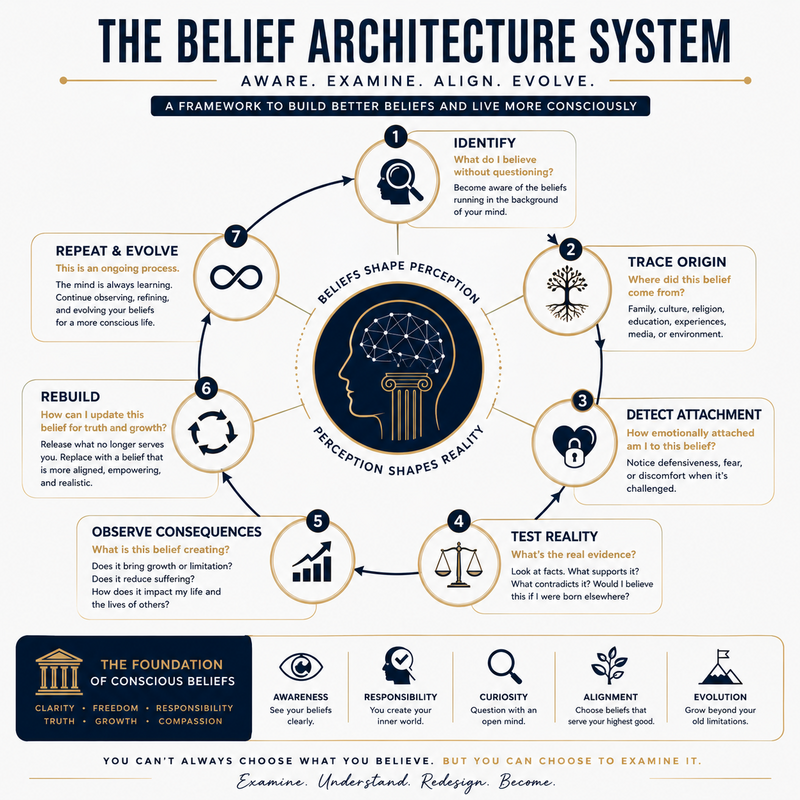 The Belief Achitecture System (BAS) Most people assume their beliefs are their own. But if you observe closely, something unsettling becomes clear: A large portion of what we call “personal belief” is inherited conditioning that we never consciously examined. From family, culture, religion, education, media, and lived experience—we absorb frameworks of meaning long before we are aware enough to question them. In that sense, we do not begin life by thinking. We begin life by absorbing. And what we absorb becomes the invisible architecture of perception. Beliefs Are Not Just Thoughts — They Are Operating Systems A belief is not simply an idea in the mind. It is a filter through which reality is interpreted. It influences:
Most importantly, beliefs do not announce themselves. They operate silently in the background, shaping behavior while remaining largely invisible to the thinker. This is why two people can experience the same event and walk away with completely different realities. They are not seeing reality directly. They are seeing it through belief systems. The Illusion of “My Beliefs” We often say: “these are my beliefs” But the word my deserves closer inspection. How many of these beliefs were actually chosen consciously? How many were:
Even beliefs we think we arrived at independently are often built on earlier assumptions we never questioned. True originality of belief is rare. Most belief is inheritance layered upon inheritance. When Beliefs Become Identity The most important transformation in human psychology happens when belief becomes identity. At that point: “I believe this” becomes “This is who I am.” And once belief becomes identity, it stops being flexible. Because now, to question the belief feels like questioning the self. This is why people become defensive, emotional, or even hostile when core beliefs are challenged. They are no longer protecting an idea. They are protecting their identity structure and the foundation upon which they have built their lives. To them, the collapse of that belief system may feel like a threat to their very existence. This is also where human growth often slows down. Because identity resists change even when reality demands it. Collective Belief: When Mind Becomes Culture Beliefs do not only operate individually. When shared across groups, they scale into something far more powerful: collective consciousness. Collective belief is what creates:
For example, a company like Coca-Cola is not just selling a drink. It is selling a shared emotional association:
Over time, repeated exposure turns meaning into perceived reality. People do not just consume the product. They consume the story attached to it. And that story becomes self-reinforcing because millions of people agree on it simultaneously. This is the essence of collective belief: When enough minds agree on a meaning, that meaning begins to function as reality. For good or for harm, this mechanism scales everything in human civilization. A Simple Personal Example: Conditioned Preference For years, I held a simple belief: Pizza and hamburgers “needed” Coca-Cola. Not because I consciously decided this. But because my mind learned a pattern: greasy food → Coke → satisfaction The carbonation, sweetness, and sensory contrast reinforced the experience. Repetition solidified the association. Eventually, it stopped feeling like a preference. It felt like the correct pairing. But nothing about that pairing was objectively necessary. It was learned. This is important because it reveals something deeper: If even taste can be conditioned… then what else in life is operating on unexamined conditioning? The Belief Architecture System (BAS) If beliefs shape perception, and perception shapes reality, then beliefs must be examined like a system—not blindly followed. Here is a simple framework: 1. Identify What do I believe without questioning? 2. Trace Origin Where did this belief come from? 3. Detect Attachment Do I become emotional when this belief is challenged? 4. Test Reality What evidence supports or contradicts it? 5. Observe Consequences Does this belief create expansion or limitation in my life? 6. Rebuild Update the belief without ego attachment. 7. Repeat Because the mind is always learning—whether we are aware of it or not. Why This Matters Most people do not suffer because they think incorrectly. They suffer because they never examine the system behind their thinking. An unconscious belief is not just an idea. It is a program running the mind. And unexamined programs eventually become lived reality. The goal is not to eliminate beliefs. That is impossible. The goal is to transform belief from unconscious inheritance into conscious design. Because once a belief is seen clearly, it stops controlling you in the same way. And at that point, something fundamental changes: You are no longer just a product of inherited perception. You become an active participant in how perception is formed. Closing Reflection The deepest question is not: “What do I believe?” But rather: “Which beliefs am I currently living inside without knowing it?” Because the moment that question becomes real… the architecture of the mind begins to reveal itself. And once you see the architecture, you are no longer fully trapped inside it. 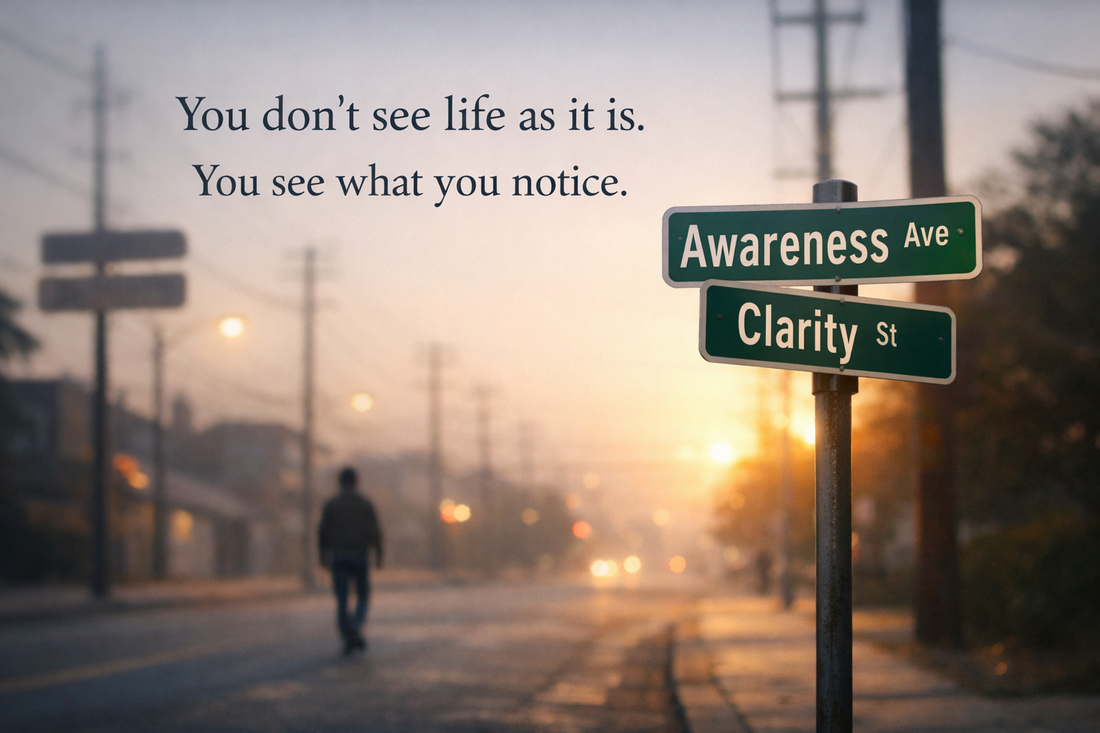 Most people don’t live bad lives. They live unconscious ones. We don’t experience reality as it is--we experience what we pay attention to. Everything else disappears into the background, not because it isn’t there, but because our awareness never stops to notice it. I realized this through a simple experiment. I’ve lived in the same neighborhood for sixteen years, yet I still don’t know the names of some of the cross streets near my home. When I finally slowed down and intentionally paid attention, I remembered the street names immediately. This wasn’t a memory problem. It was an attention problem. That insight opened a larger question: if I can overlook something so basic for years, how many important aspects of my life have I also missed--patterns, emotions, beliefs, opportunities--simply because I wasn’t paying attention? Why Most People Live Unconsciously Living unconsciously isn’t a moral failure. It’s a biological strategy. The brain is designed to conserve energy. Awareness takes effort. Questioning takes effort. So the mind defaults to automation. Our experience of life is shaped by what we attend to. Attention acts as a filter--what passes through becomes our reality. Most people don’t consciously choose that filter. Instead, it’s shaped by:
Over time, this creates a narrow version of reality that feels complete but isn’t. Research in psychology supports this. Daniel Kahneman showed that much of human behavior operates on fast, automatic thinking. We don’t actively choose most of our thoughts--we repeat them. Efficiency keeps us functioning. But it also keeps us asleep. The Hidden Cost of Unconscious Living When we don’t pay attention:
The problem isn’t suffering. The problem is not noticing the cause of suffering. An unconscious life isn’t empty--but it’s limited. Awareness Is Not a Personality Trait--It’s a Skill Here’s the good news: awareness isn’t something you either have or don’t have. It’s a skill. I didn’t need years of meditation or a spiritual retreat to notice the street names. I simply directed my attention deliberately for a moment. That single act revealed something important: unconscious living isn’t permanent. It’s a default setting. Every moment of noticing--your breath, your tension, your thoughts, your reactions--is a small interruption in that default. How Attention Changes Your Life Your life doesn’t change when circumstances change. It changes when attention changes. Most people try to fix their lives by changing external conditions. Fewer people realize that shifting attention alters perception, behavior, and ultimately identity. When you begin to observe instead of react:
This isn’t abstract philosophy. It’s practical awareness. A Simple Practice to Live More Consciously Start small. Pick one ordinary thing today and pay full attention to it--your walk, your breathing, a conversation, the environment around you. No analysis. Just noticing. Then ask yourself: What else in my life have I been moving past without seeing? That question alone begins to wake you up. Final Thought Most people aren’t unconscious because they’re incapable of awareness. They’re unconscious because they were never taught that attention shapes reality. Once you see this, you can’t unsee it. And the real question becomes: What kind of life unfolds when you notice on purpose? 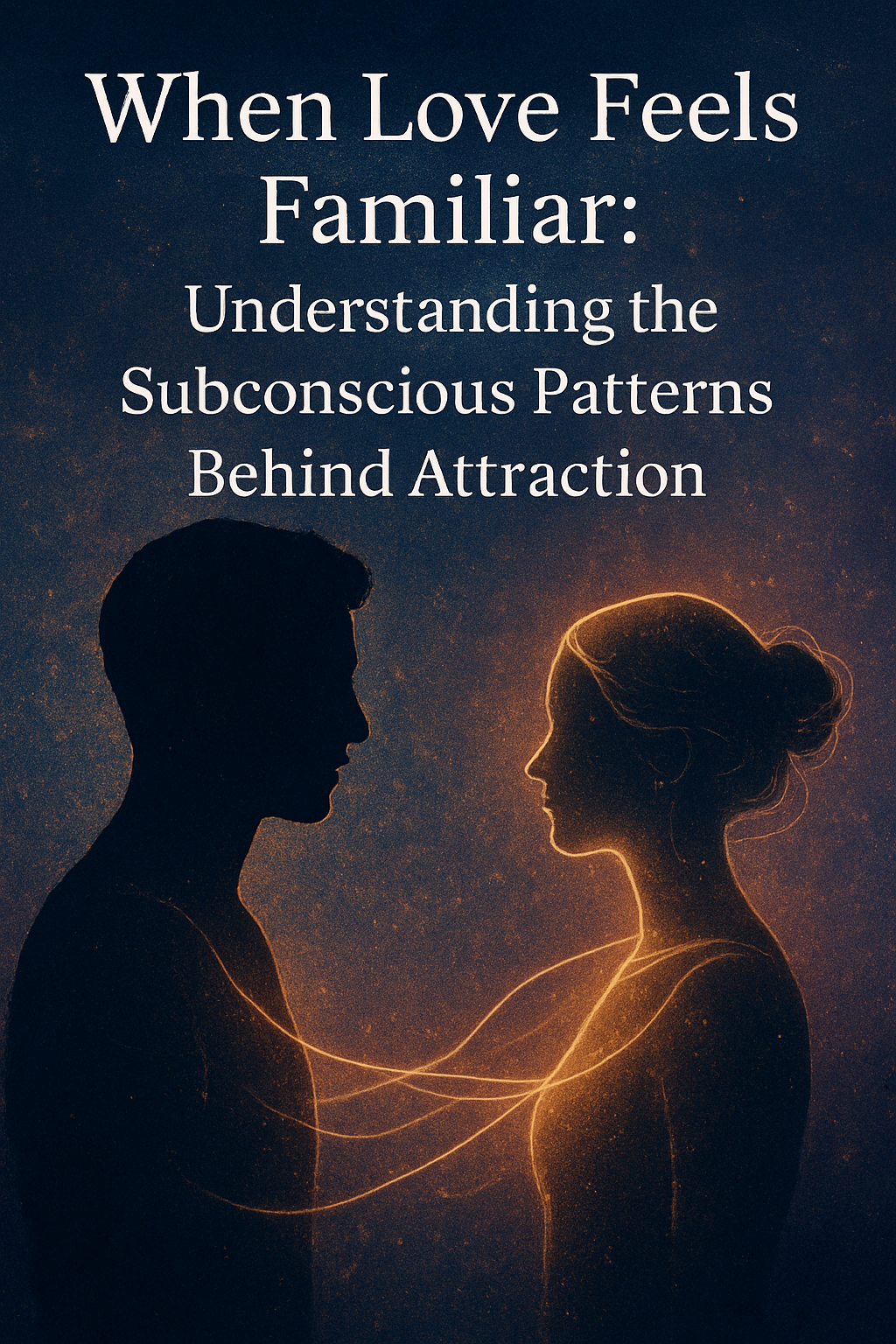 We like to believe we’re fully in control of our decisions — that each choice we make is born of conscious reasoning, logic, or even intuition. But beneath the surface of our awareness lies a vast network of memories, impressions, and emotional imprints that quietly influence almost everything we do. Each personal experience we’ve ever had — especially the emotionally charged ones — leaves a mark in the subconscious mind. Over time, these marks form into conditions, shaping our perceptions, preferences, and even the people we’re drawn to. In truth, we’re not as free as we think. We are, in many ways, walking reflections of our conditioning. Take attraction, for instance. Have you ever wondered why you keep falling for the same type of person, even after realizing that type may not be healthy for you? You may tell yourself, “I’m going to choose differently this time,” yet somehow you end up replaying the same emotional movie with a different actor. That’s not coincidence — that’s your subconscious at work. It already decided what “love” should look and feel like long before your conscious mind got involved. Sometimes, that decision was made in childhood, through observing your parents’ relationship or experiencing certain emotional dynamics yourself. The mind then stores that familiar emotional pattern as comfort, even if it’s toxic. So when you meet someone new, your conscious mind might be scanning for compatibility, but your subconscious is quietly scanning for familiarity. It looks for cues — the tone of their voice, their body language, their scent, their energy. Just one small detail can act as a trigger, instantly recreating the emotional signature of what your subconscious recognizes as “home.” And there it is — that spark. That magnetic pull you can’t explain. You tell yourself it’s chemistry, or fate, or a sign from the universe. But more often than not, it’s a memory disguised as destiny. Let’s paint a real-life example. Imagine a woman named Maya. Her father was emotionally distant but charming in public — the kind of man who could make anyone laugh but never truly opened up at home. Growing up, Maya learned to equate love with earning attention, mistaking emotional unavailability for depth. Years later, she meets Alex — charismatic, magnetic, a little mysterious. From the first conversation, she feels that irresistible connection. “He feels familiar, like we have known each other for years.” she tells her friends, and indeed, he does. Not because he’s her soulmate, but because his mannerisms mirror the emotional rhythm she grew up with. Her subconscious recognizes the dance — a dance of chasing affection, of proving worth — and pulls her toward it. Meanwhile, her conscious mind might whisper, “Be careful, this feels like the last one,” but the subconscious has already taken the wheel. This is how conditioning runs our lives — not out of malice, but out of memory. The subconscious doesn’t care if something is good or bad for you; it only cares if it’s familiar. Breaking the Pattern Awareness is the only true liberation. But awareness doesn’t happen when we’re constantly exposed to triggers. That’s why changing environments can be so powerful. When you step away from the people, places, and patterns that keep stimulating old emotional programs, you give yourself a moment of silence — a space where you can finally hear your own thoughts. In that quiet, the pattern reveals itself. You start to notice what your subconscious reacts to — the type of energy you’re drawn to, the tones that stir emotion, the circumstances that make you feel small or alive. Changing environments doesn’t erase the conditioning, but it weakens its grip. It gives you the breathing room to see it clearly — to respond rather than react. Yet real transformation happens only when you turn toward your triggers, not away from them. When you observe a familiar pull arising and ask, “Why does this feel magnetic to me?” you bring what was hidden into the light. Because here’s the truth: once a trigger is fully understood, it loses its power. What was once automatic becomes a conscious choice. The Path Forward Healing, then, isn’t about avoiding the same mistakes — it’s about understanding why those mistakes felt right to begin with. The subconscious doesn’t need to be destroyed; it needs to be integrated. Its old programs dissolve in the light of awareness, in patient self-observation, and in choosing differently even when the old pattern calls your name. So the next time you feel that unexplainable attraction — that lightning bolt that feels like destiny — pause. Take a breath. Ask yourself: Does this person feel new, or do they feel familiar? If it feels like déjà vu, it might not be love calling. It might be your subconscious asking for closure. And if you can see that clearly, without judgment, you’ve already taken the first step toward freedom — not just from others, but from the invisible forces that once guided your every choice. Reflection Prompts for Awareness Take a few quiet minutes, maybe after meditation or journaling, and reflect on these questions. Don’t rush the answers — let them rise naturally from within you.
🕊️ Awareness is not about judging who you were — it’s about understanding why you were that way. Once you see the roots clearly, the soil of your mind becomes fertile for something new to grow. |
AuthorFeelasoulphy Categories
All
Archives
March 2026
|
 RSS Feed