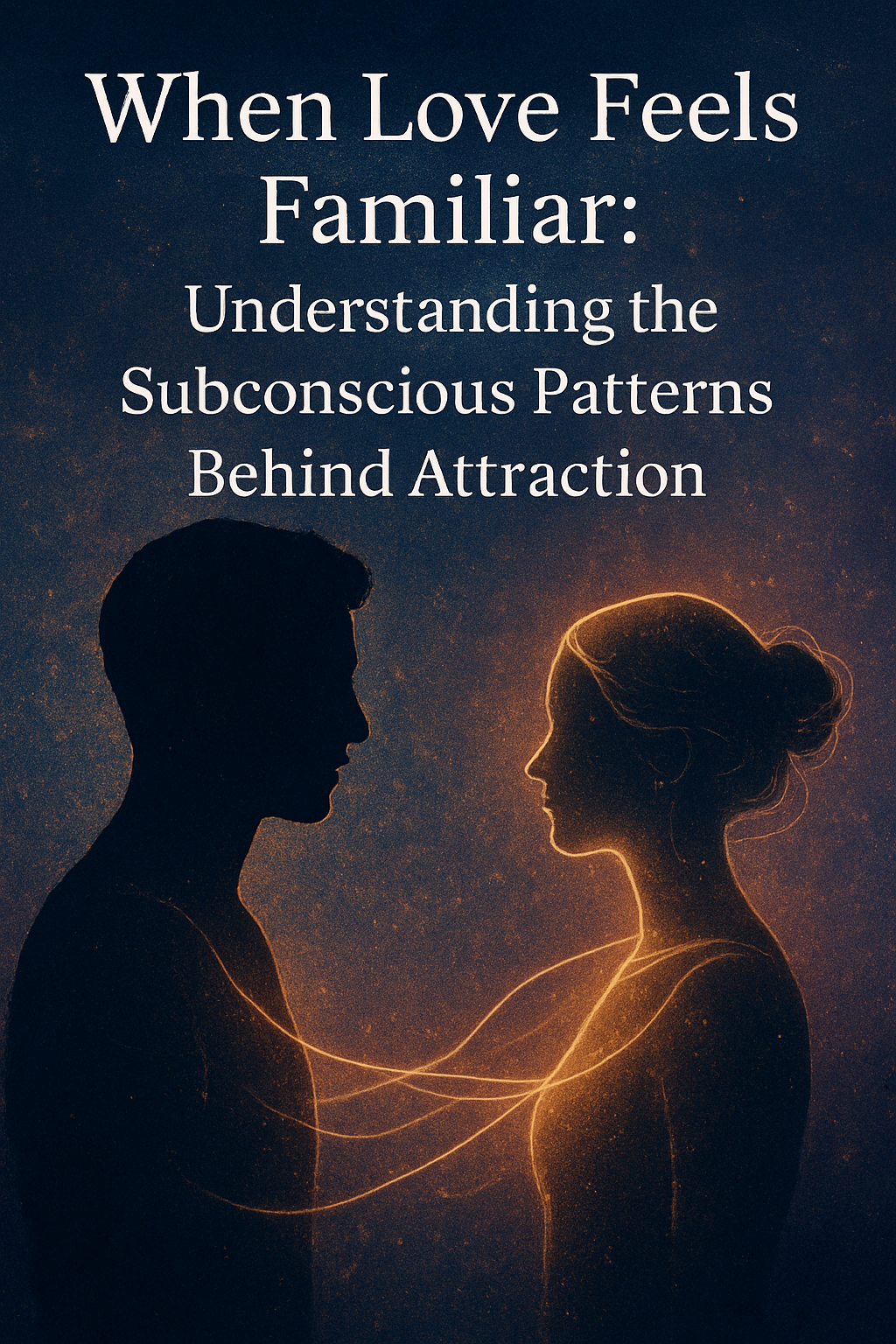
 We like to believe we’re fully in control of our decisions — that each choice we make is born of conscious reasoning, logic, or even intuition. But beneath the surface of our awareness lies a vast network of memories, impressions, and emotional imprints that quietly influence almost everything we do. Each personal experience we’ve ever had — especially the emotionally charged ones — leaves a mark in the subconscious mind. Over time, these marks form into conditions, shaping our perceptions, preferences, and even the people we’re drawn to. In truth, we’re not as free as we think. We are, in many ways, walking reflections of our conditioning. Take attraction, for instance. Have you ever wondered why you keep falling for the same type of person, even after realizing that type may not be healthy for you? You may tell yourself, “I’m going to choose differently this time,” yet somehow you end up replaying the same emotional movie with a different actor. That’s not coincidence — that’s your subconscious at work. It already decided what “love” should look and feel like long before your conscious mind got involved. Sometimes, that decision was made in childhood, through observing your parents’ relationship or experiencing certain emotional dynamics yourself. The mind then stores that familiar emotional pattern as comfort, even if it’s toxic. So when you meet someone new, your conscious mind might be scanning for compatibility, but your subconscious is quietly scanning for familiarity. It looks for cues — the tone of their voice, their body language, their scent, their energy. Just one small detail can act as a trigger, instantly recreating the emotional signature of what your subconscious recognizes as “home.” And there it is — that spark. That magnetic pull you can’t explain. You tell yourself it’s chemistry, or fate, or a sign from the universe. But more often than not, it’s a memory disguised as destiny. Let’s paint a real-life example. Imagine a woman named Maya. Her father was emotionally distant but charming in public — the kind of man who could make anyone laugh but never truly opened up at home. Growing up, Maya learned to equate love with earning attention, mistaking emotional unavailability for depth. Years later, she meets Alex — charismatic, magnetic, a little mysterious. From the first conversation, she feels that irresistible connection. “He feels familiar, like we have known each other for years.” she tells her friends, and indeed, he does. Not because he’s her soulmate, but because his mannerisms mirror the emotional rhythm she grew up with. Her subconscious recognizes the dance — a dance of chasing affection, of proving worth — and pulls her toward it. Meanwhile, her conscious mind might whisper, “Be careful, this feels like the last one,” but the subconscious has already taken the wheel. This is how conditioning runs our lives — not out of malice, but out of memory. The subconscious doesn’t care if something is good or bad for you; it only cares if it’s familiar. Breaking the Pattern Awareness is the only true liberation. But awareness doesn’t happen when we’re constantly exposed to triggers. That’s why changing environments can be so powerful. When you step away from the people, places, and patterns that keep stimulating old emotional programs, you give yourself a moment of silence — a space where you can finally hear your own thoughts. In that quiet, the pattern reveals itself. You start to notice what your subconscious reacts to — the type of energy you’re drawn to, the tones that stir emotion, the circumstances that make you feel small or alive. Changing environments doesn’t erase the conditioning, but it weakens its grip. It gives you the breathing room to see it clearly — to respond rather than react. Yet real transformation happens only when you turn toward your triggers, not away from them. When you observe a familiar pull arising and ask, “Why does this feel magnetic to me?” you bring what was hidden into the light. Because here’s the truth: once a trigger is fully understood, it loses its power. What was once automatic becomes a conscious choice. The Path Forward Healing, then, isn’t about avoiding the same mistakes — it’s about understanding why those mistakes felt right to begin with. The subconscious doesn’t need to be destroyed; it needs to be integrated. Its old programs dissolve in the light of awareness, in patient self-observation, and in choosing differently even when the old pattern calls your name. So the next time you feel that unexplainable attraction — that lightning bolt that feels like destiny — pause. Take a breath. Ask yourself: Does this person feel new, or do they feel familiar? If it feels like déjà vu, it might not be love calling. It might be your subconscious asking for closure. And if you can see that clearly, without judgment, you’ve already taken the first step toward freedom — not just from others, but from the invisible forces that once guided your every choice. Reflection Prompts for Awareness Take a few quiet minutes, maybe after meditation or journaling, and reflect on these questions. Don’t rush the answers — let them rise naturally from within you.
🕊️ Awareness is not about judging who you were — it’s about understanding why you were that way. Once you see the roots clearly, the soil of your mind becomes fertile for something new to grow.
0 Comments
Leave a Reply. |
AuthorFeelasoulphy Categories
All
Archives
May 2025
|
 RSS Feed