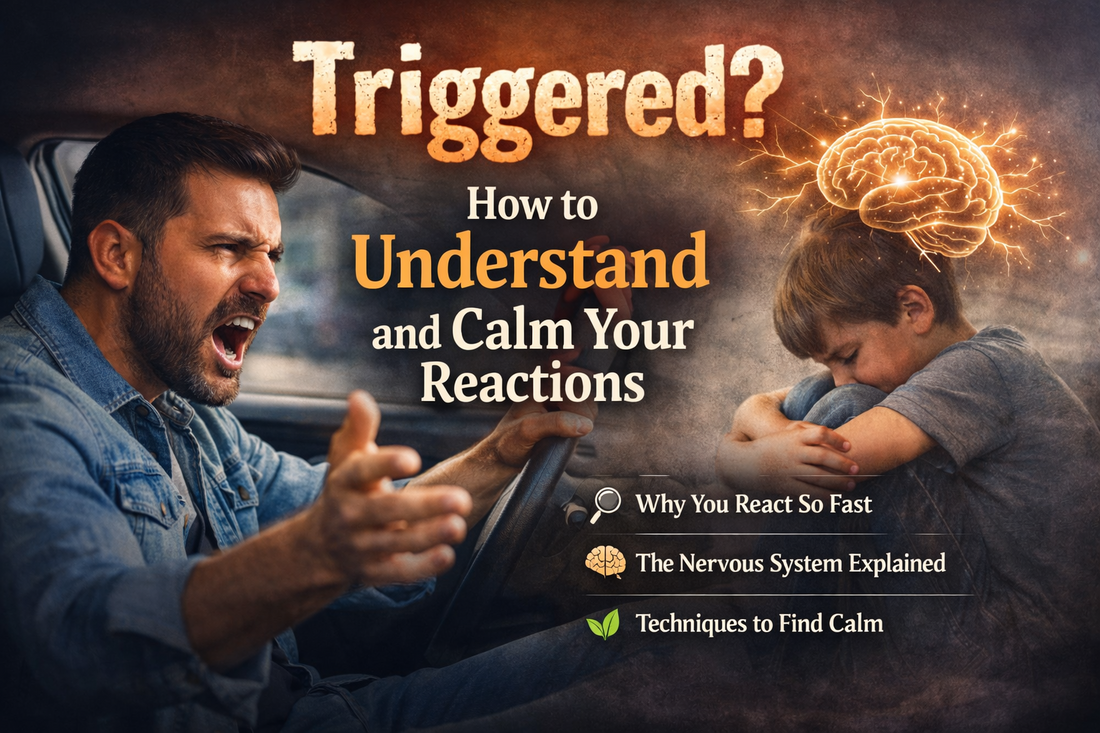
 "You don’t discover yourself when you’re peaceful. You discover yourself when something disturbs your peace." That moment when someone cuts you off… When your parent says that thing again… When a small inconvenience creates a big reaction… That is not random. That is revelation. Most people treat triggers as problems to suppress. But triggers are not interruptions. They are instructions. They show you exactly where your inner work lives. The nervous system: why this happens so fast Your nervous system is built for survival. Not for calm. Not for wisdom. Not for patience. When it senses a threat, it reacts before your thinking mind catches up. A tone. A look. A honk. A certain phrase. And your body goes: “Danger. Protect. Now.” That response can look like:
This is not weakness. This is conditioning. Your body learned somewhere along the way: “In moments like this, we react fast.” A simple truth most people miss Peace doesn’t expose you. Pressure does. When nothing is happening, you feel evolved. When something hits you, you see what is still raw. That reaction? It was not just the moment. It was memory. Pattern. Protection. Let’s break it down Every trigger has 3 layers: 1. The Story (Surface) “This person is rude.” “This shouldn’t be happening.” 2. The Emotion (Signal) Anger. Frustration. Defensiveness. 3. The Root (Truth) What actually got touched?
That is where the real work is. Real-life example You’re driving. Someone honks, speeds past, gives you a look. Instant reaction: “What the hell is his problem?!” But look deeper:
Now you are not dealing with a driver. You are dealing with a pattern. Another example Someone interrupts you. Surface: “They are disrespectful.” Deeper: “I’m not being heard.” Root: “My voice doesn’t matter.” Here’s the shift Instead of asking: “Why are they like this?” Ask: “Why did this affect me like that?” That question changes everything. A simple framework to use in real time 1. Catch it “Something just got activated.” 2. Name it “What am I feeling?” 3. Trace it “What does this remind me of?” 4. Identify the threat “What feels at risk? Respect? Control? Safety?” 5. Reframe it “Is this about them… or something in me?” How to calm yourself (this is where the real power is) You cannot always stop the first reaction. But you can regulate what happens next. If you catch it early (before or during) 1. Slow your breath (this is the fastest reset)
This tells your body: we are safe. 2. Relax your body on purpose
The body sends signals to the mind, not just the other way around. 3. Widen your awareness Instead of locking onto the trigger, zoom out:
You break the tunnel vision of the reaction. 4. Use a simple grounding thought Not something fancy. Something believable:
If the reaction already happened 1. Don’t fight it Adding judgment (“I shouldn’t react”) makes it worse. Let it pass through. 2. Shorten the recovery time That is the real growth. Minutes → seconds → moments. 3. Reset your body again Breath. Posture. Relaxation. You are teaching your nervous system a new ending. 4. Reflect later, not during Ask:
This is how you rewire. Questions to ask yourself
The uncomfortable truth You may not eliminate the first reaction. Your body is fast. But you can become someone who:
That is mastery. Final thought Your triggers are not your flaws. They are your unfinished lessons. Life will keep pressing the same buttons… Until you stop reacting and start understanding. That is when peace becomes real.
0 Comments
Leave a Reply. |
AuthorFeelasoulphy Categories
All
Archives
May 2025
|
 RSS Feed