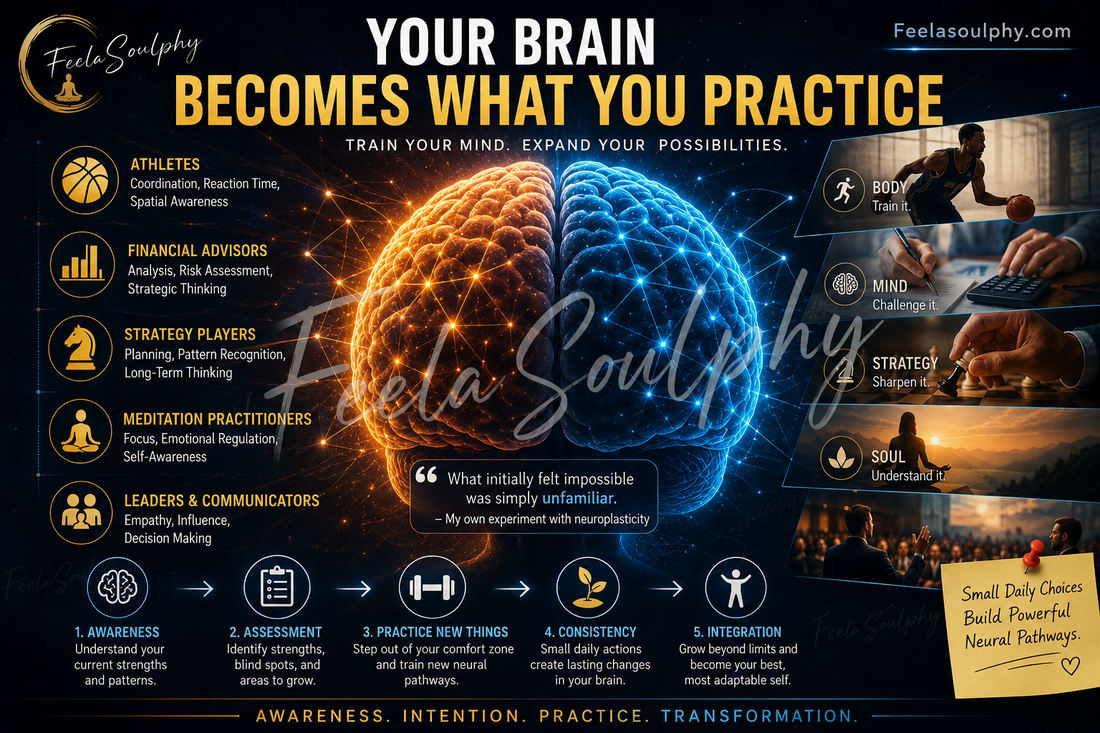
 Most people understand that exercise changes the body.
Far fewer realize that every activity they engage in changes the brain. Your profession, hobbies, routines, conversations, and even the thoughts you repeatedly think are strengthening specific neural pathways. Over time, those pathways become the lens through which you experience the world. In a very real sense, your brain becomes what you practice. The Hidden Specialization of the Human Brain A basketball player develops different neural pathways than an accountant. A musician develops different pathways than a soldier. A chess player develops different pathways than a meditation practitioner. This doesn't necessarily mean one person is more intelligent than another. It means their brains have become optimized for different functions. A financial advisor may quickly recognize risk, opportunity, and long-term consequences. A basketball player may instantly process movement, timing, and spatial relationships. A musician may hear subtle patterns and variations others miss. A meditator may notice thoughts and emotions arising before they become reactions. Each person is seeing the same world through a brain that has been trained differently. The brain adapts to whatever it repeatedly does. This process is known as neuroplasticity. The more frequently a neural pathway is used, the stronger and more efficient it becomes. Like a trail through a forest, repeated use transforms a narrow path into a well-traveled road. My Own Experiment With Neuroplasticity Years ago, I unintentionally tested this principle myself. I was setting up a computer in my room. Because of the way the desk was positioned, the modom had to sit on the left side. The problem was that the mouse cable was too short for me to comfortably use it with my right hand. Most people would have moved the desk. Instead, I saw an opportunity. I had always wondered whether I could train my non-dominant hand, so I decided to use the mouse with my left hand. At first it felt awkward and frustrating. Simple tasks required concentration. My movements were slower and less accurate. My brain constantly wanted to return to the familiar pathways it had spent years developing. But I kept practicing. Eventually, something changed. The movements became smoother. The effort disappeared. What once felt impossible became natural. Today, I can comfortably use a mouse with either hand. That experience taught me a lesson I have never forgotten: What initially felt impossible was simply unfamiliar. The limitation wasn't physical. It was neurological. My brain simply needed time to build new pathways. The same principle applies to communication, confidence, meditation, relationships, leadership, public speaking, creativity, and countless other skills. Many things we believe we cannot do are often things we have not practiced long enough to develop. The Strengths and Blind Spots of Specialization Every specialization creates strengths. But every specialization can also create blind spots. An accountant may become highly analytical but struggle to stop overthinking. A soldier may develop exceptional situational awareness but remain hypervigilant in safe environments. An entrepreneur may constantly search for opportunities and find it difficult to relax. A spiritual seeker may spend so much time looking inward that practical action gets neglected. The same pathways that create expertise can also create limitations. This is why personal growth often requires us to step outside what feels natural. Growth begins where familiarity ends. Discover Your Brain's Specialty Before developing new abilities, identify what your brain is already training every day. Ask yourself:
Your answers reveal the pathways that have been strengthened through years of repetition. Most people already have a specialty. Very few are consciously aware of it. The Brain Expansion Framework If you want to become more adaptable, creative, and well-rounded, deliberately train abilities outside your normal strengths. Think of this as cross-training for the brain. Step 1: Identify Your Dominant Strength Determine the area where you spend most of your mental energy. Are you primarily:
This is likely the area where your strongest neural pathways exist. Step 2: Train the Opposite Growth often comes from developing what you naturally avoid. If you're analytical:
If you're highly physical:
If you're highly social:
If you're naturally introspective:
Step 3: Become a Beginner Again One of the healthiest things you can do for your brain is regularly place yourself in situations where you are not already competent. Beginners create new neural pathways. Experts often repeat existing ones. Stay a student. Step 4: Embrace the Awkward Stage Most people quit during the exact phase where the brain is beginning to change. Awkwardness is not evidence that you cannot do something. Awkwardness is evidence that your brain is learning. The discomfort you feel is often the sensation of growth. Simple Ways to Train New Parts of Your Brain You don't need a complete life overhaul. Start small. Try:
Every new challenge encourages the brain to form new connections. Small experiments performed consistently create lasting change. The Real Purpose of Growth Many people focus on improving their circumstances. Far fewer focus on improving the instrument through which they experience those circumstances. Every activity is training your brain. Every habit is reinforcing a pathway. Every repeated thought is strengthening a pattern. The question is not whether your brain is changing. The question is what it is changing into. Ask yourself: What part of my brain am I training every day? And perhaps more importantly: What part of myself have I neglected? Your greatest growth may not come from becoming better at what you already do. It may come from developing the abilities you have never given yourself permission to explore. Because in the end, we do not simply become what we believe. We become what we repeatedly practice.
0 Comments
Leave a Reply. |
AuthorFeelasoulphy Categories
All
Archives
March 2026
|
 RSS Feed