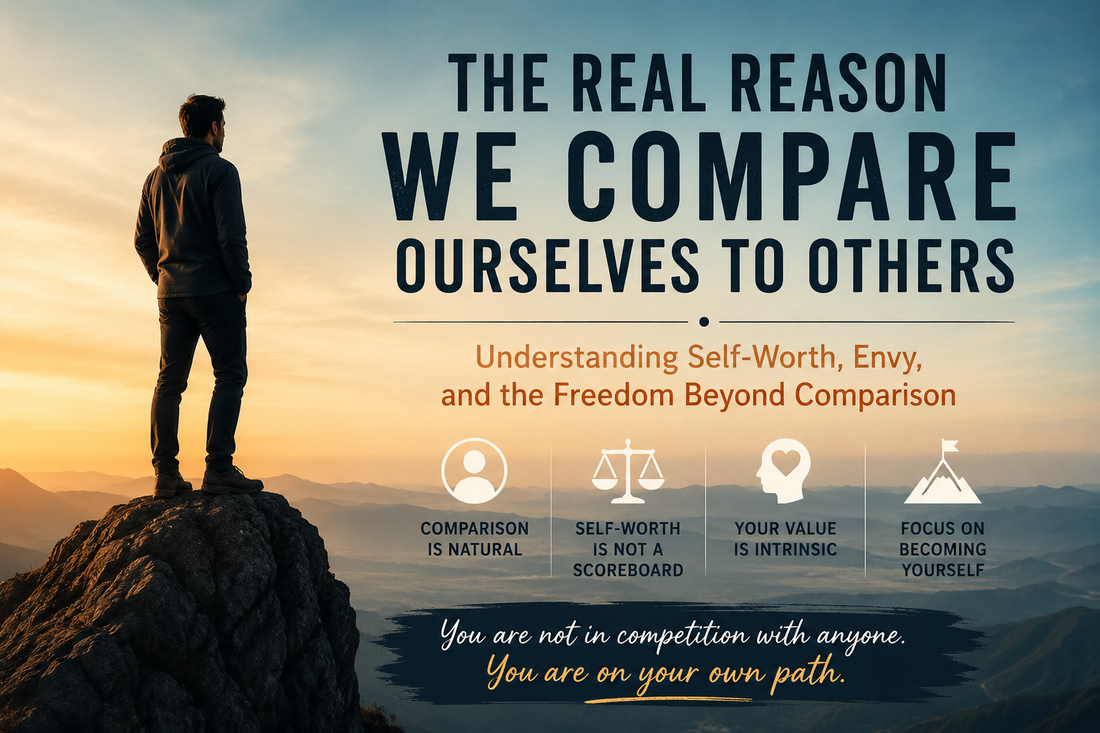
 Most people believe comparison is the problem. We hear phrases like: "Stop comparing yourself to others." "Stay in your own lane." "Comparison is the thief of joy." While these statements contain wisdom, they often fail to address the deeper issue. The truth is that comparison itself is not the problem. The real problem is what comparison threatens. For most of us, comparison threatens our sense of self-worth. Comparison Is Natural The human mind compares things constantly. It compares prices before making a purchase. It compares routes before taking a trip. It compares options before making decisions. Comparison is simply a mental tool. Without comparison, we would struggle to navigate everyday life. The problem begins when we stop comparing things and start comparing our value. Instead of observing differences, we begin measuring ourselves against others. Suddenly, comparison is no longer about information. It becomes about identity. The Hidden Equation Many people unconsciously live by an equation they never chose: Self-Worth = My Value Relative to Others The equation is rarely spoken aloud, but it quietly influences how we feel. If someone is more successful, we feel smaller. If someone is more attractive, we feel less desirable. If someone is wealthier, we feel less accomplished. If someone appears more enlightened, we feel less spiritual. The moment another person rises, our value appears to fall. But is that actually true? Consider two scenarios. In the first scenario, you earn $500,000 a year while everyone around you earns $100,000. In the second scenario, you earn $500,000 a year while everyone around you earns $5 million. Your income has not changed. Your life has not changed. Your achievements have not changed. Only your position within the social hierarchy has changed. Yet many people would feel more successful in the first scenario and less successful in the second. Why? Because the feeling of worth was never coming from the achievement itself. It was coming from comparison. What Is Self-Worth? This is where things become interesting. Most people spend their lives trying to increase their self-worth. But few stop to ask: What is self-worth? Can your worth actually increase? Can it decrease? Can another person's success diminish your value? Can another person's beauty make you less beautiful? Can another person's intelligence make you less intelligent? If your worth can be reduced simply because someone else possesses more of something, then your worth was never truly yours. It was dependent upon external conditions. It was conditional. And anything conditional can be taken away. The Endless Chase The ego loves comparison because comparison creates hierarchy. Hierarchy creates winners and losers. And if there are winners, then perhaps one day we can become one. This creates an endless pursuit. "I'll be worthy when I become successful." "I'll be worthy when I make more money." "I'll be worthy when people recognize me." "I'll be worthy when I find my purpose." "I'll be worthy when I become enlightened." Yet every time one goal is achieved, another appears. The finish line keeps moving. The person may become more accomplished, but they rarely become more whole. This is why some of the most successful people in the world still struggle with envy, insecurity, and self-doubt. They improved their position in the hierarchy but never questioned the hierarchy itself. What Comparison Is Really Protecting When comparison hurts, it is usually protecting an identity. It is protecting a story about who we believe we are. When someone else's success triggers us, we can ask: What am I making this mean about me? Often the answer reveals the deeper fear. Perhaps we fear being insignificant. Perhaps we fear being left behind. Perhaps we fear not being enough. Perhaps we fear that our value depends on being exceptional. Comparison is not creating these fears. It is exposing them. The discomfort we feel is often an invitation to investigate the foundation upon which our identity is built. A Different Way of Living Imagine asking a different question. Instead of: "Am I better than others?" Ask: "Am I becoming more fully myself?" The first question creates competition. The second creates growth. The first depends on what others are doing. The second depends on what you are doing. The first produces envy. The second produces fulfillment. A rose does not compare itself to an oak tree. A mountain does not compare itself to the ocean. Each expresses its nature completely. Neither gains value by becoming the other. Human beings often suffer because we forget this. We spend so much time trying to become someone else that we never fully become ourselves. The End of Envy Many people want to eliminate envy. But envy is often a symptom, not the cause. The cause is the belief that another person's success says something about our worth. Once that belief dissolves, envy begins to lose its foundation. What remains is something entirely different. Admiration instead of jealousy. Inspiration instead of resentment. Appreciation instead of competition. You can witness greatness without feeling diminished by it. You can celebrate another person's success without questioning your own value. You can appreciate beauty without feeling less beautiful. You can honor another person's gifts without denying your own. A Question Worth Contemplating If you were the only person on Earth, would you still have worth? If the answer is yes, then your worth cannot come from comparison. And if your worth does not come from comparison, then comparison loses its power to threaten you. Perhaps freedom is not found in eliminating comparison. Perhaps freedom is found in realizing that your value was never dependent on comparison in the first place.
0 Comments
Leave a Reply. |
AuthorFeelasoulphy Categories
All
Archives
March 2026
|
 RSS Feed