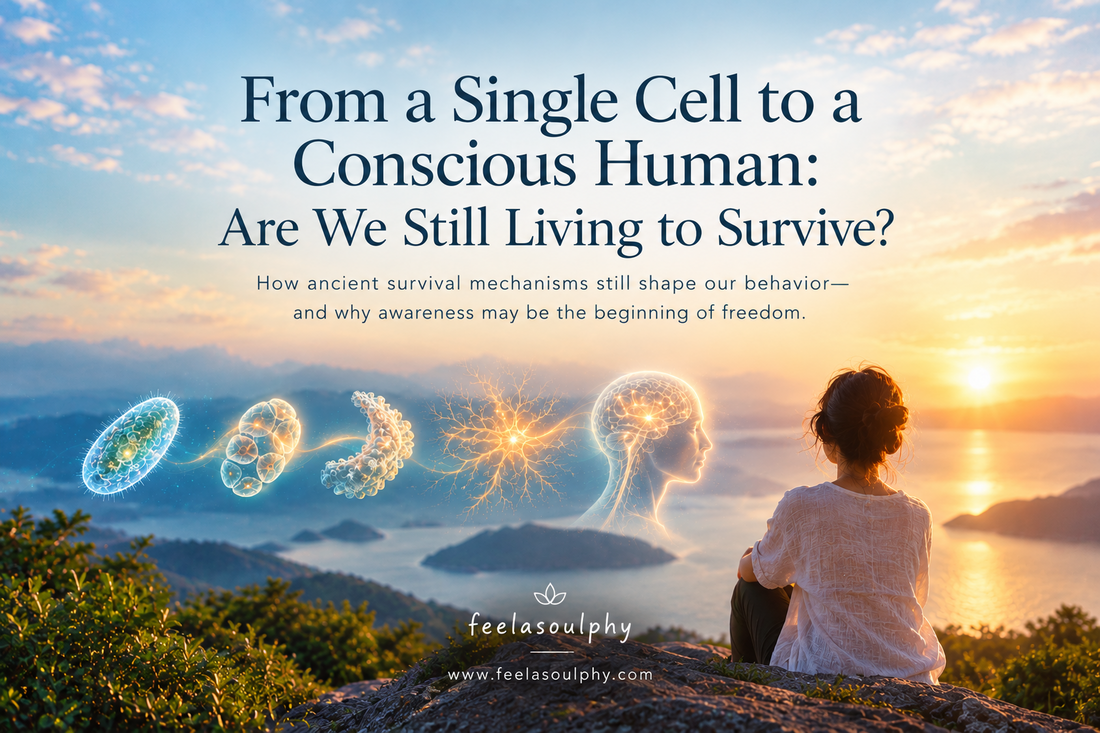
 How ancient survival mechanisms still shape our behavior—and why awareness may be the beginning of freedom. Imagine the first living organism on Earth. No language. No philosophy. No concept of tomorrow. No understanding of death. No question about the meaning of existence. Perhaps it was nothing more than a tiny single-celled organism surrounded by an environment it could barely “understand.” And yet, it had one fundamental problem: it had to keep itself alive.
It had to obtain what sustained it and avoid what damaged it. It didn't need to think about survival; its biology simply responded to its environment. Something beneficial? Move toward it. Something harmful? Move away. Something threatening? Protect itself. There was no meditation between stimulus and response and no philosophical debate. There was simply: Stimulus → Response And that simple relationship became part of the foundation of an extraordinary evolutionary journey. How Did Life Become Better at Surviving? There is an important part of evolution that is easy to misunderstand. When we say an organism “developed” a trait that made it better at surviving, we don't mean the organism consciously decided that it needed a new skill. Evolution doesn't work that way. One of the key ingredients is variation. Individuals within a population are not genetically identical. When organisms reproduce, differences can arise through mutations, recombination, and other biological processes. Most differences may have little consequence. Some may be harmful. Some may happen to be beneficial under particular environmental conditions. Imagine a population of primitive cells living in an environment where nutrients are concentrated in one direction. Suppose one cell happens to have an inherited difference that makes it slightly better at detecting or moving toward those nutrients. That cell has a small advantage. It may obtain more energy, survive longer, and reproduce more successfully. Its descendants inherit that characteristic, while further variation continues to occur. Generation after generation, characteristics that improve survival or reproduction can become more common. The organism didn't consciously learn the trait. The environment filtered the variation. In simplified form: Variation → Selection → Inheritance → Adaptation This process repeated across enormous stretches of time, and life became extraordinarily sophisticated at one thing: survival. From Survival to the Human Brain Over time, organisms evolved increasingly sophisticated ways of sensing and responding to their environments. Then came nervous systems, increasingly complex brains, memory, learning, prediction, emotion, social behavior, and thought. Eventually came humans. But here's the strange thing: the original problem never completely disappeared. We still need food. We still avoid danger. We still seek shelter. We still protect ourselves. We still compete for resources. We still seek connection and belonging. What changed was the sophistication of the machinery—and the environment in which it operates. A single cell might respond to a chemical signal. A human being can respond to an insult. An animal may defend its territory. A human may defend an opinion. An animal may compete for food. A human may compete for wealth, status, recognition, beauty, influence, or social position. The stimulus has changed. The fundamental survival logic has not. And that may explain something fascinating about human behavior: we can be living in an environment that is dramatically safer than the one our ancestors faced while still carrying a nervous system shaped by a very different world. We May Be More Primitive Than We Think Consider something people commonly admire: a person who can deliver a brilliant comeback immediately after being insulted. We might call that person quick-witted, sharp, confident, or strong. And perhaps they are. But why can a fast comeback feel so satisfying? Underneath the sophistication may be an ancient social calculation: “I can defend myself.” In a primitive social environment, responding effectively to aggression could have mattered enormously. Being unable to defend yourself could make you vulnerable. Over time, the expression of defense became more sophisticated. The physical confrontation can become a verbal confrontation. The weapon becomes the argument. The territory becomes reputation. Physical dominance becomes social status. And the instinct remains: “Don't allow yourself to be dominated.” Today, two people can sit safely behind their phones, hundreds or thousands of miles apart, exchanging clever insults. There may be no physical danger whatsoever, yet something inside us can still respond as though something important is at stake. And we may even reward the behavior by saying, “Damn, that comeback was good.” Maybe it was. But it is worth asking: What exactly are we admiring? Are we admiring intelligence and humor, or are we unconsciously admiring someone's ability to defend their psychological territory? Sometimes it may be both. Ancient Survival in Modern Attraction Consider another example. People can be attracted to partners who appear capable of protecting themselves and others. Physical strength can communicate, at a very basic level, “This person can defend us.” But in the modern world, protection doesn't necessarily mean physical strength. It can mean emotional stability, financial competence, confidence, intelligence, social skill, leadership, or the ability to remain calm under pressure and solve problems. The underlying question may still be remarkably ancient: “Can this person handle danger and uncertainty?” In a primitive environment, physical strength could provide an obvious survival advantage. In modern society, the qualities associated with security may be distributed across many different characteristics. This doesn't mean every human preference can be reduced to survival. Human attraction is far too complex for that. But it is worth recognizing how much of what we admire may still carry echoes of our evolutionary past. The expression has changed. The fundamental need for safety and security has not. The Problem Isn't Survival We shouldn't demonize our survival mechanisms. They are extraordinary. They helped keep our ancestors alive, and they still protect us every day. If a car suddenly comes toward you, you don't want to stop and contemplate the metaphysics of transportation. You want to move. Survival mechanisms are useful. The problem isn't that we have survival mechanisms. The problem is that we can become so identified with them that we mistake their reactions for our choices. Someone criticizes you, and your body tightens. You become defensive and feel the urge to strike back. Someone succeeds, and you compare yourself. Someone rejects you, and you withdraw. Your future becomes uncertain, and you worry. Someone challenges your beliefs, and you feel threatened. The ancient question, “Is this safe or dangerous?”, has gradually become, “Does this threaten me?” And “me” can mean much more than our physical body. It can mean our ego, our reputation, our beliefs, our possessions, our relationships, our future, our sense of control, or even our idea of who we think we are. We can spend decades responding to life without ever stopping to ask: “Why am I responding this way?” The Space Between Reaction and Choice This is where being human becomes particularly interesting. A single cell encounters a stimulus and responds according to its biological machinery. Humans have developed something extraordinary: we can observe our own reactions. You can become angry and notice, “I am angry.” You can feel fear and notice, “I am afraid.” You can experience jealousy and notice, “I am feeling jealous.” You can feel the urge to defend yourself and notice, “Something in me wants to defend my identity.” That tiny act of observation creates space. And within that space, something remarkable becomes possible: Choice. Consider two people receiving the same criticism. The first person experiences: Criticism → anger → defense → attack The second experiences: Criticism → anger → awareness → reflection → choice The second person still feels anger. They haven't transcended biology, and they haven't become emotionless. They have simply become aware of what is happening inside them. They may still choose to respond firmly, but the response is no longer necessarily dictated by the first impulse. This is where conscious living begins—not when we stop having emotions, not when we stop experiencing fear, and not when we eliminate our survival instincts, but when we become sufficiently aware of them that we don't automatically obey them. There is a difference between saying, “I am angry,” and recognizing, “Anger is arising in me.” There is a difference between, “I'm afraid,” and, “Fear is present right now.” There is also a difference between, “They disrespected me,” and, “I am experiencing a strong interpretation that I have been disrespected.” The second versions create psychological space, and psychological space creates the possibility of choice. This doesn't mean we should suppress emotions or endlessly analyze every reaction. Sometimes the appropriate response is immediate. Sometimes anger is useful. Sometimes fear is correct. Sometimes you need to defend yourself. Consciousness does not mean becoming passive. It means becoming aware enough to distinguish: “I am choosing this response.” from: “My conditioning chose it for me.” What Do Highly Conscious People Do Differently? Throughout history, contemplative traditions have described people who appear remarkably difficult to provoke. We can also find examples among highly trained meditators, martial artists, therapists, philosophers, and others who have spent years observing their own minds. Does this mean they no longer experience emotion? Not necessarily. There is an important distinction between feeling an emotion and being controlled by an emotion. A person may experience anger without becoming anger. They may experience fear without becoming paralyzed. They may experience pain without immediately turning it into resentment. They may recognize aggression without automatically returning aggression. One possible reason is that deeper awareness can change how an event is interpreted. Imagine someone insults you. Your unconscious mind may interpret it as, “This person is attacking me.” Your identity becomes threatened, and your survival machinery activates. But someone with greater awareness may recognize: “This person is acting from their own conditioning, insecurity, fear, or pain.” The insult is still heard. The behavior may still be unacceptable. But the psychological meaning can change. And when the perceived threat changes, the emotional response can change with it. This doesn't mean such a person becomes passive. Equanimity is not weakness. A conscious person can still establish boundaries. They can walk away. They can say no. They can defend themselves. And if physical danger is real, they can act decisively. The difference is that their action doesn't necessarily come from blind emotional reactivity. They may respond from clarity rather than compulsion. That is a very different kind of strength. Perhaps This Is Part of Human Evolution Biological evolution operates across generations. But humans possess another form of evolution: conscious development. We can observe our patterns, question our assumptions, examine our conditioning, learn new responses, become less reactive, and expand our capacity to tolerate uncertainty. We can recognize when our survival machinery is responding to a psychological threat rather than a physical one. We can choose values over impulses. And perhaps most importantly, we can become aware of the machinery itself. The single cell simply responds to its environment. The animal can learn from its environment. The human can reflect upon its experience. And the conscious human can potentially say: “I see what is happening inside me. I don't have to become it.” Perhaps this is part of what human evolution can mean: from reaction to awareness, from awareness to choice, and from choice to intentional living. You Are Not Your Survival Mechanisms You will still experience fear. You will still experience anger. You will still want approval. You will still feel scarcity. You will still become defensive. You will still sometimes react unconsciously. That's okay. The goal isn't perfection. The goal is to catch yourself a little earlier. Perhaps yesterday you reacted for an hour before becoming aware of what was happening. Tomorrow you notice it after thirty minutes. Eventually, you notice it after five minutes, then perhaps after thirty seconds. And one day, you notice the reaction beginning. That moment of noticing is progress. You are no longer completely lost inside the reaction; you are observing it. And when you can observe something, you have begun creating a relationship with it rather than being completely controlled by it. Catch the Cell For the next seven days, try a simple experiment. You don't need to meditate for an hour or use any special equipment. You simply need to notice. Whenever you experience a strong emotional reaction, pause and take one slow breath. Then ask yourself four questions. What happened? Describe the event without interpretation. For example, “They didn't respond to my message.” Not, “They are ignoring me because they don't care.” Separate the event from the story. What am I feeling? Name the emotion: anger, fear, jealousy, shame, sadness, anxiety, excitement—whatever is actually present. What is my survival system trying to protect? Ask, “What feels threatened right now?” Is it your physical safety, your money, your relationship, your status, your identity, your need to be right, your sense of control, or your need to be accepted? This question can reveal a tremendous amount about ourselves. Finally, ask: What response would I choose if I didn't have to react immediately? Don't ask only, “What do I feel like doing?” Ask, “What do I consciously choose to do?” Then wait. You don't always need to act immediately. Sometimes the most conscious response is no response at all. Notice. Pause. Choose. You can reduce the entire practice to three words: Notice. Pause. Choose. Notice the reaction. Pause before acting. Choose your response. Do this repeatedly and you begin to discover something extraordinary: you are not as free as you may have assumed—but you are also not as trapped as you may have believed. Much of your behavior has been shaped by biology, conditioning, memories, experiences, culture, fears, beliefs, and unconscious patterns. But awareness allows you to see those forces. And what you can see, you can begin to work with. Perhaps that is what conscious evolution really means—not becoming something other than human, but becoming more conscious of the human being you already are. The single cell's primary question was: “How do I survive?” Perhaps humanity's next question is: “Now that I am alive, how do I choose to live?” And perhaps the deepest form of freedom isn't having no conditioning. Perhaps freedom is becoming conscious enough of our conditioning that it no longer automatically determines what we do next. To truly experience free will, perhaps we must first learn to live consciously.
0 Comments
Leave a Reply. |
AuthorFeelasoulphy Categories
All
Archives
March 2026
|
 RSS Feed