 I personally believe that life purpose is something we remember from a spiritual perspective rather than something we create. Of course, this depends on a person’s beliefs, and their viewpoint may differ. For me, I remembered my purpose when I discovered my passion—helping and motivating others to reach their full potential. I believe my purpose was already determined before I was born, but it remained dormant or was gradually unfolding as I matured. When the time was right, I became aware of it, understood it, and eventually began embodying it. This process has been gradual, but now my purpose is very clear to me: to learn, to experience, and to serve others. I believe there was a reason for me to come back to Earth, meaning my purpose was already determined before birth. Once my soul defined this purpose, it had to manifest it into reality—into a physical form—so I was born with this purpose written inside me. But here’s the key: It’s not that you are looking for your purpose. Your purpose has always been guiding you. We often think of purpose as something we must actively seek, as if it’s hidden somewhere outside of us. But in reality, our purpose is always present, subtly directing us through our experiences, passions, and even challenges. The process of life itself is designed to help us remember and align with it. An Analogy: The Meeting of Forgotten Purpose Imagine we all have a condition—not Alzheimer’s, but a type of forgetfulness where we remember bits and pieces, just not everything clearly. We find ourselves in a meeting but don’t remember why we’re there. The entire time, we’re trying to recall the purpose of the meeting and our role in it. We try different things to spark our memory, hoping to find something that feels right, but nothing fully clicks. Since our memory is unreliable, we rely on feelings and intuition. Deep down, we sense we’re in the right place—we planned to be here—but we’re not truly fulfilling our purpose because we don’t fully remember what we came to do. Others in the meeting are in the same situation. Some might remember more than others. Together, we start piecing together clues, helping each other recover fragments of our memory. As more people remember, the purpose of the meeting becomes clearer, and soon, things start moving in the right direction. The key to feeling at peace isn’t just remembering the purpose—it’s fulfilling it. Once we recall why we’re here, the anxiety and frustration fade, giving us clarity. Instead of spending all our time just trying to remember, we can focus on doing what we came here to do—contributing, making a difference, and even helping others remember their purpose too. For Spiritual and Non-Spiritual Perspectives For those on a spiritual path, the journey of purpose looks like this: Higher purpose → Manifested → Living and remembering our higher purpose → Fulfilling our purpose. For those who do not hold spiritual beliefs, purpose can still be deeply meaningful: Nothing → Something → Lost/Confused → Finding a purpose → Fulfillment. Even without believing in a higher purpose, one can still enter “the meeting” with a reason—to learn, to contribute, and to experience life. There’s nothing wrong with not believing in spiritual destiny. The key is long-lasting fulfillment, rather than chasing fleeting goals. Why Does Purpose Seem to Change? Why is it that sometimes we feel certain about pursuing something, only to realize later that it no longer feels right? Because your goal was never meant to last forever. It may have even been aligned with your larger purpose, but only as a fraction of what you were meant to accomplish. The universe guides you into doing something, then out of it, so you can continue fulfilling your greater purpose. Mind vs. Soul: The Illusion of Purpose Purpose exists for the mind at the human level—it needs direction to continue its journey. But the soul is already living its purpose, patiently progressing according to a greater plan. The struggle comes because the mind, limited by ego and human perception, cannot fully comprehend the soul’s deeper purpose. In many cases, the mind’s pursuit of purpose originates from the ego. The ego seeks identity, validation, and significance. It wants to feel special, to achieve something, to leave a mark. This is why people sometimes chase goals that later feel empty—because they were ego-driven rather than soul-aligned. But when the mind finally recognizes the soul’s true purpose, the two align, and purpose is naturally fulfilled. In other words, the moment you realize your true purpose, you are already living it. Whether you feel like you’ve accomplished or fulfilled your purpose is simply the mind trying to measure and understand something that was always in motion. A Lesson from 50 First Dates In 50 First Dates, Adam Sandler’s character, Henry, can be seen as a representation of God/Spirit Guide or an awakened friend trying to help someone (Lucy) recover her memory—just like how an awakened soul helps those who are still “asleep” remember their true purpose. Henry knows that Lucy will likely forget everything by the next morning, yet he has no expectations or frustration. Instead, he patiently works with her, bringing joy into her life each day. He meets her where she is, without force or pressure. Lucy, despite her memory loss, still experiences happiness in her day-to-day life. And Henry, through his unwavering commitment, lives with a sense of purpose every day. This mirrors the journey of awakening—some people forget who they are and why they’re here, but those who remember can gently guide them, not by forcing remembrance, but by being present, patient, and leading with love. In the end, whether one remembers or not, the key is to live with joy and purpose in each moment. “The world exists because of you, not the other way around.” - FeelaSoulphy
0 Comments
 Sunset at Opal Cliff, Santa Cruz, California, USA   When I was 13, I had a history final coming up, but I hadn’t studied the entire semester(the story of my entire pre-college years) Luckily, the teacher gave us a cheat sheet with all the answers—on the condition that we memorized it. The night before, I worked hard to remember everything and woke up early the next day to review while still lying in bed. To my surprise, I recalled everything perfectly and scored an A on the exam later! At the time, I didn’t understand how I could do that other than thinking it was pure luck, so I never tried it again—until a few years ago when I started exploring the science of brainwaves and meditation. I realized that by staying relaxed in the early morning, I had accessed my brain’s alpha state, and with focused review, I had transitioned into gamma, where memory and mental clarity are amplified. This realization led me to develop my morning meditation practice, which helps me access these brainwaves intentionally. Here’s how it works and how you can do it too. What Are Brainwaves and Why Do They Matter? Your brain operates at different frequencies, called brainwaves, depending on your activity and state of mind. Here’s how they work and what they unlock: • Delta (0.5-4 Hz): The deep sleep state essential for recovery and healing. • Theta (4-8 Hz): A dreamy, intuitive state tied to creativity and emotional processing. • Alpha (8-14 Hz): A relaxed, alert state perfect for mindfulness, learning, and calm focus. • Beta (14-30 Hz): Active thinking and problem-solving but also linked to stress. • Gamma (30-100 Hz): A high-performance state of intense focus, learning, and insight—the key to moments of brilliance and breakthroughs. By learning to move through these brainwave states, especially into gamma, you can unlock heightened awareness, creativity, and clarity. The Path to Gamma: Starting with Morning Meditation If you ask any mediators they will tell you that there’s usually a process to get into a relaxed state of mind, such as alpha state, especially meditating in the middle of the day, and it is not guaranteed they’d achieve this state everytime. However, in the morning, often times your brain naturally transitions from delta (deep sleep) through theta (dreaming) into alpha—a relaxed yet alert state. This is the perfect time to guide your mind into gamma for peak mental performance. Here’s how you can do it: 1. Start Relaxed (Alpha State): Upon waking, stay lying down or sit comfortably with your eyes closed. Let your thoughts flow naturally, observing them without judgment. This keeps your brain in alpha, a state of calm focus. 2. Focus on a Subject (Gamma Activation): When a thought or idea feels significant, gently direct your attention to it. Ask yourself reflective questions like: • “What am I feeling right now?” • “Why do I feel this way?” • “How can I better understand or address this?” Dive into the details, exploring the answers with curiosity and depth. This deliberate, focused attention transitions your brainwaves from alpha into gamma, enhancing clarity and insight. 3. Take Notes for Insights: As insights or creative ideas emerge, jot them down. Writing reinforces the sharpness and clarity of the gamma state also allows you to revisit them for contemplation at a later time. Sometimes you may find yourself writing nonstop because your mind is flooded with insights and creative ideas. This simple practice not only fosters self-awareness but also allows you to tap into the gamma state’s power for mental breakthroughs. Why Gamma Is Powerful Gamma brainwaves enhance memory, creativity, problem-solving, and moments of profound insight. They’re where you experience mental clarity and your greatest breakthroughs. This is what we often call “The Zone” or “Flow State” what many top athletes and artists experience when they reach their peak performance. I personally use this method to create more “aha” moments or epiphanies to elevate my perception of the world and to write materials like this. By transitioning into gamma, you tap into the highest potential of your mind. This morning meditation is just one way to reach gamma. In future posts, I’ll share other simple techniques, such as walking and shower meditation, etc. Let me know if you try it and how it works for you. Each person's experience may vary so I'd love to hear your experience working with this technique. Reading Tips: Click on Meditation and Brainwaves under Categories for more info on this topic.  Sunset at James Lick Observatory, Mt. Hamilton, San Jose, California, USA Our minds are a complex system of two primary components: the conscious and the subconscious. While they work together seamlessly, each has distinct roles depending on the state we are in—awake, asleep, or meditating. Understanding this dynamic can help us tap into deeper insights and maximize our mental potential. The Roles of Conscious and Subconscious Minds Conscious Mind: • The seat of focus, logic, and deliberate thought. • Active during tasks requiring attention, problem-solving, and decision-making. Subconscious Mind: • A vast memory bank, storing all experiences, emotions, and information. • Operates automatically, running habits, retrieving memories, and processing emotions in the background. How the Two Minds Interact 1. In Daily Life: • When awake and focused, the conscious mind leads, while the subconscious supports by providing background data (e.g., recalling memories or automatic skills). • Example: Driving a familiar route while consciously thinking about other things relies heavily on the subconscious. 2. In Sleep and Dreams: • During sleep, the subconscious dominates, creating dreams by piecing together fragmented memories. • The conscious mind typically takes a backseat unless you experience lucid dreaming, where awareness emerges within the dream state. 3. In Relaxed States: • When relaxed, such as in the alpha brainwave state, the subconscious becomes more active. This is why daydreaming and wandering thoughts occur effortlessly. • The conscious mind shifts to an observer role, which allows for contemplation and creative connections. Meditation: A Bridge Between the Two Minds Meditation offers a unique opportunity to balance the two minds: • The conscious mind quiets down, stepping into the role of a calm observer. • The subconscious becomes more accessible, revealing forgotten memories or making unexpected connections. In this state, insights often emerge because the subconscious processes information in a non-linear way, free from the constraints of conscious logic. Writing down these realizations after meditation ensures they don’t fade away. Epiphanies and Creative Breakthroughs Ever had a great idea seemingly out of nowhere? That’s the result of your subconscious working in the background. Even when the conscious mind moves on to something else, the subconscious continues processing information. When the two minds synchronize, this background processing can deliver surprising insights or solutions. This explains why moments of clarity often occur during relaxed states, like taking a walk, showering, or meditating. The Subconscious as a Memory Bank The subconscious is like a hard drive—it stores everything, but it isn’t always organized. • Dreams, for instance, can feel chaotic because the subconscious tries to link unrelated memories. • Without conscious intervention, it can seem as if the subconscious has “a mind of its own,” creating unexpected scenarios that even surprise us. By taking time to reflect, meditate, or write down these thoughts, we can give structure to this vast storehouse of information. Practical Takeaways 1. Meditate Regularly: • Use meditation to quiet the conscious mind and gain access to subconscious insights. • Don’t try to analyze during meditation—just observe. 2. Write Things Down: • Whether it’s a dream, a random thought, or a moment of clarity, writing helps organize subconscious material for conscious analysis later. 3. Leverage Relaxed States: • Activities like walking, daydreaming, or light meditation allow the subconscious to take the lead. These moments often spark creativity or problem-solving. 4. Trust the Process: • Understand that the subconscious works in the background, even when you’re not aware of it. By consciously creating time for relaxation, you open the door to unexpected insights. Conclusion The interplay between the conscious and subconscious mind is a remarkable system of balance. By learning how to work with both—letting the subconscious process while the conscious observes and organizes—we can achieve greater clarity, creativity, and self-awareness.  Mt. Diablo State Park, Clayton, California, USA Did you know your mind is constantly creating stories—narratives so vivid and detailed they feel as real as the world around you? But here’s the catch: not all of these stories are true. Some are distorted memories, others are pure imagination, and many are a mix of both. The mind is so powerful that these stories can shape how you feel, how you act, and even the reality you create. Let’s dive deeper into how this works, why it happens, and what you can do to reclaim control over your mind’s narratives. How the Mind Creates Stories Imagine this: You’re walking down the street, and you see someone you know. They don’t wave or smile back at you. Within seconds, your mind starts spinning: • “Did I upset them? Are they mad at me?” • “Maybe they don’t like me anymore…” What really happened? Maybe they didn’t see you or were distracted, but your brain filled in the gaps with assumptions and emotional stories. This happens because your mind relies on two key sources: 1. Memories: The brain doesn’t store perfect snapshots. Instead, it remembers bits and pieces of past experiences and emotions, which it reconstructs when you recall them. 2. Imagination: When details are missing, the mind fills in the blanks using your thoughts, fears, or expectations. The result? A story that feels real, even though it may not be true. The Emotional Power of Thought Have you ever woken up from a vivid dream feeling angry, sad, or even anxious? Maybe you dreamed a friend betrayed you, and for a moment, it felt so real that you couldn’t shake the emotion. That’s because your brain doesn’t differentiate between real and imagined events when it comes to emotions. When you imagine something, your amygdala (the brain’s emotion center) reacts just as it would to a real experience, producing physical sensations like a racing heart, sweaty palms, or tightness in your chest. For example: • Replaying a past failure: If you keep replaying the time you made a mistake at work, your brain relives the embarrassment, making you feel like it’s happening all over again. • Worrying about the future: Thinking, “What if I mess up my presentation tomorrow?” triggers anxiety in the present, even though the event hasn’t happened yet. Why You Can’t Always Trust Your Thoughts The stories your mind creates can be distorted in several ways: • Memory Bias: Your brain may exaggerate or alter details over time. For example, you might remember a childhood argument as worse than it actually was because your emotions magnified it. • Negativity Bias: You’re more likely to dwell on negative memories or imagined outcomes than positive ones because the brain evolved to focus on threats for survival. • Catastrophizing: Your mind jumps to the worst-case scenario, like thinking your partner didn’t text back because they’re upset with you, when in reality, they may just be busy. These distortions can lead to unnecessary stress, anxiety, and even conflicts with others. Virtualization in the Brain: How It Helps and Hurts Your brain is like a virtual reality machine. It constantly simulates past experiences, imagines future ones, and creates “what-if” scenarios. This ability to virtualize happens in areas like the prefrontal cortex (planning and imagination) and the hippocampus (memory recall). • Example of Help: Picture yourself preparing for a big presentation. You mentally rehearse what you’ll say and visualize yourself succeeding. This boosts confidence and readiness. • Example of Harm: Imagine you’re lying awake at night, replaying a potential argument with your boss. Even though it hasn’t happened, your body reacts with stress as if it’s real, robbing you of peace and sleep. The key is learning to use virtualization for growth, not unnecessary suffering. Reclaiming Control: How to Stop Believing Every Thought Here’s the truth: you are not your thoughts. Your mind is an incredible tool, but it’s also a storyteller that doesn’t always tell the truth. Here’s how to take back control: 1. Practice Mindfulness: When a thought arises, pause and observe it without judgment. For example: • “Is this thought based on fact or assumption?” • “Is this helping me or harming me right now?” Treat your thoughts like passing clouds. You don’t have to grab onto them or believe every one. 2. Use Visualization Wisely: Instead of letting your mind spiral into negative scenarios, consciously visualize positive outcomes: • If you’re nervous about a job interview, picture yourself feeling calm, confident, and answering questions well. • When revisiting a painful memory, imagine yourself learning from it and growing stronger. Visualization isn’t just a mental exercise—it rewires your brain over time, helping you build optimism and resilience. 3. Ground Yourself in the Present Moment: If you find yourself spiraling into “what-ifs,” bring yourself back to the present. Try this: • Take 3 deep breaths, focusing on the sensation of air filling your lungs. • Name 3 things you can see, hear, or feel right now to ground your senses. These simple techniques remind you that the only moment that truly exists is now. 4. Remember: Thoughts Aren’t Facts: Just because your mind says something doesn’t mean it’s true. For example: • Thought: “I’ll fail at this.” • Reality: You haven’t even tried yet. What if you succeed instead? Final Takeaway Your mind is an extraordinary tool, capable of creating detailed stories that can help or hurt you. The key to reducing unnecessary suffering is learning to question your thoughts, use your imagination wisely, and focus on the present moment. The next time your mind tells you a story, ask yourself: “Is this true? Or is it just a thought?” Reclaim your power by becoming the observer of your mind, not its victim.  Lick Observatory, Mt. Hamilton, San Jose, California, USA For many, smoking isn’t just about the nicotine—it’s about the ritual. It’s a moment to step away from the noise of life, breathe deeply, and be present. In those few minutes, you might feel calmer, grounded, even centered. In a strange way, it feels like meditation. Here’s the truth: smoking does bring you into the present moment. The act of lighting up, inhaling, exhaling, and watching the smoke swirl engages your senses and momentarily quiets the mind. But here’s the catch—it doesn’t truly heal. Smoking gives temporary relief while harming your body, creating a cycle of dependency. The Science Behind the Calm 1. Dopamine’s Role: Smoking triggers the release of dopamine, the “feel-good” chemical in the brain. This creates a fleeting sense of relaxation and reward, but it also fuels dependency, as your brain craves more nicotine to sustain that effect. Mindfulness practices like meditation can naturally increase dopamine levels without harming your body. 2. Stress Relief or the Pause? Many smokers believe that cigarettes help reduce stress. However, research suggests it’s not the cigarette itself but the act of pausing, breathing deeply, and stepping away that brings relief. This is something you can achieve without nicotine, simply by practicing mindfulness or focused breathing. 3. The Power of Breath: Smoking involves deep inhalation, which mimics diaphragmatic breathing—a proven method for activating the body’s “rest and digest” system. Deep, slow breaths lower your heart rate, reduce blood pressure, and calm the mind. You can achieve these same benefits with intentional breathwork, without the toxic effects of smoking. 4. Breaking the Habit Loop: Smoking often becomes a conditioned response to stress, boredom, or anxiety. It follows the habit loop: cue (stress), routine (smoke), reward (relief). Mindfulness helps break this cycle by increasing awareness of your triggers and replacing the routine with a healthier alternative that still offers calm and presence. A Meditation for Smokers Trying to Quit If you’re looking for a way to replace the act of smoking, here’s a meditation designed specifically for you. It mimics the familiar rhythm of smoking while transitioning to a healthier habit of mindfulness and visualization. Visualization Meditation: “The Peaceful Cigarette” 1. Find a Quiet Space: Sit comfortably, just as you would when preparing to smoke. Hold your hands as if holding a cigarette, and close your eyes. 2. Visualize the Ritual: Imagine yourself lighting the cigarette. Picture it in detail—the feel of it in your fingers, the warmth of the flame. 3. Engage Your Breath: Inhale deeply, as if drawing in the smoke. Hold your breath for a moment, and then exhale slowly, visualizing the smoke leaving your mouth in soft, swirling clouds. Repeat this for the same amount of time it typically takes you to smoke a cigarette. 4. Shift the Imagery: As you continue, begin to change the visualization. Instead of smoke, imagine exhaling stress, tension, or negativity. With each inhale, imagine drawing in calm, healing energy. 5. End in Tranquility: Over time, replace the image of the cigarette with a scene of peace—a serene beach, a quiet forest, or simply a warm, glowing light. Let this become the focus of your meditation. 6. Repeat as Needed: Each time you feel the urge to smoke, return to this meditation. The act of pausing and visualizing will help you retrain your mind and body to associate the need for calm with a healthier practice. Eventually, you won’t need to visualize smoking at all—you’ll go straight to the place of peace. Reconditioning the Brain: How Visualization Helps Quit Smoking The brain is incredibly adaptable and has the ability to recondition itself through new experiences and habits. This process is known as neuroplasticity—your brain can form new neural pathways when you repeatedly engage in new behaviors or mental practices. When you smoke, your brain creates a strong connection between the action (lighting up, inhaling) and the reward (relief, calm). This creates a habit loop in your brain: stress → cigarette → relaxation. But here’s the fascinating part: Your brain doesn’t differentiate between real or imagined experiences. Whether you’re physically smoking or visualizing it in your mind, the brain responds to the signals and creates a similar experience. In your visualization meditation, when you imagine smoking—breathing deeply, exhaling, and feeling that calm—the same neural pathways are activated. However, over time, you can start to replace the cigarette imagery with something more peaceful. Your brain begins to associate the same sense of calm and relief with healthier practices, slowly reprogramming your mind to choose peace instead of nicotine. With repetition, the neural pathways associated with smoking weaken while those tied to relaxation, mindfulness, and tranquility strengthen. Eventually, you won’t need to visualize smoking at all—you’ll simply experience the calm directly, without the cigarette. A Healthier Way to Find Peace What if you could achieve the same sense of calm and presence without the harmful side effects? Imagine this: instead of reaching for a cigarette, you take a mindful pause. You breathe deeply, just as you would when smoking, but now it’s fresh air. You focus on your breath, your body, and the sensations around you. You’re still grounded in the present moment, but now you’re nourishing yourself rather than depleting. Next time you feel the urge to smoke, ask yourself: What am I really craving? Is it the cigarette, or is it the moment of calm? And if it’s calm you’re after, what’s stopping you from choosing a path that heals instead of harms? If you know someone who is trying to quit smoking or could benefit from more mindful practices, please feel free to share this meditation with them. Let’s spread the word of peace and self-care together.  We are conscious beings, living unconsciously. We exist as conscious beings, often navigating life's intricacies unconsciously. Embracing consciousness empowers us to shape our experiences, allowing us to actively choose between living a mindful, intentional life or drifting through existence unaware. - Feelasoulphy  One cannot solve a deep rooted problem with a shallow mind. - Feelasoulphy  Silence your mind so you can listen to your heart. - Feelasoulphy  If you are truly heart broken, I congratulate you that you have finally arrived at the deepest part of your heart all the way from...your head... A wise friend once told me that our life journey is merely the distance from our head to our heart, a whopping 16 inch long! I believe that we spend our entire life traveling back and forth between our head and our heart. We have all been to the heart but it took some of us a traumatic event to go straight to the heart instantly which is a blessing in the sky. When we hit rock bottom and broke down that’s when we can no longer live with all the lies we have been telling ourselves and we finally arrived at the heart. This is a place without ego and only truth exists. When we cry, we cry out of our heart and not our head because we feel it directly from the heart. Sadness is bad if we only focus on the negative emotions that it brings to us. When we turn sadness into compassion we are then acting upon the power of love. Next time when you feel the pain in your heart again remember that you have arrived at the heart and a positive change in your life is in the making. Take this precious opportunity to reflect on things and see what you can do now to improve your life! It’ll always be your choice to stay here or return to your head. - FeelaSoulphy 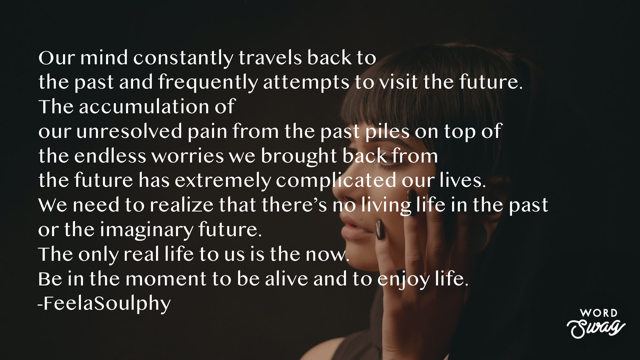 Our mind constantly travels back to the past and frequently attempts to visit the future. The accumulation of our unresolved pain from the past piles on top of the endless worries we brought back from the future has extremely complicated our lives. We need to realize that there’s no living life in the past or the imaginary future. The only real life to us is the now. Be in the moment to be alive and to enjoy life. - FeelaSoulphy |
AuthorFeelasoulphy Categories
All
Archives
March 2026
|
 RSS Feed