 (Part of The Story Series) Introduction: Why This Story Matters We don’t just tell ourselves stories about who we are or about the people in our lives. We also hold a powerful story about the world itself. Is it safe or dangerous? Friendly or hostile? Full of opportunity or scarcity? Evolving or falling apart? Most of us rarely realize how deeply these beliefs shape not just our choices, but the very reality we participate in creating. “The world we see is a reflection of how we see it.” How It Works in the Mind Your worldview acts like the largest filter of all — the lens through which you interpret everything.
What’s even more important: your personal worldview doesn’t just stay with you. It spreads to those you influence — friends, family, community. Collectively, our worldviews become the shared story that actually drives history. Historic Examples War Through Story Think of leaders who convinced entire nations that their survival required hating another group.
It all began with a story about the world: “They are dangerous. We must destroy them to survive.” Belief Shapes Discovery In contrast:
The collective view literally changed the map. Personal Example Maybe your parents taught you: “The world is a dangerous place. Don’t trust anyone.” Even if they meant to protect you, you might have lived decades with fear, guardedness, and missed opportunities for connection. Or perhaps you were taught: “The world is full of possibilities. People are mostly good.” This story probably made you more open, curious, and willing to try new things. Why It Matters So Much Your worldview doesn’t just stay in your head. It drives your behavior. It influences others. It becomes self-fulfilling. If enough people see the world as hopeless, they stop trying to improve it. If enough people see the world as capable of change, they act — and the world changes. Analogy: The Collective Mirror Imagine humanity standing before a giant mirror. What we see reflected back isn’t objective reality, but the sum of what we believe about the world. If billions see hostility, they behave defensively — and the world becomes hostile. If billions see possibility, they build bridges, invent, heal, and evolve. Good and Bad Stories About the World Good Examples:
Your Reflection Practice Pick a quiet time and write honestly about these prompts:
Your Assignment
Remember: Changing your story about the world is one way you help change the world itself. Closing Thought “We don’t see the world as it is, we see it as we are.” You have the power to choose how you see — and how you help shape what the world becomes. The story you hold isn’t just for you. It’s part of the story we all share. Let’s make it one worth living in. Read: Part 1: The Story We Tell About Ourselves Part 2: The Story We Tell About Others
0 Comments
 “What if the world was always this vivid—and we just forgot to pay attention?” Most of us eat distracted. We’re watching TV. Scrolling. Talking over dinner. We don’t even taste our food. But one day, I learned what it was like to really eat. I was on an edible. I remember biting into a kiwi. Suddenly, it was electric. Juicy. Tart. Sweet. The texture of the seeds. The smell of the fruit. Every sense was awake. Even watching a movie, I felt more emotional, more attuned to what was happening on screen. It was like my empathy was dialed up—I could sense what the characters felt. It was such a strange gift. Why did this happen? It turns out this isn’t magic. It’s attention. Edibles (like cannabis) can reduce activity in the default mode network (DMN)—the part of the brain responsible for mind-wandering and constant self-narration. When the DMN quiets down, sensory networks become more active. Emotions and empathy rise to the surface. In other words: When you’re really here, you really feel. Eating is special Eating is one of the few everyday activities that naturally engages all our senses: Sight: color, shape, presentation. Smell: aroma. Taste: layers of flavor. Touch: texture, weight. Sound: crunch, slurp, chew. It’s designed to be immersive. But we numb it by multitasking and rushing. When you actually focus? It’s an experience. It’s not just food—it’s people This kind of presence doesn’t just change eating. It changes how we connect with others. When you really listen to someone—without waiting to talk, without checking your phone—you hear them on a different level. You notice subtle emotions in their voice. You see the story in their eyes. You feel with them, not just next to them. Presence is the foundation of empathy. And empathy is what deepens connection. Science agrees Mindfulness meditation reduces DMN activity, just like certain drugs can—but without side effects. It increases interoceptive awareness (body sensations) and sensory acuity. It also strengthens brain regions linked to empathy and compassion (anterior cingulate, insula). Long-term meditation practice literally rewires the brain for presence. Drugs vs. Meditation Drugs can open the door to this state. They show you how present you could be. But they don’t train you to stay there. Meditation does. Presence practice does. It’s a lifelong shift, not a temporary escape. Try This: A Mindful Eating Practice Pick something simple. A kiwi. An apple. Chocolate. Look at it carefully. Color. Shape. Smell it. Take a slow bite. Chew carefully. Feel the texture. Notice the sound. Taste all the flavors. Keep bringing your mind back when it drifts. This isn’t just about food. It’s a training ground for attention. A Practice for Connection Next time you’re with someone: Put the phone away. Look them in the eyes. Really listen. Notice tone, words, pauses. Feel what they’re feeling. Watch how the conversation changes. Watch how you change. Final Reflection That kiwi taught me that life is always offering something beautiful—if I’m willing to really show up for it. Food can be spiritual. Conversations can be sacred. This moment can be everything. Presence turns ordinary life into holy ground. 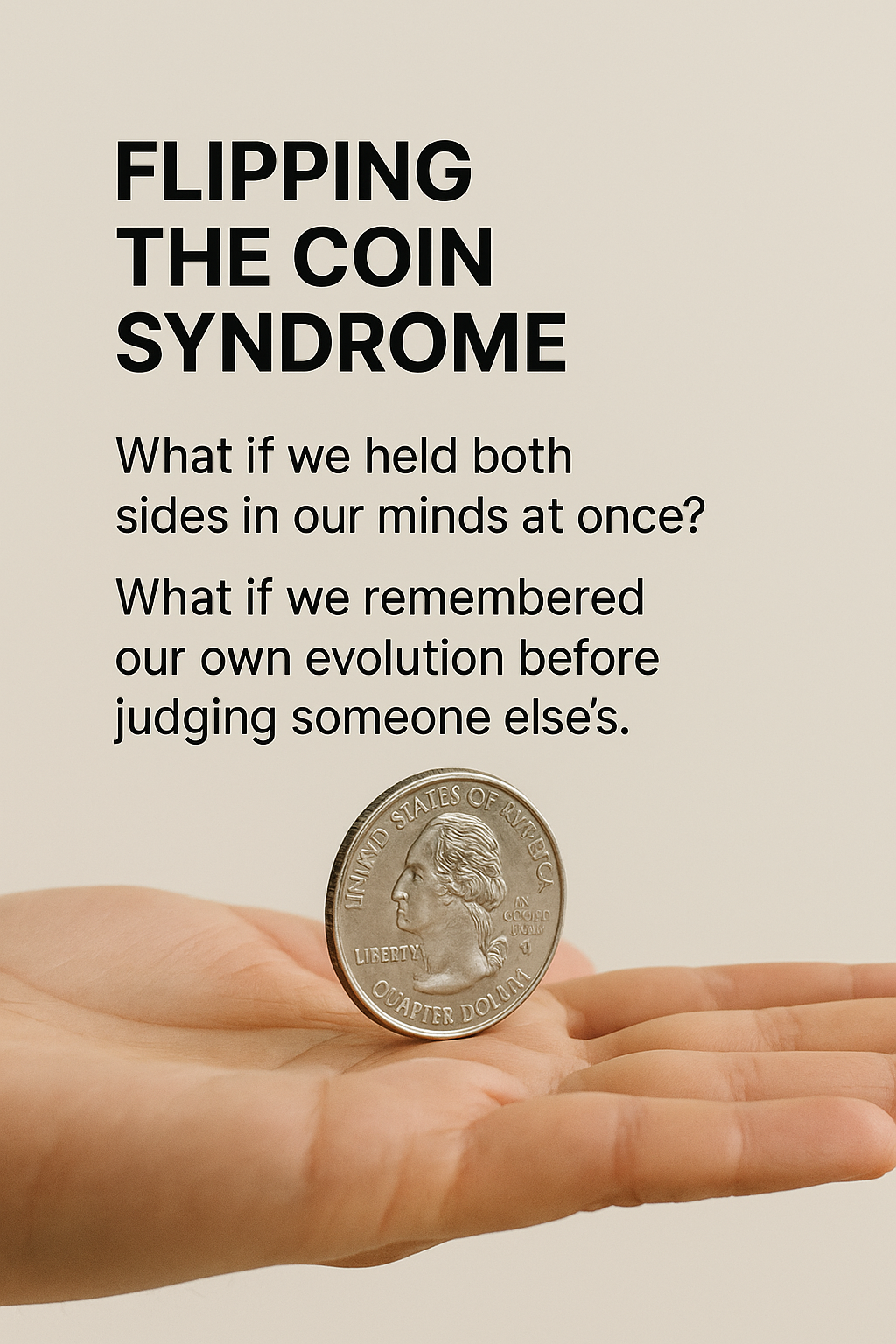 Have you ever noticed how easy it is to forget what you once believed? We humans have a strange habit I call “Flipping the Coin Syndrome.” We treat our beliefs like a coin in our hand. When we’re staring at one side—the side we now agree with—it feels like the only truth. We forget that the other side even exists. When we learn something new, it’s as if the old belief evaporates. We distance ourselves from it. We disown it. And then, ironically, we often start judging anyone who still holds that old view—as if we were never like them. We forget that the coin still has two sides. Think about it:
In all these cases, the judgment carries a kind of convenient amnesia. It’s as if we want to deny the simple truth that we once stood exactly where they’re standing now. Why do we do this? Perhaps because it’s uncomfortable to hold both sides of the coin in our mind at once. To admit that both perspectives have a reality to them. That our past self wasn’t simply “wrong,” but growing. That the people we’re judging are simply in process, just like we are. We prefer certainty. Simplicity. The security of believing: “Now I’m right. Then I was wrong.” “I’m enlightened. They’re lost.” But reality is rarely so neat. The Cost of Forgetting When we forget the other side of the coin, we don’t just lose empathy for others. We lose humility. We lose the chance to see ourselves as travelers on a path rather than owners of the truth. We also close the door on learning even more. Because what if the side we’re dismissing still has something to teach us? Holding Both Sides What if, instead, we practiced remembering? Remembering where we used to be. Remembering that growth is messy and slow. Remembering that certainty can be a cage. Imagine looking at someone you’re tempted to judge and asking: “What did it feel like to see the world the way they do?” “What did I need when I was there?” “How would I have wanted someone to treat me?” That’s not weakness. It’s wisdom. An Invitation We don’t have to flatten complexity. We can hold it. We can remember both sides of the coin at once. We can let our past selves humble us. We can let other people’s current struggles soften us. We can be firm in our values without forgetting our own evolution. Judgment shrinks the world. Compassion expands it. If you find yourself flipping the coin today, try holding it steady in your palm. Look at both sides. See the whole picture. You might find that truth is bigger than you thought. What’s a belief you’ve changed your mind about? How do you treat people who still hold the view you used to?  Most people never question the game they’re playing. Money. Work. Consume. Repeat. But do you know the rules? Do you know who wrote them? 1. A Brief History of Money Money didn’t start as some divine truth. It was a human invention. Once upon a time, we bartered. Kings realized they could mint coins and demand taxes in those coins. Now people had to work for the king’s money just to avoid punishment. The same system has been reinforced by us perpetually. Fast forward: Governments print fiat currency. They decide the supply by setting the price of money itself—interest rates—through the Federal Reserve. They demand you pay taxes in their currency. You work your whole life for paper they print at will. That’s the original trick. And it still works. 2. How Taxes Really Work (The $1 Million Example) You think you earn $1 million? Watch the system take its cut over and over: Earn it → ~50% income tax(Fed and CA) → $500,000 left. Spend it → ~9% sales tax → ~$45,000 more gone. Seller earns it → ~50% tax on profit → ~$200,000 more gone. Seller spends → more sales tax. Save and invest? → capital gains, dividends and interests taxed. Buy property? → property tax every year. Die? → estate tax on what’s left. Here's a simple math without the rest of taxes.
Economic terms: tax cascading, double taxation, tax drag. Same money. Taxed again and again. Forever. 3. The Psychology of the Game They know your desires: Security Status Power Belonging They know your fears: Poverty Exclusion Failure Advertising, social pressure—they keep you playing. You’re told you’re a winner if you have more. More than your neighbor. More than last year. But the house always wins. 4. The Damage It Causes This game costs us more than taxes:
We forgot what wealth really is. 5. The Benefits of the System It’s not all evil. Let’s be honest. Social stability. Motivation to work. Financial responsibility. Technological advancement. Medicine, infrastructure, communication. Food and shelter. Without some system, we’d be living in chaos. But don’t confuse useful with just. Don’t confuse beneficial with fair. 6. How to Avoid Getting Played Here’s the truth: You don’t have to reject the game. You just have to know you’re playing. Learn the rules. Become aware: it’s designed to keep you working/playing. Decide when enough is enough. Don’t let money own you. Make it work for you. Don’t choose money over love, relationships, kindness. Find your true purpose beyond accumulation. Serve others without asking for money. Minimize your taxes legally. Build income streams that don’t kill you. Become heart-centered instead of money-centered. Work on yourself so you can tame your fears and desires which makes you less prone to others' control and manipulation. Realize your purpose is not to hoard fake paper. Wake up. See the truth. Don’t kill yourself—or others—for money. Final Words Play the game. But don’t get played. Life is not about winning in someone else’s casino. Life is about remembering who you are. What you love. What you stand for. And living it—fully, freely, consciously.  Bay Bridge, San Francisco-Oakland, California, USA Growing Up Without Boundaries: My Personal Story Growing up in an authoritative household, I never really had the space to explore my own preferences. My mother made the decisions for me—what I should do, feel, and want. There was no room for my opinions. That pattern shaped me into someone incredibly easygoing—too easygoing, to the point where I didn’t know where I ended and others began. I became someone who just went along with whatever others wanted, thinking that was the path of least resistance. And sure, on one hand, it made me flexible and able to enjoy almost any situation. But the cost? I lost touch with what I wanted. The Cost of Not Having Boundaries I struggled with making decisions. I’d let others take the lead—not out of respect, but out of habit and fear of conflict. I didn’t speak up when something bothered me. And when people—often unknowingly—crossed lines I didn’t even know I had, I’d silently stew. I’d build resentment. And then, instead of addressing the issue, I’d retreat. I became passive-aggressive, slowly backing out of relationships without ever really explaining why. What Healthy Boundaries Really Mean It took me years to realize: boundaries aren’t walls to keep people out. They’re bridges to help others meet us where we are. But to even build that bridge, we have to know where we stand. Boundaries Are a Form of Self-Love and Self-Respect One of the most powerful truths I’ve learned is this: boundaries are not just about protecting yourself from others. They are acts of self-love and self-respect. When you set a boundary, you are sending a message to yourself and the world: "I matter. My feelings, my needs, and my energy deserve to be honored." This is not selfish—it’s sacred. Without boundaries, we give too much, we say yes when we mean no, we bend until we break. And slowly, we disconnect from ourselves. But when we start setting healthy limits, we rebuild that connection. We begin to treat ourselves the way we want others to treat us. And something beautiful happens: when we respect ourselves, others learn to respect us too. Setting boundaries isn’t just about making your life more peaceful—it’s about making your relationships more authentic. When people know what you need and where you stand, they can engage with you honestly, without guessing or overstepping. It’s not only a gift to yourself; it’s a gift to everyone you love. Loving yourself enough to set boundaries is one of the most courageous and compassionate things you can do—not just for you, but for everyone around you. Why Self-Awareness Comes First The first step to creating healthy personal boundaries is self-awareness. We can’t communicate what we need until we understand what makes us feel seen, respected, and safe. Sometimes, what we call a boundary is actually a wound—a sore spot from the past. If someone’s words or actions offend us, it’s worth asking: is this about them, or is it a reflection of something I haven’t healed yet? When we don't do that inner work, we risk setting boundaries based on fear, not freedom. We might end up pushing away the very experiences and people who could help us grow. Examples of Healthy vs. Unhealthy Boundaries That’s why I believe in healthy boundaries—those that are rooted in clarity, not confusion. Here are a few examples: Unhealthy Boundary: “I never let anyone get close to me because I don’t want to be hurt.” Healthy Boundary: “I take my time getting to know people and only open up when I feel emotionally safe.” Unhealthy Boundary: “If someone says something I don’t like, I cut them off immediately.” Healthy Boundary: “If something upsets me, I take a moment to reflect and then have a calm conversation about it.” Unhealthy Boundary: “I let people do whatever they want so I don’t cause drama.” Healthy Boundary: “I express my needs clearly and respectfully, knowing that honest communication builds stronger connections.” How to Communicate Boundaries Effectively Once you've done the inner work and become clear on what your boundaries are, the next step is learning how to express them in a way that is both firm and compassionate. Here are a few proven methods for communicating personal boundaries: 1. Use "I" Statements This helps reduce defensiveness and keeps the focus on your feelings.
2. Be Direct, Not Aggressive Kindness and firmness can coexist. Express your needs without attacking.
3. Set Clear Consequences Boundaries without consequences are just suggestions.
4. Repeat and Reinforce You might have to restate your boundary more than once.
Final Thoughts: Practice Makes Progress Boundaries aren’t about creating distance. They’re about creating clarity. They let others know how to love and respect us. And they teach us how to love and respect ourselves. So if you’ve struggled with boundaries like I have, be gentle with yourself. You’re not broken. You’re learning. Boundaries aren’t something you suddenly master—they’re something you practice. And the more you practice, the more your relationships—starting with the one you have with yourself—begin to thrive.  (Part of The Story Series) Introduction: Why This Story Matters We often believe that the state of our relationships depends on how others behave. But in truth, much of it depends on the story we’ve created about them in our mind. “She’s cold and doesn’t care about me.” “He’s manipulative.” “They always try to control me.” “They’re selfish. They’ll never change.” These stories may contain truths. They may have grown from real pain, real betrayal, or real patterns we’ve observed over time. But here’s what’s also true: The story we tell about someone becomes the lens through which we see them. And over time, that lens becomes a wall. It holds us back from forgiveness. It keeps us distant from people we may still care about. It locks us in resentment and prevents us from healing. Sometimes, these stories even bleed into how we relate to other people, causing patterns of mistrust, avoidance, or guardedness in entirely new relationships. What’s Happening in the Mind When you’ve been hurt, your mind forms a narrative to protect you. It says: “This is what they did. This is who they are. And I won’t let it happen again.” The brain links pain with identity: “This person caused this pain — therefore, they are dangerous.” It’s a survival instinct — but it can become a spiritual and emotional prison. Even if the story is partly true (e.g. “they are manipulative”), it becomes an identity label. And when we see someone only through their ego patterns, we stop seeing their humanity. An Example: The Manipulator Let’s say someone in your life constantly manipulates you. It’s exhausting. It’s real. You’ve felt used, maybe even emotionally twisted. So the story becomes: “They’re a manipulative person who’s always trying to get what they want.” But now pause — and go deeper. Ask yourself:
Maybe manipulation was the only way they could get love, safety, or validation when they were young. Maybe they still use it because they don’t know how to ask for their needs honestly. Understanding this doesn’t excuse the behavior — it softens your heart, so you don’t meet pain with more pain. A Powerful Example: The Movie “Pig” In the film Pig, the main character seeks revenge for the loss of his beloved animal. When he finally meets the man who stole from him, he doesn’t attack or retaliate. Instead, he cooks him a meal — a dish tied to a loving memory the man shared with his wife who is now unconscious due to illness. That act bypassed the ego and touched the man’s heart. The wall crumbled. Emotion broke through. And healing began. This is what happens when we stop fighting the ego and begin speaking to the soul. Compassion is Not Weakness This work is not about denying your hurt, or pretending everything’s okay. It’s not about letting people continue to harm you. It’s about choosing to see the full picture, so your responses come from clarity, not pain. You can:
Why This Work Is Hard (and Worth It) Some people may still trigger you. You may rewrite the story one day, then snap back into the old version the next. That’s okay. It’s all part of reconditioning the mind. You’re not trying to erase the old story in one sitting. You’re practicing a new way of seeing. And with practice, you’ll return to your heart more easily and more often. Your Reflection Practice Choose someone in your life who is important to you — especially someone with whom you’ve had conflict, distance, or emotional pain. This can be someone from the past or present. Then journal through the following prompts:
Your Assignment
Closing Thought When you change your story about others, you don’t just heal the relationship — you heal your own heart. You stop carrying old pain forward. You soften the space between you and them. And even if they never change, you do. And that change? That peace? That shift in energy? It changes everything. Read: Part 1: The Story We Tell About Ourselves Part 3: The Story We Tell About the World Part 6: The State Shifter — How to Move Between Brainwave States to Master Your Mind & Life6/12/2025  Tunnel Trail at Pinnacles National Park, California, USA We’ve explored the brain’s core frequencies — from deep Theta to elevated Gamma. You now understand that your brain isn’t locked in one state — it’s a dynamic instrument, constantly tuning itself based on your environment, focus, and internal habits. Here’s the empowering truth: You can learn to consciously shift between brainwave states to support whatever your life calls for — whether it’s insight, creativity, relaxation, connection, or action. This is the art of becoming a State Shifter — a person who moves fluidly between levels of consciousness with skill and intention. Let’s explore how. Recognizing What State You’re In Awareness is the first step. Here’s a simple guide to recognizing your current state: State How It Feels Common Signs Beta Alert, busy, scattered Mental chatter, worry, multitasking, social engagement Alpha Calm, present, open Flow state, gentle focus, relaxed body Theta Dreamy, intuitive, spacious Hypnagogic images, insights, inner voice emerges Gamma Elevated, deeply connected, clear “Aha” moments, unity experiences, love, rapid learning Delta Deep sleep, healing Not consciously accessible unless trained (lucid sleep/yoga nidra) Pay attention throughout your day. Ask yourself: “What state am I in right now? Is it helping or hindering what I need to do?” Self-awareness is the master key. Tools to Enter or Exit Each State Here’s a practical toolkit to help you shift as needed: To Exit Beta (Calm the Mind):
To Enter Alpha (Flow & Relaxed Focus):
To Enter Theta (Subconscious Access):
To Enter Gamma (Peak States & Spiritual Connection):
To Return to Beta (Productive Action):
Using State Awareness for Life Mastery Why does this matter? Because knowing how to shift states allows you to:
Real-Life Examples Public Speaking:
Conflict Resolution:
Decision Making:
Creativity (Writing, Art, Innovation):
Final Thought: Your Mind Is a Multidimensional Instrument Most people live trapped in one narrow band of brainwave activity — usually stuck in chronic Beta. But when you learn to move skillfully between states, you unlock an incredible range of capacities: Wisdom Creativity Healing Productivity Spiritual insight You become not just a thinker — but an artist of consciousness. And the more you practice, the more fluid and natural this shifting becomes. Remember: You are not your thoughts. You are the awareness that can move through thought, silence, insight, and beyond — at will. Part 6 Bonus: The State Shifter Cheat Sheet + Guided Practice Quick Reference: Brainwave States & How to Access Them State Best For How It Feels How to Enter Beta (12–30 Hz) Focus, logic, action Alert, thinking, busy Bright light, caffeine, movement, goal setting Alpha (8–12 Hz) Flow, calm, receptivity Relaxed focus, present Breathwork, hot shower, 5→1 countdown, silent driving Theta (4–8 Hz) Insight, healing, Dreamy, slowed, Hypnagogic journaling, body scan, subconscious intuitive meditation after waking reprogramming Gamma (30–100 Hz) Peak performance, Clear unified, elevated Focused love, deep insight, heart coherence, inspired spiritual downloads Guided Meditation Script: “Shift Your State in 5 Minutes” You can record it in your voice. Use soft ambient music with a slow tempo (~60 bpm) to enhance Alpha/Theta access. Script: “Shift Your State” Welcome to your moment of reset. This short practice will help you shift from stress or overthinking into the state your soul truly needs right now. Find a quiet space. Sit or lie comfortably. Let your hands rest. Close your eyes. Let’s take three deep breaths together: Inhale… Exhale… Again — in… and out… One more… let it go fully. Now gently ask yourself: “What state am I in right now?” Just notice. No judgment. Are you racing? Are you foggy? Are you already calm? Now, bring to mind the state you’d like to shift into. Choose one: calm, creative, focused, open, or connected. Good. Now we’ll begin a countdown to shift you into that state. 5… Release tension in your face and jaw. 4… Let your shoulders drop. Let your belly soften. 3… Bring your awareness to your breath. 2… Feel the ground or chair holding you. 1… Let go. Arrive here. Fully. Now simply breathe in this new state. If you chose calm, let your breath deepen. If you chose focus, feel a slight lift in your spine. If you chose connection, place your hand on your heart. Let the feeling of your chosen state expand. It’s not far away. It’s already within you — just a frequency shift away. Breathe into it. Let it anchor. [Pause 30–60 seconds in silence or soft background music] Now take one last breath… And when you’re ready, open your eyes -- carrying this new state with you. You’ve just shifted your frequency. You are not stuck. You are powerful. And you can return here — anytime. Read: Part 1: The Neuroscience of Epiphanies: Why Sudden Realizations Can Change Your Life Instantly Part 2: Relax to Receive - Why the Alpha Brainwave Is the Gateway to Spiritual Insight Part 3: Tapping the Divine Frequency - Gamma, Spiritual Downloads, and the Mystical Mind Part 4: The Portal of Dreams - How Theta Brainwaves Reveal Your Soul's Voice Part 5: Breaking Free from Mental Noise - Escapting Beta Overdrive to Find Peace  A guide to understanding and rewriting the inner story that shapes your life Introduction One of the most powerful forces in your life is the story you tell yourself. This story — about who you are, what the world is like, and what is possible — runs in the background of your mind all the time. It shapes:
Most of us rarely examine this story consciously. Often it was written for us by others: parents, teachers, culture, media, past experiences. But here’s the good news: you are the author of your story and you have the pen in your hand. You can rewrite it. And when you do, your life begins to change. Why is your story so important? Your brain is a storytelling machine. It is always trying to make sense of the world by building a narrative. This narrative acts like a filter through which you experience life. You don’t experience life directly — you experience it through the lens of your story. How this works in the mind (psychology):
In other words: we live inside our story more than we live inside objective reality. Analogies to help you understand: Your story is like your glasses. Every day, you put on “story glasses.” If they say “Life is a struggle,” you’ll notice struggle everywhere. If they say “I’m someone who makes a difference,” you’ll find opportunities to do so. We don’t see life as it is — we see it as our story tells us it is. Your story is like your brain’s operating system. Just like your phone runs on iOS or Android, your mind runs on a “story operating system.” If it’s an outdated OS written by fear or old beliefs, it limits what you can do and experience. When you rewrite your story, you upgrade your OS — and life runs smoother, freer, more aligned with who you really are today. Visual: The Story Cycle
If you change the story, the whole cycle begins to shift. Real-life examples: “I’m not creative.” A woman believed she wasn’t creative because of one teacher’s comment years ago. She rewrote the story and became an artist and a poet. “People will always disappoint me.” A man carried this story from past betrayal. It made him guarded in relationships, which led people to pull away. When he rewrote his story to allow trust where it is earned, his relationships transformed. “The world is dangerous and getting worse.” A woman consumed only negative news and became anxious and withdrawn. By balancing her inputs and rewriting her story to acknowledge both challenges and goodness, her anxiety eased and she re-engaged with life. The Work: I encourage you to reflect deeply on the story you tell yourself — and to start consciously rewriting it if needed. Here are the questions you can work through: Reflection Questions — The Story You Tell Yourself 1. What’s the story you always tell yourself? (Example: “I’m someone who struggles with relationships.” Or “I’m a guide and healer helping others.”) 2. How does it make you feel when you run that story through your head? 3. How do you like your story? (Is it empowering? Limiting? Fulfilling?) 4. Where do you think you got the story from? (Parents? Culture? Past experiences? Media? Your own reflection?) 5. How valid or truthful do you think your story is? (How much of it is still true? How much is an old version of you?) 6. If you had a chance to rewrite your story, how would you do it? (What story would serve you better now?) Final thoughts “Stories are powerful — but remember this: you are the storyteller. Every day is a new page.” I encourage you to take this process seriously. The more conscious you become of your inner story, the more freedom, clarity, and joy you will experience in life. Read: Part 2: The Story We Tell About Others Part 3: The Story We Tell About the World  Lassen Volcanic National Park, California, USA Have you ever felt like your mind just won’t shut up? One thought leads to another… then another… and suddenly you’re not here anymore. You’re in your head, planning, worrying, analyzing, replaying. This is the grip of Beta brainwaves — the default setting of a society built on productivity, pressure, and problem-solving. Let’s unpack why beta dominates so many minds today — and how you can consciously shift out of it when needed. What Are Beta Brainwaves? Beta waves range from 12 to 30 Hz and are associated with:
In moderation, beta is great. It’s what helps you write an email, drive safely, or give a presentation. But when we get stuck in high beta, we enter the zone of hypervigilance and chronic stress. The Overthinking Trap: When Beta Becomes a Cage The modern world keeps us in high beta almost nonstop:
When beta overactivity becomes chronic, it creates:
Why? Because beta is the brainwave of survival. Your nervous system is on guard. Your body is bracing for attack. Your mind is rehearsing “what if” scenarios to stay one step ahead. But here’s the problem: when you’re in survival mode, you can’t access peace, creativity, or spiritual insight. You’re not in harmony — you’re in defense. Downshifting from Beta to Alpha or Theta The good news? You can train your brain to shift down from beta to more relaxed states like Alpha or Theta, where insight, peace, and clarity naturally emerge. Here’s one of the simplest techniques to help you break the beta loop: Technique: Counting Backward from 5 to 1 This deceptively simple practice is incredibly powerful. How it works:
Why it works scientifically:
Think of it as your internal elevator. Every time you count down, you descend from the “penthouse” of thinking into the “heart-level” of being. More Tools to Escape Beta Overdrive Besides the countdown, here are additional practices to break the cycle of mental noise:
Using Beta Consciously — Not Compulsively Beta isn’t bad. In fact, it’s a gift when used intentionally. In lower ranges, beta allows you to:
The key is to use beta as a tool, not live there as your home. When you learn to toggle between brainwave states, you’re no longer controlled by your thoughts — you become the master of your mind. Final Thought: Silence Is Not Laziness — It’s Wisdom In a world that worships speed, being still looks lazy. But nothing is more productive than training your brain to listen — not just think. When you shift out of beta and into a deeper state, you make space for:
Break the loop. Count down. Tune in. You’ll find that your soul isn’t lost — it’s just been waiting for the noise to quiet down. Guided Meditation: “From Noise to Now” (Beta to Alpha in 5 Steps) This meditation is designed to help you shift out of an overthinking mind and into a state of calm presence using a simple but powerful countdown technique. It works best if you can sit or lie somewhere quiet without distractions. Let’s begin. Close your eyes. Take a deep breath in through the nose… And let it out slowly through the mouth. Again… Inhale… And exhale… Let your body settle. Let your shoulders drop. Let your jaw relax. Let yourself land — here and now. Notice your thoughts, not with judgment, but curiosity. They may still be moving quickly. That’s okay. You’re not here to stop the thoughts — just to slow down and reconnect with stillness. Now, gently bring your attention to the space behind your forehead… Feel the energy of thinking. That mental buzz or tension. Now imagine we’re going to slowly turn down the volume -- not by force, but by shifting frequency. We’ll begin a countdown from 5 to 1, and with each number, your body will relax deeper, and your mind will soften and open. 5… Feel yourself softening. The thinking slows just a little. Your breath is steady. Let go of your outer world. 4… Your body feels heavier now. The space behind your eyes is wide and calm. You’re safe to relax. 3… Your mind may try to grab another thought — let it go. You’re drifting now… Deeper into yourself. Breath is smooth. Shoulders are soft. 2… You’re beginning to feel a gentle quiet within. The mental noise is fading… And a calm clarity is arriving. 1… You’ve arrived. Not in some faraway place, But right here — fully present. Your body is calm. Your mind is soft. You’ve entered the Alpha state. Rest here for a moment. Feel what it’s like to just be. No fixing. No analyzing. Just being. If a thought arises, let it pass like a cloud. Return to the feeling of your breath. Return to the stillness between the thoughts. Now gently bring your awareness back to your body. Wiggle your fingers and toes. Take a deep breath in… And a slow exhale out. When you’re ready, open your eyes. You’ve shifted your state — from mental noise to presence. Read: Part 1: The Neuroscience of Epiphanies: Why Sudden Realizations Can Change Your Life Instantly Part 2: Relax to Receive - Why the Alpha Brainwave Is the Gateway to Spiritual Insight Part 3: Tapping the Divine Frequency - Gamma, Spiritual Downloads, and the Mystical Mind Part 4: The Portal of Dreams - How Theta Brainwaves Reveal Your Soul's Voice Part 6: The State Shifter - How to Move Between Brainwave States to Master Your Mind & Life  Carcamping by A Radiata Pine Tree in the fog off Highway 1 by Big Sur, California, USA Have you ever woken up with a strange but powerful thought, a feeling that something just clicked, or a vivid image that lingered for hours? That’s not random. That’s Theta. And Theta is the doorway. It’s the portal between your conscious mind and the vast ocean of your subconscious. It’s where healing begins, memories surface, and your soul whispers truths you may not hear in the noise of the day. What Are Theta Brainwaves? Theta brainwaves operate at 4 to 8 Hz, and are most active during:
In this state, you are relaxed but not unconscious. You are suggestible but still present. It’s fertile ground for inner work, intuition, and spiritual connection Why Theta Matters Spiritually and Psychologically Theta is where we meet:
In this liminal state, the conscious mind loosens its grip. Your subconscious takes the stage. This is why theta is often associated with dreamwork, deep healing, and mystical visions. In many indigenous cultures, dreams are considered more real than waking life — a realm where the soul travels and speaks. Pre-Sleep and Early Morning States: The Hidden Gold Two of the most potent windows for accessing Theta are: 1. Just Before Falling Asleep (Hypnagogia) This is when your brain transitions from beta (alert) to alpha (relaxed), then into theta. It’s the “twilight zone” where images flash, memories drift in, and symbolic insights arise. Practice: Instead of scrolling or watching something, lie in silence and observe what thoughts, visuals, or messages come through. You’re slipping into the soul’s frequency. Sleep tip: If you're having a hard time falling asleep, try letting your mind naturally create a series of random images, one after another. Often, this can help you drift off within minutes. This technique mimics the way we dream—moving from one random scene to the next without pause. By doing this, you're essentially allowing your subconscious mind to take over and gently ease you into a dream state. 2. Just After Waking Up You haven’t fully left the theta state yet. This is the moment when you’re most open, intuitive, and unguarded — before the rational mind boots up. Practice: Lie still, reflect on your dreams or first thoughts, and write them down. You’re catching the echoes of the subconscious before they dissolve. Journaling in Theta: Soul-Deep Integration Journaling during these windows isn’t just for remembering dreams — it’s for integration. You’re documenting raw material from the subconscious. Ask:
You don’t need to interpret every symbol. Often, just recording it anchors the insight into waking consciousness. You can also use AI to analyze your dreams. This has helped me gain deeper insights into their meanings and has even led to personal breakthroughs. Why Theta Is the Sweet Spot for Reprogramming Your subconscious mind runs about 95% of your daily behavior. It holds the beliefs you absorbed as a child — and the ones still shaping your life today. Theta is the state where these beliefs are accessible and changeable. That’s why hypnotherapy, guided meditation, and affirmations are most effective during or just before sleep. Use this time to plant new beliefs:
Repeated in the theta state, these aren’t just affirmations — they become rewrites in the code of your mind. Using Theta for Deep Healing The subconscious doesn’t just hold beliefs. It stores emotions, energy, trauma, and intuition. Theta allows you to:
Healing in Theta is non-linear. It’s not logical. It’s emotional. It’s symbolic. It’s spiritual. And it’s real. Final Thought: The Voice in the Silence In the theta state, your soul speaks softly. Not through thoughts, but through images. Emotions. Sensations. Symbols. You don’t need to force understanding. Just listen. Record. Trust. Because this is the realm where your soul becomes your guide, your dreams become your teachers, and your beliefs become changeable. Theta is not the absence of awareness. It’s where your deepest awareness lives. Read: Part 1: The Neuroscience of Epiphanies: Why Sudden Realizations Can Change Your Life Instantly Part 2: Relax to Receive - Why the Alpha Brainwave Is the Gateway to Spiritual Insight Part 3: Tapping the Divine Frequency - Gamma, Spiritual Downloads, and the Mystical Mind Part 5: Breaking Free from Mental Noise - Escapting Beta Overdrive to Find Peace Part 6: The State Shifter - How to Move Between Brainwave States to Master Your Mind & Life |
AuthorFeelasoulphy Categories
All
Archives
March 2026
|
 RSS Feed